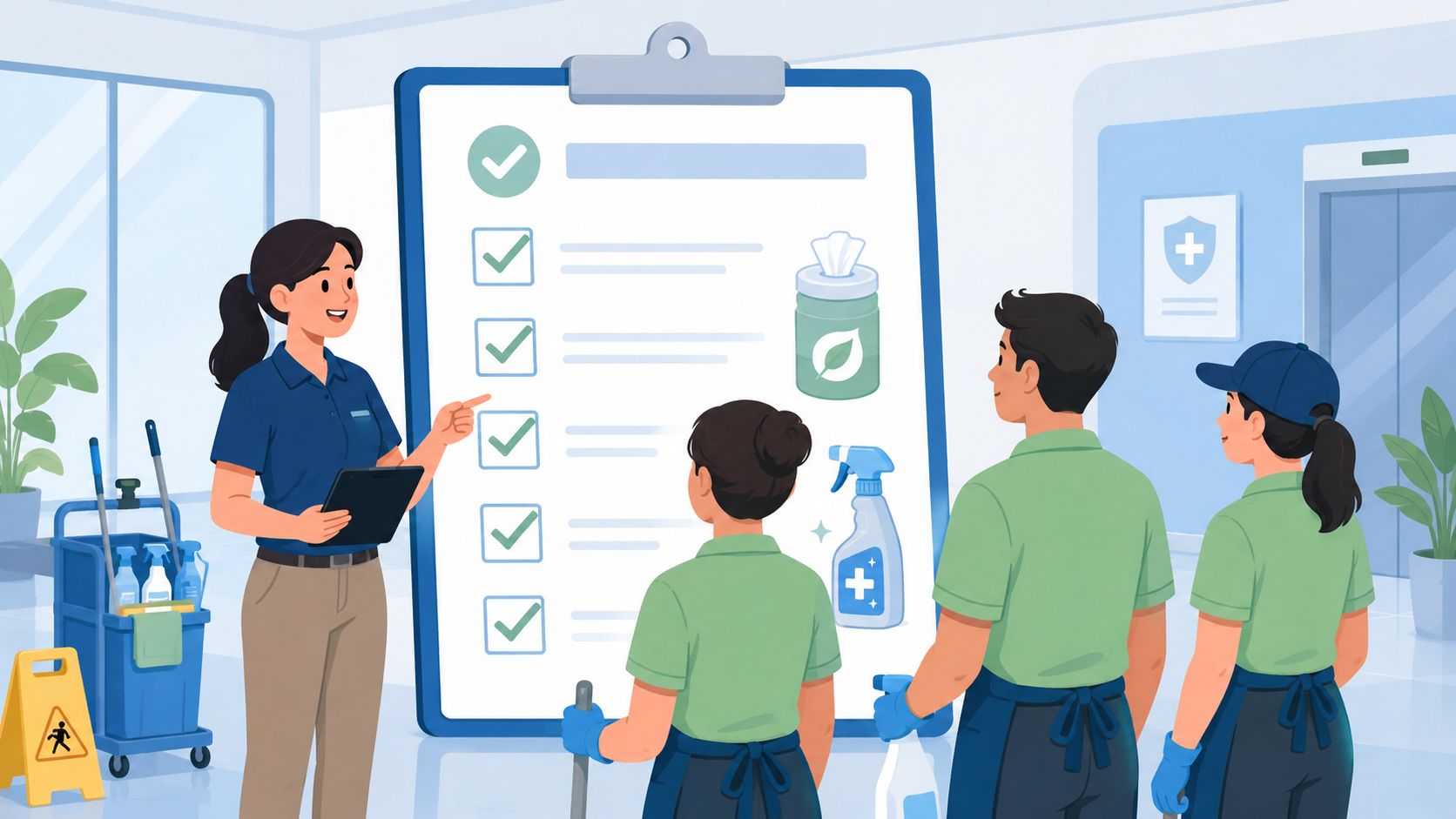
You're usually not looking for a staff training program template because things are calm. You're looking for one because standards feel uneven. One shift wipes down gate seats correctly, the next misses armrests. A gym team cleans floors well but rushes through machine handles. A rental turns over on time, yet the remote and entry keypad get inconsistent attention.
That gap is where sanitation programs break. Not in the policy binder, but in the handoff between expectation and daily behavior. A good template closes that gap. It gives staff a repeatable playbook for cleaning, disinfecting, documenting, and checking their own work, especially in facilities where high-touch surfaces shape both health risk and customer trust.
Disinfecting wipes belong in that playbook. They're fast, visible, easy to standardize, and effective when teams use them correctly.
Why Sanitation Training Matters
An airport arrivals hall tells the story fast. If the restroom counters look streaked, gate seats feel tacky, and trash rings the touchpoints, travelers assume the rest of the operation is slipping too. The same pattern shows up in fitness clubs, retail stores, and short-term rentals. Guests don't separate “clean enough” from brand quality. They fold it into one judgment.
That's why a staff training program template matters. It turns sanitation from a vague expectation into a managed system. Instead of telling staff to “wipe things down more often,” it assigns surfaces, methods, timing, and verification. In high-touch settings, that structure protects reputation as much as it protects health.
Clean first, then disinfect correctly
Many teams still blur cleaning and disinfecting into one step. That causes problems. If staff grab disinfectant wipes without understanding coverage, surface sequence, or contact time, they may leave behind visible soil or fail to disinfect fully. Commercial spaces need both technique and consistency.
Practical rule: Staff should know which surfaces need routine cleaning, which need disinfection, and when a wipe-down is only cosmetic.
Disinfectant wipes are especially useful because they support visible hygiene routines. In gyms, that means quick wipe-downs between users. In front-of-house areas, it means staff can handle touchpoints without hauling a bucket and spray bottle through customer traffic. The process looks simple, but the standards need to be trained.
Training affects business, not just housekeeping
The strongest sanitation templates connect hygiene tasks to operational outcomes. Organizations using structured training see 24% higher profit margin, 18% higher productivity, and 92% employee retention, compared with 68% where training investment is minimal. Those figures come from the verified industry data provided for this topic. In practice, that means cleaner execution, fewer avoidable mistakes, and less churn in roles that already suffer from inconsistency.
For facilities teams, the message is straightforward. Training isn't overhead. It's one of the few controllable systems that improves service quality every day staff show up.
Planning a Sanitation Curriculum
A sanitation curriculum starts with the floor, not the classroom. Before writing modules, list where mistakes occur. In gyms, that's often machine handles, free weights, and mats. In offices, it's breakroom touchpoints, door hardware, and shared devices. In rentals, it's remotes, handles, switches, and bathroom fixtures.

A robust training structure should include a needs analysis, measurable objectives, and an evaluation framework built on the four Kirkpatrick levels with milestones at 30, 60, and 90 days so managers can verify behavior change, not just memory recall, as outlined in this staff training program template reference.
Build the curriculum around real touchpoints
Start by mapping the facility into sanitation zones. Don't train in generalities. Train by object, frequency, and risk.
- Guest-contact surfaces: Door pulls, counters, kiosks, handrails, seats, and POS screens.
- Staff-shared surfaces: Radios, carts, tablets, utility sinks, locker handles.
- Specialty equipment: Weight benches, yoga mats, cardio consoles, or rental touchpads.
Once those are listed, assign what good performance looks like. Staff shouldn't just “know the standard.” They should be able to demonstrate it.
Use milestones that match the job
A 2024 industry survey found that 63% of facility managers prioritize templates with milestones such as week 1, 30, 60, and 90 days to keep sanitation training on track, and 88% say built-in assessments improve staff accuracy and efficiency. Those milestones work because they reflect how habits form on the job.
A practical curriculum often looks like this:
| Stage | Focus | What to check |
|---|---|---|
| Week 1 | Orientation and product basics | Can the employee identify approved wipes and target surfaces? |
| 30 days | Task competency | Are wipe-down routines consistent during active shifts? |
| 60 days | SOP adherence | Does the employee follow sequence, coverage, and safety steps? |
| 90 days | Behavior consistency | Does the routine hold up without reminders? |
Teams get better when managers score what they can observe, not what they assume staff remember.
The learning mix matters too. The 70:20:10 model is useful here. Most sanitation habits stick through hands-on repetition, peer reinforcement, and short formal instruction, not long slide decks.
Crafting Custom Templates
Generic templates rarely survive first contact with a real facility. A gym needs wipe protocols for machine touchpoints and yoga mat wipes. A restaurant needs front-of-house and back-of-house separation. An airport needs different standards for gate seating, restroom touchpoints, and security-adjacent surfaces.

The best template is modular. It gives you a shared structure, then lets you swap in role-specific tasks without rewriting the whole program.
Three templates every facility should build
The first is the onboarding schedule. Keep it simple. Assign the surfaces the employee owns, the products they can use, and the checks a supervisor will perform at each milestone. That matters because 63% of facility managers prioritize milestone-based templates, and 88% report better staff accuracy and efficiency when assessments are built in.
The second is the SOP sheet for wipes, an area where many programs stay too vague. Spell out product access, PPE if required, where wipes are stored, which surfaces qualify, and what to do if a wipe dries too early. For teams that handle chemical documentation, this guide on safety data sheets training fits naturally beside the SOP.
The third is the competency checklist. Staff should be able to self-audit and supervisors should be able to score the same form. That prevents the common problem where training says one thing and audits score another.
Include dwell time in the SOP, not just in vendor literature
Disinfecting wipes only work as intended when the surface stays visibly wet for the required dwell time. Depending on the product, that can range from 15 seconds to 4 minutes, with many high-traffic facilities favoring 15 to 30 seconds for practicality, according to guidance on disinfectant wipe contact time. If staff wipe a surface dry before that threshold, the process isn't complete.
That requirement should sit directly in the template, next to the task itself. Don't make staff hunt for it on a canister label.
A useful way to think about template design comes from outside sanitation. Coaches who need to streamline youth sports coaching sessions face the same challenge. They need repeatable structure without losing context. Sanitation teams do too.
Delivering Effective Training
Delivery is where good templates either become daily habit or stay paperwork. Long classroom sessions usually fail on busy shifts. Staff remember the orientation, then revert to speed and shortcuts. Sanitation training works better when the format matches the environment.

Programs that include a pilot phase and use real-time analytics dashboards show stronger adoption and a clearer link between training and business outcomes than one-and-done sessions, based on training program rollout guidance.
What works on the floor
Hands-on demos are still the anchor. Staff need to see the wipe pulled, folded, applied, and discarded correctly. In gyms, that means showing how to clean machine handles, adjustment pins, and pads without skipping awkward edges. For workout wipes and gym equipment wipes, a live demo closes the gap between “I know” and “I can do it under pressure.”
Short e-learning modules help with product knowledge and policy reminders. Use them for topics like approved surfaces, labeling, and why drying a surface too soon defeats the disinfecting step.
Then add coaching. A supervisor walking the route with a new hire often catches more than a quiz does.
Pilot before full rollout
Pilots save rework. Run the template with a small group first, ideally on different shifts. Watch where people hesitate. If the wipe SOP is too wordy, they'll skip it. If the storage point is inconvenient, compliance drops. If the timing doesn't fit active operations, the process won't survive launch week.
A pilot tells you whether the template works in a real building, with real interruptions, on a real schedule.
Follow-up matters just as much. Manager check-ins at milestone points are where sanitation behavior gets reinforced. For teams refining their process, these staff training best practices are worth applying to sanitation roles specifically.
Teams that handle specialized cleaning can also learn from adjacent trades. The safety mindset used in Professional Window Cleaning is a good example of task-specific training tied tightly to method and risk.
Tracking Compliance and KPIs
Training only counts when it changes what staff do on shift. Completion records matter, but they're not enough. A sanitation manager needs to know who finished training, who can apply it correctly, and whether that behavior is improving operations.

The metrics worth tracking
The most useful sanitation KPIs are operational, not decorative.
- Completion rates: Who finished assigned modules and practical checks.
- Time-to-completion: How long employees take to finish training.
- Certification attainment: Whether staff cleared required sanitation or hazard content.
- SOP adherence: Whether observed behavior matches the wipe protocol on shift.
- Guest-facing outcomes: Hygiene-related satisfaction feedback and complaint patterns.
Top-performing organizations achieve 95%+ certification compliance in critical areas like disinfection and hazard mitigation, according to the verified industry data supplied for this topic. That's a strong benchmark because it reflects consistency in regulated or high-risk tasks, not just attendance.
Tie training to ROI
If leadership asks whether the program is worth the effort, use the built-in ROI formula: (annual program benefit – annual ongoing costs) / one-time setup costs × 100. That framework gives managers a practical way to compare training cost against reduced errors, stronger consistency, and fewer avoidable service issues.
There's also a direct business case for formal training. Organizations using structured training see 24% higher profit margin, 18% higher productivity, and 92% employee retention compared with 68% where training investment is minimal. Those figures belong in executive conversations because they move training out of the “soft initiative” category.
Use audits to verify behavior
When sanitation staff receive role-specific training aligned with operational checklists, error rates in high-touch danger zones can decrease by up to 40%. That's the type of result managers should validate through recurring audits, not assume from classroom completion.
A simple review loop works well:
| Review point | What managers inspect |
|---|---|
| Daily | Spot checks on wipe use, storage, and visible surface coverage |
| Weekly | Supervisor observations of technique and missed touchpoints |
| Quarterly | Trend review, content updates, and checklist revisions |
If a KPI can't be observed on the floor, it won't correct behavior for long.
Adapting Training for Different Facilities
One sanitation template can serve many facilities, but only if the touchpoints change with the setting. The core structure stays steady. The surface list, wipe routine, and selling points should not.
Match the template to the facility
For offices, the obvious targets are entry hardware, shared kitchen points, desk hoteling stations, and meeting-room controls. For retail, add checkout counters, card readers, fitting-room hardware, and hand baskets. In restaurants, front-of-house surfaces need one rhythm, while staff-only prep and service areas need another.
Gyms deserve tighter guidance because the user behavior is constant and hands-on. Equipment should be wiped down after every single use to limit cross-contamination on high-density touchpoints such as dumbbells, machine handles, and mats, as noted in guidance for gym sanitation routines. That's where terms like gym wipes, fitness wipes, wipes for gym equipment, and yoga mat wipes fit naturally into both training and procurement language.
For facilities that want a visible setup, a gym wipe dispenser near entry, cardio, and stretching zones helps prompt use. Staff still need rounds and audits, but placement reduces friction for members.
Focus audits on the points that matter most
Audits are more effective when they target 15 to 20 critical high-touch spots, such as door handles, light switches, POS systems, and shared equipment, because that approach cuts health risks and correlates with better customer reviews and lower staff absenteeism in offices, gyms, and retail environments, based on high-touch audit guidance.
That principle helps every facility type:
- Airports: Security trays, gate armrests, restroom hardware, check-in kiosks.
- Venues: Seating arms, rails, concession counters, restroom touchpoints.
- Short-term rentals: Door handles, remotes, thermostat controls, bathroom fixtures.
- Car dealerships: Steering wheels, showroom kiosks, waiting-area armrests.
- Schools: Desks, shared devices, cafeteria touchpoints, staff room hardware.
Conclusion and Next Steps
A sanitation-focused staff training program template does more than organize onboarding. It gives teams a repeatable way to clean, disinfect, audit, and improve. That matters in airports, gyms, rentals, restaurants, retail stores, and any facility where customers notice touchpoints before they ever comment on them.
The practical path is straightforward. Build the curriculum around real surfaces. Write custom SOPs that include wipe technique and dwell time. Pilot the process before full rollout. Track completion, adherence, and outcomes. Then adapt the template by facility, not by guesswork.
Disinfectant wipes make that system easier to run because they're fast, visible, and easy to standardize. Used well, they support cleaner equipment, better guest perception, and more reliable day-to-day execution.
If cleanliness is becoming a bigger part of your brand promise, treat it that way. Tighten the training, make wipe use visible, and give staff clear standards they can follow under pressure.
Leave a Reply