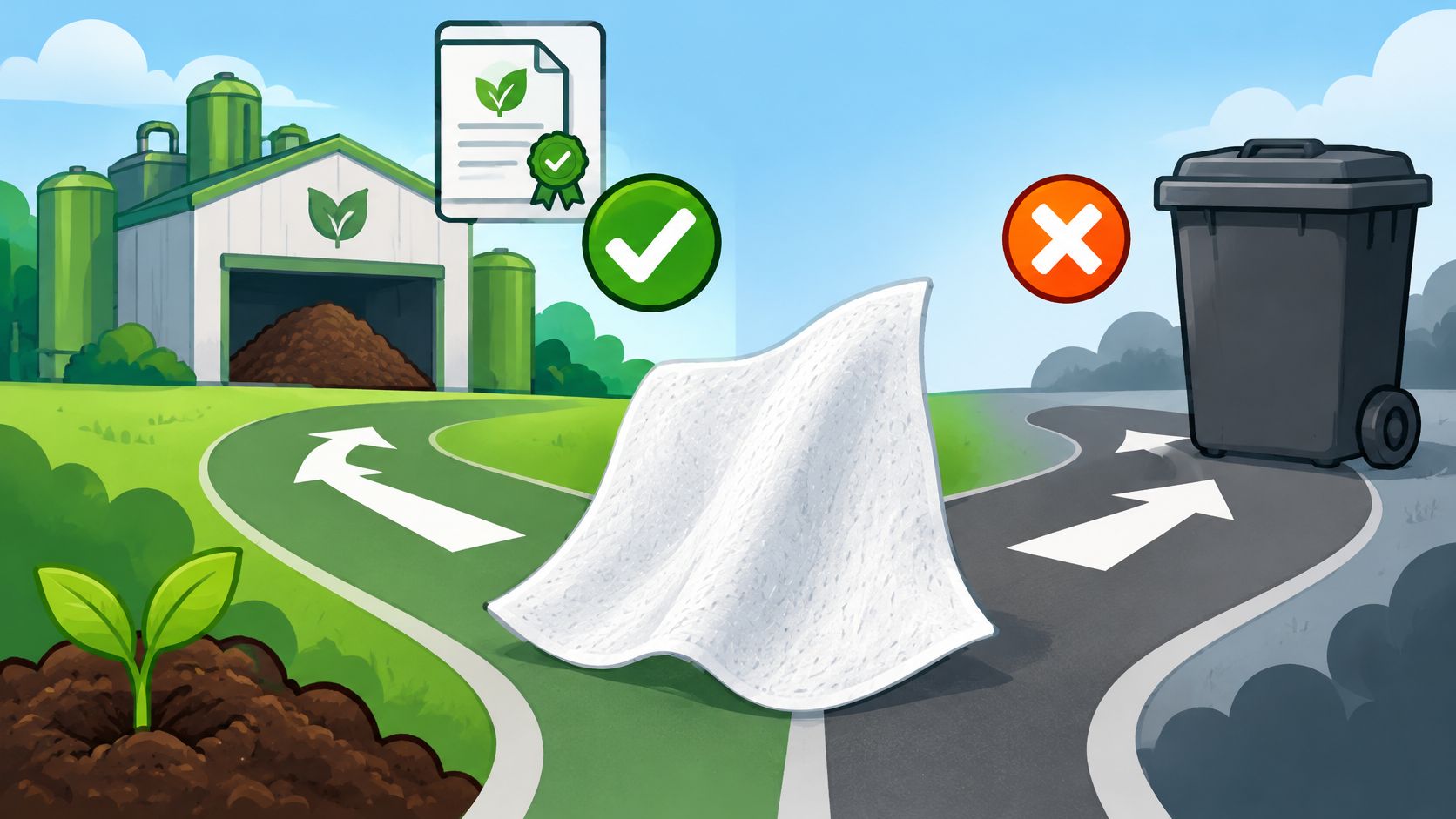
The most popular advice about compostable disinfecting wipes is simple: buy them, put a green bin in the break room, and count the sustainability box as ticked. I'd push back on that. A compostable wipe that has just come off a restroom faucet, a blood spill, or a pet-waste cleanup has no business in an organics stream, no matter what the package says. The claim on the label proves what the material can do under controlled industrial conditions. It proves nothing about what happens after your staff uses the wipe on a real surface and drops it in a bin.
That gap matters because facility managers are being sold compostable wipes as an easy environmental win, and the harder operational question keeps getting skipped. A wipe isn't compostable in the abstract. It's compostable at a specific facility, under a specific processor's acceptance rules, after a specific use. Get any one of those wrong and the green bin becomes a contamination source. What holds up is this.
Standards That Prove a Wipe Is Compostable
Start with the question any buyer should ask before accepting a sustainability claim: which recognized standard supports the word "compostable" on this package? If the supplier can't name one, you're looking at marketing language, not a verified property.
The EPA's Safer Choice Standard is a useful starting point because it treats compostability as a standards-based claim rather than a description of a plant-derived or plastic-free material. Under that framework, a qualifying wipe substrate must be able to be composted in an industrial composting facility, backed by a certificate of analysis or equivalent testing. The standard lists recognized methods including ASTM D6400, ASTM D6868, ASTM D5338, EN 13432, and ISO 14855.
Those frameworks don't just ask whether a wipe eventually breaks down. They test biodegradation under controlled composting conditions, physical disintegration, restricted chemical residues, and potential plant toxicity. EPA also requires certified wipe products to display prominent "Do Not Flush" wording and symbolism, and it holds compostable and biodegradable marketing claims to the FTC's Green Guides.
Here's how the recognized standards compare, and what a certified result lets you conclude.
| Standard | What It Tests | What It Proves |
|---|---|---|
| EPA Safer Choice (Design for the Environment) | Substrate composting capability with certificate of analysis or equivalent testing | Wipe substrate qualifies for industrial composting |
| ASTM D6400 | Aerobic biodegradation, disintegration, heavy metals and plant toxicity under controlled composting | Industrial compostability of plastic-based materials |
| ASTM D6868 | Biodegradation and disintegration of coated or additive-containing substrates | Compostability of coated paper and similar wipe substrates |
| ASTM D5338 | Aerobic biodegradation under controlled composting temperature and moisture | Biodegradation in a controlled composting setting |
| EN 13432 | Biodegradation, disintegration (under 10% above 2 mm after 12 weeks), heavy metals and plant toxicity | Compostable packaging under European criteria |
| ISO 14855 | Ultimate aerobic biodegradation measured by CO2 evolution | Full conversion to CO2 under composting conditions |
| ISO 17088 | Specification framework for compostable plastics | Finished product meets defined compostability requirements |
The finished wipe is what gets tested
A fiber certificate is not a wipe certificate. Binders, preservatives, printing, packaging residue, and the disinfectant formulation all become part of the finished article, and the certification has to cover that complete premoistened product. Ask for the test report on the wipe as sold, not on the raw substrate the mill shipped.
What to request from a supplier: the exact standard cited, the test report covering the premoistened wipe, and wording that names industrial composting rather than general "eco" or "biodegradable" language.
If you want the longer explanation of what biodegradable means on a wipe package, this breakdown of biodegradable wet wipe claims covers the terminology traps. And because compostability sits inside a much broader materials conversation, Monopack's guide to composting paper plates is a solid primer on how certification works for single-use food service items, which follow much the same logic.
Why Compostable Wipes Break Down Unevenly
Two wipes can both carry a compostable claim and behave nothing alike. That isn't a loophole in the rules. It's a function of substrate and test setting, and the measured spread is wide enough to change a purchasing decision.
In an accelerated anaerobic biodegradation test modeled on landfill conditions using ASTM D5511, a wood-pulp-based disinfectant wipe reached 94.3% relative biodegradation after 15 days, while a standard plastic-based wipe reached only 0.6% under the same program, with the plastic comparison reported at day 75. Both figures come from published wipe substrate research.
Read that carefully, though. ASTM D5511 models accelerated landfill biodegradation. Industrial compostability is assessed through ASTM D6400 or ASTM D6868. A strong landfill result is not a compostability certificate, and a compostability certificate is not a landfill prediction. Both are useful. Neither is universal.
| Material or Wipe | Test Setting | Reported Result | Reading Note |
|---|---|---|---|
| Wood-pulp disinfectant wipe | Accelerated anaerobic, ASTM D5511 | 94.3% relative biodegradation at day 15 | Landfill model, not industrial compost |
| Standard plastic-based wipe | Same ASTM D5511 program | 0.6% relative biodegradation (reported at day 75) | Shows why substrate choice matters |
| Polypropylene | Soil burial, 90 days | 5% mass loss | Slow breakdown in soil |
| Polyethylene terephthalate | Composting at elevated temperature | 20% mass loss | Limited breakdown even under composting |
| Polylactic-acid nonwoven | Industrial composting vs natural soil | Effective in industrial composting; no significant degradation in tested soil | Disposal setting decides the outcome |
| Cellulose-based material | Industrial composting studies (review range) | Roughly 30-80% degradation | Varies with inoculation, temperature, moisture and formulation |
What a genuine compostable result requires
A compostable claim rests on several conditions being met at once, not one. The material has to show substantial aerobic biodegradation under controlled composting, physical disintegration, limits on heavy metals, and no adverse effect on plant growth. Under EN 13432-style rules, less than 10% of the original material may remain in fragments larger than 2 mm after 12 weeks of composting.
Cellulose-based materials land anywhere from roughly 30% to 80% degradation across industrial composting studies, depending on inoculation, temperature, moisture, formulation, and test duration. Same fiber family, very different outcomes.
The polylactic-acid finding is the one I'd flag hardest for buyers. A 2025 study of PLA nonwoven disinfectant-wipe material found degradation was effective under industrial composting conditions but substantially slower in natural environments, with no significant PLA degradation in the tested soil. Silver-containing treatments further suppressed biodegradation indicators. That's the practical trap: the antimicrobial additives that make a wipe perform better as a disinfectant can make it perform worse as a feedstock.
Ask your supplier directly whether the substrate carries silver or another antimicrobial additive before you assume the wipe will break down on the schedule its certificate describes.
Matching Each Used Wipe to the Right Disposal Route
Most compostable wipe programs fail here. The package claim describes the material. It says nothing about whether the wipe, after it has done its job, can enter an organics stream. EPA-approved disinfectant labeling can identify the fabric as compostable while directing users to dispose of the wipe in the trash and never flush it. Both statements are true at once, and the second one governs your operations.

Work through five checks in order for every wipe stream in your building.
- Note what the wipe touched. A desk surface, a treadmill handle, and a toilet seat are three different problems.
- Check for bodily fluids, vomit, blood, or animal waste. If any are present, infectious-waste rules apply and composting is off the table.
- Read the label. Certified wipes carry Do Not Flush wording and direct disposal to the trash.
- Confirm processor acceptance. Your hauler taking certified food packaging does not mean it takes disinfecting wipes.
- Route to the bin the earlier answers point to. Compost only when every check passes.
That sequence settles most of the arguments staff will have standing over a bin.
| Use Case | Recommended Route | Why |
|---|---|---|
| Routine wipe of desks or equipment with no body fluids | Compost only if the local processor accepts disinfecting wipes; otherwise trash | Compost acceptance is local, not automatic |
| Restroom or toilet surfaces | Trash; never flush | Certified wipe labels require Do Not Flush |
| Blood, vomit or other bodily fluids | Infectious-waste stream or trash under local rules | Contaminated wipes are not compost feedstock |
| Animal waste | Infectious-waste stream or trash under local rules | Waste contamination can make the wipe unsuitable for composting |
| Food-contact surfaces | Rinse per label instructions, then trash the used wipe | Residue and contamination concerns override compost claims |
The contamination rules override the sustainability claim
Human or animal waste can make an otherwise compostable wipe unsuitable for composting, and municipal acceptance has to be checked locally. EPA labeling also directs infectious materials and cleaning materials to follow applicable infectious-waste rules. A compostable substrate cannot override a public-health requirement, and no facility manager should want it to.
That leads to the conclusion I'd defend in any budget meeting: for many facilities, trash is the more responsible choice than composting. When contamination, disinfectant residues, or local processor rules block organics collection, landfill disposal is the correct call. Write that into your policy in plain language so staff aren't guessing. If you're also managing flushable product claims in the same building, the safety guidance on flushable wipes explains why the toilet is never the answer.
Contact Time and Surface Checks Before You Buy
A wipe does not disinfect because it touched something. The surface has to stay visibly wet for the product's full labeled contact time, and that number varies more than most buyers expect.
The EPA-registered wipe label directions are explicit: apply enough wipes to wet the entire hard, non-porous surface, maintain visible wetness for the specified period, then let the surface air-dry. One registered wipe label specifies a one-minute wet contact time. Another specifies five minutes for certain listed organisms. CDC guidance notes that many EPA-registered disinfectant labels specify 10 minutes, while published studies have shown meaningful microbial reductions at shorter intervals for some products and organisms. EPA-style efficacy testing commonly benchmarks at least a 3-log10, or 99.9%, reduction under defined conditions.
Your product's own label governs. Nothing else does.
Surfaces to test before you commit to a bulk order
Compatibility is where a wipe purchase goes wrong. Test on the materials you have:
- Stainless steel on handrails, elevator panels, and equipment housings
- Coated plastics on carts, kiosks, and seating
- Painted surfaces on doors, frames, and partitions
- Upholstery-adjacent hard plastics around reception and waiting areas
- Touchscreens, only where the device manufacturer permits
Absorbent wipes can pull disinfectant off the surface before exposure finishes, and wiping pressure removes liquid along with soil. More product, not more scrubbing, is usually the fix.
Working routine: pre-clean heavily soiled surfaces, wet the whole surface with enough product, hold visible wetness for the label period, let it air-dry, and rinse food-contact surfaces with potable water where the label requires it.
Assign one person or route to pre-cleaning visibly dirty areas and timing contact periods. That split keeps the second pass fast and stops anyone treating a quick swipe as completed disinfection. If you're setting up stations for guests or staff, Avistar's guidance on where to place guest wet wipes is worth a look for placement ideas that keep product where contact happens.
Facility Routines for Gyms, Offices and Schools
Theory collapses on the floor, so here's where each facility type should put its effort.

Gyms carry the strictest schedule
Shared equipment touches bare skin repeatedly, which is why CDC athletic-facility guidance says shared equipment should be cleaned after each use and allowed to dry before the next use, whether or not a MRSA infection has occurred. Staff should focus daily on surfaces that contact athletes' bare skin and keep a regular cleaning-and-disinfection plan.
In practice that means gym equipment wipes at every station: beside treadmills, benches, weight machines, mats, and locker-room fixtures. A gym wipe dispenser at each point beats a single dispenser by the front desk, because members won't walk across the floor mid-workout. Signage and staff checks reinforce the after-each-use rule when people are in a hurry. Operators who stock bulk gym wipes as a fixed operating cost get steadier compliance than those who treat wipes as an occasional purchase.
Offices, schools, restaurants, and retail
| Facility | Priority Surfaces | Wipe Frequency |
|---|---|---|
| Gyms and fitness centers | Shared equipment, benches, mats, locker-room fixtures | After each use, air-dry before next use |
| Offices | Desks, keyboards, phones, shared doors | At least daily, more in busy rooms |
| Schools | Desks, handles, sinks, faucets | At least daily, more during peak periods |
| Restaurants | Counters, handles, tables | At least daily, and during service as needed |
| Retail stores | Carts, counters, door handles, payment terminals | At least daily, more during peak traffic |
CDC recommends cleaning high-touch surfaces at least once daily, and more often in heavy-traffic areas or where occupants are unlikely to practice good hand hygiene. Its list of high-touch examples works as a ready-made checklist: pens, counters, shopping carts, tables, doorknobs, light switches, handles, stair rails, elevator buttons, desks, keyboards, phones, toilets, faucets, and sinks. WipesBlog.com names schools, gyms, warehouses, and waiting rooms as examples of the organizations it aims to help, and this list is the reason.
Three habits pay off fast. Put wipes at the point of contact rather than in a supply closet, because a canister stored 40 feet away doesn't get used. Give one person a fixed route so refills and checks happen on schedule. Set a refill trigger at roughly a quarter canister left so stations never run dry mid-shift. For wipe formats that suit these stations, see wipes.com.
Selling Compostable Wipes on Hygiene ROI
If you sell into facilities, stop pitching compostable disinfecting wipes as a green convenience item. Pitch them as the visible part of a hygiene process the buyer can audit.
EPA defines contact time as the period a treated surface must stay wet for a disinfectant to work against the organism claims on its label. That definition is a sales tool, because it turns hygiene into something measurable: a procedure, a training item, a checklist, a refill schedule. A buyer who understands contact time also understands why a cheap wipe that dries in 20 seconds costs more than it saves.

Three arguments carry a bulk conversation:
- A visible routine builds trust. Members, customers, and staff notice a station that's stocked and used. WipesBlog's mission is to help organizations understand how disinfectant wipes contribute to better health outcomes, operational efficiency, and customer satisfaction, and that framing sells better than a fiber spec.
- Auditable beats aspirational. A documented contact-time procedure survives an inspection. A vague eco claim doesn't.
- Bundling simplifies the order. Commercial disinfecting wipes, dispensers, and refill planning in one line item reduce the number of suppliers a facility has to chase.
Size the volume to the traffic
Offices plan stations around desks, phones, keyboards, and shared rooms. Gyms budget for post-use equipment cleaning across every machine and mat. Retail and airport operators size supplies by cart and counter traffic, which spikes seasonally. Bring a rough station count to the meeting and the conversation moves from price per canister to cost per protected surface.
Then demonstrate the whole process on site: pre-clean where needed, wet the surface fully, hold the contact time, and dispose of the wipe correctly. That last step matters commercially. Sell a compostable wipe without explaining the disposal route and you've set the buyer up for a contamination problem in their own building. Walk them through the routing decision and you'll be the rep who solved it rather than the one who created it.
Confirm the Disposal Route Before You Switch
Before any facility moves used wipes from trash to organics, check whether the route exists at all. In 2025, only 35.9% of the sampled U.S. population had access to a composting program, and just 18.1% had access to programs accepting food waste plus some compostable packaging, according to the 2025 composting access data. A compostable bin in the break room is not a compost route.

Even where collection exists, acceptance of disinfecting wipes is a separate question from acceptance of certified food-service packaging. Contamination management accounts for roughly 20% of composting operating expenses, which is exactly why processors reject ambiguous loads instead of sorting them.
Run this checklist before you change a single bin:
- Get written confirmation from your hauler or processor that used disinfecting wipes are accepted.
- Obtain the exact certification and test documentation for the premoistened wipe, using a recognized standard rather than a supplier's summary.
- Set separate, clearly labeled bins for compost-eligible and trash-only wipes.
- Audit contamination periodically, because a load rejected at the gate undoes months of good intent.
- Train staff on the routing sequence so the bin choice isn't a guess at 11 p.m.
Default rule: if any answer is no, used wipes go to the trash. That isn't a failure of the sustainability program. It's the program working correctly.
If your facility already manages regulated waste streams, the same discipline applies, and Clear It Services' explanation of licensed waste disposal is a useful reference for how documented routing works in practice.
Decide the disposal route first. Then build the wipes into the routine. That order keeps you out of contamination trouble and leaves you with a hygiene program you can defend to a customer, an inspector, or a processor.
You can start this week. Pick your five highest-touch surfaces, put a stocked dispenser within arm's reach of each, post the contact time where staff can see it, and label every bin so nobody has to guess where a used wipe goes. WipesBlog.com breaks the science of sanitation into simple, actionable insights, and this is the simplest one worth acting on. Get the bin right and the rest of the program follows.
Leave a Reply