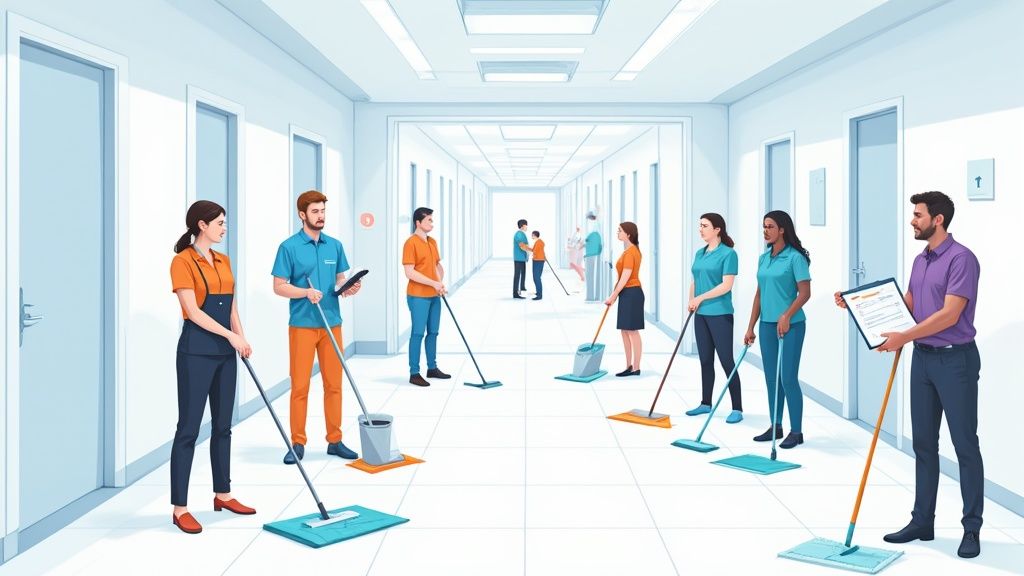
A visibly clean and hygienic environment is no longer a luxury; it's a fundamental expectation for customers, employees, and guests across all facilities. From offices and gyms to schools and retail stores, the standard of cleanliness directly impacts brand reputation, customer loyalty, and public health. While quality cleaning supplies like commercial-grade disinfectant wipes are crucial tools in any sanitation arsenal, their true effectiveness hinges entirely on the knowledge and skill of the people using them. This is where implementing proven staff training best practices becomes a game-changing competitive advantage.
An untrained employee can waste valuable supplies, miss critical high-touch surfaces with a disinfectant wipe, and create a false sense of security. Conversely, a well-trained team becomes your first and most effective line of defense against germs, ensuring every cleaning action is both efficient and impactful. Investing in robust training transforms your cleaning protocols from a routine chore into a powerful business asset, ensuring every wipe counts and every surface contributes to a safe, welcoming environment.
This guide moves beyond simply telling staff to clean and focuses on training them how to clean effectively with tools like disinfectant wipes. We will explore nine powerful training methodologies designed to build a confident, competent, and consistent sanitation team. You will discover practical cleaning tips, sales strategies, and facility-specific advice to elevate your hygiene standards. Prepare to equip your staff with the skills they need to protect your facility and enhance its reputation.
1. The 'High-Touch Hotspot' Drill: Competency-Based Training for Targeted Disinfection
Standard cleaning checklists often treat all tasks as equal, leading to a "check-the-box" mentality where critical disinfection points can be rushed. The 'High-Touch Hotspot' Drill shifts the focus from simple task completion to demonstrated mastery, a cornerstone of effective staff training best practices. This competency-based method ensures your team not only cleans high-risk areas but understands their epidemiological significance and masters the correct disinfection protocol using tools like disinfectant wipes.
This approach transforms routine cleaning into a targeted, skill-based exercise. Instead of just listing "wipe down door handles," the drill requires staff to demonstrate the proper technique for disinfecting various types of handles (lever, knob, push plate) using approved disinfectant wipes, adhering to specific dwell times, and explaining why these points are critical for preventing germ transmission.
How to Implement the 'High-Touch Hotspot' Drill:
- Identify & Map: Create a visual map of your facility's top 10-15 high-touch hotspots. For a gym, this would include dumbbell handles, treadmill screens, and locker room benches. In an office, it would be elevator buttons, shared keyboards, and coffee machine handles.
- Demonstrate & Practice: During training, a supervisor demonstrates the correct disinfection process for each hotspot. This includes selecting the right product (like a powerful disinfectant wipe), applying it to achieve full coverage, and respecting the required contact time (dwell time) for the disinfectant to work effectively. Trainees then practice this under supervision until they can replicate it perfectly.
- Competency Check: Instead of a written test, conduct a practical "walk-through" assessment. Ask the employee to identify and correctly disinfect five random hotspots from the map, explaining the importance of dwell time as they go. They pass by performing the task to standard, not just by memory.
Sales Tip: When selling disinfectant wipes, educate clients on the concept of high-touch hotspots. Provide them with sample maps for their specific industry (e.g., a gym or restaurant) to demonstrate the value of a targeted disinfection strategy. This positions you as a hygiene consultant, not just a supplier, and highlights the ROI of using your products correctly.
2. The Microlearning Method: Bite-Sized Training for Maximum Retention
Traditional, hours-long training sessions often lead to information overload, where staff forget crucial details almost as soon as they return to their duties. The microlearning method flips this model, delivering training in small, highly-focused bursts. This approach is one of the most effective staff training best practices because it aligns with how adults naturally learn and retain information, turning complex sanitation protocols into digestible, memorable tasks.
This strategy breaks down a large topic like "Proper Disinfectant Wipe Usage" into a series of 3-7 minute modules. For instance, a staff member might watch a short video on their phone demonstrating the proper technique and dwell time for a specific disinfectant wipe on a gym treadmill screen, followed by a quick two-question quiz. This gamified approach turns learning into an engaging, ongoing process.

How to Implement the Microlearning Method:
- Deconstruct the Skill: Break down a core competency, such as "Restroom Sanitization," into its smallest teachable components. This could result in separate micro-modules like "Proper Use of Disinfectant Wipes on Faucets," "Toilet Handle Disinfection Protocol," and "Understanding Dwell Time for Different Surfaces."
- Focus on One Objective: Each microlearning module must have one single, clear learning objective. For example, "The trainee will be able to correctly identify the required contact time for our primary disinfectant wipe." This sharp focus prevents cognitive overload and improves mastery.
- Build a Learning Path: Structure the individual modules into a logical sequence. A new hire in a retail store might start with basic modules on safety data sheets (SDS), then progress to specific tasks like using disinfecting wipes on checkout counters and shopping cart handles.
Cleaning Tip: Use your phone to create your own microlearning videos. A 60-second clip showing the most efficient way to wipe down a conference table or a set of dumbbells can be shared instantly with your team, providing a clear visual guide that reinforces training.
3. The 'Peer-to-Peer Sanitation Pro' Model: Cultivating In-House Expertise
Top-down training can sometimes feel disconnected from the day-to-day realities of the job. The 'Peer-to-Peer Sanitation Pro' model flips the script, transforming experienced staff into mentors and trainers. This collaborative approach is one of the most effective staff training best practices because it leverages existing, proven expertise and builds a culture of shared responsibility for facility hygiene.
This method empowers your most knowledgeable employees to share practical wisdom, such as the most efficient way to disinfect oddly shaped gym equipment or the specific sequence for cleaning high-traffic school restrooms during peak hours. A veteran custodian explaining why a certain disinfectant wipe is better for stainless steel surfaces than another carries immediate, credible weight with new hires, accelerating their learning curve and fostering team cohesion.

How to Implement the 'Peer-to-Peer Sanitation Pro' Model:
- Identify & Empower Mentors: Select experienced staff who not only excel at their sanitation duties but also demonstrate strong communication skills. Formally recognize them as "Sanitation Pros" or "Hygiene Leads," providing them with basic guidance on how to teach others effectively.
- Structure the Knowledge Transfer: Create structured shadowing opportunities. For example, a new hire in a restaurant might spend their first week paired with a Sanitation Pro, learning everything from proper food-surface sanitation protocols to disinfecting tables and payment terminals between customers.
- Facilitate Collaborative Problem-Solving: Establish regular, brief team huddles where staff can share challenges and solutions. One team member might share a new technique for quickly disinfecting a fleet of shopping carts, while another asks for advice on tackling a persistent odor, allowing the group to solve it collectively.
Key Insight: This model does more than just transfer skills; it builds a self-sustaining ecosystem of continuous improvement. When staff learn from trusted colleagues, the training feels more relevant and authentic. This fosters a powerful sense of ownership and pride in maintaining a safe, sanitary environment, directly impacting guest satisfaction and public health.
4. The Competency Gauntlet: Mastering Skills Before Clocking Hours
Traditional training often measures success by time spent in a classroom, not by skills actually acquired. The Competency Gauntlet flips this model, prioritizing demonstrated mastery over logged hours. This is a core principle of effective staff training best practices, ensuring that team members don’t just "complete" training but can verifiably perform critical tasks—like using a disinfectant wipe correctly—to a high standard.

This approach moves away from a one-size-fits-all curriculum. Instead of progressing after a set number of days, an employee advances only after proving they can master a specific skill, such as correctly identifying all high-touch surfaces in a classroom or safely disinfecting electronic equipment in an office without causing damage. This ensures every staff member has the proven capability to do their job correctly, which is non-negotiable in hygiene-sensitive environments.
How to Implement the Competency Gauntlet:
- Define Critical Competencies: Work with veteran staff to identify the top 5-7 core skills essential for the role. For a fitness center, this might include "Proper Disinfection of Cardio Equipment" and "Safe Use of Chemicals in Locker Rooms." For office staff, a key competency would be "Sanitizing Shared Workstations."
- Create Assessment Scenarios: Develop practical, real-world tests. To assess disinfectant wipe usage, create a scenario where a trainee must select the correct wipe for a sensitive electronic surface versus a durable countertop, explaining their choice and demonstrating the proper application technique and dwell time.
- Establish a Mastery Threshold: Clearly define what success looks like. For instance, passing the "Restroom Sanitation" competency might require a trainee to clean and disinfect a multi-stall restroom within a specific timeframe, passing an inspection with zero misses on high-touch points like flush handles and soap dispensers.
Sales Tip: Frame your disinfectant wipes as part of a competency-based solution. Offer clients a simple checklist or "competency card" that outlines the proper use of your product. This adds value to your offering and helps ensure customers achieve the best results, leading to greater satisfaction and reorders.
5. Gamification of Training: Interactive, Reward-Driven Learning for Disinfection Mastery
Traditional training often feels monotonous. Gamification integrates game design elements—points, badges, leaderboards—to boost engagement and reinforce staff training best practices. By turning your disinfection protocols into a challenge, teams stay motivated to perfect their techniques with disinfectant wipes, master dwell times, and understand the hygiene ROI of their efforts.
This method turns dull protocols into interactive missions. Instead of passively reading instructions, staff could earn points for correctly sanitizing doorknobs, keyboards, or gym machines according to a set frequency. A leaderboard in the breakroom can spark friendly competition among teams in a school or retail store. For example, the team responsible for the cleanest section of the store for a week could win a small prize.
How to Implement Gamification of Training:
- Align Mechanics with Objectives: Map points and badges directly to critical disinfection steps—proper wipe coverage, achieving correct dwell time, and safe disposal.
- Start Simple & Scale: Launch with basic tasks like a "Wipe Down Wednesday" challenge focusing on personal desks and phones. Add complexity over time with timed zone sweeps or team-based "High-Touch Hotspot" hunts.
- Combine Solo & Team Play: Reward individual streaks for consistent daily cleaning and team achievements for passing weekly hygiene inspections.
- Provide Meaningful Rewards: Offer tangible incentives—a free coffee, extra break time, or public recognition—linked to achieving hygiene goals.
- Refresh Monthly Challenges: Rotate focus areas to maintain engagement. One month could focus on breakroom appliances, the next on elevator buttons and handrails.
- Analyze & Feedback: Track progress and use the data to provide coaching to those who are struggling and celebrate top performers.
Key Insight: Gamified training turns routine disinfection into an engaging, habit-forming activity. Staff become active participants in maintaining a clean facility, driving a culture of proactive hygiene that elevates safety and boosts the ROI of your cleaning program.
6. Just-in-Time Training: On-Demand Support for Immediate Sanitation Needs
Traditional training sessions often happen weeks before the knowledge is actually needed, leading to information decay. Just-in-Time (JIT) Training flips this model by delivering small, targeted bursts of information precisely when and where employees need it. This performance support approach is a powerful staff training best practice because it embeds learning directly into the workflow, ensuring staff can solve immediate problems correctly and confidently.
This method transforms training from a scheduled event into an on-demand utility. For example, a janitorial staff member in a school can scan a QR code on a cleaning cart. This action could instantly pull up a 30-second video demonstrating the correct disinfectant wipe to use on a smartboard versus a student's desk, directly applying knowledge at the point of need.
How to Implement Just-in-Time Training:
- Create a Digital Knowledge Hub: Develop a simple, mobile-accessible library of micro-learning content. This can include short videos, one-page PDF guides, or interactive checklists. Organize this content by task (e.g., "Disinfecting Gym Equipment") or problem ("Chemical Spill Protocol").
- Use QR Codes: Place QR codes in relevant locations. A code in a restaurant kitchen can link to a guide on food-safe surface sanitation. A code in an office can link to a video on cleaning shared electronics like printers and conference room phones.
- Integrate into Existing Tools: If your team uses a work management app, build the JIT resources directly into it. When a task is assigned to clean a common area, the work order can include a direct link to the step-by-step disinfection guide.
Cleaning Tip: Use this method to clarify which disinfectant wipe to use where. A simple chart or video accessible via QR code can prevent costly mistakes, like using a harsh chemical on a sensitive surface, ensuring efficiency and protecting your assets.
7. Continuous Feedback and Assessment: Fostering a Culture of Mastery
Traditional training models often save evaluation for a single test at the end, a method that fails to capture real-world application and can let bad habits solidify. The Continuous Feedback and Assessment model transforms training from a one-time event into an ongoing process of refinement. This is one of the most crucial staff training best practices because it focuses on dynamic improvement, ensuring skills are not just learned but mastered and retained.
This approach dismantles the "train and forget" cycle. Instead of waiting for an annual review, supervisors provide immediate, constructive feedback. For instance, if a retail employee rushes the disinfection of a payment terminal, a manager provides on-the-spot coaching about the importance of dwell time and full coverage with the disinfectant wipe, reinforcing the correct protocol when it matters most.
How to Implement Continuous Feedback and Assessment:
- Schedule Regular Check-ins: Institute brief, weekly huddles focused on sanitation practices. Discuss recent challenges, celebrate wins (like a flawless facility inspection), and address any questions about product use, like the best application for specific disinfectant wipes.
- Leverage Peer-to-Peer Coaching: Train experienced staff to act as mentors. In a fitness center, a senior employee can shadow a newer team member, offering tips on efficiently cleaning a circuit of machines between users, fostering both accountability and teamwork.
- Use Micro-Assessments: Use short, practical quizzes or observational checklists. A restaurant manager could use a digital form to quickly assess if a server correctly disinfected a table and chairs after guests leave, providing instant feedback.
Key Insight: Continuous feedback shifts the focus from passing a test to achieving excellence. It cultivates a proactive learning environment where staff feel supported. This model builds deep-seated competency, ensuring your sanitation standards are not just met but consistently exceeded, directly boosting client confidence and the overall hygiene ROI of your facility.
8. Personalized Learning Paths: Customizing Training for Maximum Impact
A one-size-fits-all training program often fails to address the unique needs of individual team members. Personalized Learning Paths move beyond this generic model, representing one of the most sophisticated staff training best practices. This approach creates tailored educational journeys for each employee based on their specific role, current skill level, and performance metrics.
This method transforms training into an individualized experience. A seasoned janitorial supervisor in a large office building doesn't need to review basic cleaning safety. Their path might offer an advanced course on sustainable cleaning practices. For a new hire at a gym, the path would focus on mastering the disinfection of specialized equipment and understanding member-facing hygiene protocols.
How to Implement Personalized Learning Paths:
- Conduct a Skills Assessment: Begin with a practical "walk-through" evaluation of each employee's cleaning technique, including their use of disinfectant wipes on various surfaces, to benchmark their current knowledge.
- Integrate Performance Data: Connect training modules to real-world performance. If post-cleaning inspections consistently find a specific area lacking, such as improperly sanitized restrooms in a school, the system can automatically assign relevant micro-learning modules to the responsible staff member.
- Leverage Technology & Learner Choice: Use a Learning Management System (LMS) or even a simple digital checklist to assign and track progress. Offer a library of training resources—from videos on cleaning high-touch electronics to articles on customer communication—and allow employees to choose electives that align with their goals.
Sales Tip: When offering cleaning supplies, provide personalized training resources as a value-add. Create simple learning paths for different roles (e.g., "Office Manager's Guide to Workplace Hygiene," "Janitorial Staff's Advanced Disinfection Techniques") that feature your products, like disinfectant wipes, as the primary tool.
9. Action Learning Projects: Solving Real Sanitation Challenges
Traditional training often happens in a vacuum. Action Learning Projects bridge this gap by turning real-world sanitation challenges into training opportunities, making it one of the most impactful staff training best practices. Instead of just discussing a recurring cleaning issue, a team is tasked with analyzing, creating, and implementing a real solution, solidifying their learning through direct application.
This method fosters active problem-solving. For instance, a gym's staff might be tasked with a project to "Reduce equipment wipe-down time while improving effectiveness." This project would require them to research and test different disinfectant wipes, analyze member traffic patterns to optimize cleaning schedules, and present their findings and new standard operating procedure to management. The learning is deeply embedded because it is tied to a tangible business outcome.
How to Implement Action Learning Projects:
- Select High-Impact Projects: Identify a persistent sanitation problem. Examples include improving the disinfection turnaround time for restaurant tables during peak hours, or developing a more efficient waste management system for a retail store.
- Form a Cross-Functional Team: Assemble a small group of employees to tackle the project. Include frontline staff, a supervisor, and perhaps someone from another department to bring diverse perspectives.
- Provide Resources & Coaching: Equip the team with the necessary resources, such as a budget to trial new disinfectant wipes, access to data, and dedicated time to work on the project. Assign a coach to guide their problem-solving process.
- Facilitate Reflection Sessions: Schedule regular check-ins for the team to reflect on what they are learning. Ask questions like, "What's working? What new skills have you applied?" This step is crucial for cementing the learning.
Key Insight: Action Learning creates a powerful feedback loop where training directly improves operations. Staff become owners of the sanitation quality, not just executors of tasks. This fosters innovation from the ground up, generating practical solutions that are immediately relevant and sustainable because the team that built them is invested in their success.
Making Cleanliness Your Competitive Advantage
The journey to impeccable facility hygiene doesn't end with purchasing the right supplies; it begins with empowering the people who use them. Implementing modern staff training best practices transforms your sanitation protocols from a routine checklist into a dynamic, results-driven program. Whether through bite-sized microlearning videos or hands-on action projects, the goal is to build a culture of excellence where every employee understands their role in protecting public health.
Moving beyond a one-size-fits-all training model is a strategic necessity. A pristine facility isn't just clean; it's a direct message to every customer, client, and guest that you prioritize their well-being. To translate these insights into tangible results, start by evaluating your current training program against these methods and identify where you can make immediate improvements.
From Theory to Action: Your Next Steps
- Conduct a Training Audit: Where are the gaps in your current approach? Start small by creating a microlearning video that demonstrates the correct use of your primary disinfectant wipe, including crucial details like dwell time.
- Identify Your High-Impact Priorities: Pinpoint your facility's most critical hygiene challenges. Is it ensuring consistent cleaning in high-traffic restrooms? Is it training staff on rapid turnover protocols? Apply a new training method to solve your most pressing problem first.
- Empower Your Team with the Right Tools: Effective training is amplified by effective tools. Ensure your staff has access to high-quality, broad-spectrum disinfectant wipes that are easy to use. Incorporate specific usage instructions for these tools directly into your training modules.
The ultimate goal is to make superior cleanliness an ingrained part of your brand's DNA. It’s about building a team so well-versed in best practices that they can identify and neutralize hygiene risks before they become problems. Now is the time to prioritize this crucial investment. Begin by reviewing your protocols, empowering your team with knowledge, and integrating a robust disinfectant wipe strategy as a cornerstone of your daily operations. Build a standard of clean that speaks for itself.
Leave a Reply