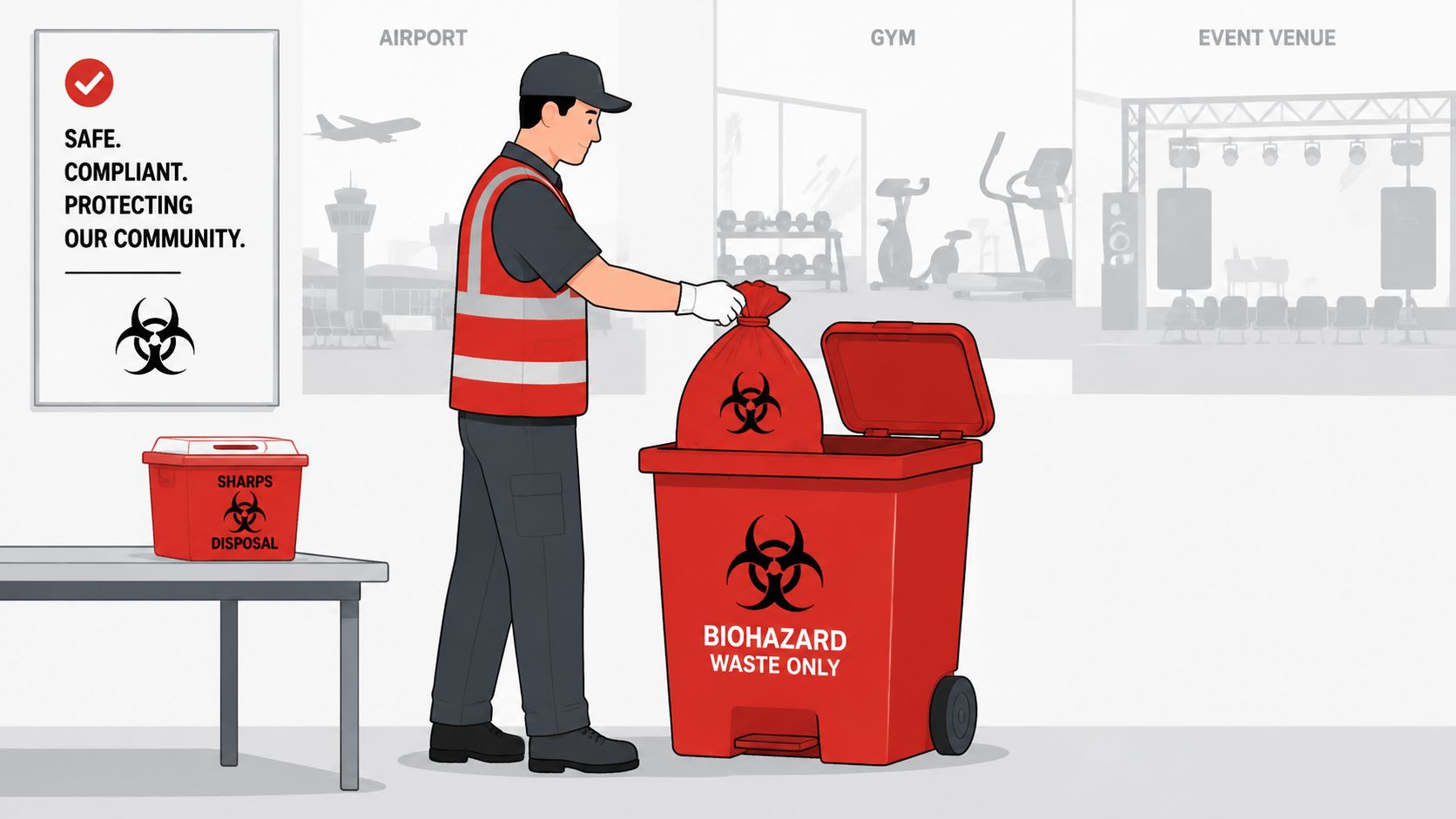
A staff member waves you over because someone bled on a locker room bench. A used lancet shows up in a restroom trash can. A first-aid cleanup bag from an event ends up mixed with paper towels and empty bottles. In commercial facilities, that's where biohazard waste disposal stops being a hospital topic and becomes your problem.
Most facility managers already understand cleaning. The gap is what happens when routine cleaning crosses into regulated waste handling. In gyms, airports, schools, venues, retail stores, and restaurants, the biggest mistakes usually aren't dramatic. They're small classification errors, rushed cleanup steps, and sloppy storage habits that create injury risk, vendor problems, and avoidable cost.
Cleanliness still matters at the front end. Regular surface care, visible hygiene practices, and ready access to disinfectant wipes help staff control messes early and keep high-touch spaces usable throughout the day. But wipes are only part of the answer. Once blood, sharps, or other potentially infectious material enters the picture, your team needs a tighter process.
Identifying Biohazardous Waste in Your Facility
In a commercial setting, staff often overcomplicate the question. Biohazardous waste is not “anything gross.” It's waste that may expose people to infectious material and therefore requires controlled handling.
That distinction matters because misclassification cuts both ways. If staff throw actual biohazard waste into general trash, they create exposure and transport risk. If they throw ordinary waste into regulated containers, they drive up disposal cost and expand your liability trail for no operational benefit.

What counts in non-clinical facilities
In airports, gyms, venues, and similar properties, the most common biohazard triggers are straightforward:
- Sharps: Needles, lancets, or broken contaminated glass found in restrooms, locker rooms, first-aid areas, or employee wellness spaces.
- Blood-saturated items: Towels, gauze, absorbents, or gloves that are visibly contaminated after a bleed or injury response.
- Body fluid cleanup materials: Items used during a spill response when the material involved is potentially infectious.
- Pathological or specialized waste: Less common in typical commercial sites, but relevant in veterinary, educational, or contracted medical service spaces.
What usually does not belong in a regulated stream? Dry paper towels from ordinary handwashing. Empty disinfectant bottles. Routine janitorial waste. Packaging from first-aid supplies that never contacted blood or other potentially infectious material.
Practical rule: If an item is merely soiled from normal facility use, treat it as routine waste. If it contains sharps or is contaminated with potentially infectious material, treat it as regulated waste.
Why source separation matters
The operational lesson is simple. Classify at the point of generation. Once staff start tossing everything from a spill scene into one red bag “just to be safe,” your waste program gets expensive and harder to defend.
The World Health Organization notes that 85% of waste generated by healthcare activities is general, non-hazardous waste, and poor segregation causes whole waste streams to be treated as hazardous, increasing risk and cost at the source. That's the core reason classification discipline matters even outside hospitals. See the WHO fact sheet on health care waste.
Facility examples your staff should recognize
A few examples make training stick better than policy language.
| Facility | Likely general waste | Likely biohazard waste |
|---|---|---|
| Gym | Used gym wipes, drink bottles, empty wipe canisters | Blood-soaked towel, used lancet, contaminated gloves |
| School | Cafeteria napkins, classroom trash | First-aid absorbents saturated with blood |
| Restaurant | Food packaging, routine restroom paper waste | Cleanup materials from a bleeding injury |
| Retail store | Regular trash, cardboard, dusting cloths | Sharps found in restroom, blood-contaminated absorbents |
| Event venue | Cups, ticket stubs, routine janitorial waste | Post-incident cleanup waste from a medical response |
For gyms and fitness centers, there's another practical boundary. Daily use of wipes for gym equipment, fitness wipes, or yoga mat wipes supports visible hygiene and cuts down on ordinary grime transfer. It does not turn your routine wipe program into a biohazard program. Keep those two systems separate in staff training.
The Immediate Response Protocol for Spills and Incidents
When a spill or improperly discarded sharp is discovered, speed matters, but sequence matters more. The safest teams don't improvise. They follow the same response order every time.
Secure the scene first
Start with control, not cleaning. Keep guests and untrained employees out of the area. If the incident is in a busy zone like a gate waiting area, locker room aisle, or retail restroom, block access immediately and direct traffic elsewhere.
Then assign one trained responder. Too many hands at a spill scene usually creates more contamination, not less.
A practical response order looks like this:
- Isolate the area: Use signs, cones, or temporary barriers.
- Get the spill kit: Don't begin with improvised supplies from a janitor cart.
- Put on PPE: Gloves are the minimum. Add face and body protection based on splash risk.
- Remove sharps safely if present: Use the designated sharps process, never bare hands.
- Clean and disinfect the surface: Follow your product label and your exposure-control procedure.
- Contain the waste for disposal: Segregate by stream before it leaves the scene.
Use wipes correctly during the first cleanup pass
For many commercial facilities, the first practical tool at hand is a canister or bucket of commercial disinfecting wipes. That's appropriate for surface response when the wipe product is intended for the surface and the contamination level is manageable. Wipes are especially useful for benches, counters, door hardware, touchscreens, handrails, check-in kiosks, cardio consoles, and similar non-porous surfaces after gross contamination is removed.
If you stock EPA registered disinfecting wipes, train staff on one point that gets missed constantly: the surface must stay visibly wet for the product's required dwell time on its label. A quick swipe and immediate dry-off may make the area look clean while failing the disinfection step.
For teams that need a tighter surface-response routine after blood incidents, this blood spill cleanup guide is a useful operational reference.
For supply planning, it also helps to standardize by area. Front desk stations, fitness floors, first-aid rooms, and public restrooms often need different wipe formats, dispenser setups, and replenishment cadence. Commercial teams comparing canisters, buckets, and wall units can review disinfectant wipe options for facility use.
A visible wipe station helps with routine hygiene. A stocked spill kit protects staff when routine hygiene turns into exposure response.
Handle liquids without shortcuts
Bulk liquid biohazard cleanup requires a stricter method than a fast wipe-down. The industry-standard chemical inactivation protocol for liquid biohazardous waste uses a 1:13 dilution of concentrated bleach with a mandatory 30-minute contact time, and failing to hold that contact time can reduce inactivation efficacy by up to 40%, according to the University of Florida biosafety waste guidance.
That requirement is where many facility teams fail. They pour, wait “a few minutes,” then rush the drain or disposal step because the area needs to reopen. That shortcut exposes your staff and weakens your documentation if an incident is reviewed later.
High-touch areas that deserve more attention
In commercial properties, incident response often overlaps with daily hygiene work. Keep these areas on tighter wipe schedules even when there's no spill:
- Gym floors and strength areas: Handles, benches, adjustment pins, touchscreens, mats
- Airports and venues: Armrests, kiosks, railings, tray surfaces
- Schools: Nurse stations, desk edges, restroom hardware
- Restaurants and retail: POS stations, restroom fixtures, service counters
A simple habit helps. During operating hours, assign staff to pair routine sanitizing wipes rounds with visual hazard checks. That catches small problems before they become reportable incidents.
Proper Containment Segregation and Labeling
Most compliance failures happen after cleanup, not during it. Staff clean the area well enough, then ruin the process by bagging the waste incorrectly, overfilling a container, or skipping labels because pickup isn't until later.
Containment has to match the waste stream. If your team remembers only one rule, make it this one: sharps never go in a bag.

Match the container to the material
Use this as a floor-level decision guide:
- Sharps containers: For needles, lancets, scalpels, and other puncture risks.
- Red biohazard bags or lined rigid containers: For soft contaminated waste such as gloves, gauze, absorbents, and dressings.
- Rigid liquid containers: For liquid waste that requires controlled handling.
- Specialized streams: Pathological or chemical materials require separate handling under your site program and vendor instructions.
Here's the mistake I see most in commercial sites. Staff use the nearest container instead of the correct one. If a restroom needle goes into a soft waste bag, you've created a transport hazard for your own people before the hauler ever arrives.
Non-negotiable sharps rules
Sharps handling is one area where “almost right” still fails. According to the verified operating procedure, sharps containers must be sealed and disposed of within 30 days of being closed, and incineration is the mandatory treatment method once the container reaches the ¾ fill line. That requirement exists to prevent puncture leakage during transport. Review the sharps handling procedure here.
A few practical controls make compliance easier:
| Task | Correct practice | Common failure |
|---|---|---|
| Fill level | Close at the ¾ line | Stuffing “one more item” inside |
| Placement | Keep near likely generation points | Storing one box far from use area |
| Closure | Seal as designed by manufacturer | Taping over an overfilled lid |
| Removal | Route for disposal within required timeframe | Leaving closed boxes in storage indefinitely |
Overfilled containers injure employees during handling. They also tell an inspector your training isn't working.
Labeling is part of containment
Every container should be unmistakable to the next person who touches it. That means the universal biohazard symbol where required, the correct waste stream identification, and internal handling consistency so staff don't have to guess.
If your team struggles with label systems in mixed-use facilities, this GHS label compliance article is worth reviewing alongside your own waste labels. It helps supervisors tighten hazard communication across janitorial, maintenance, and operations teams.
For managers building broader risk controls around waste handling, Safety Space has a practical guide for workplace safety controls. It's useful because waste problems are rarely solved by containers alone. You usually need a combination of placement, signage, access control, training, and supervision.
Keep routine cleaning supplies separate from regulated waste supplies
This matters in gyms, studios, and wellness spaces where surface sanitation happens all day. Gym equipment wipes, workout wipes, and a wall-mounted gym wipe dispenser should support member hygiene and staff turnover cleaning. They should not become your catch-all solution for contaminated waste.
That separation also helps on the sales side if you supply products to clients. Position bulk gym wipes and gym equipment cleaning wipes as part of a broader hygiene program: visible member use, faster equipment resets, simpler high-touch cleaning, and cleaner handoff between users. Then separately address regulated waste supplies and disposal procedures. Buyers trust vendors more when the product categories are clearly distinguished instead of blended into one vague “sanitation package.”
Compliant Storage and Arranging for Pickup
Once waste is packaged correctly, the next failure point is temporary storage. Many commercial sites treat storage as an afterthought. A sealed container ends up in a mop closet, behind a front desk, or beside routine janitorial stock. That's poor control and poor optics.
Your storage area should function like a controlled handoff point, not a forgotten corner.

What a workable storage area looks like
For commercial facilities, the best storage areas share a few traits:
- Restricted access: Only trained staff should enter.
- Clear signage: Anyone approaching should understand the hazard immediately.
- Separation from routine supplies: Don't mix regulated waste with paper products, chemicals, or guest-facing stock.
- Easy cleaning: Floors and surfaces should be easy to disinfect after handling activity.
- Pickup readiness: Containers should be staged so the hauler can inspect and remove them without disrupting the facility.
In practice, this often means a dedicated room or enclosed area near service access. Not near food service. Not in a public corridor. Not in a place where part-time staff improvise.
Vet your disposal vendor like a risk partner
A waste hauler isn't just a pickup service. They're part of your compliance record. Ask direct questions before signing or renewing:
- What waste streams will you accept from this facility type
- What packaging or labeling standards do you require before pickup
- How do you document each pickup and final treatment
- What happens if your driver rejects a container on site
- Who answers incident questions after hours
Sales teams in the cleaning and facility supply space can use this moment well. If you sell wipes, liners, dispensers, PPE, or janitorial systems, don't pitch them as isolated products. Show how they support cleaner segregation, better incident response, and fewer rejected pickups. That's a stronger hygiene ROI conversation than “these wipes smell good” or “this bucket is on sale.”
For gyms, schools, and retail operations, routine visible sanitation still matters. Stock disinfecting wipes where staff and users can clean high-touch surfaces quickly. In fitness settings, a well-placed fitness center wipes station can reduce sweat buildup and improve member confidence between formal cleaning rounds. But again, routine wipe use should feed your general cleanliness program, not replace your regulated disposal protocol.
The appeal and risk of on-site treatment
Some small generators are looking at on-site autoclaving instead of relying fully on outside transport. The appeal is obvious. More control, fewer hauling headaches, and potentially simpler operations for sites with low but recurring volumes.
The risk is false confidence. A verified 2024 NIH finding reported that 68% of small generators using this approach incorrectly assumed autoclaved waste could be discarded as regular trash without documentation, creating potential RCRA exposure. See the discussion in this biohazard disposal guide covering on-site autoclaving issues.
That's why most commercial sites should be cautious. If you're not equipped to manage the treatment record, post-treatment classification, and state-specific requirements, on-site treatment can create more ambiguity than savings.
Staff Training to Minimize Risk and Cost
If you want lower disposal costs and fewer compliance problems, train the people who handle the waste. Policies don't segregate trash. Employees do.
In non-clinical facilities, the recurring cost leak is non-infectious waste drift. That's the slow slide where ordinary janitorial waste gets tossed into regulated medical waste containers because staff aren't sure, don't want to decide, or think over-classifying is the “safe” choice.

What the cost drift looks like in real operations
This problem shows up everywhere outside hospitals. Locker room attendants bag ordinary paper waste with spill debris. Event crews sweep cleanup materials into red bags because they're already open. Airport restroom staff treat suspicious-looking waste as regulated even when it never contacted infectious material.
That pattern is expensive. In non-healthcare facilities, improper segregation can inflate disposal costs by up to 83.6%. A 2025 industry audit also found that 42% of regulated medical waste generated in these settings was non-infectious, while only 12% of facility sanitation training programs addressed the issue. Those figures are summarized by Biomedical Waste Solutions.
If your training never teaches staff the difference between contaminated and merely soiled waste, your invoices will.
Train by scenario, not by policy binder
Commercial teams learn faster from scenes they recognize. Build short drills around your actual facility:
- Gym scenario: Blood on a bench, used towel, open wipe bucket nearby, guests waiting
- School scenario: Nosebleed in a hallway, student traffic, teacher response
- Restaurant scenario: Employee hand injury in prep-adjacent space, contaminated gloves and absorbents
- Venue scenario: Patron injury in seating area, mixed janitorial and first-aid materials
- Retail scenario: Sharp found in restroom, staff unsure whether housekeeping or management owns the response
Then define exactly who does what. Who isolates the space. Who brings the kit. Who documents the event. Who seals the waste. Who checks replenishment.
What to include in a workable training program
A useful program for non-clinical sites should cover four things repeatedly:
- Recognition: What counts as sharps, blood-contaminated material, and routine trash.
- Response: How to secure a spill area, wear PPE, and disinfect surfaces safely.
- Segregation: Which materials go into sharps containers, red bags, or routine waste.
- Escalation: When staff should stop and call a supervisor, safety lead, or medical response provider.
Use short refreshers. Post visual guides in housekeeping closets, first-aid stations, and break rooms. Audit bags and containers occasionally. If the same mistakes repeat, retrain the shift where the error starts instead of sending another generic all-staff email.
Cleaning tips that support training
Routine cleanliness reduces confusion during incidents. A few habits help across offices, gyms, schools, restaurants, and stores:
- Set wipe stations where use happens: Cardio areas, check-in desks, counters, kiosks, and shared equipment.
- Standardize products by zone: Staff shouldn't guess whether a wipe is for glass, electronics, or hard non-porous surfaces.
- Create visible refill checks: Empty canisters kill compliance faster than weak slogans.
- Pair wipe rounds with inspection: The person restocking antibacterial wipes should also spot overfilled bins, damaged labels, or missing sharps containers.
For cleaning industry sales professionals, that creates a better conversation with clients. Don't sell wipes as a commodity. Sell them as part of a practical system: product placement, dispenser selection, refill planning, staff prompts, and waste segregation support.
Navigating Regulations and Maintaining Documentation
Facility managers don't need to become regulatory lawyers. They do need to know where liability attaches. In biohazard waste disposal, paperwork is what proves your process happened the way you say it happened.
When an inspector, insurer, or investigator reviews an incident, they won't judge you by good intentions. They'll look for records.
Know which rules touch your operation
At a practical level, most commercial facilities deal with three layers:
- OSHA-related workplace safety duties: Employee exposure, handling procedures, PPE, labels, and training
- EPA and waste-related obligations: Treatment, disposal pathway, and potentially hazardous classifications depending on waste type
- State and local rules: Storage, transport, manifests, and approved vendor requirements
That overlap is why assumptions create trouble. A janitorial supervisor may think the issue is “just trash.” A vendor may classify it differently. Your state may require records your staff never thought to request.
The documents that protect you
Keep your documentation set simple and complete. At minimum, maintain:
- Training logs: Who was trained, on what topic, and when
- Exposure control procedures: Current written instructions for spill response and waste handling
- Incident reports: What happened, where, who responded, and what was disposed
- Pickup records and manifests: Proof the waste left your site through the proper channel
- Vendor credentials on file: Current service agreement, permit or registration information as applicable, and contact details
A useful way to explain manifests to non-safety staff is through chain-of-custody thinking. Packaging Panda's essential guide for UK e-commerce isn't about medical waste, but it does a good job illustrating why documented custody matters whenever responsibility changes hands.
The waste manifest is your legal memory. If that document is incomplete or missing, your verbal explanation won't carry much weight.
Review records like an operator, not a clerk
Don't just file documents. Check them.
Look for mismatched dates, vague waste descriptions, missing signatures, or pickup notes that don't align with what your team staged. If a vendor rejects containers often, that's not a paperwork nuisance. It's evidence of a training or packaging failure inside your building.
This is also where routine cleaning programs support compliance indirectly. Facilities that run disciplined daily sanitation usually keep better logs, maintain supply levels better, and catch damaged labels faster. Offices may need wipe rounds on shared desks and conference controls. Gyms need frequent attention on benches, handles, mats, and touchscreens. Schools and restaurants need especially tight restroom and hand-contact cleaning. Good cleaning habits don't replace regulated disposal, but they create the operational discipline that makes regulated disposal easier to sustain.
Keep the standard practical. Clean high-touch surfaces consistently. Use wipes where they improve speed and coverage. Escalate anything involving sharps or potentially infectious material into the formal waste process immediately.
Clean facilities are easier to manage, easier to trust, and safer to defend when something goes wrong. Make disinfectant wipes part of your daily routine for high-touch surfaces, especially in gyms, offices, schools, retail spaces, and public-facing venues. Then back that routine with clear waste segregation, trained staff, and documented disposal.
If you want more practical cleaning and sanitizing tips for commercial spaces, visit WipesBlog.com and consider adding a stronger wipe program to your daily operations or product offering.
Leave a Reply