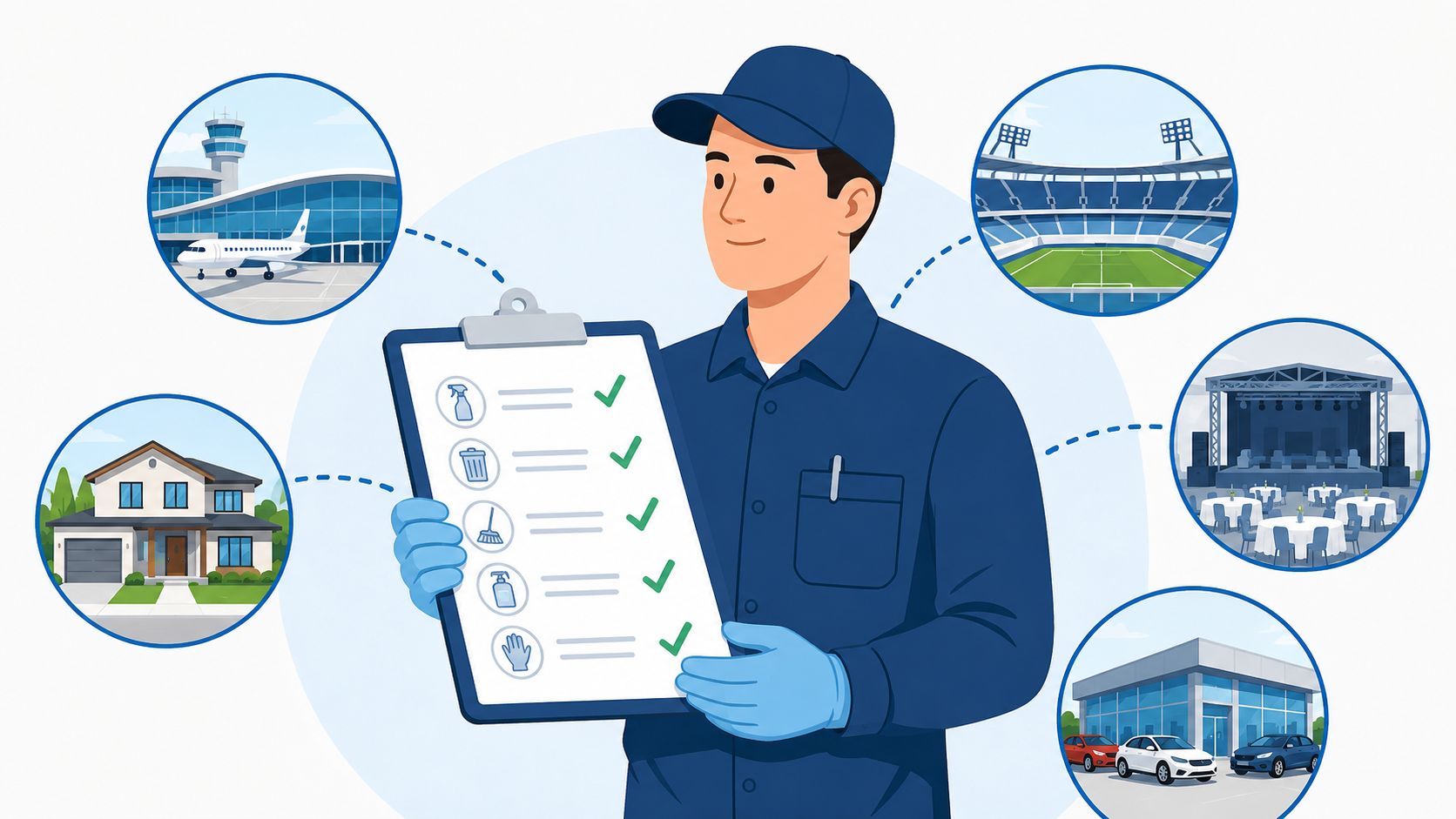
Beyond the Clipboard: Building a Defensible Sanitation Program
For any facility manager, the threat of a failed inspection or a customer complaint about cleanliness is a constant concern. A compliance audit checklist is your first line of defense, but an effective program goes far beyond a simple piece of paper. It's about building a systematic, verifiable process that protects your brand, ensures guest safety, and fosters customer trust. An effective program isn't just about stocking disinfecting wipes. It's about deploying the right tools, training your team, and documenting every step. This guide provides a roundup of the best resources to build a sanitation compliance audit checklist that is not only thorough but also actionable for your entire team, from janitorial staff to business owners.
Most operators already know the pain points. Supplies run low at the worst time. Staff clean inconsistently across shifts. Customers notice a smudged handle or an empty gym wipe dispenser long before they notice the effort behind the scenes. When that happens in a gym, restaurant, school, or retail store, cleanliness stops being a back-office task and starts affecting trust, retention, and revenue.
A workable program starts with standards, evidence, and hiring the right people to carry it out. If you're building the team behind your audit process, Talent Pronto's guide to compliance hiring is a useful companion.
1. WipesBlog.com

WipesBlog.com is the most practical resource on this list if your audit program revolves around visible cleanliness, repeatable disinfection, and facility trust. It doesn't stay at the policy level. It translates sanitation science into operating routines that janitorial teams, gym owners, and multi-site operators can implement on the floor.
That matters because sanitation programs often fail in the handoff between compliance language and daily execution. Teams know they need disinfectant wipes, but they don't always know how to choose the right product, where to place dispensers, or how to verify whether a wipe is appropriate for a given surface. WipesBlog closes that gap.
Why it stands out in sanitation-heavy environments
If you're auditing a fitness center, a dealership waiting area, a school front office, or a short-term rental turnover process, the strongest advantage here is specificity. The site leans into real operating questions such as contact time, label reading, dispenser placement, and zone-by-zone routines for high-touch surfaces.
One detail many teams miss is wipe performance during actual use. Surfaces must remain visibly wet for the full contact time to achieve verified kill claims, and that window typically ranges from 15 seconds to 4 minutes for practical facility use, though some commercial products require up to 10 minutes depending on the EPA-registered formula, as explained in Zogics' disinfectant wipe guidance. That single point changes how you train staff and members. A fast swipe isn't always disinfection.
Practical rule: If a member uses wipes for gym equipment and the surface dries too soon, the team should treat that as a failed disinfection step, not a completed one.
WipesBlog is also strong on product literacy. For buyers comparing sanitizing wipes, antibacterial wipes, and EPA registered disinfecting wipes, it helps connect label details to operating decisions instead of turning procurement into guesswork. That's valuable for sales professionals too. Clients respond better when you explain why a product supports audit readiness and guest confidence, not just why it fits a budget.
Best fit and limitations
This is a strong choice for:
- Multi-site operators: Standardize gym equipment cleaning wipes, restroom wipe rounds, and evidence collection across locations.
- Janitorial procurement teams: Build a shortlist for commercial disinfecting wipes without losing sight of use case, dispenser fit, and workflow.
- Gym and fitness owners: Set practical rules for workout wipes, yoga mat wipes, and fitness center wipes in member-facing areas.
The trade-off is simple. WipesBlog isn't a software platform and it isn't a direct purchasing system. It gives you the operating playbook, not the automated task routing. Pair it with a workflow app if you need remediation tracking.
For facilities that want to turn sanitation into a visible brand asset, WipesBlog.com is the best starting point on this list.
2. OSHA Self-Inspection and Compliance Checklists
OSHA's self-inspection materials are a strong baseline when you need your compliance audit checklist grounded in a U.S. regulatory framework. They aren't glamorous, and they aren't suited for every sanitation scenario, but they give operators something many hygiene programs lack: defensible structure.
For commercial facilities, that's useful because sanitation isn't only about customer perception. It's also about documented workplace conditions, routine inspections, and evidence that management is actively checking hazards instead of reacting after complaints.
Where OSHA helps most
OSHA is especially useful for offices, warehouses, schools, and mixed-use commercial properties where cleaning intersects with employee safety. If your team handles chemical storage, restroom servicing, breakroom hygiene, or locker-room maintenance, these checklists help you set a baseline inspection cadence and show that supervisors are reviewing conditions consistently.
A sanitation-focused team can adapt OSHA's general framework into practical questions such as:
- Supply readiness: Are disinfecting wipes stocked where staff and visitors need them?
- Surface priorities: Are high-touch points like door pulls, shared counters, and machine touchpoints included in rounds?
- Training proof: Can supervisors show staff were trained on proper wipe use and hazard communication?
A useful companion is WipesBlog's article on OSHA sanitation standards, which helps translate broad requirements into floor-level hygiene procedures.
Cleanliness programs get stronger when safety teams and janitorial teams use the same inspection language.
Trade-offs to expect
The main downside is format. OSHA's materials are largely static, so you won't get built-in reminders, mobile photo capture, or issue escalation. Teams often print them, annotate them, and then lose the audit trail.
That said, OSHA's small business compliance resources are still one of the best free starting points if you need authority first and automation second. For many businesses, that's enough to establish the first version of a sanitation inspection standard, then layer in a digital tool later.
3. CDC Infection Control Assessment and Response Tools

CDC ICAR tools were built for healthcare, but the environmental cleaning sections are valuable well beyond clinical settings. If you manage a gym, school, event venue, or busy retail site, these tools help you assess whether cleaning protocols are being followed where transmission risk is highest.
The strength here is rigor. ICAR pushes teams to think in terms of training, observation, auditing, and feedback. That structure is useful in any facility where people share surfaces all day and management needs more than a vague "we cleaned it" answer.
Why gyms and other high-touch sites should pay attention
In fitness settings, members touch dumbbells, machine handles, benches, mats, lockers, and check-in counters in constant rotation. Industry guidance says all equipment, including dumbbells, machine handles, and yoga mats, should be wiped down immediately after every single use by members, with staff conducting regular rounds in high-touch zones, according to WipesBlog's sanitation guidance for gyms. That expectation changes how you design your audit.
A gym audit built from ICAR principles should check:
- Member access: Are gym wipes or fitness wipes available at the point of use, not across the room?
- Staff reinforcement: Are attendants correcting gaps during floor walks?
- Shared equipment turnover: Are wipes to disinfect gym equipment used on benches, grips, mats, and touchscreens consistently?
This also applies to schools, where shared desks and lab counters need visible protocols, and to restaurants, where host stands, payment devices, and waiting-area surfaces can undermine trust fast if they look neglected.
Best use case
Use CDC's ICAR toolkit when you want to tighten observation-based auditing. It's less useful if you need broad enterprise workflow automation. It's more useful when you need a supervisor to walk a facility and assess behavior, documentation, and environmental cleaning quality with discipline.
4. HHS OCR HIPAA Audit Protocol

A rehab clinic finishes its evening cleaning round. The floors are done, treatment tables are disinfected, and the supervisor signs off in a mobile log. If that log includes patient names, appointment details, or incident notes, the sanitation record has crossed into HIPAA territory.
That is why the HHS OCR HIPAA Audit Protocol belongs on this list. It gives healthcare operators and business associates a detailed set of audit areas across Privacy, Security, and Breach Notification requirements. For a cleaning-focused audit program, the value is not surface disinfection guidance. It is control over the data your hygiene process creates, stores, and shares.
Where it connects to sanitation operations
Facilities often separate cleaning compliance from data compliance. On the ground, they meet in the same workflow. Environmental services teams use tablets, supervisors review exception reports, outside vendors access work orders, and front-desk staff document spills or exposure events. Each step can create records tied to protected health information.
The trade-off is practical. Digital sanitation logs improve accountability and speed up audits, but they also expand your risk if access controls are loose or retention rules are unclear. A paper checklist can be slower and harder to verify. A digital checklist is easier to search and trend, but only if permissions, storage, and incident response are set correctly.
This matters most in medical fitness centers, therapy practices, outpatient clinics, dental offices, and wellness providers. In those settings, a missed privacy control can damage trust just as fast as a missed cleaning step.
A good approach is to separate operational sanitation data from patient-identifiable information wherever possible, then document who can see what, who approves exceptions, and how long records stay in the system. Teams building those workflows can also borrow from practical commercial cleaning checklist templates for facility audits and adapt them so hygiene verification does not pull in more sensitive data than the task requires.
If your cleaning workflow creates or touches PHI, your sanitation audit needs privacy and security controls built into it.
When to use it
If your organization does not handle protected health information, this protocol will feel heavier than you need. If it does, the HHS OCR HIPAA Audit Protocol is one of the clearest ways to turn legal requirements into audit questions, evidence requests, and role-based responsibilities.
It works best when compliance leaders translate the protocol into plain-language checks for facility managers, environmental services supervisors, and vendors. That is how a HIPAA document becomes a usable sanitation audit standard instead of a binder that never leaves the shelf.
5. SafetyCulture

A facility manager finishes a floor walk at 6:30 a.m., spots an empty wipe station near the cardio area, notices residue on high-touch equipment, and sends corrective actions before the morning rush starts. That is the kind of sanitation audit workflow SafetyCulture supports well. It turns hygiene inspections into live operating records instead of end-of-day paperwork.
For cleaning-focused compliance programs, that matters. A missed restroom check or delayed dispenser refill is not just a housekeeping issue. It affects guest trust, staff confidence, incident exposure, and, in member-driven businesses like gyms or wellness facilities, retention.
Why operations teams use it
SafetyCulture is strong in the field. Teams can run recurring sanitation inspections on a phone, capture photos, log issues by area, and assign follow-up tasks on the spot. That shortens the gap between identifying a hygiene failure and correcting it.
The practical benefit is consistency across shifts and locations. A regional operator can standardize how sites inspect locker rooms, touchpoints, wash stations, and cleaning supply levels without relying on each manager to document the work differently. If you need a starting point for that structure, these commercial cleaning checklist templates for facility audits can help translate cleaning standards into usable mobile inspections.
SafetyCulture also creates a better audit trail than paper forms or scattered photos in text threads. Supervisors can show what was checked, what failed, who was assigned, and whether the fix was verified. In sanitation compliance, that level of documentation supports internal accountability and makes it easier to defend your process when a client, franchisor, or regulator asks for proof.
Best and worst fit
Best fit:
- Multi-site gyms: Daily floor walks, wipe station checks, restroom inspections, and member-facing hygiene verification.
- Restaurants and retail: Opening, mid-shift, and closing sanitation checks with photo documentation.
- Facility service providers: Site audits that need clear evidence, fast issue assignment, and client-ready reporting.
Weak fit:
- Single-site operators with simple routines: A basic spreadsheet or paper log may still be enough.
- Teams with highly customized compliance mapping needs: SafetyCulture is better for executing inspections than building complex control matrices across multiple frameworks.
One trade-off is design discipline. The app makes it easy to launch forms quickly, but speed can create bloated checklists that staff click through without thinking. Strong programs keep templates short, separate critical hygiene controls from nice-to-have observations, and review failed items for patterns that affect safety, guest experience, or revenue.
For broader audit templates, start with SafetyCulture's template library.
6. Smartsheet

A district manager opens Monday reporting and sees three locations with overdue restroom checks, two sites with low wipe inventory, and one facility still missing sign-off on a corrective cleaning action from last week. That is the kind of sanitation problem Smartsheet handles well.
Smartsheet fits teams that already know their hygiene standards but need tighter control over execution across multiple sites. It gives operations leaders a shared system for assignments, due dates, approvals, and status tracking without forcing everyone into a completely new way of working. For sanitation audit programs, that matters because missed cleaning tasks do not just create compliance risk. They show up in guest complaints, staff frustration, and lost repeat business.
Where Smartsheet stands out
Its strongest use case is central oversight. A gym group, school network, outpatient clinic operator, or restaurant brand can use Smartsheet to connect site audits, corrective actions, supply checks, and training records in one place. One sheet can hold sanitation findings by location. Another can track dispenser repairs, chemical restocking, or staff retraining. Dashboards then give regional leaders a live view of what is slipping and which managers are closing the loop.
That control-matrix structure is useful in sanitation-heavy environments. Teams can map each recurring hygiene task to the policy, standard, or inspection requirement it supports, then trace failures back to a missed control instead of treating every issue as a one-off. In practice, that makes audit reviews faster and remediation more defensible.
Practical sanitation uses
For facility and housekeeping leaders, Smartsheet works well for the management layer behind the cleaning program:
- Inventory planning: Track wipe usage by area, compare actual consumption against par levels, and flag stockout risk before peak traffic hours. 2XL's guide to selecting disinfectant wipes for your facility is a useful reference for setting wipe-related purchasing assumptions.
- Training records: Log who was trained on sanitizer contact times, dispenser refills, PPE use, and cleaning procedures for high-touch surfaces.
- Corrective action management: Assign failed hygiene checks to a named owner, set due dates, collect proof of completion, and keep an approval trail.
- Executive reporting: Show trends by site, issue type, or vendor so sanitation problems can be tied to operational risk and customer experience.
There is a trade-off. Smartsheet is better at coordination than frontline inspection capture. If housekeepers or supervisors need a highly guided mobile form for rapid floor checks, another tool on this list may feel easier in the field. Smartsheet earns its keep after the inspection, when the business needs follow-through, visibility, and proof that sanitation standards are being maintained.
Teams comparing audit and legal operations platforms may also find value in LegesGPT's legal tech recommendations, especially if compliance documentation needs review across operations and legal stakeholders.
If your sanitation audit checklist has outgrown spreadsheets but your managers still want spreadsheet-style control, Smartsheet is a practical choice.
7. Process Street
Process Street is a good option when your sanitation compliance audit checklist needs to run as a repeatable process, not just exist as a document. It's built for recurring workflows, approvals, and evidence capture. That makes it useful for facilities with scheduled cleaning, recurring vendor reviews, and layered sign-off requirements.
A lot of sanitation failures happen because teams rely on memory. Process Street reduces that problem by turning a checklist into a runbook with tasks, required fields, and approval steps.
Where it fits better than a static template
This platform is strong when the same sequence has to happen every day, every shift, or every turnover. Think fitness centers with opening inspections, midday wipe replenishment, and evening deep-clean verification. Think restaurants with front-of-house and back-of-house hygiene steps. Think schools that need classroom reset routines plus nurse office sanitization logs.
It also supports stronger vendor and risk workflows. Vendor inventory and compliance monitoring updates can reduce breach risks by 45 percent, and risk-tier-based rolling audit schedules are preferred over static annual checks, according to Censinet's third-party compliance monitoring checklist. That logic applies cleanly to sanitation supply chains. High-risk vendors, critical wipe dispensers, and service partners shouldn't all be reviewed on the same casual schedule.
Limits and best fit
Process Street is a smart fit for:
- Recurring audits: Daily and weekly hygiene routines that need approvals.
- Multi-role workflows: Staff clean, supervisors verify, managers close findings.
- Documentation-heavy environments: Facilities that need auditable records attached to each task.
It's less appealing for one-off audits or very small teams that just need a printable form. Heavier process design takes some setup, and some buyers will want pricing clarity earlier in the evaluation.
If your operation already thinks in SOPs and runbooks, Process Street's compliance templates are worth exploring. For broader legal and compliance tooling, LegesGPT's legal tech recommendations offer another useful angle.
Compliance Audit Checklist: 7-Tool Comparison
| Solution | Implementation Complexity 🔄 | Resource Requirements ⚡ | Expected Outcomes 📊 | Ideal Use Cases 💡 | Key Advantages ⭐ |
|---|---|---|---|---|---|
| WipesBlog.com | Low–Medium, ready‑to‑use SOPs but needs local adaptation 🔄 | Low, content, checklists, no software purchases ⚡ | Practical hygiene programs, improved guest perception & liability reduction 📊 | Multi‑site operators, facility managers, procurement teams 💡 | Facility‑specific SOPs, regulatory walkthroughs, procurement filters ⭐ |
| OSHA Self‑Inspection & Checklists | Low, static, straightforward PDFs 🔄 | Very low, free downloads; manual execution ⚡ | Defensible regulatory baseline and compliance evidence 📊 | U.S. workplaces seeking regulatory alignment and annual self‑evaluations 💡 | Official, authoritative source for OSHA compliance ⭐ |
| CDC ICAR Tools | Medium, structured/fillable tools; may need tailoring 🔄 | Moderate, facilitator time, adaptation for non‑healthcare settings ⚡ | Evidence‑based infection control audits and training outcomes 📊 | Healthcare and high‑traffic facilities adapting IPC practices (e.g., gyms) 💡 | Authoritative CDC guidance with facilitator materials ⭐ |
| HHS OCR HIPAA Audit Protocol | High, detailed, line‑by‑line legal protocol 🔄 | High, compliance/legal resources, documentation effort ⚡ | HIPAA audit readiness and reduced regulatory risk 📊 | Covered entities and business associates handling PHI 💡 | Exact OCR expectations; reduces regulatory uncertainty ⭐ |
| SafetyCulture (iAuditor) | Medium, app adoption and template customization 🔄 | Moderate, subscriptions, mobile devices, user training ⚡ | Digitized inspections, photo evidence, trend analytics 📊 | Multi‑site operations needing mobile audits and evidence trails 💡 | Large template library, mobile features, integrations ⭐ |
| Smartsheet | Medium, templates + workflow setup and governance 🔄 | Moderate, licenses, admin setup, possible add‑ons ⚡ | Centralized audit programs, dashboards, automated reminders 📊 | Enterprises centralizing audits, dashboards, and remediation tracking 💡 | Familiar spreadsheet UX, automation, enterprise scale ⭐ |
| Process Street | Medium, buildable runbooks and approval flows 🔄 | Moderate, subscriptions, process modeling, integrations ⚡ | Repeatable workflows, auditable records, scheduled audits 📊 | Recurring compliance processes and runbook automation across locations 💡 | Strong runbook automation, role assignments, evidence capture ⭐ |
From Checklist to Culture: Activating Your Program
It is 6:15 a.m., the doors open at 7, and a supervisor finds three empty wipe stations, a half-finished cleaning log, and no clear record of who checked the locker room the night before. That is how sanitation failures usually start. Not with a policy gap on paper, but with a routine that breaks under real operating pressure.
A compliance audit checklist earns its value on the floor. Staff need to use it during shift changes, rush periods, and supply shortages. Managers need to spot the difference between a task marked complete and a process that actually protects people. In sanitation programs, that means checking whether high-touch surfaces were cleaned at the right frequency, whether disinfectants stayed wet for the labeled contact time, and whether supply points stayed stocked where guests and employees need them.
The strongest programs treat hygiene as an operating standard tied to trust, safety, and revenue. An empty dispenser in a gym signals neglect. A missed restroom check in retail can trigger complaints before anyone files an incident report. In healthcare-adjacent settings, weak cleaning records create exposure fast because teams cannot prove what was done, when it was done, or who verified it.
Good audit programs close that gap. They assign ownership, collect evidence in one system, and require corrective action while the issue is still small. They also test readiness before an outside review. For sanitation teams, that means checking logs for missing dates, confirming approvals, matching supply usage to cleaning schedules, and correcting weak spots before a health inspection, member complaint, or bad review exposes them.
The strongest hygiene programs are visible to customers and verifiable to auditors.
If you're building a cleaning-focused audit program, keep the daily controls simple enough to run every day and strict enough to hold up under review:
- Set cleaning checks by risk level: Audit high-touch surfaces, shared equipment, restrooms, and food-contact or care-adjacent areas more often than low-traffic spaces.
- Train staff on product use, not just task completion: Teams should know contact times, surface compatibility, PPE requirements, and when a wipe is cleaning versus disinfecting.
- Place supplies at the point of use: Put wipes, gloves, and refill stock where the task happens so compliance does not depend on back-room access.
- Document proof, not just activity: Record rounds, exceptions, corrective actions, and supervisor signoff in a format your team will maintain.
- Review failures for patterns: Repeated stockouts, skipped checks, or late signoffs usually point to scheduling, training, or staffing issues, not isolated mistakes.
Culture shows up in the small details. Supervisors refill stations before they go empty. Frontline staff replace vague initials with complete records. Managers review sanitation misses the same way they review safety incidents or customer complaints.
That discipline protects more than cleanliness scores. It supports retention, reduces preventable complaints, and gives guests fewer reasons to question your standards. For organizations building stronger operations with limited budgets, free nonprofit tools may also spark ideas for lightweight process support.
Prioritize visible sanitation, train your team on proper wipe use, and make high-touch disinfection part of everyday operations. If you sell or manage cleaning programs, make disinfecting wipes part of a repeatable system clients can sustain, measure, and defend during an audit.
Leave a Reply