Saturday lunch service is moving fast. A porter leaves the restroom after restocking supplies, sees a condiment spill in the dining room, and grabs a yellow microfiber cloth because the blue cloths are sitting in the laundry sink. The same cloth is later dropped onto a shared cart, then picked up for work near the tray line.
That small shortcut creates a preventable hygiene risk. It can trigger re-cleaning, customer complaints, an inspection problem, or a loss of trust that takes longer to repair than the original spill took to wipe. Color coded microfiber cloths give staff a visible control point, while properly used disinfectant wipes add a practical layer for high-touch surfaces and fast response work.
The system works best when the cloth, chemical, cart, laundry process, and training all reinforce one another. A color legend on its own is decoration. A documented zone-control program is an operating standard.
The Moment a Wrong Cloth Costs a Facility
The porter in the restaurant doesn't make a reckless decision. They make a rushed decision that seems harmless. The restroom needs attention, the dining room needs attention, and the correct cloth isn't within reach. A yellow cloth handles the condiment drip, then travels with the cart toward a food-service area.
The danger is the path. Material from a high-risk restroom surface can move to a lower-risk surface when staff reuse a cloth without a clear visual barrier. In a restaurant, that can place the tray line, counters, or food-preparation environment in conflict with the facility's sanitation expectations. The same pattern appears in offices, gyms, schools, and public venues when one cart carries mixed tools without separation.
A manager may discover the problem through an inspection failure, a customer review, an odor complaint, or a staff absence caused by illness. The facility then spends labor hours retracing tasks, replacing supplies, inspecting surfaces, and explaining what happened. The original mistake lasted seconds, but the response consumes attention across several shifts.
Operational rule: If a cleaner has to remember where a cloth was used, the system has already placed too much responsibility on memory.
Make the visual cue impossible to ignore
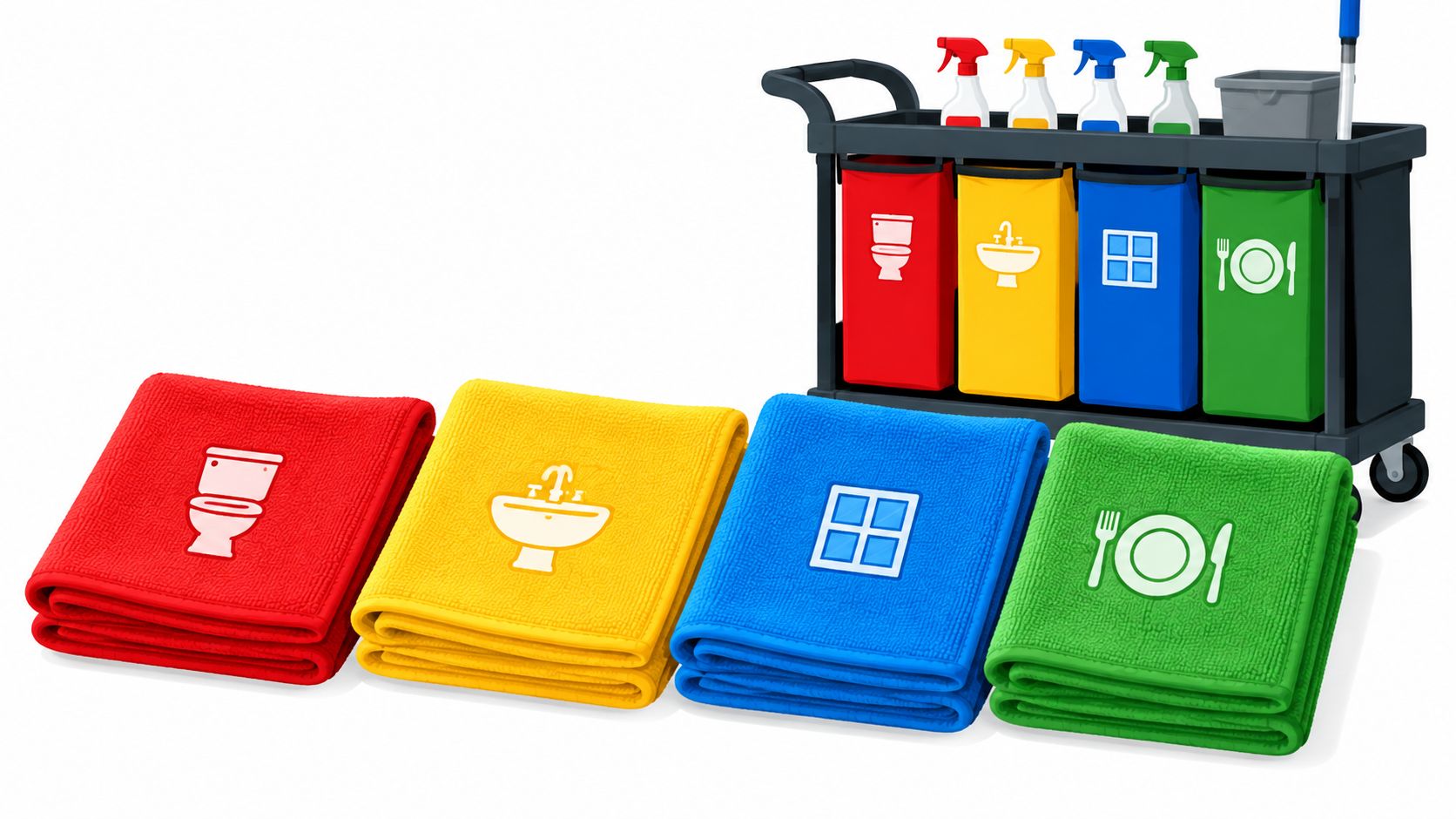
Color coding matters because staff can identify the intended zone before they start wiping. Professional guidance commonly uses red for toilets and urinals, yellow for restroom sinks and sanitary-contact areas, blue for low-risk general areas, and green for kitchens and food-preparation zones. There's no federally mandated U.S. color standard, so each facility must publish and enforce its own legend. Commercial cleaning guidance on sustainable cleaning for facilities also helps managers connect hygiene controls with responsible supply and waste practices.
The color doesn't disinfect a surface. It prevents a task tool from moving between incompatible zones. That distinction matters when staff work under pressure, contractors rotate between buildings, or a busy facility has several carts operating at once.
For public-facing sites, pair microfiber with disinfectant wipes for high-touch objects that need quick attention between full cleaning rounds. The CDC identifies surfaces such as door handles, elevator buttons, touchpads, restroom fixtures, counters, desks, stair rails, shopping carts, and point-of-sale keypads as examples requiring regular cleaning, with some public objects requiring cleaning and disinfection before each use. CDC facility cleaning guidance provides the operational baseline.
How the Four-Color System Works in Practice
A four-color model works only when every worker follows the same assignments. Publish the legend as site policy, not a suggestion, and make it specific enough to guide a new hire during a cart check.
| Color | Zone / Use | Example Surfaces | Risk Level |
|---|---|---|---|
| Red | High-risk sanitary areas | Toilets, urinals, restroom floors | Highest |
| Yellow | Restroom touchpoints | Sinks, dispensers, counters, mirrors | Moderate |
| Blue | General low-risk areas | Desks, glass, hallways, windows | Lower |
| Green | Food and kitchen areas | Prep areas, counters, breakrooms | Controlled food-service zone |
Red and yellow create restroom boundaries
Reserve red for toilets, urinals, restroom floors, and other high-risk sanitary surfaces. Red cloths stay in that zone, even when they look clean. Visible cleanliness does not prove that soil or chemical residue is absent, so do not send a red cloth to a desk, food surface, or fitness machine.
Use yellow for restroom surfaces outside the toilet area, including sinks, dispensers, counters, mirrors, and nearby touchpoints. Separating yellow from red divides restroom tasks into clear work zones. It also gives supervisors a visible way to correct cross-use during inspections.
Blue and green cover different lower-risk tasks
Blue handles desks, glass, hallways, windows, and other general low-risk surfaces. Green remains assigned to kitchens, food-preparation areas, cafeterias, and breakrooms. Food-service rules need a hard boundary. A cloth used near toilets cannot touch a preparation counter.
Material choice supports the system. Split microfiber fibers form fine capillary channels and provide more surface area for trapping water and particulate soil. Unsplit synthetic yarns behave more like ordinary cloth, while split microfiber supports stronger absorption and soil capture. Technical discussion of microfiber structure explains how the fiber construction affects performance.
Set one policy when sources disagree
Suppliers and cleaning guides do not always assign colors the same way. One program may use blue for glass, another may use green for general cleaning, and another may reserve yellow for fixtures or dry dusting. Some facilities also add a separate color for isolation or clinical work.
Choose the assignment that fits your zones, then document the reason. Print the approved legend on every cart, post it in supply rooms, and place it in each contractor's scope of work. Train supervisors to treat deviations as process failures, record the correction, and change supplies when the available colors encourage misuse. A defensible policy is consistent, visible, and easy to audit after staff or contractors change.
Matching Colors to Real Facility Zones
A four-color model gives managers a starting point, not a complete site plan. Each facility has a zone that the basic legend doesn't fully protect, and that forgotten zone is where staff start borrowing cloths.

Compare the overlooked zones
Offices usually rely heavily on blue for desks, glass, keyboards, and common areas. Green can cover kitchenettes and breakrooms, while red stays inside restrooms. The forgotten area is often the shared supply room, where clean and used cloths sit together.
Gyms and fitness centers need a dedicated solution for sweat and skin-contact surfaces. Reserve a separate color for equipment wipe-downs, or create a clearly labeled equipment kit that never handles locker-room floors. Use wipes for gym equipment between users, then keep microfiber for scheduled cleaning and detail work. A gym wipe dispenser makes the correct product visible near treadmills, weight machines, benches, and shared mats.
Restaurants and commercial kitchens need strict separation between restroom work, dining-room work, and food-preparation tasks. Green should stay in food zones, while red and yellow remain outside them. The commonly forgotten zone is the delivery or waste area, where grease, packaging soil, and restroom traffic overlap.
Short-term rentals should treat each unit as its own operational zone. Label cloths by unit and purpose so a bathroom cloth from one property never returns to a shared bag for another property without proper processing.
Car dealerships and service bays need a grease and solvent category. Black or gray cloths can handle auto-service grime while staying out of restroom, food-grade, and customer lounge systems.
Event venues and schools face constant cross-traffic. Separate carts by zone where possible, post the legend at each storage point, and define what happens when a contractor runs out of one color. The forgotten zone is usually the loading dock or event turnover area.
Clear safety zone sign types can reinforce the boundary where visual traffic is high. The sign should show the color, approved tasks, storage location, and the action required when a cloth is misplaced.
Laundering and Disinfecting Without Undoing the System
Most color-coded programs fail in the laundry room. Staff may separate cloths on the floor, then combine them in one collection bag, one washer, or one storage shelf. That erases the zone boundary before the next shift begins.
Treat every used cloth as contaminated from pickup through drying. Use separate, labeled bags or bins for each color family, and process restroom, kitchen, and general-purpose cloths according to the facility's approved laundering protocol and the textile manufacturer's care instructions.
Protect the microfiber structure
Microfiber works through its fiber structure, so laundry handling matters. Avoid fabric softener because it can coat the fibers and reduce their ability to capture soil. Don't overload the washer, and don't mix color families when the program requires separate processing.
The exact wash process must match the cloth label, detergent, equipment, and local requirements. A facility shouldn't copy a temperature from one supplier's product and assume it applies to every textile. Record the approved cycle for each cloth type, including detergent, bleach compatibility, drying setting, and inspection point.
Laundry rule: A cloth isn't ready for service because it came out of the dryer. It's ready when it's clean, fully dry, intact, and returned to the correct color inventory.
Disinfectant wipes require contact-time discipline
Use wipes for rapid response on high-touch, hard, non-porous surfaces when the product label permits that use. The CDC recommends cleaning with soap and water first, then disinfecting with an EPA-approved product. For electronics without manufacturer guidance, it suggests alcohol-based wipes or sprays containing at least 70% alcohol. CDC community and workplace guidance
A disinfectant wipe must keep the surface visibly wet for the full label contact time. Some EPA product labels specify two minutes or more, and repeated wiping may be needed to maintain wetness. EPA disinfectant wipe label instructions should govern the product in use, not fragrance, speed, or a cleaner's assumption.
For teams that need a practical wash reference, link the laundry procedure to washing microfiber cloths. Retire any cloth that no longer releases liquid evenly, develops a sour smell after drying, or has badly frayed edges. Document the trigger so supervisors make consistent decisions.
Branded gym towels for branding can support visible ownership in fitness environments, but branding never replaces zone separation. A logo doesn't make a cloth safe for another task.
Storage, Carts, and Signage That Prevent Mix-Ups
The correct cloth must be easier to grab than the incorrect one. Loose cloths in a shared bucket create confusion, especially when the cart moves between restrooms, public areas, and food-service spaces.
Give each color its own labeled bin, hook, or caddy pocket. Store clean cloths above the floor, keep used cloths in closed collection bags, and place a color legend inside the cart lid and on the supply-room wall.
Build the cart as a visual control
Use matching color cues across the kit. Color-matched spray bottles, caddy pockets, mop handles, and laundry bags help staff recognize the entire task set rather than relying on one small cloth.
A laminated zone map inside the cart can show the permitted colors for that shift. A hook board in the supply closet gives returned cloths a defined location where they can dry before processing. If a cloth has no assigned hook, it will eventually end up on the nearest shelf.
| Zone | Storage Type | Signage Element | Replacement Trigger |
|---|---|---|---|
| Restrooms | Dedicated red and yellow bins | Color swatch, approved surfaces, zone warning | Fading, odor, fraying, or failed inspection |
| Food service | Closed green container | Food-zone restriction and laundry route | Staining, uneven wetting, or contamination event |
| General areas | Blue caddy pocket | Task list for desks, glass, and halls | Loss of pickup or visible wear |
| Equipment zones | Dedicated labeled kit | Equipment-only instruction | Cross-use, damaged fibers, or poor coverage |
| Service bays | Black or gray bin | Grease and solvent warning | Chemical damage or transfer residue |
Make signage readable and durable
Post the color, purpose, and one direct instruction at eye level. “Red cloths do not leave this restroom” is stronger than a paragraph of policy language.
Faded red becomes pink, and pink creates doubt. Replace faded cloths on a fixed inspection cycle, not after a supervisor has to ask whether the color still means what the sign says. For staff with limited color vision, add tactile markers such as stitched ribbons near the hem, embossed logos, or large printed zone labels.
Training Staff and Contractors to Follow the Program
A new cleaner can follow a good system quickly if the facility teaches the system at the cart. A new cleaner can also defeat it quickly if the only instruction is a sheet taped to a closet wall.
Start every rollout with a 30-minute kickoff briefing. Open with the restroom-to-dining-room scenario, then walk through the actual cart, collection bags, laundry route, storage shelves, and approved disinfectant wipes. Staff should handle each color and name the zone before working independently.

Test recognition, not attendance
Give every new cleaner a practical color quiz using ten images and ten color choices, with a 90% pass mark. Use real surfaces from the building, not abstract diagrams. Include a trick scenario, such as a yellow cloth found near a food-preparation counter, and ask the employee what happens next.
Issue a pocket card with the site legend and a QR code linked to a short refresher video. The video should show the cart, the cloth return process, and the response to a misplaced cloth. Keep it short enough for part-time staff to watch on a phone before a shift.
The staff training best practices procedure should sit alongside the site-specific color legend, not replace it. General training explains behavior. The facility legend defines the approved assignments.
Control contractor overlap
Schedule a 15-minute booster every quarter and repeat it after any supplier change. New packaging, altered cloth shades, or a different dispenser can confuse experienced staff more than new hires because veterans may assume the old system still applies.
When several vendors share a building, put the legend in the contract scope. Require photo sign-off at shift change showing carts, bins, and storage points. Record each employee's completion date and signature, then keep the log available for inspections and internal review.
Supervisor's test: Ask a cleaner to point to the correct cloth, the used-cloth bag, and the laundry destination. If they can't do all three, training isn't complete.
Rollout Checklist and Metrics That Prove It Works
Don't change every cart, closet, contractor agreement, and laundry cycle at once. A phased rollout exposes weak points while the manager can still correct them without disrupting the entire facility.

Days 1 to 30
Audit every cleaning zone, including restrooms, kitchens, equipment areas, loading docks, service bays, storage rooms, and contractor workspaces. Select the site legend, define par levels, label carts and storage areas, and purchase enough cloths and collection bags to prevent borrowing across colors.
Record where current cloths are stored and where laundry breaks down. If a team can't keep green separate from red during pickup, solve the collection problem before training staff on the new labels.
Days 31 to 60
Train and certify the core team, issue color-specific kits, run cart inspections, and correct mislabeled containers. Pilot the program in one area before expanding it to every shift.
Document exceptions instead of hiding them. A missing blue cloth, a supplier color change, or an overloaded laundry day reveals a process gap that needs an owner and a fix.
Days 61 to 90
Review workload, replacement frequency, laundering records, inspection findings, incidents, labor use, and product costs. Standardize the process that works across shifts, buildings, and contractor teams, then update the contract scope and training materials.
The timeline should support a 90% or higher color-code adherence target, as represented in the rollout visual, but managers must define how adherence is observed and recorded before using the target.
Track process and outcome evidence
Assign one owner to each metric and review the results monthly.
- Color-selection compliance: Observe cleaning tasks and record whether the worker selected the approved cloth.
- Laundering compliance: Check separation, cycle completion, drying, and return to the correct inventory.
- Replacement rate and useful-life cost: Record when cloths leave service and why, then compare the pattern by color and zone.
- Contamination and complaint indicators: Log reported cross-contamination events, odor complaints, food-surface failures, and inspection findings.
- Operational outcomes: Review restroom inspection scores, staff sick leave, re-cleaning labor, and customer complaints by zone, shift, crew, and contractor.
Don't declare success because complaints fell. Complaints can fall when reporting weakens. Sustained color compliance, documented laundering, stable inspection results, and clear exception records provide stronger evidence that the system is operating.
Clean high-touch surfaces on a defined schedule, use EPA-approved disinfecting wipes according to the label, and keep gym equipment wipes, microfiber cloths, carts, and laundry streams assigned to their proper zones. Facility owners, janitorial leaders, and cleaning suppliers should publish one color legend, train every worker who touches the cart, and build the controls into the daily routine. Start with one area this week, document the gaps, and integrate a reliable wipe program into your cleaning or product offering before the next busy shift.
Leave a Reply