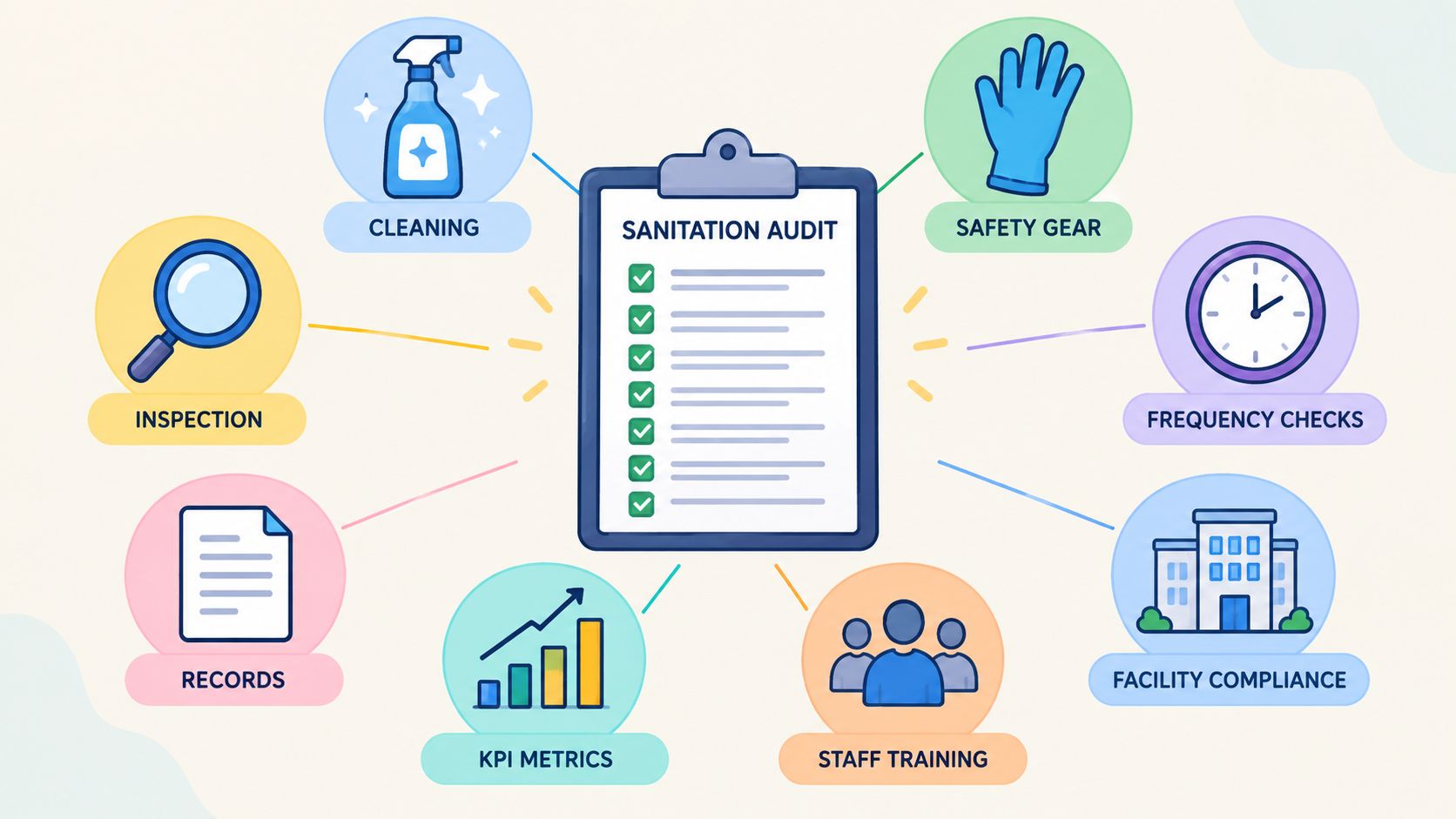
A gym can pass a visual inspection before the morning rush and still expose process failures. Fingerprints on treadmill controls, residue on a water-fountain button, or an unwiped shared yoga mat reveal gaps that polished floors and an orderly front desk conceal. Airports, dealership showrooms, event venues, offices, restaurants, and retail stores face the same risk. Clean appearance does not confirm consistent sanitation.
A practical operational audit checklist converts sanitation from a general expectation into a repeatable control. It directs managers to identify high-touch areas, verify staff procedures, protect equipment, maintain supplies, communicate standards, and preserve audit evidence. ISO 19011:2018 describes checklists as work documents auditors can use to record evidence, findings, and meeting notes. Its guidance addresses audit principles, program management, execution, and auditor competence.
The eight checkpoints below apply that audit discipline across different facility types. They also connect sanitation requirements with sales conversations for cleaning-product teams. A gym may need disinfectant wipes at shared equipment, while an airport, rental operation, event venue, or dealership may require commercial disinfecting wipes suited to counters, touchscreens, vehicle interiors, or other materials. Product recommendations should follow the customer's surfaces, traffic patterns, label directions, and operating schedule.
1. Identify high-touch surfaces and set a disinfection protocol
A sanitation audit should begin with the surfaces people touch most often, not with the areas that are easiest to clean. Walk through the facility during normal activity and record door handles, handrails, elevator buttons, payment terminals, faucet handles, trash lids, light switches, shared pens, touchscreens, and equipment controls. In a gym, include treadmill rails, resistance-machine pins, dumbbell handles, locker handles, bench adjustments, and rowing-machine grips.
Map these points by location and risk. A color-coded floor plan can show which areas need attention during every shift, which require inspection during busy periods, and which belong to a scheduled deep-cleaning route. The map should remain editable because use patterns change. A new self-checkout screen, temporary event entrance, or popular piece of exercise equipment can create a high-touch zone that wasn't on the original route.
The audit should test both the written schedule and the evidence that staff followed it. Ask who owns each area, where products are stored, whether the correct product is available, and whether the surface stayed visibly wet for the product's stated contact time. EPA registered disinfecting wipes may be appropriate where the label permits the intended use, but staff must follow the label directions and confirm material compatibility.

Make the route visible and accountable
Use a short log with the area, date, time, staff initials, product used, and exception notes. In fitness settings, place a gym wipe dispenser near equipment clusters so members can wipe down contact surfaces before or after use. For dealerships, include steering wheels, gear selectors, door pulls, and payment terminals after test drives. Airports and event venues should add armrests, queue barriers, ticket scanners, and temporary counters to their maps.
Practical rule: If a surface is touched repeatedly, assign it an owner, a product, a frequency, and a record.
2. Train staff and verify accountability
A product sitting on a janitorial cart doesn't create a sanitation standard. Staff need to know which surface they're cleaning, how much product is required, how long the surface must remain wet, and when personal protective equipment is necessary. Training should also cover ventilation, safe storage, prohibited product combinations, and the difference between removing visible soil and disinfecting a surface.
Demonstration works better than a policy document alone. Show a cleaner how to unfold or use a wipe so one section of the wipe doesn't get dragged across unrelated surfaces. Demonstrate coverage on textured plastic, vinyl seating, chrome, touchscreens, and exercise-machine controls. Ask the employee to repeat the process, then record completion in a training register.
The same standard must reach temporary workers, contractors, rental hosts, event crews, and front-desk employees. A short-term rental operator may need to verify turnover cleaning, while a fitness director may need to ensure that every shift understands the difference between gym equipment wipes and a product intended for another material.

Turn training into observable work
Use a digital checklist, photo verification, and supervisor spot-checks where they fit the operation. A paper log may work for a small office, but a distributed airport, gym network, or dealership group usually needs time-stamped records that managers can review across locations. The staff training best practices guide can support a broader training program.
Useful audit questions include:
- Product knowledge: Can the employee identify the approved product for each common surface?
- Technique: Can the employee demonstrate complete coverage and the required contact time?
- Escalation: Does the employee know what to do when a surface is damaged, heavily soiled, or outside the product label?
- Guest communication: Can staff explain the cleaning routine accurately without making unsupported health claims?
Rewarding reliable execution can reinforce the standard, but the audit should focus on evidence rather than enthusiasm. A signed form without observation proves very little.
3. Sanitize restrooms and hygiene facilities
Restrooms reveal whether a facility controls the details. Inspect toilet seats, flush controls, stall locks, faucets, soap dispensers, hand dryers, towel dispensers, door pulls, baby-changing stations, floors, drains, and waste receptacles. Look behind toilets and beneath sinks, where rushed cleaning routes often leave gaps.
Separate soil removal from disinfection. A visibly dirty surface usually needs cleaning before a disinfectant can work as intended. Staff should use the product label as the authority for application, contact time, surface compatibility, and required protective measures. Color-coded cloths, gloves, and tools can help prevent a toilet-area tool from moving to a sink or food-adjacent surface.
Peak-use planning should be based on observed traffic, complaints, occupancy, and event schedules. A gym may need more frequent checks around locker rooms and showers than in a quiet office. An airport or event venue should account for arrival waves, boarding periods, and intermission traffic. A restaurant needs restroom records that align with its broader food-safety documentation.

Audit the overlooked points
Place a visible last-serviced record outside the restroom, but don't treat signage as proof. Match the posted time to the route log and inspect the condition of the room. Guest reporting through a QR code or phone number can reveal failures between scheduled rounds, especially at busy venues.
For fitness centers, wipes near towel racks and sinks can support self-service cleaning of permitted high-touch surfaces. Sanitizing wipes may help with routine cleaning needs, while a disinfectant product should be selected and used according to its label. The audit should confirm that staff aren't selecting a product based solely on its familiar packaging.
4. Integrate equipment sanitation with maintenance
Equipment cleaning works best when it sits inside the maintenance system rather than in a separate folder. In a gym, inspect grips, seats, touchscreens, adjustment levers, weight-stack pins, mats, and floor-contact points. In an airport, review armrests, tray tables, charging stations, and seating. In a dealership, inspect steering wheels, door handles, consoles, and vehicle keys after demonstrations.
Shared equipment creates a trade-off. Cleaning after every meaningful use can support confidence and reduce visible residue, but a rushed wipe-down can damage sensitive materials or leave equipment unavailable longer than necessary. The correct approach pairs each equipment type with an approved product, technique, and return-to-service check. Wipes for gym equipment should be compatible with the manufacturer's material guidance, particularly on vinyl, coated metal, screens, and touch controls.
The audit should also look for deterioration. Repeated exposure to unsuitable chemicals can crack upholstery, cloud plastics, dry rubber, or weaken labels. A cleaner who reports damage early protects both the asset and the sanitation process.

Build a product and maintenance pairing
Create a quick-reference sheet that names the equipment, approved wipe or cleaner, application method, contact time, and inspection requirement. Put gym equipment cleaning wipes near high-use stations, but don't let dispenser placement replace staff checks. Members may wipe the handles while missing adjustment pins, seat edges, or control panels.
A sales professional can use this checkpoint to recommend a complete package rather than a single case of wipes. The package may include dispensers, refills, surface-specific products, signage, and a simple usage log. The value is operational consistency, not just product volume.
5. Control inventory and the disinfection supply chain
A facility can't follow a cleaning route when the approved product is missing. Audit the full path from purchasing to storage, issue, use, disposal, and replenishment. Verify product labels, safety data sheets, storage conditions, damaged packaging, and expiration or manufacturer guidance where applicable.
Inventory should reflect actual use by zone. An airport terminal, large gym, event venue, or dealership group may need different products for restrooms, equipment, vehicles, counters, and shared devices. A small office may need fewer categories but still requires a clear reorder point. Bulk gym wipes can simplify purchasing for high-traffic fitness areas, while specialty products such as yoga mat wipes may be more appropriate for studios and wellness spaces.
Avoid choosing solely on unit price. A lower-priced wipe may create more labor if it dries quickly, tears, requires repeated passes, or damages surfaces. A higher-cost product may be justified when it improves coverage, reduces handling, or supports a documented protocol. The audit should compare efficacy, material compatibility, safety, disposal, storage requirements, and staff acceptance.
Give sales conversations an operational basis
Cleaning-supply sales professionals can ask practical questions:
- Usage pattern: Which areas consume the most wipes, and when do stockouts occur?
- Product fit: Are staff using one wipe for surfaces with different compatibility requirements?
- Workflow: Are dispensers placed at points of use, or where storage is convenient?
- Evidence: Can the customer connect product use to route logs, training, and corrective actions?
A supplier can recommend barcode tracking, manual cycle counts, or a digital inventory record, depending on the customer's scale. Multiple suppliers may reduce single-source exposure, but additional vendors also create training and documentation work. Keep the approved product list controlled so substitutions don't undermine the audit.
6. Communicate sanitation to guests and members
Cleanliness affects what visitors believe about the whole operation. Guests notice visible fingerprints, overflowing bins, empty wipe dispensers, and employees who ignore obvious spills. They also notice orderly cleaning activity, clear instructions, and equipment that is ready for use.
Communication must be accurate. A gym can explain that members should wipe contact surfaces after use and identify the product supplied. An airport can display cleaning routes in high-traffic areas. A rental host can document turnover tasks without implying that a checklist eliminates every health risk. A dealership can explain that vehicles are cleaned after test drives, then show the process through a simple handoff record.
Use signs that answer practical questions: what was cleaned, when it was checked, which surfaces members should wipe, and where used wipes belong. Product descriptions can add credibility when they are precise, such as EPA-registered disinfecting wipes, provided the product possesses that status and the intended use matches the label.
Make transparency part of the service
A fitness center might place a “last checked” field near each equipment bank, supported by staff route records. A venue can include sanitation readiness in event planning documents. A retail store can train associates to respond when a customer points out a dirty basket handle or payment terminal.
Visible cleaning earns trust only when the underlying work is real, repeatable, and easy to verify.
This checkpoint also creates a sales opportunity. Instead of selling antibacterial wipes as an isolated add-on, connect them to member experience, dispenser placement, staff training, replenishment, and signage. Customers are more likely to value a supply program when it solves a workflow problem they can see.
7. Plan for seasons and special events
A normal cleaning route may fail when occupancy, turnover, or event activity changes. Audit the calendar for conferences, concerts, holidays, promotional events, school schedules, vacation periods, membership campaigns, and weather-related surges. Then compare expected demand with staff coverage, product availability, equipment access, restroom capacity, and waste handling.
The plan should be written before the busy period begins. Create reusable event templates for guest arrival, peak activity, restroom rounds, equipment turnover, spill response, and post-event reset. A short-term rental manager may need a clear handoff between departing guests, cleaners, inspectors, and incoming guests. An event venue may need separate routes for setup, doors-open, intermission, and teardown.
Staffing decisions involve trade-offs. Adding temporary workers improves coverage but increases training and supervision needs. Increasing cleaning frequency may improve visible conditions but can interrupt operations if routes aren't designed around traffic. Pre-positioning supplies reduces response time, but excessive storage can create clutter and make stock rotation harder.
Match preparation to the operating calendar
Maintain a 12-month sanitation calendar that marks known occupancy changes and special events. Contact suppliers early when demand is likely to rise, and pre-position commercial disinfecting wipes and dispensers in areas where staff or guests will use them. Confirm that temporary staff know the approved products and escalation process before the event starts.
After a major event, inspect the facility rather than checking off a generic reset task. Look for adhesive residue, spilled drinks, shared equipment, queue barriers, restroom damage, and areas where contractors created new touchpoints. Record corrective actions with named owners and due dates so the next event benefits from what the team learned.
8. Maintain compliance records and audit evidence
A completed task and a provable task are different audit outcomes. Test whether cleaning logs, product labels, safety data sheets, training records, incident reports, inspection findings, and corrective actions are complete, current, and accessible. Missing evidence can create findings, while an upstream record can affect confidence in the task that follows it. operations audit readiness guidance
Use a defined audit sequence rather than a single walk-through. Set the scope, review procedures and records, observe the work, document findings, assign corrective actions, and verify closure. This approach keeps sanitation audits tied to actual controls and follow-up instead of paperwork alone.
The same test applies across airports, restaurants, gyms, rentals, dealerships, and event venues. A photograph may show a clean room, but it may not identify who cleaned it, which product was used, whether the product suited the surface, or whether the procedure was repeated after the next occupancy change.
Score findings by risk and business impact
Trace one operational process from start to finish. In a gym, follow equipment from member use through wipe availability, member cleaning, staff inspection, waste disposal, and replenishment. Compare what occurred with the SOP, handoffs, and relevant performance indicators. Guidance for operational audits recommends testing the workflow itself and rating findings by risk and business impact operational audit checklist guidance.
A structured 1–5 scoring model can help teams rate core operating categories. A separate gap analysis compares the current state with the target state. The audit checks whether required controls and steps exist. Benchmarking shows how far performance sits from a peer or best-in-class target checklist benchmarking guidance.
Record the evidence digitally where practical, but keep supervisory judgment in the process. A checklist app can retain time-stamped entries and prevent incomplete sign-off. Supervisors still need to investigate exceptions, confirm product and procedure use, and verify that corrective actions closed the identified risk. The compliance audit checklist resource can support a wider documentation process. Food-service operators can also review IPM for food establishments alongside sanitation and facility-control procedures.
8-Point Operational Audit Checklist Comparison
| Checkpoint | Implementation complexity 🔄 | Resource requirements ⚡ | Expected outcomes 📊 | Key advantages ⭐ | Ideal use cases 💡 |
|---|---|---|---|---|---|
| High-Touch Surface Identification and Disinfection Protocol | 🔄 Medium, mapping, schedules, and staff coordination | ⚡ Ongoing labor + EPA-registered wipes; moderate PPE/training | 📊 Lowers transmission risk; +15–20% guest confidence | ⭐ Visible sanitation, outbreak prevention, inspection compliance | Airports, retail, sports facilities, fitness centers |
| Staff Training and Accountability Systems | 🔄 High, curriculum, assessments, digital tracking | ⚡ Investment in training time, LMS/tools, supervisor hours | 📊 Improves execution; +10–15% staff efficiency, measurable compliance data | ⭐ Consistent protocols, fewer cross-contamination errors, better retention | High-traffic sites: airports, gyms, short-term rentals, event venues |
| Restroom and Hygiene Facility Sanitation Checkpoint | 🔄 Medium-High, frequent inspection cycles and specific protocols | ⚡ Frequent staffing, supplies, higher water/waste usage | 📊 Major impact on perception; +20–30% positive reviews | ⭐ Significantly reduces transmission in concentrated areas; guest confidence | Restaurants, malls, airports, fitness centers, event venues |
| Equipment Sanitation and Maintenance Integration | 🔄 Medium, syncs disinfection with preventive maintenance | ⚡ Specialized wipes, training, scheduled downtime for deep-cleaning | 📊 Reduces illness complaints 25–35%; extends equipment life ~15–20% | ⭐ Protects equipment, preserves warranties, reduces odor/deterioration | Gyms, car dealerships, airports, restaurants, event venues |
| Inventory Management and Supply Chain for Disinfection Products | 🔄 Medium-High, digital tracking and supplier coordination | ⚡ Software, storage space, procurement resources, buffer stock | 📊 Reduces supply costs 12–18%; prevents stockouts and operational interruptions | ⭐ Cost optimization, forecasting, mitigates supply risk | Multi-site facilities, airports, fitness center chains, event operators |
| Guest and Member Communication and Transparency Programs | 🔄 Low–Medium, signage, digital content, staff messaging | ⚡ Signage, CMS/app updates, customer service time | 📊 Boosts satisfaction +20–30%; cuts negative reviews 15–25% | ⭐ Builds trust, justifies premium pricing, reduces complaints | Hotels, fitness centers, short-term rentals, airports |
| Seasonal and Special-Event Sanitation Planning | 🔄 High, forecasting, surge staffing, pre/post-event protocols | ⚡ Temporary staffing, extra supplies, advance supplier coordination | 📊 Prevents 70–80% of peak-period failures; maintains service levels | ⭐ Proactive scaling, reduces burnout, avoids emergency spend | Holiday travel (airports), January gym surges, large events, peak retail seasons |
| Regulatory Compliance and Audit Documentation Systems | 🔄 High, centralized records, SDS, incident logs, audits | ⚡ Administrative staff, secure software, training, archival storage | 📊 Reduces penalties by 80%+; streamlines inspections 40–50% | ⭐ Legal protection, audit readiness, continuous improvement data | Airports, restaurants, fitness centers, short-term rentals, regulated venues |
Take the next step to a cleaner, safer facility
A clean facility supports more than appearance. It gives staff a clear operating routine, gives managers evidence to review, and gives guests a visible reason to trust the business. The strongest programs connect surface identification, product selection, training, equipment care, inventory, communication, seasonal planning, and follow-up instead of treating each task as an isolated cleaning chore.
Start with a walkthrough during normal operating conditions. Mark the door handles, railings, payment terminals, restroom fixtures, shared devices, equipment controls, mats, vehicle touchpoints, and other surfaces people use. Then compare the observed workflow with the written SOP. If the route depends on a product that isn't available, a dispenser that's out of reach, a handoff nobody owns, or a log nobody reviews, record that as an operational gap.
Facility owners and managers should select products by label directions, surface compatibility, contact time, safety requirements, and storage needs. In fitness environments, integrate fitness wipes or approved equipment wipes into the member experience, place dispensers where cleaning occurs, and train staff to inspect equipment after use. Offices, schools, restaurants, retail stores, airports, rentals, events, and dealerships should adapt the same logic to their distinct traffic patterns and materials.
Sales teams can strengthen customer relationships by asking about workflow rather than leading with a product claim. Recommend a practical program that may include wipes, dispensers, refill planning, signage, staff education, safety documentation, and audit records. Explain hygiene ROI in operational terms, such as fewer workflow interruptions, clearer accountability, stronger customer communication, and better control of supply usage. Don't promise outcomes the product label or available evidence doesn't support.
Run the audit again after corrective actions. Review recurring complaints, empty dispensers, damaged surfaces, late route entries, inaccessible records, and tasks marked complete without supporting evidence. A checklist creates value when someone uses its findings to improve the next shift, the next event, and the next customer experience.
Prioritize cleanliness today by adding approved disinfectant wipes to the areas people touch most, assigning clear ownership, and recording each completed cycle. If you're a facility manager, build these eight checkpoints into your daily routine. If you sell cleaning supplies, help customers combine commercial disinfecting wipes with a documented sanitation program that staff and guests can follow. Explore the facility-focused resources at WipesBlog.com, then put one high-touch route, one dispenser station, and one verification log into operation before the day ends.
Leave a Reply