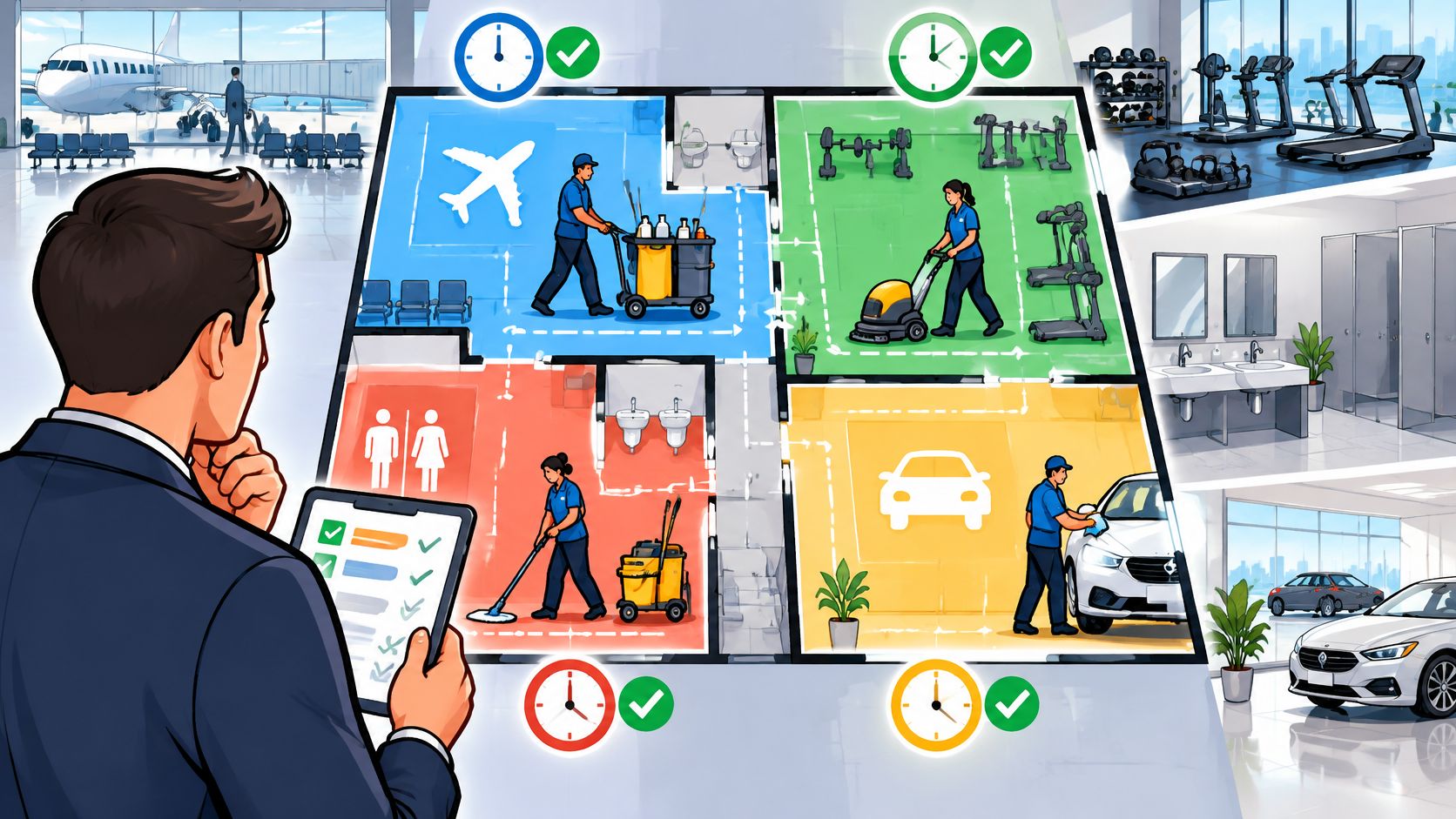
The opening rush has passed, the restroom needs attention, and someone has signed off the equipment area even though the handles still feel sticky. Your cleaner is busy, but customers are touching surfaces faster than the route covers them.
A useful zone cleaning schedule fixes that mismatch. It assigns work according to touch frequency, contamination risk and the cost of a missed service, then uses completion logs to show whether the plan is working. Cleanliness protects the condition of your facility and the confidence of the people using it. Disinfectant wipes can support that work, provided staff use the right product correctly rather than treating every wipe-down as disinfection.
Zone Cleaning Frequencies by Facility Type
Baseline and peak cleaning intervals by zone and facility
These are proposed starting intervals for a pilot, not universal standards. Find your zone, start with its baseline, and switch to the peak rule when traffic or incidents increase.
| Zone | Facility | Baseline interval | Peak interval |
|---|---|---|---|
| Gym locker rooms and restrooms | Gym | Every 2 hours | Every hour at peak |
| Gym equipment and handles | Gym | Between each user | Continuous wipe-down coverage during peak, between users |
| Airport restroom fixtures | Airport | Every 2 hours | After arrival surges and whenever visibly soiled |
| Terminal seating and tray tables | Airport | Twice daily | After each major boarding wave |
| Venue doors, rails and concessions | Event venue | Before opening, at intermission, after event | After every session |
| High-touch items in rentals | Short-term rental | Every turnover | Mid-stay check on long stays |
| Showroom touchscreens and key fobs | Dealership | Daily | After each customer test drive |
| Shared kitchen and printers | Office | Daily | Twice daily during busy weeks |
| Desks and door handles | School | Daily | Midday during illness season |
| POS, restroom and table surfaces | Restaurant | Every 2 hours | Between seating waves |
The gym baseline has a specific reference point: the New York fitness-center guidelines require equipment cleaning and disinfection between patrons and locker-room and restroom cleaning and disinfection at least every two hours, or more often. That document provides context for the proposed gym intervals, not a universal legal requirement for every facility.
Read the interval alongside the task
A restroom check isn't automatically a completed clean. Staff must inspect fixtures, remove soil, replenish supplies and complete the assigned surface treatment before signing off.
Likewise, the restaurant row isn't permission to leave a dirty table until the next round. Clear and clean tables between customers, and use the appropriate food-contact sanitizing procedure wherever required. Keep POS electronics separate from food-contact work.
For an office route, office cleaning advice from Eco Clean Solutions offers a useful companion resource when defining shared-space tasks. A high-touch versus low-touch surface guide can also help staff distinguish frequently handled objects from surfaces that mainly collect dust.
Practical rule: A queue, class change or boarding wave is a scheduling trigger, not merely a busy period to work around.
For this pilot, review the logs after two weeks. Shorten intervals where soil repeatedly appears before service; consider lengthening low-contact routes only when inspections support it. Don't relax product instructions or applicable requirements.
The zones most easily under-served are entry doors, payment points and shared equipment. Give them explicit tasks rather than assuming someone handles them while passing.
Scoring Zone Risk and Building Your Zone Map
Clock time alone doesn't tell you how urgently a surface needs attention. The CDC's cleaning guidance states that, when nobody with confirmed or suspected COVID-19 has been in a space, cleaning once per day is generally sufficient, while high-touch surfaces need at least daily cleaning and more frequent attention in high-traffic areas.
That scope matters. A baseline for ordinary conditions doesn't replace an illness-response procedure, and an infrequently used storage area shouldn't receive the same labor allocation as a busy restroom.
Score the exposure, not the room name
The CDC's environmental-services guidance supports assessing risk and cleaning high-touch surfaces more frequently than low-touch surfaces. Use contamination probability, traffic and touch frequency, occupant vulnerability, and the consequence of missed cleaning to make that assessment operational.
Four risk factors for scoring a zone
| Factor | Question to ask | Low-risk example | High-risk example |
|---|---|---|---|
| Contamination probability | Could someone ill have used this space recently? | Storage closet | Restroom at a rush-hour airport gate |
| Traffic and touch frequency | How many hands touch it per hour? | Office supply room | Gym cable-machine handle |
| Vulnerability of occupants | Are children, older adults or patients present? | Warehouse back office | School nurse's room |
| Consequence of missed cleaning | What happens if this zone is skipped for one shift? | Filing room | Rental kitchen between guests |
For a simple pilot scoring system, assign 1 to 3 points to each factor, producing a total of 4 to 12. These are proposed management thresholds, not CDC-issued scores:
- 10 to 12 points: Service after every event or turnover and whenever visibly soiled, with between-user treatment where appropriate.
- 7 to 9 points: Maintain a daily minimum and add peak rounds.
- 4 to 6 points: Use a fixed periodic route with spot cleaning, while preserving daily attention for any high-touch assets within it.
Say a cable-machine handle receives repeated hand contact throughout a busy class change. It scores high for touch frequency and the consequence of missed service. A locked supply closet scores low. Marking both as "daily" hides the difference that matters.
The rink illustration offers a visual analogy for bounded zones and assigned coverage, rather than a cleaning procedure.

Build a map someone can actually work
- Draw workable boundaries. Mark zones on a floor plan small enough for a cleaner to complete in a pass without abandoning unfinished work.
- Name the touchpoints. Include handles, stair rails, elevator buttons, faucets, counters, phones and shared equipment. “Lobby” isn't a sufficiently specific task.
- Apply the risk factors. Score actual use, including class changes, passenger arrivals and vulnerable occupants, rather than relying on the room label.
- Assign a tier and service trigger. Choose a starting interval and state what moves the zone into peak coverage. Record the trigger beside the task.
- Sequence the route. Remove waste and visible soil, clean before disinfecting, move from cleaner areas toward dirtier areas, and finish floors last. Keep restroom tools separate from other zones.
- Give every zone an owner and shift window. Name a backup for breaks and incident response. “All staff” usually means nobody has clear responsibility.
- Pilot and verify. Log the zone, employee, start and end time, product, dwell-time compliance, exceptions and supervisor initials. Check the physical result against the entry.
A signature proves someone made an entry. Inspection establishes whether the zone received the intended service.
A small airport concourse and a gym operating around the clock need different zone sizes. Copy the method, not another building's floor plan.
Staffing and Shift Handoffs Across Operating Hours
Staffing and rounds by traffic band
This is a hypothetical coverage model to test against your floor area, task duration and operating hours.
| Traffic band | Example | Cleaners on zones | Rounds per shift |
|---|---|---|---|
| Quiet | Weekday office or school after hours | 1 rotating cleaner | 2 rounds, opening and closing |
| Steady | Midday gym or rental between stays | 1 cleaner plus floor staff | 3 rounds |
| Peak | Airport holiday weekend or venue event day | 2 to 3 cleaners, one per zone cluster | Every 2 hours plus peak checks |
| Incident | Reported illness, major spill or mass turnover | 1 dedicated team member | Immediate round, then closing round |
Healthcare schedules show why coverage should change with risk: the World Health Organization's infection-control guidance recommends cleaning screening and triage areas at least twice daily and shared patient toilets at least three times daily. Those are healthcare intervals, but the transferable principle is straightforward: shared, heavily used zones need shorter service gaps.
For commercial operations, organize coverage around pre-opening, mid-operation and closing rounds, with turnover work added for rentals and dealerships. Don't treat the staffing table as a productivity guarantee. Measure the route with travel, supply replenishment and product contact time included.
Make the handoff physical
The diagram illustrates handoff coverage; cleaning assignments still need named zone owners.

In a hypothetical 24-hour gym, use a two-minute walk-through at the 6 a.m. handoff. Confirm locker rooms and showers first, then review completed zones, last service times, products used, open incidents and missed rounds.
An illustrative schedule could look like this:
- 5:30 a.m. reset: Locker rooms, showers and entry handles.
- 8 a.m., noon and 4 p.m. coverage: Equipment support and restroom checks, alongside the separate restroom service cadence.
- 9 p.m. closing-style round: Complete the evening log and transfer responsibility to overnight staff.
At an always-open facility, that last round isn't the end of coverage. Stock bulk gym wipes near equipment to reduce supply-room trips, and rehearse the handoff through a custodial training program.
No zone leaves a shift without being marked done or not done.
Using Disinfectant Wipes Zone by Zone
Wipe approach for common high-touch surfaces
| Surface | Pre-clean first? | Wipe approach | Watch for |
|---|---|---|---|
| Gym equipment grips and handles | Yes, when sweat or grime is visible | Gym equipment wipes, kept visibly wet for the label contact time, then air-dried | Padded or fabric surfaces may not be hard and nonporous |
| Yoga mats | Yes, remove visible residue | Yoga mat wipes only if the mat maker approves them | Foam and porous materials can absorb disinfectant |
| Showroom touchscreens | Yes, for fingerprints and dust | Electronics-compatible wipe following product and device instructions | Liquid pooling near ports and seams |
| Rental remotes and thermostats | Yes, between guests | Single pass with a fresh wipe for soil removal; complete any disinfection separately as labeled | Spraying or soaking into openings |
| Restroom fixtures | Yes, for soap residue | EPA-registered disinfecting wipes, with contact time per the label | Faucets and handles drying before contact time ends |
Make the wet time count
An EPA-registered disinfectant wipe label specifies a one-minute contact time, pre-cleaning of visibly soiled areas, enough wipes to maintain visible wetness, and air-drying. That time belongs to that product and its labeled use; it isn't a universal instruction for every container.
A quick swipe that leaves a handle dry may remove some dirt without delivering the claimed disinfection. Staff need to distinguish cleaning, sanitizing and disinfecting claims rather than assuming the words mean the same thing.
- Check compatibility first: Match the label's approved surface and use to the equipment manufacturer's instructions.
- Remove soil: Use a suitable cleaner or pre-cleaning method before applying the disinfectant where required.
- Maintain coverage: Wet the entire target surface and use additional wipes when needed.
- Protect the result: Let the surface complete its labeled contact time and drying process before reuse.
Buying test: Reject any proposed workflow that staff can't complete during real operating conditions.
Place a gym wipe dispenser where users finish their exercise, with a nearby waste bin and readable instructions. Members can wipe before and after use with an approved product, but staff still own inspection and replenishment.
Sell a workable supply program
For buyers comparing wipe options at wipes.com, start with surface compatibility, intended claims, contact time and dispenser fit. Then match stock levels to the zones consuming it. A low purchase price doesn't help if the wipe dries too quickly for the job or damages upholstery.
Sales professionals should demonstrate the full task, not just hand over a sample. Bundle compatible refills, dispensers, pre-cleaning supplies, waste bags and staff instructions.
Explain hygiene ROI through observable operating costs: replenishment trips, repeat cleaning, wasted wipes and avoidable surface damage. Don't promise a specific illness reduction or financial return without evidence.
First-Week Plan for Fixing Schedule Failures
Start with the symptom customers notice first: restrooms that smell by midday, equipment that looks clean but feels tacky, or zones marked daily that remain dirty. Each points toward a different failure, so adding more wipes everywhere isn't a diagnosis.
Midday odor can indicate a missing service round, but staff should also inspect drains, leaks, waste bins and contaminated grout. Tackiness calls for a check of soil removal, product residue, compatibility and application technique. A shortened contact time can undermine disinfection, but tackiness alone doesn't prove that happened.
Persistent dirt often means the zone sits in too low a tier, the task description is incomplete, or the assigned cleaner doesn't have enough time. Compare the physical condition with the service record before blaming effort.
Run a controlled first-week pilot
Use this proposed sequence to establish where the schedule breaks, rather than changing the entire building at once.
- Score your ten busiest zones. Start where customers and staff repeatedly share handles, fixtures or equipment. Walk the route during busy operation, not only after closing.
- Post a handoff log at each zone entrance. Require done or not done at shift change, plus a reason for any missed work. Keep detailed employee records in the appropriate staff-access location.
- Check every dispenser before the first peak. Confirm stock, dispensing function, nearby bin capacity and readable directions. A full container in the supply room doesn't help someone beside an empty station.
- Run a pilot shift. Compare scheduled work with actual completion times and inspect selected surfaces. Ask staff where travel, access restrictions or customer use prevented completion.
- Review intervals after fourteen days. Look for repeated exceptions, premature soil and unnecessary service in quiet areas. Change the interval or staffing assignment that caused the problem.
Don't make the cleaner absorb every additional task without removing work or adding coverage. If an incident pulls someone away from a route, the supervisor needs to reassign the uncovered zones and record the gap.
Turn findings into purchasing decisions
Suppliers can use the same zone logic to offer bulk refills and sanitizing wipes as part of a broader cleaning program, while keeping each product's claims distinct. Recommend quantities based on observed consumption and replenishment capacity, not an oversized order.
Operators should judge the program by completed services, usable stations and corrected exceptions. A tidy checklist on the wall isn't the outcome.
Prioritize cleanliness as a daily routine. Start with high-touch surfaces, remove visible soil, use compatible products and keep wipes at the point of use. Build those habits into your facility's schedule or your customer supply offering, then verify that staff have the time and materials to carry them out.
Leave a Reply