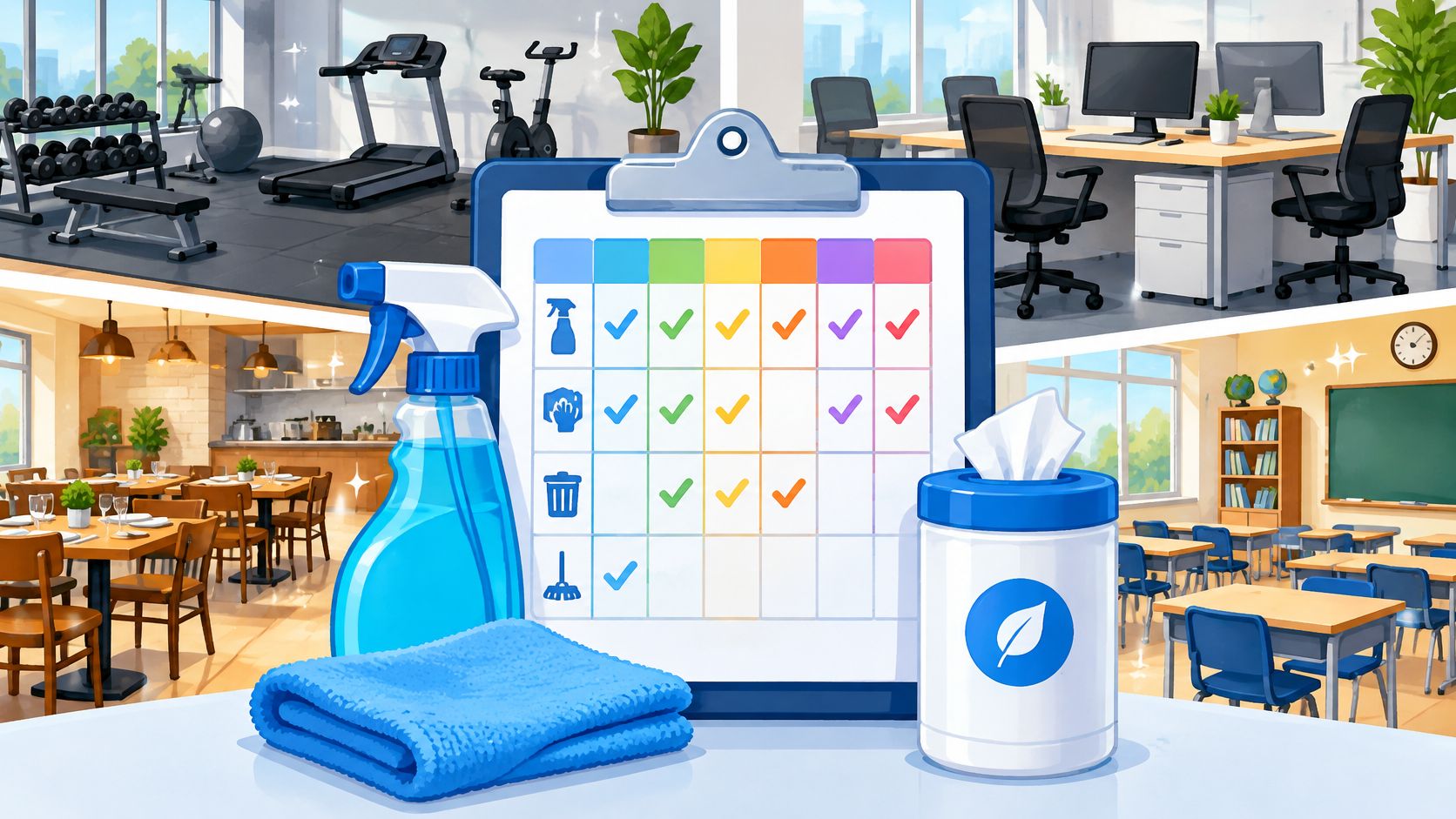
Cleanliness is an operating system, not a task you squeeze in when staff have spare time. That's not opinion for effect. U.S. Centers for Disease Control and Prevention guidance on cleaning once per day when no confirmed or suspected COVID-19 case is known sets a daily baseline, then expects you to increase frequency for high-touch surfaces, heavy traffic, young children, and inconsistent hand hygiene. Door handles, stair rails, elevator buttons, counters, desks, and restroom fixtures need attention at least once daily under that guidance, and spills or illness should trigger immediate cleaning instead of waiting for the next round.
A quiet office and a packed gym shouldn't share the same routine. Match frequency to traffic, hand contact, and contamination risk, assign a named owner, and stock the right product where the work happens. The eight models below give you a practical cleaning schedule example for different facilities, with clear roles, wipe choices, and accountability built in. Operators who want broader context on staffing and standards can also review this Fitness GM's practical guide for fitness center operations.
Use these schedules as working templates, not wall posters. Adjust the rounds to your peak hours, log completion with initials and times, and review missed steps weekly. Visible, consistent cleaning protects member trust, supports retention, and reduces operational risk far better than occasional deep cleans.
1. Commercial Gym Cardio and Strength Floor Cleaning Schedule
A commercial gym floor gets constant skin contact, sweat, and shared grips. Your schedule has to assume equipment is touched again minutes after it's cleaned, especially during peak hours. Pair member self-service with staff rounds, and don't rely on either one alone.
Daily Rhythm
Place a gym wipe dispenser at the entrance and near each equipment cluster so members can wipe handles, seats, and touchscreens before and after use. Staff run high-touch rounds every 60 to 90 minutes during peak hours, focusing on dumbbell racks, cable handles, bench pads, and machine levers. Each night, complete a full pass over floors, mirrors, water fountains, and all equipment surfaces.

Why Disinfectant Wipes Fit Here
Frequency means nothing if the surface dries too fast. CDC guidance on when and how to clean and disinfect a facility connects disinfection to labeled contact time, and EPA examples in that data include a product that must stay visibly wet for at least 10 minutes for its claim. Choose EPA registered disinfecting wipes listed for gym equipment, use wipes to disinfect gym equipment as directed, and reapply if a surface dries early. You can explore commercial options at wipes.com when building a bulk supply plan.
A 24-hour gym placing dispensers at every cardio row gives members no excuse to skip the treadmill console. A boutique strength studio can limit wipes to bench pads and grips between classes to protect leather and vinyl finishes.
Sales Angle
Owners underestimate floor usage, so show a per-member cost breakdown. Visible gym equipment wipes are an easy retention case when members see staff using them too.
- Check the label first: Confirm gym surfaces and contact time.
- Refill at shift change: Never let dispensers run empty.
- Use a fresh wipe per zone: Limit cross-contamination.
- Let it stay wet: Don't buff surfaces dry immediately.
2. Yoga and Pilates Studio Equipment Cleaning Schedule
A studio sells calm, cleanliness, and close contact; one sticky mat or sour strap undermines all three before the first cue. Organize the routine by risk zone, not by a single wipe-down: skin-contact surfaces, foot-contact mechanisms, and fabric props that hold moisture.
| Risk zone | Cleaning trigger | Operator rule |
|---|---|---|
| Mats, blocks, bolsters | After every class plus a fixed weekly wash day | Match yoga mat wipes to the mat manufacturer's guidance, then air-dry fully before stacking. |
| Reformer carriages, foot bars, straps | At each class changeover | Use separate cloths or wipes for foot-contact parts and hand-contact parts so soil does not travel upward. |
| Floors and low walls | Daily, with attention after barefoot-heavy sessions | Clean where hands, feet, and sweat land during transitions, not only the obvious center aisle. |
Set the weekly cycle with the same authority as the class timetable. Wash removable covers per the fabric label, reset props before instructors open the room, and name the person responsible so nobody guesses between morning and evening classes.
Contact time decides whether disinfecting works. NHS England national standards of healthcare cleanliness stress that disinfectant must remain wet for the specified period and staff should know local contact times, so build that wet time into changeovers instead of allowing a rushed swipe. If props are still damp when students enter, lengthen the gap, add a second station, or choose a product whose directions fit the break.
Make the system visible because premium members read it as professionalism. Put a labeled station near the prop wall, keep a used-wipe bin off the floor, and have instructors close class with a short reset script. A hot yoga room can assign one staff member to straps and blocks while students handle mats. A reformer studio can color-code cloths for carriages and foot bars, which protects finishes and reassures members that foot soil never reaches hand grips.
3. Airport Terminal Gate Area and Restroom Cleaning Schedule
Fixed intervals waste labor in a terminal, and demand data proves it. A European airport case serving more than 17 million passengers annually replaced 24 fixed restroom cleanings per day with triggers from visitor counts and dispenser status, cutting total daily cleanings from 24 to 8, a 70% reduction, while traffic climbed from approximately 30,000 to 65,000 daily visitors with zero passenger complaints about empty dispensers.
The spread inside that airport was wide. Busy restrooms demanded constant attention while remote corridors could go days between visits. Copy the principle, not the numbers. Set demand thresholds per zone, hold minimum inspections for low-use areas, and tie surge triggers to banks of departing flights.
| Zone | Trigger | Crew action |
|---|---|---|
| Gate seating and kiosks | Repeating rounds through peak periods, timestamped | Disinfect armrests, screens, gate handles, handrails |
| Restrooms | Visitor counts and dispenser alerts | Faucets, flush levers, counters, dispensers first |
| Remote corridors | Scheduled minimum inspection | Verify, log, redeploy labor to surge zones |

Timestamp every round on a tablet or log sheet. Supervisors then prove completion and shift crews when a gate surges, instead of discovering missed zones after complaints. Keep disinfecting wipes on every cart so a round never stalls on a trip back to the closet.
Visibility does the trust work. Posted sanitation schedules near gates reassure travelers without a single announcement, and dedicated restroom crews on fixed rotation cut the gaps that appear at shift changes.
Procurement follows the same logic. Airports buy in volume, so compare bulk programs from a single supplier, then standardize one commercial disinfecting wipes product per surface type to simplify purchasing and training. Stock carts for a full shift before the first round starts.
4. Short-Term Rental Turnover Cleaning Schedule
A sticky remote costs more than a complaint. It costs the review, the listing rank, and the repeat booking behind it. Guests photograph what disappoints them, so your turnover needs a fixed sequence, a photo record, and enough buffer between check-out and check-in that cleaners never trade disinfection for speed.
The Turnover Sequence
Work from the entry toward the back of the unit in a set order:
- Strip linens, clear trash, and stage supplies before touching anything else.
- Disinfect the touchpoints guests handle most: door handles, light switches, remotes, thermostats, faucets, toilet handles.
- Reset the kitchen and bathroom last, using separate disinfectant wipes for each so a bathroom wipe never reaches a countertop.
- Photograph the finished kitchen, bathroom, and entry, then initial the checklist.

The photo log is your defense. When a guest claims the unit was dirty on arrival, dated photos settle the dispute in minutes instead of a refund negotiation. Hosts tightening inspection and restocking across multiple properties can adapt these cleanliness practices for short-term rental success between check-ins. A manager running several condos can color-code wipes and cloths by room to block cross-contamination. A cabin host can post a card explaining how guests handle shared amenities mid-stay.
Amenities and Claims
A rental gym or yoga corner earns its place in your listing photos only if it looks maintained. Wipe benches, weight handles, and mats after each stay with products labeled for those surfaces, and leave fitness wipes in the room with a short instruction card so guests can clean equipment before and after workouts.
My advice on marketing: advertise a disinfected standard only when your checklist and photos back it. Concrete claims drive reviews and repeat bookings, while vague promises create refund exposure the moment a guest finds dust on the baseboards. Confirm wipe labels for stone, wood, and screens before your first turnover, and never stack back-to-back check-ins without slack in the schedule.
5. Car Dealership Showroom and Test-Drive Fleet Cleaning Schedule
A dealership sells trust before it sells a vehicle. Customers touch desks, tablets, coffee stations, and door handles, then climb into a car another family drove an hour earlier. Build the schedule around that handoff and make it invisible.
The day runs on a fixed loop. Assign every slot to a named role, not to whoever looks free.
- Open: One person inspects each demo vehicle and the showroom floor, signs the log, and confirms every vehicle's labeled wipe kit is stocked and sealed.
- After every test drive: Wipe the steering wheel, shifter, door handles, seat belt buckles, and cup holders. Use manufacturer-approved products on touchscreens, leather, and vinyl, and never run one wipe across the wheel, the shifter, and the screen.
- Every two to three hours: Disinfect sales desks, pens, tablets, and coffee station surfaces, with extra rounds after appointment blocks.
- Slow periods: Wipe counters and waiting-area armrests so the next customer never sees rings, crumbs, or fingerprints.
- Close: Audit the kits, replace dried or missing packs immediately, and store spares away from direct sunlight so they don't dry out in a hot car.
A clean steering wheel tells a buyer more about your service department than a brochure on the desk.
This routine pays for itself at the sales desk. Customers link what they touch to how you maintain what you sell, and the connection between clean car dealerships and selling more vehicles gives managers a commercial reason to fund the labor. Post the schedule where customers wait, and train sales staff to reset a vehicle in view when it fits the conversation. If you run an employee wellness room, stock it under the same supply program as the showroom to simplify ordering.
6. Event Venue and Festival High-Touch Cleaning Schedule
A three-day festival puts more hands on one restroom door handle than an office building sees in a month. Ticket scanners, bar tops, food counters, railings, and payment terminals all take the same compressed abuse, and the crowd notices within an hour when crews fall behind.
The biggest technical failure at events is speed. EPA disinfectant wipe label guidance on keeping surfaces visibly wet states that wipes work only when the hard, nonporous surface stays visibly wet for the full label-listed contact time, and heavily soiled surfaces should be cleaned first with another wipe before disinfecting. A rail buffed dry in five seconds never reached its contact time.
Match Crews to the Event Clock
| Phase | Crew focus |
|---|---|
| Setup | Wipe tents, railings, counters, and shared stage equipment. Confirm products suit plastic, metal, and painted surfaces. |
| Gates open to peak | Restroom and food-service rounds every 30 to 60 minutes, focused on door handles, sinks, dispensers, payment terminals, and ticket-check stations. |
| Breaks between acts | Reset high-touch points, check dispenser levels, swap full waste bins. |
| Teardown | Final disinfection pass. Pack containers sealed so heat doesn't dry out the stock. |
Runners restock carts on a fixed loop so cleaners stay in their zones. Time-stamped logs across a multi-day event show which restrooms spike after headline sets or keynote sessions, and supervisors shift staffing accordingly the next day. Wipe stations near food vendors let guests handle surfaces themselves between crew rounds.
Sponsors and venue partners should get a written hygiene plan with frequencies, owners, and escalation steps before load-in. A visible schedule supports premium vendor fees and ticket pricing, because attendees experience the standard at every restroom and food stall they visit.
Order first-day supply above your estimate. Opening surges expose weak counts fast.
7. Pool Club Locker Room and Fitness Area Cleaning Schedule
Members judge a pool club by the transition from pool deck to locker room to workout floor. A damp locker room, slick tile, or sticky cardio console erodes trust and drives complaints. Assign separate crews or tools to wet and dry zones, with rounds timed to member traffic.
Build the locker room routine around opening, peak use, and closing. At opening, clean floors, showers, drains, sinks, and benches. During busy periods, check wet floors and restrooms on a fixed loop, then disinfect locker handles, hair dryer handles, and sink touchpoints. At closing, clean and dry the room thoroughly. Follow product labels and facility procedures, and never mix cleaning products with pool chemicals or other cleaners. Post each completed round with its time and the attendant's initials.
The CDC's environmental cleaning schedule by area function sets different frequencies for different levels of use and exposure. Apply that risk-based approach to a pool club: high-touch locker handles and shower fixtures need more attention than a rarely used office. Follow local requirements and product labels when setting specific frequencies.

On the fitness floor, place compatible cleaning products at the entrance and beside equipment. Ask members to wipe weight handles, benches, and cardio consoles after use, and have staff check and restock stations during peak periods. Staff should cover any missed equipment during scheduled rounds. Keep separate tools for locker-room surfaces and shower areas to avoid carrying soil between zones.
A family pool club can post the last completed locker-room round on each door, giving members a visible standard and attendants a clear handoff. Use member tours and renewal messages to explain the routine. That proof supports trust and retention, while fixed rounds reduce repeat work and help catch wet-floor hazards before they become incidents.
8. Youth Sports Complex and Team Locker Room Cleaning Schedule
A youth sports complex should reset shared spaces between teams, not just at closing time. Fast turnovers leave sweat, soil, and clutter on benches, locker-room touchpoints, training tables, and shared gear. Assign a named adult to each zone so coaches can start the next session with clean, usable facilities.
At the end of every practice or game, the assigned coach or trained volunteer wipes benches, door handles, water cooler spigots, and shared equipment. Use a disinfectant only on surfaces listed on its label, and follow the product's required contact time. Clean balls and other gear according to manufacturer instructions.
Make ownership visible. A multi-field complex can place a labeled supply bin at each bench and assign one cleaning captain per field. At a school with a shared locker room and training room, one checklist gives coaches and athletic staff the same clear closeout standard.
Between athletes, clean shared training tables and treatment equipment before the next person uses them. Foam rollers and other gear used by several teams need a daily clean, with a deeper reset during tournament breaks or the off-season. If a surface cannot remain wet for the label's full contact time, keep it out of use until it can be cleaned correctly.
Centralize purchasing for wipes and other cleaning supplies. Stocking the same approved products across the complex simplifies volunteer training and reduces the risk of teams bringing unsuitable household cleaners. Before tournament weekends, check bench supplies and assign someone to record scheduled deep cleans.
The payoff is practical: coaches spend less time chasing missing supplies, staff can verify completed work, and families see a facility that takes their children's health and safety seriously. That visible standard supports trust and makes teams more likely to return.
8 Cleaning Schedule Examples Compared
| Example | 🔄 Cleaning cadence & complexity | ⚡ Resource requirements | 📊 Expected outcomes | ⭐ Key advantages & ideal use |
|---|---|---|---|---|
| Commercial Gym Cardio and Strength Floor | Member wipe-downs plus staff rounds every 60–90 minutes; full nightly clean. Moderate coordination. | High wipe volume, stocked stations, trained staff, and logged checklists. | Cleaner shared equipment and improved member confidence. | Visible hygiene and member participation; ideal for busy gyms with frequent equipment sharing. |
| Yoga and Pilates Studio | Wipe shared props after every class; weekly deep clean. Moderate coordination between instructors and staff. | Surface-compatible wipes, laundry capacity, labeled used-wipe bins, and scheduled labor. | Cleaner shared mats and props while helping preserve equipment. | Simple class-to-class routine; ideal for studios sharing mats, props, or reformers. |
| Airport Terminal Gate Area and Restrooms | High-touch rounds every 1–2 hours, with separate restroom protocols. High operational complexity. | Large wipe supply, cleaning carts, shift logs, and trained crews. | More consistent sanitation and easier auditing across busy public areas. | Standardized, trackable routines; ideal for high-volume terminals and restrooms. |
| Short-Term Rental Turnover | Checklist-based disinfection between guests, following a set room order. Moderate complexity under tight deadlines. | Surface-appropriate wipes, restocking systems, checklists, and photo logs. | More consistent turnovers and support for guest satisfaction. | Easy to delegate and document; ideal for hosts managing individual or multiple rentals. |
| Car Dealership Showroom and Test-Drive Fleet | Showroom rounds every 2–3 hours; clean vehicles after each test drive. Moderate complexity. | Wipe kits in vehicles, surface-safe products, and staff checklists. | Cleaner customer areas and vehicles, with greater buyer confidence. | Quick, repeatable vehicle reset; ideal for dealerships with frequent test drives. |
| Event Venue and Festival | Restroom and food-service rounds every 30–60 minutes at peak times; setup and teardown checks. High complexity. | Large supply reserves, multiple carts, restocking support, and scheduled crews. | Better-managed high-touch areas and stronger attendee confidence. | Scales across zones and event days; ideal for crowded venues and festivals. |
| Pool Club Locker Room and Fitness Area | Multiple daily locker-room cycles; fitness equipment cleaned after busy periods. High complexity due to wet and dry zones. | Separate protocols and supplies, frequent labor, and visible cleaning logs. | Cleaner shared spaces and better management of moisture-related hygiene risks. | Covers distinct wet and dry areas; ideal for pool clubs with locker rooms and fitness spaces. |
| Youth Sports Complex and Team Locker Room | Shared gear and benches cleaned after each session; training rooms disinfected daily. Moderate-to-high coordination. | Bulk wipes, team-level checklists, volunteers, and product-specific supplies. | More consistent cleaning across teams and lower supply cost per use. | Clear shared responsibilities; ideal for multi-team sports facilities. |
Turn the Schedule Into a Visible Standard
The strongest schedules share three elements. You've defined the frequency by risk, named the responsible role, and created a short checklist that another manager can audit without interpretation. If any one of those elements is missing, cleaning becomes a matter of memory and good intentions, and it will fail during your busiest week.
Start with the closest cleaning schedule example above, then adapt it to your traffic peaks, surface materials, and staffing structure. A gym may need member stations plus hourly staff rounds, while a rental needs a strict room-by-room turnover order and photo proof. An airport or event venue should let demand trigger extra rounds, and a youth sports complex should tie cleaning to every session change instead of the clock alone.
Verification is what turns a schedule into performance. A community-hospital environmental-cleaning program tracked in Antimicrobial Stewardship and Healthcare Epidemiology raised surface-cleaning performance from 74.7% in year one to approximately 90% by year four, then sustained an average near 93% over the following five years. That program targeted 13 sites in four rooms per unit each month, approaching 4,992 surface tests annually at full sampling, and the improvement coincided with a 75% reduction in Clostridioides difficile rates and a 55% reduction in surgical-site infection rates.
You don't need hospital scale to use that lesson. Pick auditable surfaces, sample them consistently, publish results to staff, and retrain when a zone falls below target. Expect steady improvement from repeated measurement, not from one motivational push.
Build every schedule with execution columns, not just task names. List the product, compatible surfaces, pre-cleaning step for visible soil, application method, required wet time, responsible initials, and completion time. That detail matters most on rails, handles, touchscreens, counters, and restroom fixtures, where hurried wiping can create a false impression of sanitation.
For sales and procurement, make the hygiene return easy to explain. Show owners where gym equipment cleaning wipes reduce staff trips to a supply closet, how a managed gym wipes program prevents empty dispensers, and how visible stations invite members, guests, and customers to participate. WipesBlog.com is one relevant option for further facility-specific cleaning guidance, and wipes.com is a practical place to evaluate commercial disinfecting wipes for a managed supply program.
Review the schedule after your first busy cycle. Look at missed initials, supply usage by zone, dispenser refill timing, complaints, and any surface damage from incompatible products. Adjust frequencies where traffic demands it, remove rounds that add no value in low-use areas, and keep the daily baseline intact.
Choose one schedule today, assign an owner for every round, stock disinfectant wipes at the point of use, and make the first completed checklist visible to your team before the next peak period. Prioritize cleanliness as a business standard, train staff to keep surfaces wet for the full label time, and give customers a facility they can trust on sight.
Leave a Reply