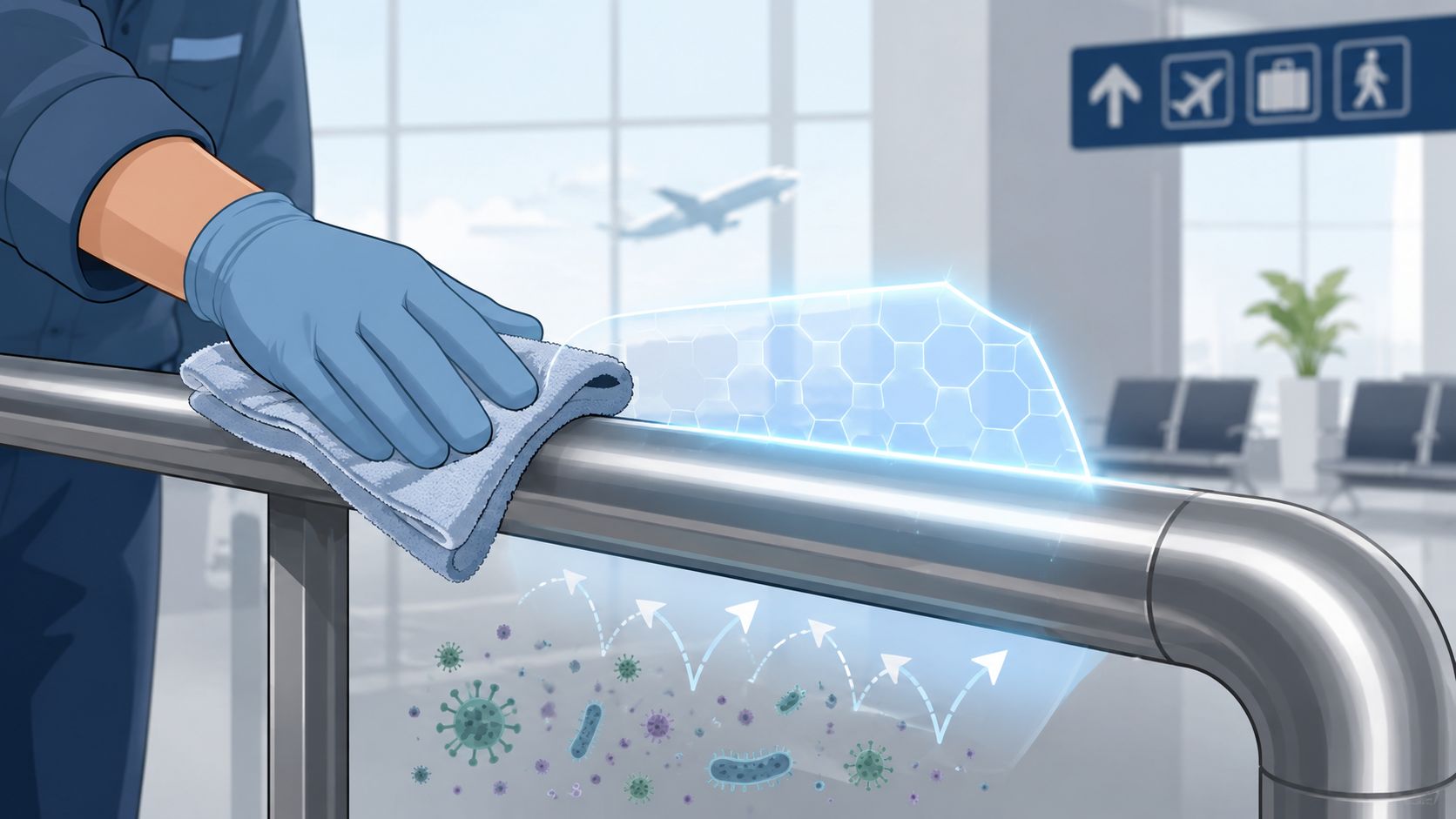
A facility manager at a regional airport notices a dark film on a handrail that was wiped only a few hours earlier. The surface carries fingerprints, skin oils, and residue from repeated cleaning, yet it still looks “maintained” from a distance. That gap between visible cleanliness and actual contamination is where many hygiene programs fail.
Antimicrobial surface coatings can reduce microbial activity between cleaning cycles, but they aren't a substitute for removing soil or following a disinfectant label. The strongest programs combine coated high-touch surfaces with regular cleaning, disinfectant wipes, hand hygiene, ventilation, staff training, and records that supervisors can audit.
This matters in airports, gyms, offices, dealerships, schools, restaurants, retail stores, rental properties, and event venues. Customers notice whether a counter looks clean, employees notice whether supplies are available, and inspectors notice whether the process is documented. For broader background on maintaining safer workplaces, this resource on professional office cleaning COVID-19 offers useful context on structured commercial cleaning.
The Hygiene Reality Facing Today's Facilities
The handrail is the warning sign, not the whole problem. A surface can appear clean after a quick pass while retaining oils, dust, sweat, and organic residue that interfere with the next cleaning cycle. A coating may still be present beneath that film, but its active chemistry can't work effectively if dirt blocks contact with the surface.
Airport travelers touch rails, kiosks, tray handles, elevator buttons, and restroom fixtures in rapid succession. Gym members move from locker handles to machines, benches, mats, and water-fountain controls. In dealerships, customers and staff handle door pulls, vehicle touchscreens, desks, and payment counters throughout the day.
The CDC's guidance for public and commercial facilities specifically identifies pens, counters, shopping carts, door handles, stair rails, elevator buttons, touchpads, restroom fixtures, and desks as high-touch areas that deserve regular attention.
Coatings belong inside a layered program
A coating provides a background layer of protection. Mechanical cleaning still removes the material that microbes live in and travel through. Wipe-based disinfection addresses immediate contamination, while hand hygiene reduces what people deposit on shared surfaces. Ventilation supports the wider indoor hygiene strategy, especially in crowded facilities.
Practical rule: If staff can see grime, they need to clean it. A coated surface isn't permission to leave visible soil in place.
The pressure to adopt coatings is understandable. Travelers and gym members expect visible cleanliness, post-pandemic scrutiny has raised service standards, and liability concerns make neglected high-touch points harder to defend. Cleaning logs, supply checks, inspection photos, and supervisor audits also make hygiene performance more visible to owners and clients.
What buyers should ask before rollout
Don't start with the product brochure. Start by mapping the surfaces that people touch most, then document the substrate, cleaning chemistry, abrasion exposure, moisture, and frequency of use.
Buyers should ask:
- What is the substrate? Stainless steel, plastic, painted metal, rubber, vinyl, and laminated counters may respond differently to the same coating.
- What does the coating claim? A general antimicrobial claim isn't automatically the same as an EPA-registered public health claim.
- What will staff use daily? The wipe chemistry may protect the warranty or shorten the coating's service life.
- How will performance be checked? Plan inspection points before installation, not after a surface begins to fail.
The right question isn't whether a coating sounds advanced. It's whether the treatment survives the facility's actual combination of travelers, sweat, cleaners, abrasion, and rushed staff.
What Antimicrobial Surface Coatings Actually Do
A shared surface can support a simple transfer chain. One hand touches a contaminated rail, microbes are deposited, another person touches the same area, and some of that contamination may move to the next hand. Antimicrobial surface coatings are designed to interfere with microbial survival or growth on the treated surface.
These coatings are thin films applied or bonded to a substrate. Depending on the chemistry, they may release active ions, damage microbial cell structures, create reactive oxygen species under light, or interfere with attachment. They aren't the same as an easy-clean finish, a self-sanitizing claim, or a standard disinfectant applied during every shift.

The chemistry in plain language
Silver and copper systems can release ions that disrupt microbial cell membranes and internal processes. Photocatalytic coatings, often associated with titanium dioxide, rely on light to produce reactive chemistry that can break down organic material and affect microbes. Quaternary ammonium silane systems can attach to a surface and interfere with microbial contact or survival.
A useful analogy is slow-release mosquito repellent versus a daily spray. A coating is intended to provide ongoing activity while it remains intact. A disinfectant wipe is the daily spray. It covers the surface, acts for the label's contact time, and removes or inactivates contamination during the cleaning event.
The analogy has limits. A coating doesn't remove visible dirt, sweat, oil, or biofilm. It doesn't replace wipe-based disinfection during an outbreak, and it won't remain active forever. Performance depends on the coating's integrity, the surface condition, humidity, soil load, and whether microbes can physically reach the active layer.
Contact time still matters
Controlled testing can make a coating look highly effective because the test surface is prepared, the microbial load is defined, and environmental conditions are controlled. A commercial counter is different. It may carry fingerprints, cleaning residue, food soil, sweat, or dust, while staff may wipe too quickly to keep the entire surface wet.
Copper illustrates the point. In controlled testing, it outperformed silver and quaternary-ammonium coatings, but performance declined as relative humidity, inoculum volume, and organic soil increased. The same evidence reports that copper alloys can achieve over 99.9% bacterial reduction within two hours at room temperature and about 50% humidity, a useful procurement benchmark rather than a guarantee for every facility. FEMS Microbes documents those conditions and limitations.
Treat the coating as a supporting control. The wipe routine remains the action that removes the grime the coating can't handle.
The Main Types of Coatings and How They Differ
Facility buyers usually encounter five broad categories. Each has a sensible application, and each has a failure mode that matters more than its headline kill claim.
| Coating Type | How It Works | Typical Durability | Wipe Compatibility | Best Fit |
|---|---|---|---|---|
| Copper-based | Copper ions and surface chemistry disrupt microbial cells | Strong potential, but patina and abrasion require inspection | Confirm compatibility before using alcohol or bleach products | Metal handrails, touch plates, selected high-touch hardware |
| Silver-ion | Releases silver ions that interfere with microbial activity | Depends heavily on binder, loading, and wear | Often compatible with selected neutral products, verify the manufacturer's schedule | Clear or low-visibility treatments on suitable substrates |
| Quaternary ammonium silane | Bonds active chemistry to the surface and interferes with microbial survival | Can be useful, but repeated wiping may affect some formulations | Neutral quat products may be suitable, but label and warranty rules control | Offices, counters, equipment, and treated hard surfaces |
| Organic or enzyme-based | Uses organic active ingredients or enzymes to inhibit growth or break down residue | Often narrower in application and more dependent on formulation | Test against the exact wipe chemistry and residue profile | Specialized applications where substrate and soil are predictable |
| Hybrid photocatalytic | Combines antimicrobial chemistry with light-activated oxidation | Requires durable integration and appropriate light exposure | Cleaning products must be checked for film damage | Bright, controlled spaces and selected architectural surfaces |
Copper and silver
Copper is attractive when a facility wants a metal surface with credible contact-killing potential. The trade-offs include appearance changes, patina, cost, and the need to confirm that routine cleaners won't damage the finish.
Silver-ion coatings can be less visually obvious and may suit surfaces where a metallic appearance isn't acceptable. Their performance depends on how silver is held in the film. A product that loses its active layer through abrasion won't deliver the same value after months of cleaning.
Silane, organic, and photocatalytic systems
Quaternary ammonium silane products are often chosen for broad commercial surfaces, but buyers should distinguish a bonded treatment from a topical spray that disappears quickly under aggressive wiping. Organic systems may fit a narrow use case, while hybrid photocatalytic products can be limited by light availability and surface condition.
EPA registration status matters. If a supplier makes a public health pesticidal claim, ask for the applicable registration details and approved label language. A general antimicrobial marketing statement isn't proof of an EPA-registered disinfectant claim.
Wipe compatibility is the dealbreaker
Alcohol- and bleach-based wipes can strip or dull certain coatings. Neutral quat wipes may preserve some formulations, but there is no universal safe chemistry. Require a written compatibility statement for the exact product, substrate, concentration, dwell time, and cleaning frequency.
Choose the chemistry that matches the surface, traffic, and cleaning protocol. The highest laboratory kill rate is irrelevant if janitorial staff must avoid the wipes they already use or if the finish fails under routine abrasion.
Real-World Effectiveness and Where the Evidence Stands
The evidence supports antimicrobial coatings as a measurable intervention, but it doesn't support treating them as autonomous cleaning systems. A systematic review of copper touch surfaces in healthcare identified one ICU randomized controlled trial reporting a 58% reduction in healthcare-associated infections and a 64% reduction in antimicrobial-resistant organism acquisition. The review rated the evidence quality low because the study wasn't properly randomized or blinded, so the result demonstrates potential without proving a universal outcome. Market Data Forecast's market overview summarizes that historical evidence.
More recent hospital evidence is stronger in practical relevance. A 2020 hospital study of a novel antimicrobial surface coating reported a 36% decline in pooled HAIs across two hospitals, with an incidence rate ratio of 0.64 and a 95% confidence interval of 0.44 to 0.91. Those findings connect a surface intervention with hospital outcome data, but facilities still need to ask whether the product, substrate, cleaning schedule, and environment resemble their own.
What lab testing can and can't prove
A laboratory protocol isolates variables. It may use a clean stainless-steel coupon, a defined organism, controlled temperature, and a fixed contact period. An airport security tray, gym machine handle, or dealership counter carries changing soil and experiences repeated abrasion.
A durability study found that some coated samples lost antimicrobial activity after only a few abrasion cycles, while antimicrobial material integrated into 3D-printed samples remained active after brushing and scratching. Another laboratory study found engineered cold-spray copper and silver coatings produced more than a 7-log reduction within minutes. Copper-on-copper eliminated microbes in about 10 minutes, while adding 5 wt% silver reduced that time to about 5 minutes. These results come from the specific test system and shouldn't be treated as a field guarantee. The DOAJ record for the coating durability research provides the relevant study context.
| Coating Type | Lab Kill Rate | Field Reduction | Key Caveat |
|---|---|---|---|
| Copper-based | Strong under controlled conditions | Depends on soil, moisture, wear, and surface maintenance | Lab conditions may overstate field performance |
| Silver-ion | Can inhibit microbes when the active layer remains available | May decline as binders abrade or residue accumulates | Verify post-cleaning activity |
| Quaternary ammonium silane | Depends on bonding and test organism | Sensitive to cleaning chemistry and surface preparation | Confirm whether the treatment is bonded |
| Photocatalytic hybrid | Depends on light and formulation | Variable in shaded or heavily soiled areas | Light and cleanliness are operational requirements |
For buyers, independent post-abrasion and post-cleaning tests matter more than a single peak result. Ask for test conditions, organism details, substrate, soil load, humidity, abrasion method, and the exact product label. A useful discussion of effectiveness verification for antimicrobial treatments can help teams build a stronger evidence request.
Playing Nicely with Disinfectant Wipes and Cleaning Protocols
The most common coating failure starts with an operational mismatch. A vendor specifies one cleaning chemistry, a janitorial contractor uses another, and staff shorten the dwell time because the counter needs to reopen. The surface may look fine until the coating loses gloss, becomes patchy, or stops meeting its expected performance.
Start with the disinfectant label. The EPA label for one disinfectant wipe requires a hard, non-porous surface to remain visibly wet for a 1-minute contact time, and the EPA wipe label makes clear that a quick pass isn't equivalent to compliant disinfection.
A field checklist for coated surfaces
- Read the label before deployment. Confirm the wipe is approved for the surface and follow the required coverage and contact time.
- Check coating compatibility. Get written confirmation for the exact wipe, not just a general statement that the coating is “chemical resistant.”
- Remove soil first when required. A wipe can't reliably disinfect through heavy grime, sweat, food residue, or bodily fluids.
- Avoid improvised abrasion. Scouring pads and aggressive rubbing can remove a topical film or damage a bonded finish.
- Inspect the surface routinely. Look for dull patches, streaking, tackiness, discoloration, peeling, or a changed feel.
- Record failures early. Photograph the area, note the product used, and notify the supplier before the warranty period becomes difficult to verify.

Make the routine visible and repeatable
The CDC advises facilities to clean high-touch surfaces regularly and other surfaces when visibly dirty. In early care and education settings, CDC guidance says visibly soiled surfaces should be cleaned immediately, body-fluid or blood contamination should be cleaned before disinfection, and disinfectant should remain on the surface for the label's contact time. The CDC's cleaning guidance for early care and education settings provides the operational framework.
For gyms, place gym equipment cleaning wipes beside treadmills, selectorized machines, benches, and shared mats. For offices, use a clearly labeled station near reception, shared printers, conference-room tables, and break areas. If you need a deeper explanation of the distinction, this guide to the difference between sanitizing and cleaning is useful for staff training.
Selecting, Procuring, and Calculating ROI for Your Facility
Procurement should begin with a surface audit, not a coating demonstration. Walk the facility during its busiest operating period and mark handrails, counters, handles, equipment grips, check-in screens, payment points, restroom fixtures, and other places where hands repeatedly land.
Then separate surfaces into three groups:
- High traffic and high abrasion: Handrails, gym equipment grips, tray handles, and door pulls need mechanical endurance.
- High visibility: Reception counters, check-in desks, dealership tables, and entrance fixtures influence customer confidence.
- Low traffic or difficult to access: These may not justify a coating if routine cleaning already controls the risk.
Build the buying file before signing
Request the product's EPA registration information where applicable, independent test reports, substrate compatibility data, post-abrasion results, post-cleaning efficacy, installation requirements, and warranty exclusions. Ask who installs the product, how staff should clean it, when the supplier will inspect it, and what evidence proves reapplication is needed.
Don't accept an ROI model that counts only reduced wipe use. Include installation, staff time, disruption, reapplication, surface repair, supply availability, and the cost of failing to meet customer or audit expectations. The global antimicrobial coatings market illustrates the scale of commercial interest, with one estimate valuing it at USD 5.09 billion in 2026 and projecting USD 7.33 billion by 2031, while another forecast estimates USD 5.4 billion in 2025 and USD 12.6 billion by 2034. These are market forecasts, not proof that a specific facility will recover its investment. MarketIntelo's antimicrobial coatings analysis presents those estimates and the differing forecast assumptions.

Where coatings make sense
- Airport terminals: Use coatings selectively on durable rails, counters, and touch plates, while keeping visible wipe stations and frequent cleaning in place.
- Gyms: Prioritize machine handles, benches, locker hardware, and check-in points. Wipes for gym equipment remain essential because sweat and skin oils require physical removal.
- Rental counters and dealerships: Treat high-visibility touchpoints where customers make quick judgments, but don't coat every surface without a traffic map.
- Event venues: Focus on rails, counters, restroom touchpoints, and shared fixtures that staff can inspect and clean consistently.
- Offices, schools, restaurants, and retail stores: Use coatings where the substrate and cleaning program are stable. Keep routine disinfecting wipes available for immediate spills, visible soil, and high-use periods.
There is no honest universal payback figure. A coating can pencil out when a surface is expensive to access, heavily touched, and compatible with a durable treatment. Routine commercial disinfecting wipes usually offer the better return when the surface is easy to reach, frequently soiled, or likely to be replaced.
From Coated Surface to Trusted Facility
A coated handrail earns its keep only when staff pair it with a visible, consistent cleaning rhythm. A passenger, gym member, or car shopper may spend only a few seconds looking at a counter before touching it. The coating is invisible. The wipe station, stocked supplies, cleaning log, and employee action are visible.
That visibility affects trust. A visitor can't confirm the coating's chemistry, but they can see whether staff respond to a dirty machine, whether a dispenser is empty, and whether high-touch areas receive attention during busy periods.
Three operational moves build confidence
Post a clear cadence. Place a schedule near high-touch zones, but make it operational rather than decorative. Identify the area, the responsible role, the cleaning product, and the inspection point.
Train a consistent motion. Staff should understand coverage, pressure, direction, and dwell time. A consistent wipe-down technique makes the work recognizable to supervisors and customers, while reducing the risk of missed edges and handles.
Keep supplies visible and ready. A free-standing gym wipe dispenser near equipment gives members a practical way to participate. In airports and dealerships, place a dispenser where people naturally pause, not behind a desk or inside a supply closet.
Run a small test this week
Deploy one labeled wipe station at an entrance counter. Use a suitable product, document the starting condition, train the assigned employees, and log restocking and cleaning activity. Review customer comments and cleanliness feedback over the following 30 days, without claiming that any change came from the station alone.
For gym owners and operators, wipes.com is a practical place to review wipe formats and dispenser options for equipment areas. Sales professionals can use the same operational logic when presenting bulk gym wipes: connect the product to surface mapping, staff workflow, visible cleanliness, and supply continuity rather than selling a container in isolation.
Antimicrobial coatings are useful when they survive the environment they're installed in. Disinfectant wipes remain the operational anchor because they remove soil, support label-compliant disinfection, and give staff a visible action customers can understand.
Prioritize the high-touch surfaces people use most, match every coating to the facility's actual wipe chemistry, and train staff to follow the label's coverage and contact-time requirements. Add a stocked wipe station to your daily routine, document the work, and review the program regularly so cleanliness becomes a dependable facility standard rather than a claim on a specification sheet.
Leave a Reply