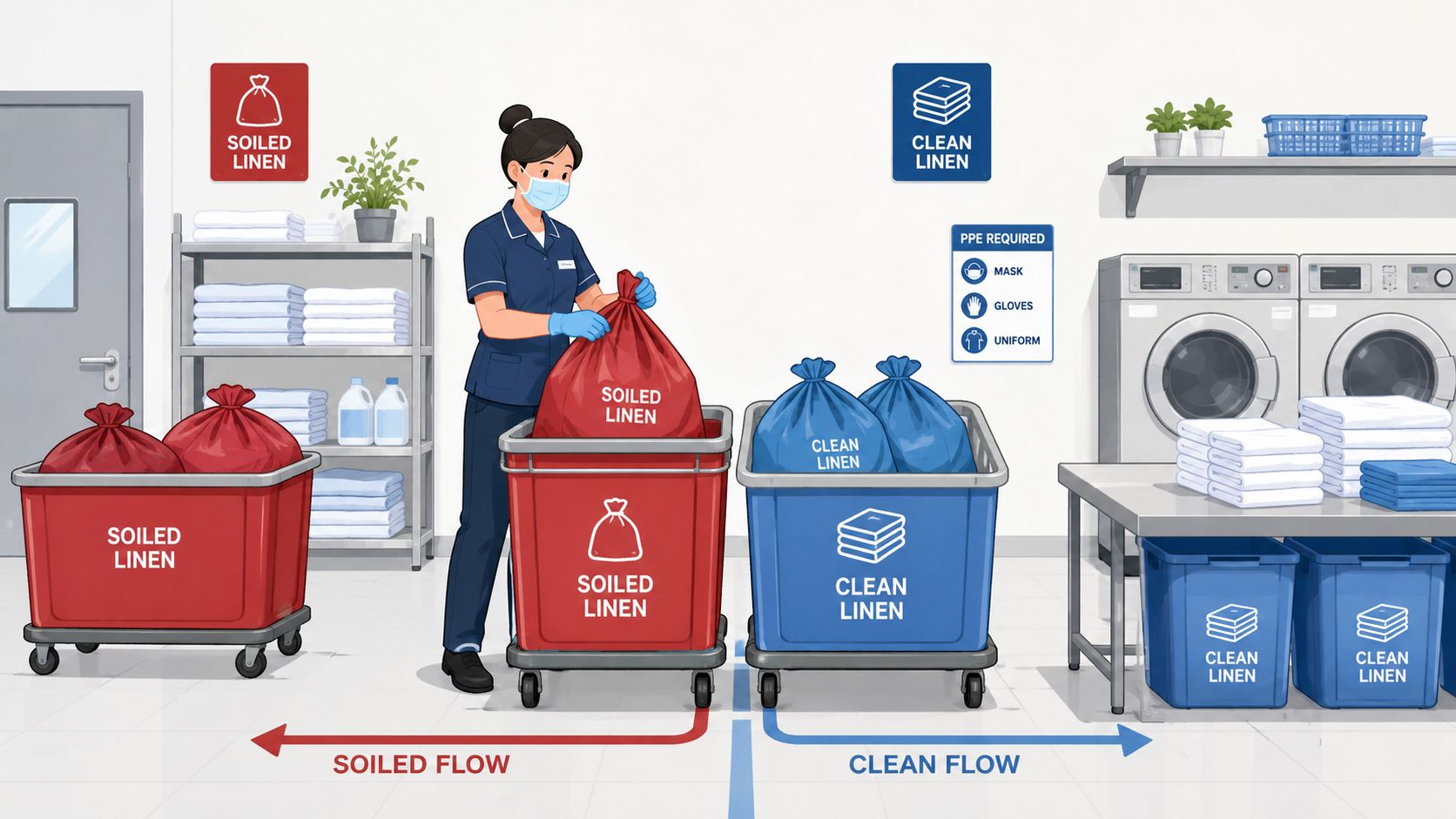
At 6:45 a.m., a linen room can tell you more about a facility's standards than its lobby. A torn bag, damp towels left on a folding table, or a stained duvet waiting for inspection can turn an ordinary shift change into a chain of rework, staff exposure, guest complaints, and avoidable replacement costs.
Effective linen handling procedures prevent that chain by controlling movement from the moment a used sheet, robe, towel, or drape leaves the point of use. The same principles used in healthcare, including containment, separation, reduced agitation, controlled laundering, and protected storage, can be adapted for hotels, gyms, spas, clinics, and short-term rentals without burying teams in paperwork.
Cleanliness also extends beyond textiles. Commercial and public facilities should routinely clean high-touch surfaces and use disinfectant wipes where repeated hand contact creates a practical contamination concern. Pens, counters, handles, rails, elevator buttons, touchpads, restroom fixtures, and desks all deserve attention under CDC facility cleaning guidance. The strongest programs make both workflows visible, simple, and easy to audit.
What Clean Linen Costs When Handling Goes Wrong
At hotel shift change, two attendants are arguing over a torn alginate bag. Wet pool towels are teetering on a folding table, and the laundry supervisor has found a complaint about a stained duvet. That duvet needs inspection, possible rewashing, and perhaps replacement. Housekeeping must locate another item, the front desk may issue a refund voucher, and a review-site photograph can keep the failure visible after the room is reset.
That is the operating cost many linen programs miss. Poor handling creates work before the wash cycle even begins. A mixed cart can transfer soil onto clean stock. Damp linen held in a warm, enclosed area creates an unpleasant, higher-risk condition. Items that skip pre-sort may enter the wrong formula, return visibly soiled, or damage fabrics that should have been isolated.
For hotels, gyms, spas, and short-term rentals, healthcare-grade controls work best when they are translated into simple decisions at the point of use. Tight staffing does not justify extra handling. It makes direct bagging, clear cart ownership, and visible separation more valuable.
The failure points staff can see
Healthcare guidance sets the basic controls: bag soiled linen at the point of use, do not shake it, do not carry it against the body, and keep clean and used linen separate. The CDC's linen handling guidance also supports reusable gloves, leak-proof labeled containers in patient-care areas, and reprocessing containers after use.
In a hotel or gym, the same breakdowns appear in practical forms:
- Mixed carts: Clean towels share space with used towels, or a cart moves from dirty collection to clean distribution without proper reprocessing.
- Uncontained moisture: Wet pool or spa linen sits exposed, leaks through improvised bags, or remains on a work surface instead of entering a designated receptacle.
- Skipped pre-sort: A heavily soiled item enters a standard load, creating rewash work or spreading soil across other pieces.
- Agitation during stripping: Staff snap sheets, shake towels, or pull twisted items apart in occupied areas, dispersing organisms and contaminating nearby surfaces.
Practical rule: A used item should reach its designated bag or cart without touching an unnecessary second surface. Every extra contact creates another control point for staff to manage.
The program rests on three habits: contain at the source, move dirty linen along a one-way route, and protect clean stock after processing. A defined workflow, physical separation, and a short audit routine let supervisors catch failures before they become guest-facing defects.
The End-to-End Linen Workflow From Collection to Storage
A useful SOP gives every employee the same sequence and assigns ownership at each handoff. The stages below use S1 through S7 so a supervisor can refer to one step during training, an incident review, or a cart inspection.
Seven stages from point of use to clean stock
S1, point-of-use collection. The housekeeper, attendant, or clinical worker places used linen directly into the correct bag or receptacle. A spa attendant might collect used robes in a covered, color-coded cart during each scheduled floor round. A clinic worker should place infectious drapes directly into a water-soluble or alginate bag, then into a second secured bag before transport, as described in international linen handling guidance.
S2, local containment. The area lead checks that bags are labeled, leak-resistant, and closed before they leave the room, treatment area, or fitness floor. Staff shouldn't sort, shake, or pre-rinse used linen in a guest room, patient-care area, locker room, or exercise studio.
S3, controlled transport. A designated dirty cart carries the closed bags to the laundry intake point. The transport attendant follows a defined route and keeps used linen away from clean carts, clean shelving, and finished goods.
S4, intake and logging. The laundry lead receives the load, records the category and condition, and identifies unusual soil, damaged items, or leaking containment. Logging doesn't need complex software. A paper intake sheet can capture the information needed to trace a recurring failure.
S5, sort and formula selection. Trained laundry staff sort only in the designated dirty zone and choose the formula according to textile, soil level, and risk. Towels, sheets, robes, microfiber, and clinical textiles shouldn't automatically share the same treatment.
S6, wash, dry, and finish. The washer operator runs the validated formula, then transfers the load through drying, folding, pressing, or other finishing steps without sending it back toward the dirty side. Equipment settings and chemical records belong with the load documentation.
S7, pack and store. The clean-room attendant folds, covers, packs, and places finished linen on enclosed shelving or in a protected clean cart. Stock rotates by date, and staff limit handling before redistribution.

Where handoffs usually fail
Most breakdowns happen when responsibility changes. The room attendant assumes the laundry team will identify a leaking bag. The laundry team assumes housekeeping separated wet towels. The distributor assumes a cart is clean because it contains folded linen.
Clean storage should be enclosed, dry, and protected from dirty routes. Some policies limit on-ward linen stock to no more than 24 hours of supply, a practical control described in this hospital laundry policy. Don't invent environmental specifications that your facility can't monitor. Set written temperature and humidity limits through your infection-prevention or facilities program, then verify them with a simple room log.
Why Manual Sorting Is the Highest-Risk Control Point
Manual sorting deserves special attention because it combines open bags, close contact, repetitive handling, and airborne disturbance. A CDC-linked assessment found the highest odds of surface contamination in primary and secondary sorting areas where employees manually sorted soiled linen. The reported odds ratio was 63.0, with P < 0.001, as documented in the CDC Stacks assessment.
The mechanics explain the result. Workers open bags, shake items flat, pull apart twisted sheets, and reach repeatedly into piles. Those actions can release particles into the breathing zone and deposit contamination on tables, cart handles, garment fronts, and nearby clean-preparation surfaces. A leaking bag makes the problem worse because staff may stop the line and manually rescue the contents.
Engineer the exposure out
The best control is to reduce the amount of open manual sorting, not to rely on better intentions. Three changes help:
- Use water-soluble or soluble-seam bags: For infectious linen, the closed bag can go directly into the washer unopened when the selected process supports it. This removes a high-contact opening step.
- Create a controlled culling point: If sorting is unavoidable, use a designated pre-sort table with appropriate ventilation and a surface that can be cleaned after each task. Keep it entirely on the dirty side.
- Adopt a no-open-sort rule for high-risk soil: Linen contaminated with blood, feces, or an unknown fluid should remain contained and follow the facility's validated infectious-linen pathway.
Staff still need reusable gloves and other PPE selected through the facility risk assessment. PPE won't correct a layout that forces dirty bags through the clean folding area.
Build a one-way room
Place collection intake, dirty cart parking, and sorting before the washer. Place drying, finishing, packing, and clean storage after the washer. Doors, floor markings, dedicated carts, and controlled access make the separation obvious to new staff.
Clean and dirty flows shouldn't share carts, shelving, worktables, or parking positions. If the building has one corridor or one service elevator, schedule movement so clean and used linen don't travel together, then clean and reprocess contact surfaces between uses.
Laundering Cycles That Disinfect Linen
A wash formula must match both the textile and the contamination risk. The usual sequence includes a flush, pre-wash, detergent wash, a compatible bleach or oxygen-activator step, rinses, extraction, drying, and finishing. Thermal disinfection depends on reaching and holding the validated temperature for the required time. A high peak shown on the control panel does not prove that the full load received the required exposure.
International laundry guidance describes effective hot-water cycles above 60°C, with recommendations ranging roughly from 65–71°C for 3–25 minutes, depending on the protocol. Treat those ranges as a starting point, not a universal recipe. Check textile compatibility, washer capability, detergent chemistry, and local requirements before adopting any temperature, chemical concentration, or hold time.
Match the formula to the fabric
Cotton sheets and towels can often handle a stronger thermal process than delicate microfiber or specialty spa textiles. Polyester blends may require lower mechanical action and tighter control of heat and finishing stress. Keep pH controlled throughout the cycle. Use an alkaline wash to remove soil, followed by an acid sour to neutralize residual alkalinity. Residual alkalinity can leave fibers harsh and accelerate wear across repeated processing.
The table below supports operator decisions. It does not replace validation.
| Linen Type | Temperature | Chemical | Cycle Time | Notes |
|---|---|---|---|---|
| Cotton sheets | 65–71°C where validated | Detergent, compatible bleach or oxygen activator | Use the validated hold and full formula | Durable fabric, but monitor shrinkage, pH, and extraction |
| Polyester blends | Follow textile and washer validation | Detergent with compatible oxygen chemistry | Adjust for soil and fabric care | Reduce excessive heat and mechanical stress |
| Towels | 65–71°C where validated | Detergent, compatible bleaching system | Use a validated disinfection cycle | High moisture retention makes extraction and drying important |
Chemical disinfection can suit heat-sensitive textiles or machines that cannot reliably deliver the required thermal process. The trade-off is tighter control of concentration, contact conditions, product compatibility, and documentation. For background on peroxide chemistry, review these hydrogen peroxide disinfectants, then follow the selected product label and facility validation before changing a formula.
Maintenance determines whether the written cycle works in production. Descale washers, inspect dosing pumps, and verify temperature with data loggers. A display reading can be misleading when a probe is inaccurate, the washer is overloaded, or the formula fails to distribute the required exposure across the load. Document failed checks, quarantine affected linen when necessary, and correct the process before releasing it for guest, patient, or member use.
Containment, Transport, and Storage Best Practices
Open carts and improvised bags look inexpensive until a leak reaches a hallway, a guest sees exposed linen, or an attendant must wipe down a contaminated cart before continuing work. Color-coded, leak-proof containment gives staff a visual decision rule and reduces improvisation under pressure.
Bag used linen at the point of use, label it, and close it before transport. Infectious linen belongs in the designated red or yellow pathway where that system is used. General soiled linen may use another clearly identified color, but the color itself isn't the control. The label, training, route, and processing method must agree.
Make dirty movement predictable
Keep soiled bags below the facility's written fill limit so they can close without compression or leakage. Don't allow employees to carry bags against their clothing or place them on floors, guest surfaces, treatment counters, or workout equipment.
Transport carts should be assigned as clean or dirty, never both. Choose rigid liners or smooth cart interiors that staff can wipe and inspect quickly. Dirty and clean carts should use separate parking locations and, where possible, separate corridors or elevators. Never park them together at shift change, when teams are moving quickly and ownership becomes unclear.

Protect the finished product
Clean linen needs a clean destination. Use dedicated shelving, keep stock off the floor, cover clean carts during movement, and restrict access to the storage room. Set temperature and humidity limits that your facility can measure consistently, then investigate excursions instead of treating the log as decoration.
The same discipline applies to high-touch surfaces around the linen operation. Clean cart handles, folding tables, door handles, shelving touchpoints, and equipment controls routinely. If someone has been sick or a spill occurs, use an appropriate disinfectant and follow the product's required wet contact time. CDC guidance emphasizes that a surface must remain thoroughly wetted for the full dwell time, with 10 minutes given as an example for some chlorine-based spill procedures in environmental cleaning procedures.
Facility-Specific Variations Across Hotels Gyms and Clinics
The control principles stay consistent, but the dominant failure changes by facility. Hotels manage volume and room turnover. Gyms and spas manage moisture and constant public contact. Clinics manage infectious-soiled pathways. Short-term rentals often outsource the wash, which transfers responsibility but doesn't eliminate the need for verification.
| Facility Type | Volume Pattern | Primary Risk | Critical Control | Outsourced? |
|---|---|---|---|---|
| Hotels | Repeating room turnover and mixed textile types | Overfilled carts, loose bag ties, mixed flows | Bedside or room-level containment and route separation | Sometimes |
| Gyms | Frequent towel circulation and damp loads | Moisture, delayed processing, cold-wash shortcuts | Covered collection, rapid intake, validated formulas | Sometimes |
| Spas | Robes, towels, and treatment textiles | Wet textiles and product residue | Covered carts and fabric-specific sorting | Often |
| Short-term rentals | Irregular property-by-property demand | Limited visibility into vendor practices | Written vendor requirements and receiving checks | Commonly |
| Medical and dental clinics | Lower volume with higher-risk items | Infectious soil and improper bag opening | Designated infectious pathway and validated reprocessing | Sometimes |
A hotel's highest-risk deviation is usually operational: attendants overfill a cart or leave bags untied because the next room is waiting. A gym or spa is more likely to let damp towels sit or substitute a cold wash without confirming that the process controls microorganisms. A short-term rental manager may trust an outsourced provider without checking whether clean and dirty loads, carts, and packaging remain separated.
Clinics need the least ambiguity. Staff should use the established infectious-linen pathway, avoid opening bags in patient-care areas, and follow the validated cycle for the textile category. Public-facing surfaces also require a separate routine. In a fitness facility, gym equipment cleaning wipes can support visible cleaning of shared handles and controls, but they don't replace proper linen containment or laundering.
Across settings, three deviations repeatedly deserve supervisor attention:
- Open or leaking containment
- Dirty and clean flows crossing
- Unvalidated wash or disinfection decisions
Training Documentation and Daily Audit Checklist
A workable linen program does not require a large software system. It requires a short onboarding session, instructions posted where tasks happen, and supervisors who correct small deviations before they become standard practice. Keep the process practical enough for hotels, gyms, spas, clinics, and short-term rentals with limited staffing.
Use a 20-minute onboarding module covering hand hygiene, bagging technique, transport routes, and sharps handling. Base the session on this staff training program template, then adapt it to the facility's carts, routes, and linen categories. Repeat a written competency check every six months, and place a one-page SOP at each cart-anchoring station. Include the WHO Hand Hygiene 5 Moments so staff know when hand hygiene applies during collection, bagging, PPE removal, and clean-linen handling.
A daily checklist supervisors can use
Print the form as one page. Mark each item pass, fail, or not applicable, then assign an owner and due date for every failure.
- Bag integrity: Are used bags closed, labeled, and free of visible leaks?
- Point-of-use practice: Did staff avoid shaking, sorting, or pre-rinsing linen at the collection point?
- Cart assignment: Are clean and dirty carts clearly designated and parked separately?
- Cart condition: Are liners, handles, wheels, and interiors clean and serviceable?
- PPE availability: Can staff access the required gloves and other risk-based PPE?
- Chemical records: Are dosing logs complete and reviewed?
- Temperature records: Do cycle charts support the facility's validated thermal parameters?
- Dirty-zone control: Is manual sorting confined to the designated area?
- Clean storage: Is finished linen covered, protected, and stored on dedicated shelving?
- Incident record: Are leaks, sharps, rewash loads, and complaints documented?
Keep the cadence tight
The weekly supervisor sweep should attach corrective-action tags to the failed location, cart, or process. A monthly trend review can group recurring failures and direct retraining toward the step that keeps breaking down, rather than leaving the report in a folder.
Surface hygiene belongs in the same operating rhythm. In gyms, place a labeled gym wipe dispenser beside shared equipment so members and staff can clean handles and controls without leaving the area. CDC guidance supports routine disinfection of frequently touched surfaces at least daily in operational settings, with facility cleaning recommendations emphasizing daily attention to high-touch points. Follow each wipe label's wet contact time, and keep the surface visibly wet for the required duration.
A supervisor can print the checklist, review it during the shift huddle, and begin collecting useful trend information without buying new software.
Clean linen procedures protect staff, guests, members, patients, surfaces, and the operation's credibility. Audit containment, separate dirty and clean flows, validate laundering, and make high-touch cleaning visible with appropriate commercial disinfecting wipes or facility-approved products. Visit WipesBlog.com for practical sanitation guidance, then include disinfectant wipes in the daily facility routine or product offering where they fit the cleaning plan.
Leave a Reply