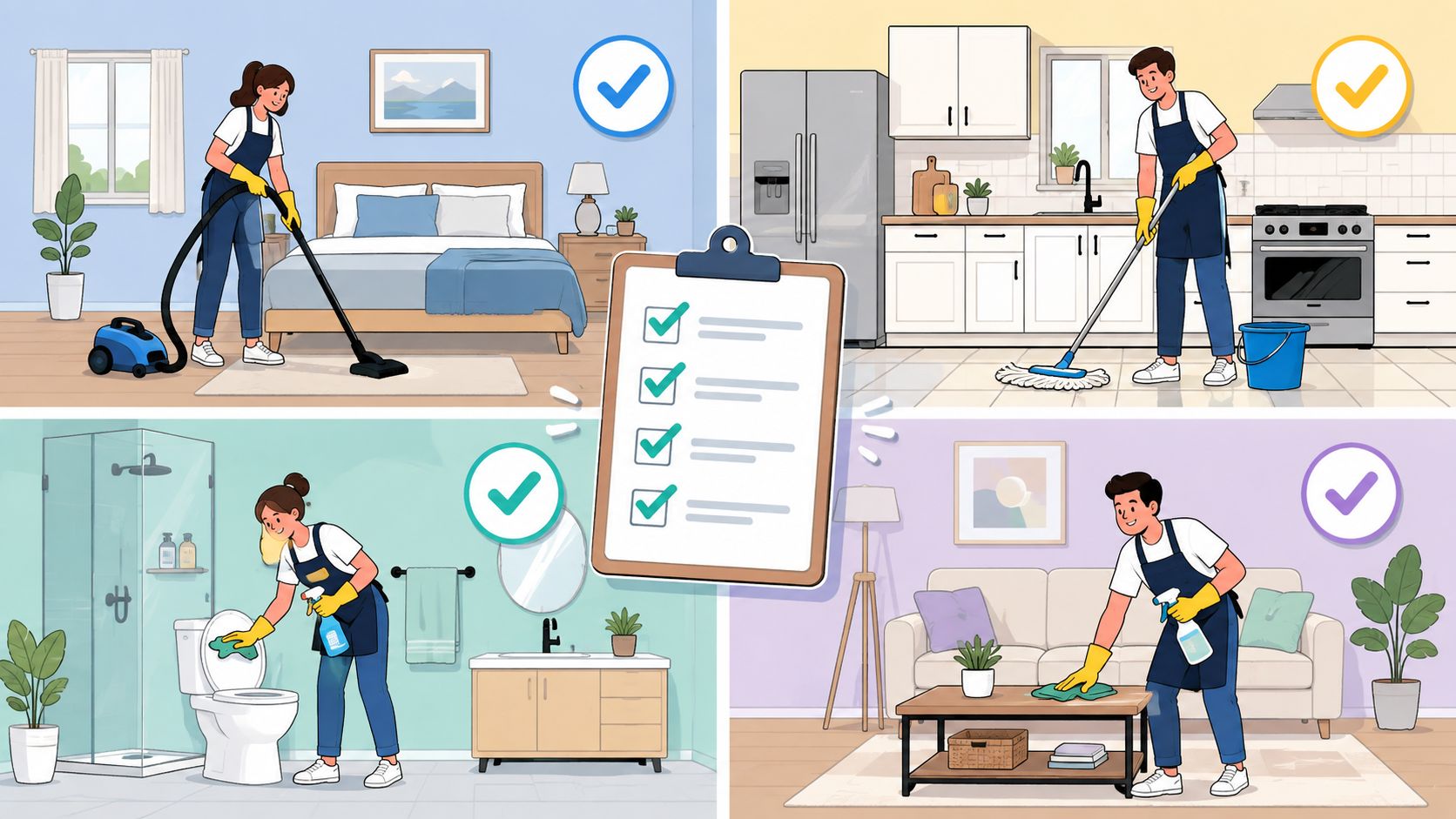
A clean turnover shapes the guest experience before anyone touches a doorknob, remote, faucet, or kitchen handle. Cleanliness is also a measurable booking signal: 81% of guests considered it important when deciding where to stay, while 78% were more likely to leave a positive review when a rental was clean and well maintained, according to research on cleanliness and guest reviews. The same source identifies cleanliness as the most heavily discussed attribute in vacation-rental feedback across major booking platforms.
A dependable rental property cleaning checklist therefore needs more than vacuuming and fresh towels. It should separate visible cleaning from disinfection, identify high-touch surfaces, follow product contact time, include room-by-room verification, document exceptions, control supplies, and create a clear handoff from departure to arrival. Cleaning removes dirt and debris. Disinfection uses a product according to its label to address microorganisms on approved surfaces.
Ready-to-use commercial disinfecting wipes can make high-touch work easier when the product label permits the intended surface. For supply planning across multiple properties, review options such as commercial cleaning wipes from Wipes.com, then match each product to the room, material, and required contact time. The workflow below also covers printable checklist design, timing estimates, inspection evidence, and adjustments for homes, apartments, gyms, fitness amenities, long stays, families, and post-departure damage checks. For broader planning, these vacation rental housekeeping essentials provide useful operational context.
1. Deep Clean High-Touch Surfaces with EPA-Registered Disinfecting Wipes
Guests form an opinion about cleanliness through the surfaces they touch first. Door hardware, light switches, remote controls, faucet handles, cabinet pulls, and stair railings deserve a dedicated pass after visible soil has been removed. A wipe that merely moves dust or grease around isn't a substitute for disinfection.
Choose EPA registered disinfecting wipes only when the label supports the surface and intended use. Product registration doesn't remove the need to follow directions. Read the label for wet contact time, compatible materials, required ventilation, food-contact instructions, and any need for a post-use rinse.

Build a repeatable touchpoint route
Work in one direction through the property so staff don't overlook a room or recontaminate a cleaned surface. A useful route starts at the entry, continues through common areas, then moves into bedrooms, bathrooms, kitchen surfaces, utility spaces, and stairs.
Mark each location on a laminated or digital checklist. Property-management inspection templates recommend pass/fail scoring by area and photographing at least 8 critical zones, including linens, bathrooms, kitchen surfaces, Wi-Fi, locks, and restocking levels, as described in this vacation-rental cleaning inspection checklist.
Practical rule: A fast wipe is only a cleaning action if the product hasn't remained wet for the label-required time.
For longer bookings, schedule a light refresh of public touchpoints without disturbing personal belongings. If the property includes exercise equipment, provide gym equipment wipes in a visible dispenser and explain that guests should use them only on compatible equipment. That turns cleanliness into both a service feature and a shared habit.
2. Disinfect Bathroom Fixtures and Grout Lines Between Guest Stays
Bathrooms expose weak turnovers quickly. A polished mirror won't compensate for soap scum around a faucet, hair near a drain, discoloration in grout, or residue on a toilet handle. The room needs two passes: remove visible soil first, then disinfect approved fixtures and touchpoints.
Start with the shower, tub, vanity, toilet, sink, and floor edges. Inspect grout lines and caulking rather than assuming a general spray has reached them. A practical assessment should categorize visible contamination as soap scum, hard-water staining, mold, grease or oil, pests, and appliance or drain-function issues, then use that record to plan labor, materials, and time per area, following this initial cleaning assessment framework.
Separate routine disinfection from restoration
Disinfectant wipes work well for small, approved fixture surfaces such as faucet handles, toilet handles, towel-rack contact points, and light switches. They aren't a replacement for a grout brush, descaling product, or mold-remediation process when buildup has become established.
Use ventilation while products work and allow surfaces to dry according to their directions. Don't mix cleaners, especially acids and chlorine products. Test unfamiliar products on a discreet area, since stone, coatings, painted finishes, and metal can react differently.
A bathroom checklist should include:
- Fixture pass: Wipe faucet handles, flush handles, door hardware, switches, and other approved high-touch areas.
- Grout inspection: Record staining, cracked caulk, recurring moisture, and areas that need deep cleaning rather than a quick turnover pass.
- Function check: Confirm drains flow, exhaust fans operate, bulbs work, and towels and toiletries are properly restocked.
- Evidence: Photograph an exception that needs maintenance, instead of marking the entire bathroom complete.
This inspection layer matters beyond appearance. Landlord-oriented guidance identifies laundry areas, entryways, air vents, light bulbs, HVAC filters, garages, storage spaces, and outdoor trash as common inspection gaps, as detailed in this move-out cleaning inspection guide.
3. Clean and Disinfect Kitchen Appliances and Food Preparation Surfaces
The kitchen has a different risk profile because guests handle food there. A clean-looking countertop may still have residue from previous meal preparation, while refrigerator handles, microwave buttons, stove controls, and sink fixtures collect repeated hand contact.
Remove crumbs, grease, spills, and food debris before applying a disinfectant. Wipes don't perform well on a heavily soiled surface, and wiping over grease can spread it across a larger area. For food-contact surfaces, use only a product whose label addresses that use, and follow any required rinse or air-dry direction before guests prepare food.
Make the appliance route explicit
A room-by-room checklist should name each appliance rather than saying “clean kitchen.” That wording leaves too much to memory, especially during a compressed turnover.
- Refrigerator: Empty leftover food, wipe shelves and seals, clean the handle, and check for odors.
- Microwave: Remove splashes from the interior, then address buttons and the handle with a compatible product.
- Range and oven: Remove grease and residue, clean controls, and inspect the hood and surrounding backsplash.
- Dishwasher: Check the door edge, handle, filter area, and interior for trapped food or film.
- Sink area: Clean the basin, drain, faucet, handles, and nearby counter.
For counters and other food-preparation surfaces, keep the product label accessible to staff. “Food-safe” isn't a universal description. What matters is the registered product's actual directions for the material, soil level, contact time, and whether rinsing is required.
A self-catering apartment illustrates the trade-off. Spending every turnover on a full refrigerator deep clean may not be efficient if the interior is already clean, but skipping the handle, seals, visible spills, and odor check creates an obvious guest-perception failure. Use a routine turnover line item for touchpoints and a separate periodic task for full appliance interiors.
If a property includes a gym kitchenette or staff break room, extend the same method to shared refrigerator handles, vending controls, coffee-machine buttons, and cabinet pulls. The surface list changes by property, but the sequence stays consistent: remove soil, apply the approved product, respect contact time, verify, and restock.
4. Implement a Turnover Disinfection Protocol with Timed Checklists
A turnover checklist should tell a cleaner what to do, in what order, with which product, and how completion will be verified. Without those details, staff may clean visible surfaces but skip remote controls, locks, vents, or the wet contact time required for disinfection.
Start by separating the workflow into post-departure assessment, cleaning, disinfection, restocking, inspection, and handoff. The first pass should identify left-behind items, damage, missing supplies, unusual contamination, and maintenance problems. That protects the cleaning team from being held responsible for a condition that existed before work began.
Use timing as a planning tool, not a race
Record how long each room normally takes under ordinary conditions, then create a realistic range based on property size, condition, amenities, laundry, and outdoor areas. A bathroom with mineral buildup and damaged grout needs a different labor plan from a lightly used powder room.
A timed checklist can include:
- Arrival scan: Note damage, odors, pests, leaks, missing items, and unusual soil.
- Dry work: Remove trash, dust high surfaces, vacuum, and collect linens.
- Wet cleaning: Wash fixtures, counters, floors, appliances, and visible soil.
- Disinfection: Apply the assigned product to approved touchpoints and maintain wet contact time.
- Reset: Replace linens, restock supplies, test systems, and stage the room.
- Quality check: Mark pass or exception, attach photos where useful, and submit the handoff.
A signed checklist doesn't prove that a surface was disinfected correctly. It proves that someone accepted responsibility for checking the step. Product directions and inspection evidence still matter.
Use different versions for a studio apartment, a family home, a luxury property, and a rental with a gym or pool. A property manager may also use color coding for kitchens, bathrooms, electronics, and outdoor areas. Digital checklists make photo submission and exception tracking easier, while laminated sheets remain useful when connectivity is unreliable.
The same logic applies to Airbnb cleanings by Canes Cleaners, where turnover work depends on a clear reset between departing and arriving guests. The strongest system is the one staff can follow under pressure without guessing.
5. Address Frequently Overlooked Areas with Remote Controls, Thermostats, and Drawer Handles
Some surfaces receive repeated contact but remain absent from generic cleaning lists. Remote controls, thermostats, drawer handles, cabinet knobs, bedside switches, and appliance buttons are easy to miss because they don't look dirty from across the room.
Give these areas their own checklist line. A cleaner who sees “living room clean” may vacuum and dust without touching the remote. A cleaner who sees “remote, thermostat, cabinet hardware” has a clear action and a clear inspection point.
Treat electronics as materials, not exceptions
Use only a product compatible with the device. Avoid saturating buttons, ports, seams, screens, and thermostat housings. Apply the wipe to the approved surface with controlled moisture, then wipe dry when the product directions call for it. Test the remote, thermostat, television, lights, and smart controls after cleaning.
The room should be inspected from the guest's point of view. Sit on the sofa and handle the remote. Adjust the thermostat. Open a drawer. Touch the bedside lamp switch. That short exercise often reveals more than a visual scan.
A high-touch sweep can include:
- Living room: Remote controls, game controllers, lamp switches, table edges, door hardware, and cabinet pulls.
- Bedroom: Bedside switches, drawer handles, closet hardware, headboard contact areas, and remotes.
- Kitchen: Appliance controls, refrigerator handle, cabinet knobs, drawer pulls, and faucet handles.
- Entry and stairs: Lock keypad, handrail, doorbell, light switches, and coat hooks.
- Utility areas: Washer and dryer controls, laundry handles, and storage hardware.
Place a small, accurate note near a remote or entry station if the property uses visible hygiene messaging. Don't claim that every surface is sterile. State that specified surfaces were cleaned or disinfected according to the property's procedure.
A rental with a home gym needs a separate inventory. List each machine, bench, handle, locker touchpoint, and wipes to disinfect gym equipment station. Keep the wipe container secured from heat and moisture, and make disposal instructions obvious.

6. Establish a Mid-Stay Guest Disinfection Refresh Protocol
A departure reset doesn't cover the entire contamination cycle of a longer booking. Guests create new soil, odors, spills, and touch patterns during their stay. A mid-stay refresh can maintain shared areas without turning the property into an intrusive service environment.
Offer the visit clearly and obtain permission for entry. Explain what staff will clean, what they won't move, how long the visit should take, and whether the service is included or optional. Privacy is part of the operating standard, so cleaners shouldn't open luggage, handle personal documents, or reorganize private belongings.
Keep the refresh narrow and predictable
Focus on public surfaces:
- Kitchen: Counters, sink fixtures, appliance handles, cabinet pulls, and trash-area touchpoints.
- Bathroom: Faucet handles, toilet controls, door hardware, switches, and visible splash zones.
- Living areas: Remote controls, switches, handles, tables, and shared electronics where compatible.
- Fitness amenities: Exercise-machine handles, benches, locker touchpoints, and dispenser areas.
- Entry points: Door hardware, keypad, handrail, and frequently handled delivery surfaces.
The refresh shouldn't become an unplanned deep clean. If staff discover mold, a leak, pests, broken equipment, or a damaged surface, they should document the exception and escalate it rather than improvising with stronger chemicals.
For a family rental, offer the refresh around the guest's schedule and pay extra attention to high chairs, booster seats, stair rails, and shared controls. For corporate housing, a predictable optional service can be positioned as convenience. For a property with a gym, place fitness center wipes where guests can see them and provide a waste bin nearby.
The business value comes from consistency, not from making unsupported promises. A clear mid-stay protocol can reduce surprise visits, give cleaners a defined scope, and create a practical service option for guests who want the property refreshed during a longer booking.
Leave a concise service note listing the areas addressed and any maintenance issue found. That record helps the next cleaner understand what changed and gives the manager a traceable handoff.
7. Train Staff on Proper Disinfectant Wipe Application and Contact Time Requirements
Product choice can't rescue poor application. Staff often wipe a handle and move on before the surface has stayed wet long enough, or they use too much liquid on electronics, wood, painted finishes, and other sensitive materials.
Training should begin with the product label, not a generic time assumption. The EPA label for one disinfectant-wipe example requires the surface to remain visibly wet for one minute, and it directs users to use enough wipes to maintain that wetness for the entire contact period, as shown in the EPA disinfectant wipe label. Other products can have different directions.
Teach the difference between wiping and disinfecting
Demonstrate the process in a real room. The cleaner removes visible soil, selects a compatible wipe, covers the full surface, watches the wet contact period, and disposes of the wipe correctly. A timer helps staff understand how long the label period feels during a busy turnover.
The CDC identifies high-touch surfaces such as tables, doorknobs, light switches, countertops, handles, desks, phones, keyboards, toilets, faucets, and sinks as surfaces that should be cleaned and disinfected. Where no specific product guidance exists, CDC material identifies alcohol-based wipes or sprays containing at least 70% alcohol as an option, as described in this CDC environmental cleaning guidance.
Use the exact product instructions for every area. A wipe suitable for a bathroom handle may not be suitable for a screen, untreated wood, food-contact counter, yoga mat, or gym console. Train staff to recognize when a wipe is inappropriate and when a different cleaning method is required.
Require initials, spot checks, and exception notes. Managers can inspect a sample of rooms, verify product storage, check expiry and package integrity, and ask staff to explain the contact-time procedure. For additional training context, review this guide to contact time for disinfectants.
8. Implement Seasonal Disinfection Adjustments for Climate and Guest Volume Fluctuations
The checklist shouldn't remain static while the property changes around it. Humidity, occupancy, guest behavior, outdoor access, weather, and event calendars can alter the amount of soil and moisture staff encounter.
In a coastal home, cleaners may need closer checks of bathroom grout, window tracks, entry mats, outdoor furniture, and HVAC-related dust. In a winter apartment, entryway moisture, salt residue, heating vents, and closed-window odors may become the more important inspection points. A mountain rental with a hot tub needs a different outdoor and moisture-control routine from an urban studio.
Adjust depth, not just product quantity
Track recurring complaints and maintenance exceptions by month. Use that record to revise the checklist. A busy holiday period may require more disciplined staging and faster supply replenishment, while a quieter period allows staff to reach behind furniture, inside cabinets, under beds, around vents, and in storage areas.
Seasonal planning should address:
- Climate exposure: Add moisture, mold, dust, pollen, or salt-residue checks where the property needs them.
- Guest volume: Prepare enough wipes, liners, gloves, laundry supplies, and replacement amenities for the booking pattern.
- Amenities: Add pool rails, outdoor tables, barbecue controls, fitness equipment, and shared entrances when those areas are active.
- Low-occupancy work: Schedule deeper inspections, repairs, filter changes, grout work, and appliance cleaning when turnover pressure is lower.
- Checklist revision: Retire steps that no longer apply and add recurring exceptions observed by staff.
WHO guidance for public settings specifically calls for frequent attention to high-touch items such as light switches, bed rails, door handles, tables, trays, mobile-cart rails, and sinks, as described in its environmental cleaning guidance. For facilities that combine lodging with a gym, clubhouse, or shared amenity, that public-setting perspective is useful.
A regulatory review should accompany seasonal planning. California's 2024 law requires short-term-rental hosts to disclose additional fees or charges tied to mandatory guest cleaning chores, according to this California short-term-rental fee disclosure update. That makes the checklist relevant to both operations and guest-facing pricing language. Keep the maintenance and seasonal version current with this rental property maintenance checklist.
8-Point Rental Property Disinfection Comparison
| Item | 🔄 Complexity | ⚡ Resources & Efficiency | 📊 Expected Outcomes | 💡 Ideal Use Cases | ⭐ Key Advantages |
|---|---|---|---|---|---|
| Deep Clean High-Touch Surfaces with EPA-Registered Disinfecting Wipes | Medium, straightforward technique but requires strict contact time | Low–Moderate cost per wipe; portable, single-step; fast per item | Immediate visible cleanliness; ~15–20% fewer cleanliness complaints | Turnovers, urban short-term rentals, guest-facing touchpoints | High efficacy (EPA), builds guest confidence, saves labor by combining cleaning+disinfection |
| Disinfect Bathroom Fixtures and Grout Lines Between Guest Stays | High, targeted grout/crevice work and longer contact times | Moderate time and specialized moisture-resistant products; more labor for grout | Prevents mold growth; ~25% fewer mold-related complaints; avoids expensive remediation | Humid climates, tile-heavy bathrooms, properties prone to moisture issues | Prevents property damage and respiratory complaints; extends grout/caulk life |
| Clean and Disinfect Kitchen Appliances and Food Preparation Surfaces | Medium, requires food-safe products and careful moisture control | Moderate cost (food-safe wipes), cautious handling for electronics and surfaces | Reduces foodborne and appliance complaints (examples show ~35% decrease) | Rentals offering self-catering, competitive markets where kitchen confidence matters | Mitigates foodborne-illness liability; improves guest trust in kitchen amenities |
| Implement a Turnover Disinfection Protocol with Timed Checklists | High, needs development, testing, staff adoption and updates | Initial time investment; mobile checklist tools and training; improves long-term efficiency | Standardizes sanitation; reduces inconsistent-cleaning complaints 30–45%; legal documentation | Multi-property managers, high-volume turnovers, teams needing consistency | Standardizes quality, creates accountability, aids scheduling and liability protection |
| Address Frequently Overlooked Areas: Remote Controls, Thermostats, and Drawer Handles | Low–Medium, simple additions but requires electronics-safe handling | Low added cost; requires electronics-safe wipes and brief extra time | Cuts cleanliness complaints (examples ~25%); reduces cross-contamination risk | Properties with many electronics, high guest turnover, attention-to-detail listings | Eliminates a common complaint category; demonstrates superior attention to detail |
| Establish a Mid-Stay Guest Disinfection Refresh Protocol | Medium, scheduling, guest privacy and communication required | Additional staff/time or paid upsell; 20–30 minute visits minimize disruption | Increases satisfaction for long stays 12–18%; reduces mid-stay health/odor complaints | Long-term bookings (7+ nights), corporate housing, premium listings | Upsell opportunity; improves repeat bookings and long-stay satisfaction |
| Train Staff on Proper Disinfectant Wipe Application and Contact Time Requirements | Medium, requires training program, refreshers, and spot checks | Time and training materials upfront; reduces wasted product and surface damage over time | Boosts real-world disinfection efficacy 40–50%; reduces guest illness complaints | Any property with cleaning staff, multi-unit operations | Ensures true efficacy of products, prevents damage, improves staff performance and compliance |
| Implement Seasonal Disinfection Adjustments for Climate and Guest Volume Fluctuations | Medium–High, needs data, forecasting, and inventory planning | Variable costs: more inventory/staff in peak/humid seasons; optimizes labor and supply use | Reduces seasonal complaints 40–60% in humid areas; prevents seasonal mold/odor issues | Coastal/humid properties, markets with strong seasonality, peak travel periods | Maintains consistent guest satisfaction year-round; prevents expensive seasonal remediation |
Turn Every Checkout Into a Verified Reset
A reliable turnover follows a simple sequence, but each step needs a defined standard. Start with the post-departure scan. Look for left-behind items, damage, leaks, odors, pests, depleted supplies, and unusual soil before cleaning begins. Photograph exceptions while the condition is visible, then route maintenance or damage issues to the responsible manager.
Next, remove visible soil. Collect trash, strip linens, dust, vacuum, wash floors, clean appliances, and address bathroom buildup. Cleaning and disinfection shouldn't be treated as interchangeable. Cleaning removes dirt that can block a disinfectant's contact with the surface. Disinfection follows on compatible, approved areas.
Apply disinfectant wipes to high-touch surfaces according to the product label. Cover the full surface, keep it visibly wet for the required contact time, and use enough product to maintain that condition. The CDC notes that high-touch surfaces can vary by facility, so local teams should define the areas requiring the most attention, as explained in this CDC environmental cleaning resource.
Then complete a room-by-room inspection. Check linens, bathrooms, kitchen surfaces, locks, Wi-Fi, lighting, HVAC, appliances, remotes, thermostats, drains, and restocking levels. Test systems after cleaning, especially if staff used moisture near electronics or controls. Mark each area as passed or record a specific exception. “Almost complete” isn't a useful handoff status.
Maintain separate templates for standard homes, larger properties, gyms or fitness amenities, long stays, family bookings, and post-departure damage checks. A house with a treadmill needs equipment surfaces and a gym wipe dispenser on the checklist. A family property needs high chairs, stair rails, play areas, and washable soft goods. A long-stay refresh needs privacy instructions and a defined public-area scope.
Safety belongs on every version. Follow product labels, don't mix chemicals, ventilate rooms, wear the required protective equipment, protect wipe-sensitive materials, and confirm food-contact directions before guests use a counter or appliance. Store wipes as directed, keep containers closed, and remove damaged or dried-out products from service.
The business case is practical. Guests notice whether a rental feels cared for, and cleanliness has a direct relationship with review quality and trust. A checklist doesn't guarantee a particular rating or booking result, but it gives owners and cleaning teams a repeatable way to protect the guest experience, document readiness, control supplies, and find problems before arrival.
Prioritize cleanliness at the next turnover. Build high-touch disinfectant wipes into the daily workflow, equip staff with property-specific checklists, and review professional wipe and sanitation supply options for your homes, apartments, gyms, or broader commercial offering.
Leave a Reply