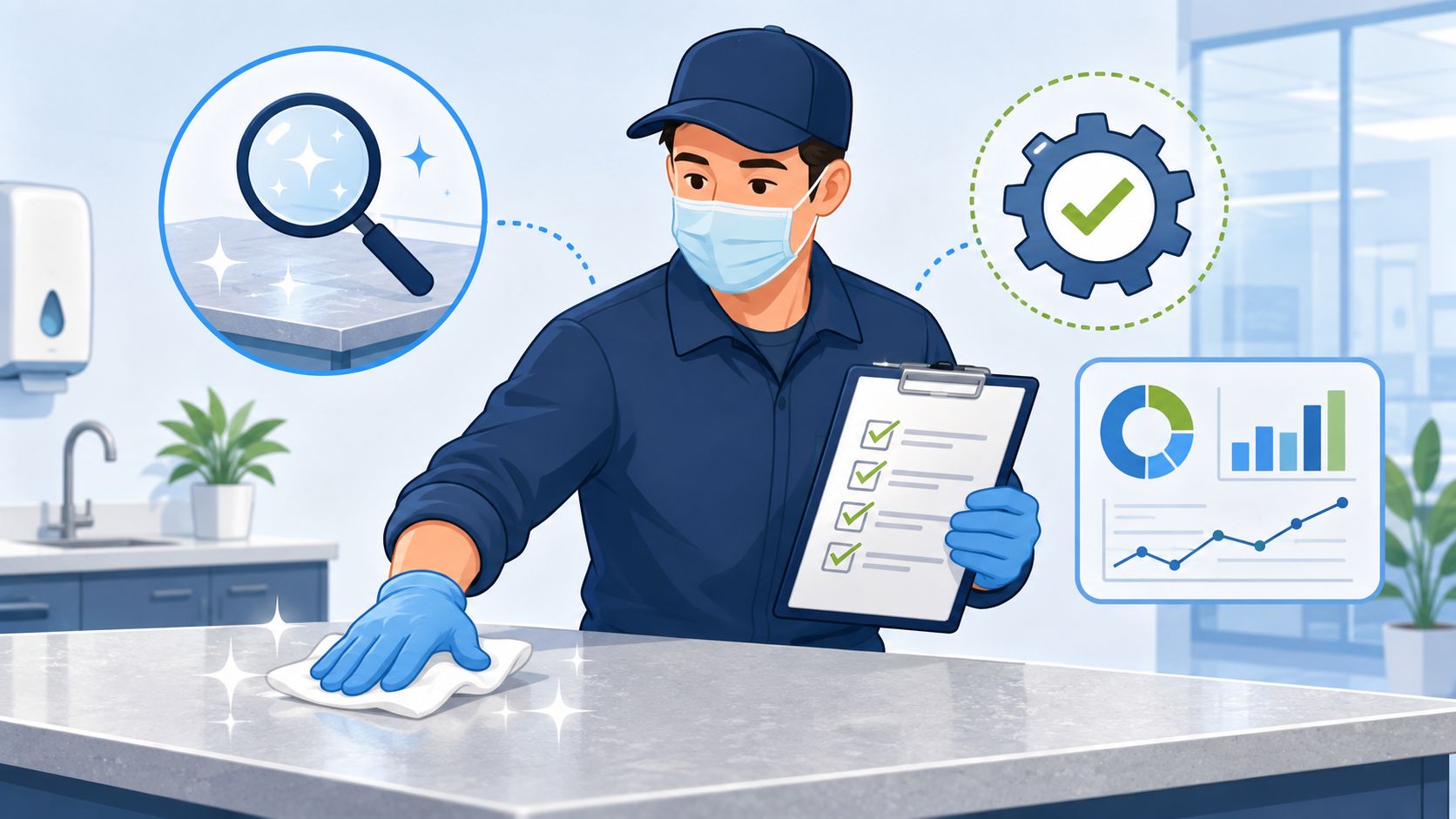
A customer walks into a gym, grabs a treadmill rail, and immediately notices the sticky surface. In an office, an employee touches a shared keyboard after lunch. At an airport, travelers move through a restroom that looks clean from the doorway but has grimy door hardware. In each case, the problem isn't necessarily a lack of effort. It's a failure to turn cleaning into a quality assurance system that works between inspections, during busy periods, and across staff changes.
Cleanliness affects customer confidence, employee comfort, public health, and brand reputation. A reliable sanitation program combines scheduled cleaning, targeted disinfection, documented checks, staff ownership, and fast corrective action. Disinfectant wipes add a practical layer because they make frequent cleaning possible at the point of use, especially on equipment and other high-touch surfaces.
Why Cleanliness Procedures Fail in Real Facilities
A checklist can be complete and still fail in practice. I've seen gym teams initial every line on a wall-mounted form while members continued finding sweat residue on machine handles. In commercial buildings, cleaners completed a restroom route early in the shift, but nobody owned the inspection after traffic increased. At airports, a polished public area could deteriorate quickly because the procedure tracked scheduled rounds instead of actual passenger flow.
The recurring issue is the gap between documented work and observable results. A standard operating procedure may say to clean equipment, restock supplies, or inspect a restroom, but it often fails to define who performs the task, what acceptable completion looks like, how the work is verified, and what happens when conditions change.
The seven gaps behind inconsistent execution
Quality assurance procedures become fragile when managers treat them as compliance paperwork rather than living operational controls. Common weaknesses include process gaps, coverage gaps, skill gaps, tooling gaps, environment gaps, data gaps, and feedback gaps, as outlined in this QA gap analysis overview.
- Process gaps: The procedure misses a step, such as allowing a surface to remain wet for the required contact time.
- Coverage gaps: The schedule overlooks door pulls, touchscreens, locker handles, shared pens, or low-visibility corners.
- Skill gaps: Employees know how to wipe a surface but haven't been trained to follow product instructions or avoid cross-contamination.
- Tooling gaps: Wipes, gloves, liners, or replacement dispensers aren't available where work occurs.
- Environment gaps: High traffic, poor ventilation, limited storage, or a constantly wet area makes the written method impractical.
- Data gaps: Supervisors collect signatures but not useful information about missed tasks, repeat failures, or supply consumption.
- Feedback gaps: Customer complaints and frontline observations never reach the person responsible for updating the procedure.
Staff turnover makes these weaknesses more visible. A routine that depends on one experienced cleaner's memory won't survive a busy weekend or a new hire. The solution isn't a longer binder. It's a shorter, clearer procedure supported by visible supplies, defined ownership, routine verification, and a corrective action process that closes the loop.
Practical rule: If a manager can't verify the result during the busiest part of the day, the procedure isn't operational yet.
A strong system measures conditions rather than paperwork. It asks whether equipment feels clean, whether dispensers are stocked, whether the restroom meets a defined standard, and whether missed work receives a documented response. That shift turns cleaning from an occasional activity into a controlled service process.
Building a Sanitation Quality Assurance Framework
A workable framework should be detailed enough to remove ambiguity but simple enough for a cleaner, supervisor, or facility attendant to use without stopping to interpret it. The historical direction of QA supports that approach. The ISO 9000 family was first published in 1987, creating the first internationally harmonized framework for quality assurance and moving practice toward prevention, documentation, and continual improvement, as described in this history of quality management systems.

Start with risk and workflow
Map the facility by surface, user behavior, traffic, and consequence. A fitness center needs separate routines for cardio consoles, free-weight handles, benches, locker rooms, showers, and reception counters. An office may prioritize shared desks, kitchen surfaces, door hardware, elevator buttons, and meeting-room equipment. A restaurant needs procedures that distinguish dining areas from food-contact surfaces and back-of-house work zones.
Write each SOP around the actual task:
- Identify the surface and product. State whether the task uses a cleaner, sanitizer, or disinfectant, and specify compatibility requirements.
- Define the method. Explain preparation, wiping direction, one-wipe-one-surface expectations where appropriate, disposal, and hand hygiene.
- Set the trigger. Use time, use, visible soil, traffic, or an incident as the reason for action.
- Assign ownership. Name the role responsible, not merely “staff.”
- Specify verification. A supervisor should know what to inspect and what failure looks like.
Build inspection and corrective action into the same workflow
A checklist should record more than a signature. Include the area, task, completion status, observed condition, supply availability, and follow-up owner. A corrective action may involve re-cleaning, replacing a depleted dispenser, retraining an employee, changing the route, or revising the SOP.
Keep the dashboard focused. Useful indicators include completed inspections, recurring failed locations, open corrective actions, customer complaints related to cleanliness, and supply outages. The purpose isn't to punish staff. It's to reveal where the system makes good work difficult.
For practical examples of how to structure a sanitation standard operating procedure, connect the written method to the inspection and response process rather than storing it separately. That linkage is what makes the framework usable during a real shift.
High-Touch Danger Zones and Cleaning Frequencies
Cleaning resources should follow contact patterns, not floor area. A quiet storage room may need less attention than a small reception counter touched continuously by visitors, employees, and delivery personnel. The CDC-aligned guidance on high-touch surfaces notes that high-touch areas are more likely to spread germs and that high-traffic facilities may need more frequent cleaning or disinfection than low-traffic spaces.

Prioritize what people repeatedly touch
In gyms, start with treadmill rails, elliptical grips, cable-machine handles, dumbbells, benches, locker handles, water-fountain buttons, touchscreens, and door pulls. These are practical applications for gym equipment cleaning wipes and wipes for gym equipment, provided the product is suitable for the surface and used according to its label.
Offices need attention on elevator buttons, shared keyboards, phones, conference-room controls, light switches, breakroom handles, refrigerator doors, and coffee-machine interfaces. Schools should focus on desk edges, door hardware, shared devices, playground touchpoints, and restroom fixtures. Restaurants and retail stores should prioritize payment terminals, shopping-cart handles, menus, counter edges, door pulls, and self-service interfaces.
Match frequency to exposure
There isn't one universal schedule. A facility should establish a baseline, then adjust it for occupancy, events, visible soil, illness concerns, and changes in traffic. The CDC guidance supports more frequent cleaning or disinfection in high-traffic areas, while lower-contact spaces may follow a less intensive route.
A practical schedule separates three types of work:
- Routine rounds: Staff inspect and clean priority surfaces at planned intervals.
- Use-triggered cleaning: Employees or users wipe shared equipment after use, such as a bench, mat, or machine handle.
- Incident response: Staff clean and disinfect after spills, bodily-fluid events, or known contamination concerns using the appropriate procedure.
Frequency matters because a single deep clean can't control recontamination throughout an active day. In schools, guidance recommends wiping high-touch surfaces throughout the day, with one recommendation calling for twice-daily wiping and at least one deep-cleaning cycle per day for those surfaces, as noted in this school cleaning guidance.
Managers can improve efficiency by placing supplies where contact occurs, assigning zones instead of vague “help clean” duties, and using a quick visual inspection after each route. A stocked gym wipe dispenser beside equipment often produces better compliance than a supply closet that requires a separate trip.
Implementing Disinfectant Wipe Protocols That Work
Wipes don't disinfect by magic. The product, surface, technique, and exposure time all matter. A cleaner who wipes a door handle and immediately dries it may leave the surface short of the product's required wet contact time.

Select the product before writing the routine
Use an EPA-registered disinfecting wipe when disinfection is required, and match the product to the harmful germ when that germ is known. The label should guide approved surfaces, preparation requirements, storage, personal protective equipment, and contact time. Product selection should also consider residue, material compatibility, fragrance sensitivity, dispenser format, and disposal requirements.
A gym may need a wipe that works on coated metal, hard plastic, vinyl, and touchscreens without damaging finishes. A school or office may prioritize easy dispensing and low odor. A restaurant must distinguish general surface disinfection from procedures for food-contact areas, where label directions and rinsing requirements can differ.
Teach the wet-time requirement
Disinfectant wipes are effective only when the surface remains wet for the product's stated contact time. Formulations vary from about 15 seconds up to 10 minutes, and the surface should remain undisturbed during that period, according to this guidance on disinfectant wipe contact time.
Train staff with a live demonstration, not a slide deck alone:
- Remove visible soil first: Cleaning may be necessary before disinfection when a surface is visibly dirty.
- Use enough product: The surface must stay visibly wet for the label's contact time.
- Avoid cross-contamination: Don't use one dirty wipe across multiple unrelated surfaces.
- Respect material limits: Test compatibility and follow manufacturer directions for electronics, leather, rubber, and finished wood.
- Dispose correctly: Follow the product label and facility waste rules.
- Record exceptions: Note empty dispensers, damaged surfaces, or tasks that couldn't be completed.
Place fitness wipes near the point of use, not only in the janitorial room. Use clear signage that tells members what to wipe, where to dispose of the wipe, and when to ask staff for help. Supervisors should periodically observe technique, check wet-time compliance, and correct shortcuts immediately.
Turning Hygiene into a Competitive Advantage
Cleanliness becomes a competitive advantage when customers can see that the facility manages it deliberately. A visible wipe station, a clean dispenser, responsive staff, and consistent equipment appearance communicate operational control before a customer reads a policy or speaks with a manager.
That matters across sectors. A gym can position bulk gym wipes as part of its member experience. An office manager can explain how shared surfaces receive attention during the workday, not only during an overnight cleaning shift. A retail operator can include wipe availability and high-touch inspections in a broader commercial cleaning supply program.
Sell the system, not a container of wipes
Sales professionals should ask operational questions before recommending a product:
- Which surfaces generate the most complaints?
- Who cleans them between scheduled janitorial rounds?
- Where do employees or customers expect supplies to be available?
- What happens when a dispenser is empty?
- How does the manager verify that the routine happened?
- Which surfaces create material-compatibility or residue concerns?
Those questions move the conversation from unit price to hygiene ROI. The return isn't limited to reduced product waste. It includes fewer visible failures, faster response to high-touch contamination, stronger customer confidence, and a clearer service standard that managers can inspect.
Research on disposable wipes for high-touch surfaces found they reduced microbial contamination more effectively than a standard outsourced cleaning routine, with residual disinfection activity lasting up to 6.5 hours after use, as reported in this high-touch surface disinfection research summary. That finding supports a layered approach, not a replacement for routine cleaning.
Make proof part of the offer
A strong proposal includes dispenser placement, refill controls, staff training, inspection forms, product documentation, and a review process. For gyms, bundle wipes with equipment signage and route planning. For offices, pair them with shared-space protocols. For restaurants and schools, clarify which products and procedures apply to each surface category.
Avoid promising that wipes eliminate every hygiene risk. Buyers trust a vendor who explains limitations, label compliance, contact time, storage, and the role of cleaning before disinfection. Credibility sells better than exaggerated claims.
Monitoring, Measuring, and Continuous Improvement
A sanitation program stays effective only when managers compare intended work with actual conditions. The continuous improvement process guidance provides a useful operating principle: track what happened, investigate repeated failures, update the process, and train people on the change.

Track evidence that helps people act
A useful dashboard doesn't need every possible metric. Start with inspection completion, failed locations, overdue corrective actions, dispenser outages, customer cleanliness complaints, and training status. Record the time, area, responsible role, finding, immediate correction, and longer-term action.
Review patterns by shift, zone, facility type, and traffic period. If the same locker-room bench fails repeatedly, the answer may be poor placement of supplies, an unrealistic route, inadequate staffing, or a surface that requires a different method. Rewriting the checklist without investigating the cause won't solve it.
Close the loop with staff
Supervisors should discuss findings during routine briefings and show employees what changed. A new wipe product, altered contact time, or revised frequency needs a short demonstration and a clear reason. Staff are more likely to follow procedures when managers remove obstacles and respond to their observations.
A missed task is a signal about the system, not just a reason to blame the last person on the route.
Use audits to verify execution, not to create fear. Walk the facility at different times, inspect high-touch zones directly, test whether supplies are accessible, and ask employees to explain the procedure in their own words. Customer feedback belongs in the same loop because members, travelers, students, diners, and shoppers often notice failures before a scheduled audit does.
The result is a living sanitation program. It adapts to traffic, staffing, surface changes, product updates, and recurring complaints while preserving a clear standard. That's the difference between having cleaning procedures on paper and running measurable quality assurance procedures every day.
Prioritize the surfaces people touch most, set frequencies that reflect real traffic, train staff on correct wipe technique and wet contact time, and inspect results rather than signatures alone. Add appropriate disinfectant wipes to daily facility routines or to your commercial cleaning product offering, place them where users need them, and build the findings into a documented improvement cycle.
Leave a Reply