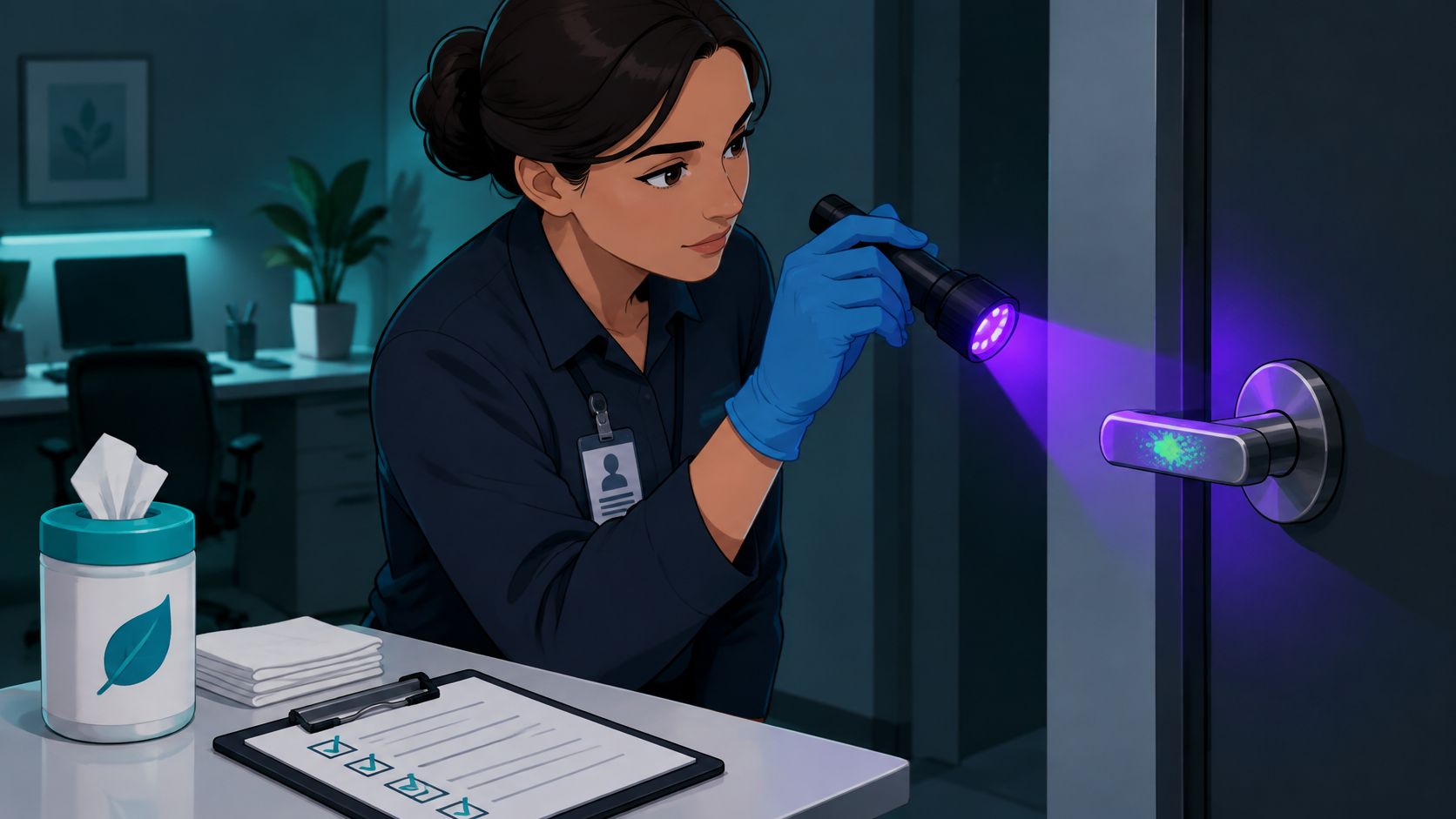
The popular advice to sweep a black light across a room and declare it clean is wrong. A black light for cleaning inspections is useful when you've placed a fluorescent marker before cleaning and checked whether staff removed it afterward. Random glow isn't a germ detector, and a disappearing dot isn't proof of disinfection.
For owners and supervisors, the value is practical: find missed wipe paths, correct the technique, and give staff the supplies to do the job properly. Visible cleanliness helps protect customer trust. A disciplined inspection program helps you deliver it consistently rather than relying on a room that looks acceptable from the doorway.
What a Black Light Pass Actually Means
A fluorescent-marker audit answers a narrow question: did someone physically wipe the marked area thoroughly enough to remove the marker? It doesn't establish pathogen absence, correct chemical concentration, adequate disinfectant contact time, or coverage of the surrounding surface.
That distinction matters in a gym. A worker can clear a mark on a bench with a quick swipe while leaving the bench insufficiently wet for disinfection. Equally, an attractive, polished surface can retain the marker because nobody wiped the sampled spot.
Before routine cleaning, choose a concealed, standardized sample of high-touch points. Door handles, light switches, faucet fixtures, equipment controls, and shared touchscreens make useful candidates. Apply a small invisible mark with a compatible fluorescent auditing product, record its exact location, and let the assigned worker complete the normal clean.
Measure coverage rather than confidence
After cleaning, inspect the same locations under reduced ambient light. Count a pass only when the mark is completely removed. Residual fluorescence is partial removal, not a generous pass awarded because the worker was busy.
Calculate the pass rate by dividing completely cleared marks by all valid marks inspected. Keep partials visible in the record instead of merging them with successful results. Otherwise, supervisors lose the distinction between an untouched surface and a wipe path that stopped short.
A hospital study covering 1,235 surfaces found an overall 63% pass rate, with sink fixtures at 54%, light switches at 55%, and bedrails at 56%, compared with toilet handles at 80% and toilet-seat undersides at 83%, according to the hospital fluorescent-marker study.
Those are hospital findings, not performance targets for your fitness center or office. Their practical warning is that obvious bathroom targets can receive attention while nearby fixtures and less conspicuous touchpoints get missed.
Keep presentation and process on separate checklists
Guests notice sticky handles, dirty edges, and unpleasant odors without an inspection lamp. Record those defects alongside the audit, but don't confuse a presentation check with a marker result.
For event operators, the Texas Old Town walkthrough checklist offers a useful companion resource for organizing the broader venue handover. Keep the fluorescent-marker record separate so a tidy walkthrough doesn't conceal incomplete wiping.
Use this scoring table consistently. The hospital references illustrate coverage gaps, not microbial safety.
How to score a fluorescent cleaning mark
| Result | What the lamp shows | How to count it | Hospital reference |
|---|---|---|---|
| Pass | Mark completely removed | Count as cleared | Overall pass rate 63 percent of 1,235 surfaces |
| Partial | Residual fluorescence remains | Do not count as pass | Often the hidden miss on fixtures and switches |
| Fail | Mark still substantially visible | Count as fail and reclean | Light switches 55 percent and bedrails 56 percent in the study |
| Stronger bathroom spots | Mark gone on the obvious target | Still sample nearby fixtures | Toilet handles 80 percent and seat undersides 83 percent |
| Ambiguous glow | Brightener, porous material, color, or glare | Photograph and use a second assessor | Not a valid pass or fail by itself |
How to Run the Inspection Without Tipping Off Staff
Tell employees that your facility monitors cleaning quality and uses the findings for training. You don't need to reveal the marked locations or announce the audit window. Transparent standards and concealed samples can coexist.
Treat the lamp as controlled inspection equipment, not a shared cleaning accessory. If workers can check their own dots before the supervisor arrives, you're measuring their ability to locate markers rather than their normal cleaning routine.
Build a repeatable inspection route
Choose the sample before the shift. Mix obvious touchpoints with awkward geometry: handle undersides, seams, hinge areas, textured plastic, and equipment interfaces. Maintain comparable surface categories between rounds so changes reflect cleaning performance rather than an easier inspection route.
Apply and log the marks privately. Use a small amount of compatible fluorescent marker and record the precise location on a confidential checklist. Confirm that the mark is visible with your lamp before cleaning begins. An unreadable starting mark cannot produce a defensible result.
Let the normal task finish. Don't interrupt the worker to suggest extra attention to a marked console or faucet. Record whether the task was routine cleaning, a turnover clean, or another defined service, because those assignments may involve different work scopes.
Standardize the viewing conditions. Inspect within a fixed window, reduce ambient light, and use the same lamp type and viewing distance. The teaching-hospital evaluation of fluorescent-marker auditing supports consistent monitoring, immediate feedback, and combining direct and indirect assessment rather than relying on an isolated visual judgment.
The workflow below is a useful supervisor reminder, but your written checklist should retain the individual site results.

Preserve the evidence and prevent rehearsed results
Photograph borderline results immediately. Capture the surface before anyone recleans it. Include enough surrounding detail to identify the location, and record the assessor's judgment while the conditions are fresh.
Separate the results into useful groups. Report the overall pass rate, then examine zone, shift, worker assignment, and surface type. Keep food-contact locations separate from restroom fixtures. A building average can hide a weak category that needs its own corrective action.
Keep the lamp with supervisors. Store it with the audit materials rather than beside the wipes. Staff should learn the complete wipe path, not how to remove a known inspection dot.
Rotate locations without changing the difficulty arbitrarily. Move marks within comparable categories and leave some inspection rounds unannounced. In a gym, alternate among adjustment levers and console buttons. In an office, include a shared phone and the side of a door plate, not just the broad desktop.
Supervisor's rule: Keep the inspection predictable in method and unpredictable in location.
Retain the raw checklist, not just the percentage displayed on a dashboard. You'll need the site descriptions, photographs, and exclusions to distinguish recurring missed contact from a surface that produces confusing fluorescence.
How to Read Glow That Is Not a Missed Wipe
A textured plastic console still glows after cleaning. Before recording a failure, compare that glow with the original marker's shape and location. A broad haze across the entire panel is a different observation from a recognizable patch of marker left around a button.
Optical brighteners, dried product film, colored materials, porous surfaces, and glare can complicate interpretation. A 2025 USDA Agricultural Research Service assessment noted human error in portable UV and blue-light interpretation and described how some materials absorb light and appear dark. Dark doesn't automatically mean clean, just as bright doesn't automatically mean dirty.
Separate the marker from the material
Start with the recorded pre-cleaning appearance. If the material already fluoresced, the assessor must identify the applied marker rather than judge the surface's total brightness.
Don't use visibly damaged, highly porous, or mirror-like surfaces for routine marker scoring when you can't reliably distinguish the mark. Choose a nearby suitable touchpoint instead. For a damaged equipment grip, add a maintenance action rather than repeatedly arguing about its fluorescence.
- Recognizable residual mark: Record partial or failed removal according to the scoring rules.
- Uniform background fluorescence: Compare with the baseline and inspect for cleaner film or material effects.
- Unresolved disagreement: Photograph the location, ask a second assessor, and exclude it from the pass-rate denominator if it remains uninterpretable.
- Repeated ambiguity: Replace that sampling location with a comparable, readable surface.
The illustration below concerns skin glow and product residue, not validation of a facility marker audit. Don't use it as a surface-scoring reference.

Verify the disinfection task separately
Glow is a process score, not a cleanliness certificate.
Pair the marker assessment with direct observation of product selection, dilution where applicable, surface wetness, and task completion. Check the product container and the worker's technique rather than expecting the lamp to answer chemical questions.
When the decision requires an additional hygiene-monitoring method, our guide to ATP swab testing provides a useful starting point. ATP testing answers a different question from marker removal and shouldn't be presented as proof that a specific pathogen is absent.
The most damaging interpretation error is turning an audit score into a public sanitation claim. Tell customers that you monitor and improve cleaning performance. Don't tell them that a black-light pass certifies a germ-free facility.
Turn Failed Marks into a Better Wipe
A recurring partial mark under an adjustment lever calls for a demonstration at that lever, not a general reminder to clean harder. Have the supervisor show how to reach the underside, maintain contact around the joint, and finish the whole touch surface.
Then watch the worker repeat the task. Check whether the problem is technique, access, inadequate supplies, or an unrealistic assignment. An empty dispenser and a missed underside require different corrections.
Teach the mechanics on the actual surface
The EPA-accepted disinfectant-wipe label directs users to make hard, nonporous surfaces visibly wet, use enough wipes to maintain wetness for the specified contact time, preclean heavily soiled surfaces with another wipe, and allow air-drying as directed. Used wipes go in the trash. Apply those mechanics according to the label on the product your facility stocks.
A fast-drying swipe can remove a marker without delivering the exposure required by the disinfectant. That's why the dispenser needs more than a refill roll: post the product-specific wet contact time where staff can see it.
- Remove heavy soil first. Use a separate cleaning wipe or the cleaning method specified for the surface before the disinfection step.
- Supply enough material. A large school desktop or equipment pad may require fresh wipes to remain wet throughout the stated time.
- Keep contamination zones separate. Don't carry a restroom wipe onto a food counter or move a locker-room wipe onto a cardio console.
- Check material compatibility. Use only products suitable for the equipment, upholstery, screen, or mat involved.
Use this checklist as a training prompt beside the actual product instructions.

Organize the route and reinforce the correction
The WHO guidance for non-healthcare settings recommends cleaning with soap or detergent before disinfection, moving from less soiled to dirtier areas, and applying indoor disinfectants with a soaked cloth or wipe rather than routine spraying. Build that order into the cart layout and task sheet.
For dealerships and rental operators, Nanak Car Wash's practical car interior cleaning tips offer a companion resource for organizing vehicle-detailing tasks. Keep detailing and disinfection instructions distinct, particularly where interior materials need different treatment.
Don't stop monitoring after an improved demonstration. An Australian hospital study recorded average cleaning scores of 34%, 53%, and then 41% across its phases and found that improvement wasn't sustained without ongoing education.
Re-audit the corrected category using fresh concealed locations and continue checks until performance stabilizes.
Where Gyms Offices and Sales Teams Should Aim
Allocate cleaning effort by touch frequency and traffic, not by equal time per room. A rarely used meeting table and a busy reception keypad don't need identical service schedules.
The CDC guidance for public spaces identifies tables, doorknobs, light switches, countertops, handles, desks, phones, keyboards, toilets, faucets, and sinks as high-touch surfaces, recommends increased cleaning and disinfection when use is high, and identifies shopping carts and point-of-sale keypads for cleaning and disinfection before each use.
Match the task to the facility
| Facility | Priority example | Practical service recommendation |
|---|---|---|
| Gym | Equipment handle and adjustment lever | Clean between users and audit the awkward contact points |
| Office | Shared phone and touchpad | Include daytime service rather than relying only on closing staff |
| School | Desk edge and faucet handle | Schedule checks between groups and after visibly messy activities |
| Restaurant | Dining surface and restroom tap | Assign separate supplies and follow applicable food-contact directions |
| Retail | Cart handle and checkout keypad | Build cleaning and disinfection into the handoff to the next user |
Place wipes for gym equipment where members finish their sets, with a visible gym wipe dispenser and concise instructions. Keep staff responsible for verification and replenishment. A member wiping a bench doesn't eliminate the facility's cleaning responsibilities.
Mats need a separate compatibility check. A product marketed as yoga mat wipes isn't automatically suitable for every mat or approved for every disinfection claim. Review both the mat manufacturer's care instructions and the wipe label.
Indoor sports operators should also plan for changing attendance and shared-equipment demand. JC Sports Houston's rain-proof sports options for Houston families provide useful context for the family activities that bring people into indoor venues. Build your service route around the spaces and equipment those activities use.
Report results by zone without naming a cleaner as the villain. Use worker-level records privately for coaching, and choose the next corrective sample from the weakest surface category.
Put Marker Scores and Wipes on One Routine
Before the next shift, assign a supervisor to own the inspection record, supplies check, and corrective actions. A lamp without an owner becomes a novelty. A score without follow-through becomes paperwork.
Use our cleaning inspection checklist to organize the broader review. Keep marker outcomes alongside supply availability, observed technique, maintenance defects, and the person responsible for closing each action.
Set a clear local correction rule
Adopt a practical trigger: a zone that misses twice receives a demonstrated wipe path and a fresh audit. Treat that as your facility's operating rule, not a scientific threshold or legal requirement.
The correction record should identify:
- The actual obstacle: Missed geometry, unsuitable product, empty dispenser, damaged surface, or insufficient task time.
- The assigned response: Training, restocking, equipment repair, or an adjusted service route.
- The verification: A new concealed sample and an observed product-use check.
- The follow-up owner: A named supervisor who confirms completion rather than assuming it happened.
Owners should review the results as an operating signal, not a substitute for walking the floor. Customers don't need to understand fluorescence to notice an unwelcoming locker room or a sticky reception counter.
At WipesBlog.com, our mission is to help organizations understand how disinfectant wipes contribute to better health outcomes, operational efficiency, and customer satisfaction. We turn sanitation guidance into practical actions for organizations including gyms, schools, warehouses, and waiting rooms.
Tonight, pick ten high-touch spots as a manageable starting sample, mark them before cleaning, and inspect them afterward under controlled low-light conditions. Prioritize cleanliness with a process staff can perform and supervisors can verify.
Leave a Reply