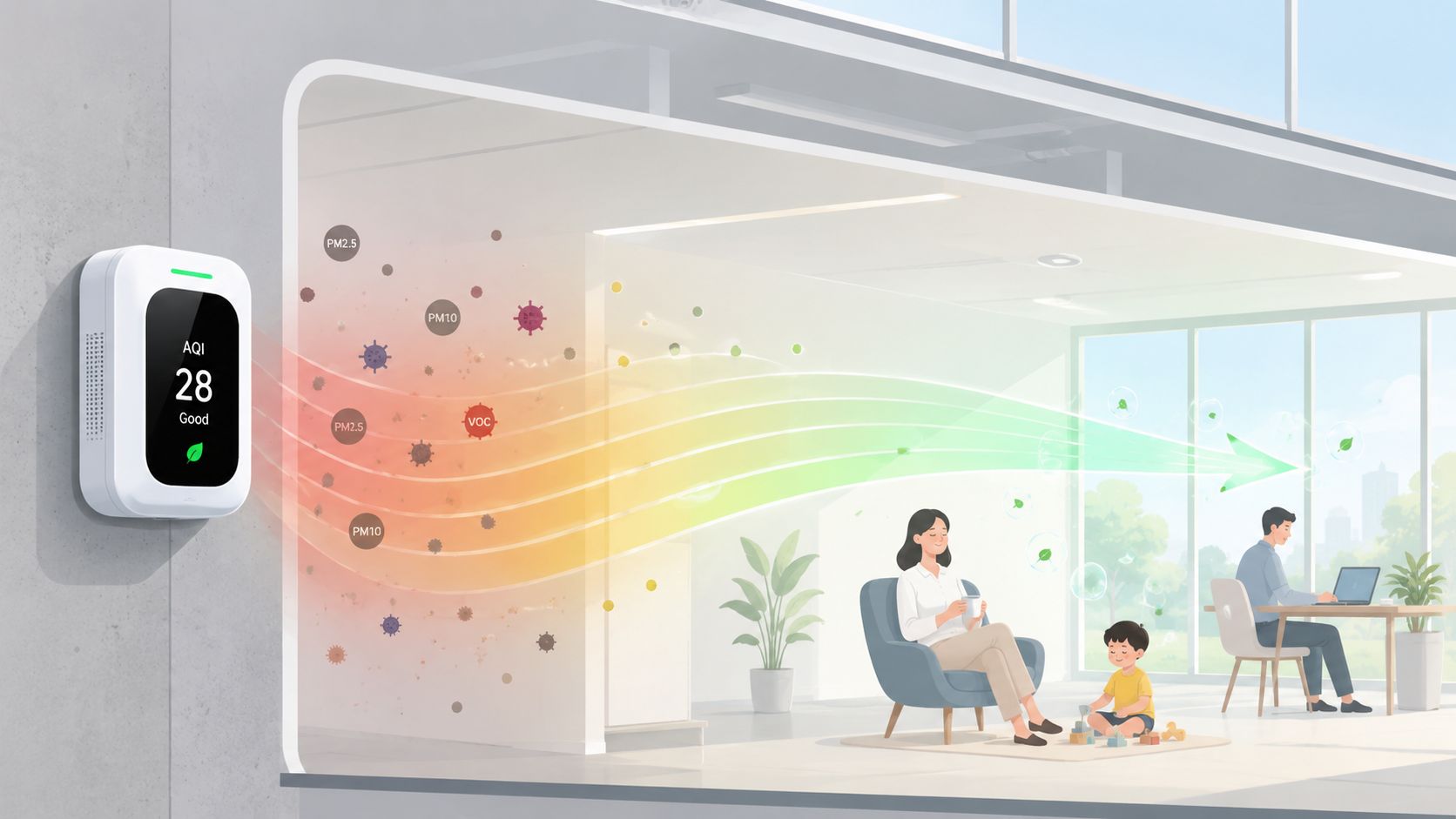
A customer walks into your facility and makes a judgment before reading a sign, before speaking to staff, and before touching a single surface. They notice the scent, the temperature, whether the air feels heavy, and whether the room feels fresh or stale. In a gym, that judgment happens between the front desk and the first treadmill. In a dealership, it happens while they wait near the showroom floor. In an airport lounge, it happens the second they sit down and take a breath.
That's why cleanliness can't stop at what people see.
A polished counter and spotless restroom matter. So do disinfectant wipes, visible wipe stations, and a staff routine that hits the right touchpoints at the right time. But if the air feels stuffy, chemical-laden, or dusty, people read the whole environment as less safe. An air quality monitoring system gives operators a way to manage that invisible layer of hygiene with the same discipline they bring to floors, fixtures, and equipment.
Used well, it becomes more than a sensor on a wall. It becomes the signal that tells your team when ventilation needs help, when crowding is changing risk, and when a standard wipe-down should become a more targeted sanitation response.
Beyond First Impressions What the Air Says About Your Facility
A clean-looking facility can still feel unclean.
That disconnect shows up all the time in commercial spaces. The lobby smells overly fragranced after a heavy cleaning round. A group fitness room looks organized, but the air feels warm and rebreathed. A waiting area has shiny tables and fingerprint-free glass, yet guests still shift in their seats because something feels off. They may not say “poor indoor air quality,” but that's often what they're reacting to.
Why people connect air with safety
Occupants use air as a proxy for care. If the air feels stale, they assume ventilation is weak. If it smells sharp with chemicals, they assume products are overused or poorly managed. If the room feels heavy during peak occupancy, they often conclude the space is crowded, poorly cleaned, or both.
That matters because sanitation is partly operational and partly psychological. People need to see evidence that a facility is managed well.
Practical rule: If the air says “neglected,” your surfaces won't fully earn trust, even when they're clean.
This is especially important in high-turnover environments. Gyms, schools, retail stores, restaurants, and public venues all rely on repeated short interactions. Customers don't conduct technical audits. They make fast decisions based on comfort and confidence.
Visible cleaning needs an invisible counterpart
Visible surface care still does heavy lifting. In busy environments, staff should focus on the 15 to 20 critical high-touch spots, including doorknobs, light switches, shared keyboards, and POS systems, using a proper dwell-time protocol because that targeted approach helps reinforce trust and lower health risk, as noted by guidance on high-touch room cleaning.
For fitness spaces, frequency matters even more. Gym equipment used by many people daily should be wiped down after every single use, with staff making regular rounds on dumbbells, machine handles, and mats, according to this gym cleaning guidance.
A strong program combines both layers:
- Visible proof: stocked wipe stations, clean entries, dry floors, and consistent staff routines.
- Invisible proof: fresh air, stable comfort, and monitored conditions that don't leave guests guessing.
- Operational proof: cleaning teams respond to actual conditions instead of relying only on the clock.
When managers connect indoor air and surface hygiene, cleanliness stops being cosmetic. It becomes measurable.
Decoding the Data What an Air Quality Monitor Actually Measures
Most operators don't need a lab-grade explanation. They need to know what the readings mean inside an occupied building.
An air quality monitoring system is useful when it turns raw numbers into plain-language decisions. Think of it as a dashboard for conditions people can feel before they can describe them.

The four readings that matter most indoors
Here's the practical version.
| Measure | What it tells you | What it often means operationally |
|---|---|---|
| CO2 | How well a space is ventilated relative to occupancy | Air exchange may be lagging when the room fills up |
| PM2.5 | Fine airborne particles like dust and aerosols | Particles are lingering instead of clearing out |
| VOCs | Gases from products, materials, and some odors | Cleaners, finishes, fragrances, or stored chemicals may be affecting comfort |
| Temperature and humidity | Comfort and moisture balance | Too much humidity can support dampness concerns, while poor comfort affects dwell time and perception |
CO2 is the easiest starting point for many facilities. It doesn't tell you everything about contamination, but it does tell you whether people are breathing in a space with adequate fresh air. If occupancy rises and CO2 climbs, your ventilation strategy may not match actual use.
PM2.5 is different. It captures very small particles that stay suspended in air. In crowded or active spaces, that matters because what stays airborne eventually settles on surfaces too.
What the numbers mean for health and comfort
High-precision systems don't just produce abstract readings. They show a direct connection to occupant outcomes. A 10 µg/m³ increase in PM2.5 can correlate with a 6 to 8% rise in acute respiratory incidents, while keeping CO2 below 1,000 ppm can reduce sick building syndrome symptoms by 25%, according to these technical air monitoring specifications.
That's why smart operators treat the monitor as part of maintenance, not just compliance. The same mindset used in predictive maintenance for industrial facilities applies here. You watch signals, catch drift early, and respond before discomfort becomes complaints.
Poor readings don't always mean your building is dirty. They often mean your building is out of balance.
VOCs deserve special attention because they're often self-inflicted. New furniture, air fresheners, floor finishes, and even storage practices can cloud indoor comfort. If you're also dealing with allergies or filtration concerns, this guide on allergen control and filtration strategy is a useful companion to monitoring data.
Connecting Air Quality Data to Your Sanitation Strategy
Most cleaning programs are still calendar-based. Restrooms every hour. Front desk every shift. Equipment rounds every so often. That structure helps, but it misses the real question. What changed in the building today that should change the cleaning response?
That's where air data becomes operational.
When CO2 rises, the room is telling you occupancy and ventilation are out of sync. When PM2.5 spikes, airborne particles are hanging around longer than they should. In both cases, some of what's in the air will also settle onto handles, touchscreens, counters, armrests, and equipment.

The monitor should trigger action
A sanitation program gets stronger when the air quality monitoring system acts like a command signal.
Instead of asking janitorial staff to clean the same way regardless of conditions, use air readings to shape the response:
- Higher occupancy with weak air exchange: increase wipe-down frequency for shared touchpoints.
- Particle spike after a rush period: target surfaces where settling is most likely, especially communal equipment and counters.
- Chemical buildup from products: improve ventilation and review which products are being used, where, and how often.
Why this makes cleaning more efficient
This approach doesn't replace scheduled cleaning. It sharpens it.
A team that uses sanitizing wipes only on a static route may miss the exact zones that just experienced a crowd surge. A team that watches the monitor can redirect effort toward the entrance cluster, the cardio area, the reception desk, the touchscreen kiosks, or the seating bay that needs attention.
Operational insight: Air data tells you where your sanitation plan should get smarter, not just busier.
That's also how you justify supply decisions. If you stock commercial disinfecting wipes and place them where occupancy and contact rates rise together, you get a more credible hygiene program than if you increase product volume everywhere.
The strongest facilities don't separate air and surface cleaning. They treat them as one sanitation system with two outputs. One is invisible and measured by sensors. The other is visible and delivered by staff.
Air Quality Management in Action Across Different Facilities
The value of monitoring becomes obvious when you tie readings to a real workflow. Different facilities need different responses, even when the trigger starts with the same dashboard.

Gyms and fitness centers
A packed spin class ends. The room doesn't look messy, but the air feels exhausted. The monitor confirms what staff can already sense. Ventilation needs help, and the room needs a faster reset before the next group arrives.
That's the moment for a combined response:
- Open the ventilation path or adjust HVAC settings.
- Send staff in with gym wipes or wipes for gym equipment for bikes, touchscreens, door handles, and benches.
- Restock the gym wipe dispenser before the next class starts.
- Use yoga mat wipes or dedicated fitness wipes where shared mats are part of the class rotation.
For gym owners, customer trust stems from these practices. Members don't just want clean equipment. They want to see that the room is being managed between sessions.
Offices, schools, and retail
In offices and schools, the warning sign is often a meeting room, classroom, or shared workstation area that feels stale late in the day. In retail, it may be the fitting room corridor, front counter, or a checkout line zone.
A practical response is less about deep cleaning and more about timing. Staff can quickly hit touchpoints with antibacterial wipes or disinfectant wipes, then address airflow before the next occupancy wave. For sales teams in the cleaning industry, this is a strong conversation point with clients. Don't sell wipes as a commodity only. Sell them as part of a response system tied to building conditions.
Restaurants, dealerships, and public venues
Restaurants and dealerships often struggle with chemical and odor management as much as dust or crowding. In a dealership, VOC-related discomfort can come from materials, detailing products, or enclosed showroom areas. In restaurants, transitions between kitchen-adjacent and customer-facing areas can create uneven comfort.
A good response looks like this:
| Facility | Air signal | Surface action |
|---|---|---|
| Restaurant | air feels heavy near the ordering area | wipe POS screens, counters, door pulls, and waiting-area tables |
| Dealership | showroom smells chemical or stale | ventilate, then wipe desks, pens, door handles, and customer seating arms |
| Airport or event space | crowded gate or check-in zone feels stuffy | clean kiosk screens, armrests, queue rails, and shared seating touchpoints |
If you sell supplies, bundle the message. Pair monitor-informed routines with bulk gym wipes, gym equipment cleaning wipes, or multi-surface products for customer-facing zones. Buyers respond better when they understand what the wipes are helping them do.
Choosing and Placing Your Monitoring System for Actionable Insights
A bad sensor location gives you clean-looking charts and bad decisions.
That's one of the most common mistakes in indoor monitoring. Managers install a device where it's convenient, not where it reflects occupant experience. Then they wonder why the numbers don't match complaints from staff or guests.
Where placement goes wrong
Proper sensor placement is critical because many guides miss indoor complexities. Nearby structures or even stored cleaning products can filter pollutants and produce falsely low readings, and there's still a lack of standardized siting protocols for unusual environments such as short-term rentals or car dealerships, according to the EPA air sensor siting guide.
In practice, these are the common errors:
- Near vents or returns: the sensor reads HVAC behavior, not room conditions.
- Next to windows or doors: every opening event distorts the trend.
- Beside kitchens or chemical closets: the reading becomes hyper-local and misleading.
- Hidden behind furniture or décor: blocked airflow dulls the value of the device.
What usually works better
Place the monitor where people breathe and linger. In most facilities, that means an occupied zone rather than a back wall or mechanical corner.
Use this checklist:
- Choose breathing-zone height: put the device where seated or standing occupants spend time, not near the ceiling.
- Prioritize representative spaces: monitor the spin room, waiting area, classroom, reception desk, or sales floor. Don't default to the least disruptive wall.
- Separate from supply sources: keep distance from vents, open doors, and direct drafts.
- Avoid product storage influence: don't place the unit near janitorial closets, fragrance systems, or detailing supplies.
If the sensor sits in the wrong place, your team may clean the wrong place harder.
For buyers comparing systems, the best question isn't “What can this unit measure?” It's “Can this unit help my staff act with confidence?” If the answer depends on perfect conditions that your building doesn't have, keep looking.
Building a Data-Driven Cleaning SOP From Alerts to Action
Most facilities don't need a complicated protocol. They need a simple SOP that tells staff what to do when the monitor changes from normal to concerning.
The strongest version is tiered. It links readings to ventilation steps, cleaning steps, and communication steps so nobody has to improvise during a rush.

A simple alert model
You can organize the SOP into three levels.
| Alert level | What staff sees | What staff does |
|---|---|---|
| Green | normal indoor conditions | continue routine cleaning and restocking |
| Yellow | rising occupancy, stale feel, moderate air concern | increase ventilation, add an extra high-touch wipe-down round |
| Red | sharp air deterioration or repeated complaints | immediate targeted sanitation response, supervisor review, ventilation correction |
This structure works because it's easy to train and easy to audit.
Match the action to the product
For yellow-level conditions, use fast-turnaround wipe rounds on counters, handles, rails, touchscreens, and shared tools. In gyms, this may mean extra passes with gym equipment wipes or workout wipes on high-contact machines and benches. In front-of-house commercial spaces, it may mean quick response kits with EPA registered disinfecting wipes for desks, kiosks, and waiting-area furniture.
For red-level conditions, product technique matters. Surfaces must remain visibly wet for the full manufacturer contact time, which can range from 15 seconds to 10 minutes. If the surface dries too early, the germ-killing process is incomplete, as explained in this guide to proper disinfectant wipe contact time.
That single point changes training. Staff often wipe too lightly, use too little product, or move on too fast.
Don't judge a wipe program by how fast surfaces dry. Judge it by whether the product stayed wet long enough to work.
Train for consistency, not heroics
A reliable SOP includes:
- Defined triggers: who checks the dashboard and when.
- Named zones: which equipment, fixtures, and touchpoints belong to each alert level.
- Assigned roles: front desk, janitorial crew, floor staff, and supervisor responsibilities.
- Supply standards: where bulk gym wipes or refill stock are stored and how replenishment gets logged.
If your team needs help documenting that process, this guide to best practices for SOP implementation is a useful reference. It also helps to pair the SOP with adjacent maintenance routines such as this article on a HEPA filter replacement schedule, because air response and filtration upkeep need to stay aligned.
For sales professionals, hygiene ROI becomes real. A wipe product is easier to defend when it's attached to a monitored response plan, reduced guesswork, and cleaner execution across teams. A Total Cost of Use view often favors wipes because it includes labor savings, reduced cross-contamination, less chemical overuse, and more reliable compliance, as discussed in this overview of wipe program cost logic.
From Invisible Data to Visible Trust Your Competitive Edge
Facilities that measure only what people can see are missing half the hygiene story.
An air quality monitoring system helps you prove that your building isn't just tidy. It's managed. That distinction matters to employees, members, customers, and prospective clients who want confidence, not guesswork. It also matters commercially. The global air quality monitoring system market was valued at USD 5.73 billion in 2024 and is projected to reach USD 11.62 billion by 2034, according to Polaris Market Research on air quality monitoring system growth. That projection reflects how seriously organizations are taking air as part of health and safety infrastructure.
The competitive edge comes from pairing that data with visible action. Better ventilation decisions. Smarter wipe-down timing. Cleaner high-touch routines. Better stocked stations. More credible conversations with customers who are paying attention to hygiene standards.
If you present monitoring results to ownership teams or clients, clear visuals matter as much as the readings themselves. This practical guide from PlotStudio AI on data presentation is worth reviewing before you build dashboards or review packs.
Prioritize both sides of cleanliness. Measure the air. Act on the data. Tighten your SOP. Keep the right commercial disinfecting wipes and supporting supplies close to the point of use. If you're refining your routine or product offering, explore practical sanitation guidance and facility cleaning ideas at WipesBlog.com and make daily cleanliness more visible, more credible, and easier to sustain.
Leave a Reply