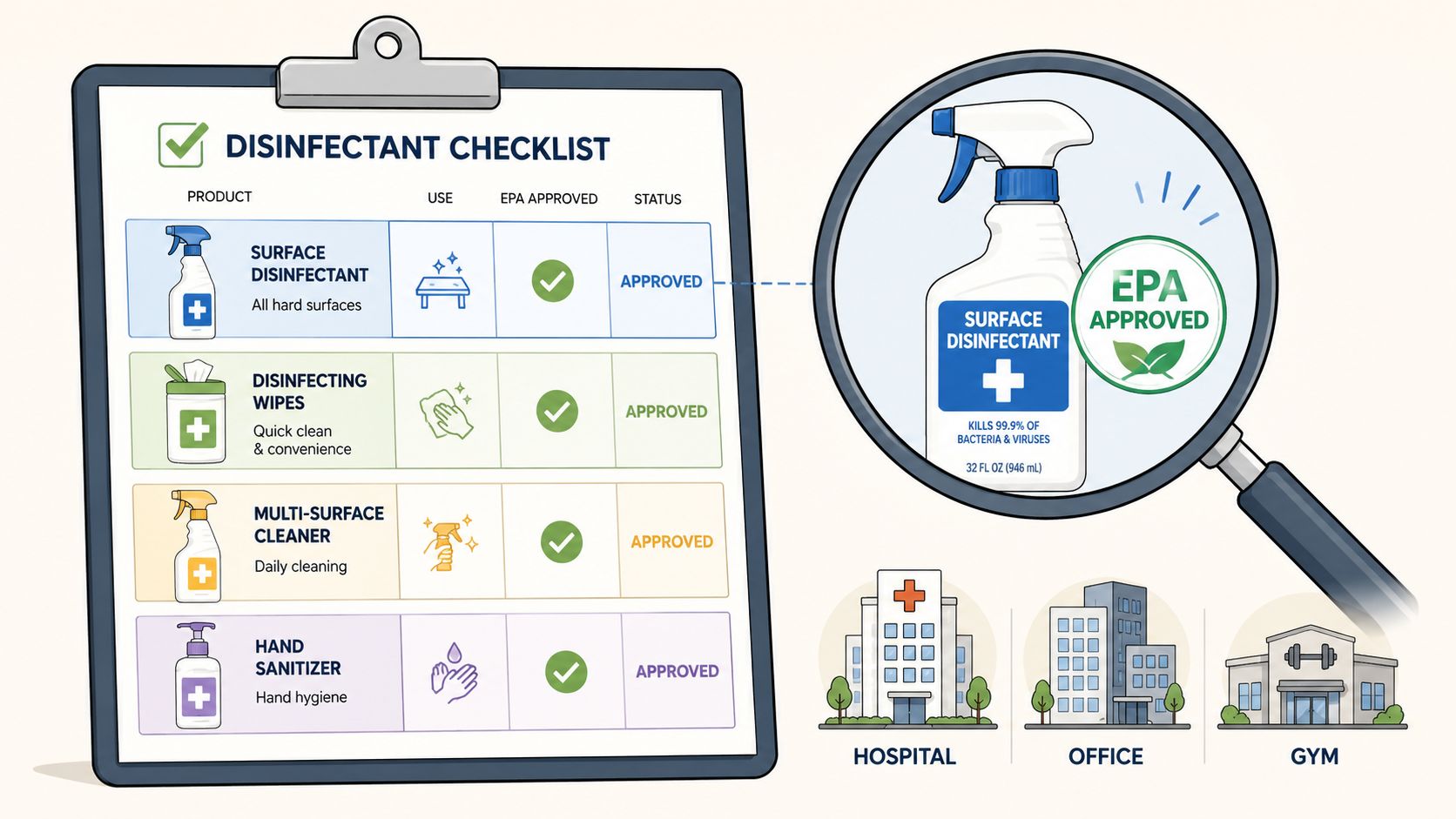
The EPA disinfectant lists usually become urgent in the middle of a normal shift. A supplier says a new product covers everything. A customer asks whether your wipes work against the virus currently in the news. A compliance manager wants proof from the label and registration record, not a brochure. That is when facility teams find out whether their process is built on verified claims or assumptions.
For gyms, offices, schools, restaurants, dealerships, and mixed-use facilities, the EPA registered disinfectants list is more than a reference page. It affects what you buy, how you train staff, how you respond to incidents, and how quickly supervisors can confirm that a product matches the job. Product fit matters at the floor level. A disinfecting wipe may be fast and convenient, but if the label does not support the organism claim, surface type, or required wet contact time, it creates risk instead of reducing it. Teams that need a refresher on disinfectant contact time requirements should settle that before they standardize any product.
The larger lesson is simple. There is no single EPA master list for every pathogen. The agency maintains multiple organism-specific lists, along with label and product databases, and each tool answers a different operational question. One list helps verify coronavirus claims. Another is built for C. diff spores. Others address norovirus, TB, hepatitis claims, or emerging viral pathogens.
This guide treats those EPA resources as a working toolkit for facility managers. Use it to verify products by EPA Reg. No., train crews on what claims mean, tighten SOPs, and build a cleaning program that supports both risk reduction and day-to-day efficiency. It also helps teams choose where disinfecting wipes make sense in daily operations, especially on high-touch surfaces where visible cleanliness, fast deployment, and consistent staff use all matter.
1. Selected EPA-Registered Disinfectants (Gateway to All Lists)

A supervisor gets asked a familiar question during a shift change. “We need an EPA-registered disinfectant. Which one?” If the answer starts and ends with the word registered, the team is already a step behind.
The Selected EPA-Registered Disinfectants page is the right starting point when the organism, claim, or use case is still unclear. It brings the main EPA disinfectant lists into one hub, which makes it easier to move from a broad request to the correct verification path. For facility managers, that saves time and cuts a common purchasing error: approving a product that is EPA-registered, but not registered for the problem you are trying to solve.
This page earns its place in an SOP because it supports three jobs that happen every week in real buildings:
- Route the question to the right list: Staff can separate a coronavirus question from a norovirus, C. diff, TB, or emerging pathogen question before they order or deploy anything.
- Verify the product by EPA Reg. No.: Buyers and supervisors can confirm the actual registration instead of relying on front-label language or distributor shorthand.
- Standardize training: It gives trainers one EPA page to reference when teaching crews how to check claims, labels, and product fit.
The operational payoff is consistency. Procurement buys with fewer mistakes. Supervisors spend less time correcting product swaps. Frontline staff get clearer instructions, especially in mixed-use facilities where restrooms, fitness equipment, waiting areas, and clinical touchpoints may each call for different products or claims.
One detail worth teaching early is EPA registration number matching. Staff should know how to read the first two parts of the EPA Reg. No. and use that information to check whether a product maps back to the underlying registration. That habit reduces guesswork when private-label products, distributor brands, or equivalent products enter the supply chain.
Practical rule: If your purchaser cannot explain how your team verifies an EPA Reg. No., product approval is still based too heavily on trust.
For disinfecting wipes, product selection only solves half the problem. Crews also need to understand the required disinfectant contact time on surfaces so the wipe used in practice matches the claim approved on paper.
2. List N Tool: Disinfectants for Coronavirus (COVID-19) – Advanced Search

A supervisor is covering a busy shift, a case gets reported, and the question comes fast: which approved product can staff use on these surfaces right now? The List N advanced search page is one of the few EPA tools built for that kind of operational pressure. Teams can filter by brand, partial EPA registration number, formulation, use site, and contact time.
That filter set matters in real buildings. A fitness center may need one wipe for member self-service on equipment and another product for staff disinfection rounds in locker rooms and restrooms. An office may need fast-turn products for reception counters and shared desks. A healthcare-adjacent facility may need to screen for use sites and contact times before approving anything for frontline deployment.
The practical value is speed with control. Managers can build a short list without asking crews to sort through hundreds of label variations by hand. Procurement can compare products that fit actual use conditions instead of buying based on broad front-label language such as "hospital grade."
List N's limitation is just as important. It answers a narrow question well: whether a product is included for use against SARS-CoV-2. It does not replace organism-specific planning for norovirus, C. diff spores, tuberculosis claims, or bloodborne pathogen protocols. Facilities get into trouble when a COVID-era approval gets treated like a blanket answer for every disinfection need in the building.
I advise clients to use this page as a screening tool, not a final approval tool. Build the shortlist here. Then confirm the exact label, use directions, surface compatibility, and contact time before the product reaches a cart, wall station, or self-service wipe bucket.
- Best fit: Fast SARS-CoV-2 product screening by use case
- Useful filters: Contact time, formulation, brand family, EPA Reg. No., and use site
- Operational benefit: Faster product selection, fewer purchasing mistakes, clearer staff guidance
- Common mistake: Treating List N status as proof of broad-spectrum disinfection coverage
For facility managers, that distinction saves time and reduces risk. The advanced search page helps translate a large federal list into a usable purchasing and training tool, especially when wipes, sprays, and ready-to-use formats all compete for the same budget and labor minutes.
3. About List N (How to Use and Interpret List N)

A common failure point shows up after the product is already in the building. A supervisor orders a disinfectant wipe listed for COVID-19, the team starts using it across classrooms, locker rooms, or guest touchpoints, and no one has explained what the listing confirms. That is where confusion turns into exposure, rework, and avoidable purchasing mistakes.
The About List N page is useful because it translates EPA language into answers managers can use. It explains how products qualify for List N, what the list is intended to cover, and how to read the fine print around use directions and contact time.
For facility managers, this page works best as a training reference, not a shopping tool.
Use it when operations asks whether one approved product can cover every area in the facility. Use it when HR or compliance needs defensible language for a policy. Use it when frontline staff need a clear explanation of why one wipe is approved for a quick turnover task but a different product is needed for a higher-risk pathogen or surface.
The trade-off is straightforward. List N simplifies SARS-CoV-2 decision-making, but it does not replace organism-specific planning or label review. A product can be EPA-registered, stocked on a cart, and still be the wrong choice for the actual exposure risk, dwell time, or surface material in front of the worker.
That distinction matters in daily operations. Teams lose efficiency when they rely on one broad instruction such as "use the approved wipe everywhere." Better SOPs are more precise. Match the product to the pathogen claim, surface type, required wet time, and use setting. That reduces misuse, protects surfaces, and gives supervisors a cleaner standard to train and audit against.
I tell clients to use this page to explain the rules behind the list, then verify the exact product label before rollout. That approach reduces compliance gaps and keeps procurement, training, and infection prevention aligned.
4. List Q: Disinfectants for Emerging Viral Pathogens (EVPs)

List Q matters when your facility plans for the next outbreak instead of reacting to the last one. The EPA List Q page for Emerging Viral Pathogens helps organizations choose disinfectants under the EPA's EVP guidance.
Planners for airports, event venues, schools, and fitness chains ought to dedicate more time to this than they typically do. It's a forward-planning tool, not just a crisis tool.
Why outbreak planning belongs here
The EPA's pathogen framework includes separate lists such as List P for Candida auris, List K for Clostridioides difficile, and List Q for emerging viral pathogens including Mpox and Norovirus, as summarized in the UNC SPICE disinfection reference. List Q organizes viruses into three tiers based on resistance and includes contact times that can range from 1 minute to 10 minutes depending on the product and active ingredient, according to that same reference.
That detail changes real-world purchasing. A fast-turn environment like a short-term rental, dealership waiting area, or group exercise studio may prefer a product with a shorter listed contact time if the label also fits the surface and use site. A slower but more controlled setting may accept a longer wet time.
- For gym operators: Keep workout wipes or wipes for gym equipment near high-touch stations, but verify that your selected product fits the pathogen plan you're preparing for.
- For schools and public venues: Build outbreak annexes into SOPs before you need them.
- For sales reps: List Q is a strong consultative entry point. It helps you talk about preparedness, not just product stock.
5. List K: Registered Products Effective Against Clostridioides difficile (C. diff) Spores

C. diff changes the conversation because spores are harder to deal with than routine daily soil or common viral concerns. The EPA List K document is the reference point when your facility needs products specifically effective against Clostridioides difficile spores.
That won't matter in every office. It matters a lot in healthcare-adjacent spaces, restrooms with high public volume, athletic training rooms, and facilities that host medically vulnerable populations.
The trade-off nobody likes
List K is useful, but the format feels older and less intuitive than newer search pages. That doesn't make it unimportant. It means your team needs a tighter verification process.
The best use of List K is narrow and disciplined. Pull the candidate products, confirm the EPA Reg. No., then move to the label system before the product ever reaches a cart or janitor closet. Staff should also know that distributor versions and lookalike brands aren't automatically interchangeable unless the registration details support that conclusion.
If a pathogen requires a special list, don't substitute a “close enough” product because it's already in inventory.
For facility operators, this list also reinforces a larger rule. Cleaning and disinfecting are not the same task. Staff still need to remove soil first where labels require it. Disinfectant wipes help on surface-level contamination and high-touch touchpoints between deeper cleaning cycles, but they don't replace the scheduled deep cleaning program your building needs for full hygiene coverage, as noted in this guidance on wipes versus broader cleaning routines.
6. List G: Registered Products Effective Against Norovirus

If you oversee food-adjacent areas, shared restrooms, or hospitality suites, norovirus planning deserves more attention than it gets. The EPA List G reference gives you product names and EPA registration numbers tied to norovirus efficacy.
This list is especially relevant for schools, restaurants, concession zones, breakrooms, daycare-adjacent operations, and any venue where gastrointestinal illness can disrupt operations quickly.
Where List G fits into daily routines
List G isn't an all-day operational tool in the way List N advanced search is. It's better used for SOP design, approved product lists, and incident response planning. Once you've selected products, crews need simple instructions they can execute under pressure.
For routine prevention, teams should focus on the surfaces people repeatedly touch with contaminated hands:
- Restroom touchpoints: Faucet handles, stall latches, flush handles, door pulls
- Food-adjacent areas: Refrigerator handles, microwaves, condiment stations, tables
- Retail and front-of-house surfaces: POS screens, counters, carts, basket handles
In a gym café or juice bar, don't let “gym equipment cleaning wipes” become the default answer for nearby food-prep touchpoints. Surface compatibility and use site approval still matter. In schools, keep separate routines for classrooms and shared washrooms. In restaurants, train staff on the difference between food-contact cleaning protocols and disinfection workflows.
A practical sales tip here is bundling. If you're selling bulk gym wipes or a gym wipe dispenser program, pair that discussion with separate restroom and food-area product planning rather than pretending one wipe solves every zone.
7. List E: Registered Products Effective Against TB, HIV-1, and HBV

List E becomes important when your facility needs a documented response for blood or body fluid incidents. The EPA List E PDF consolidates products with claims related to TB, HIV-1, and HBV.
Athletic training rooms, school nurse spaces, event medical areas, and first-aid rooms should have this reference behind the scenes even if staff never open it during routine operations.
Good for planning, weak for speed
The strength of List E is specificity. The weakness is that it's a static document, so you shouldn't stop there. Pull the product names and registration numbers, then verify the current accepted label before writing post-incident instructions.
For frontline teams, the main takeaway is procedural. Biohazard cleanup shouldn't rely on whatever antibacterial wipes happen to be closest. The selected product has to match the hazard, and the response steps need to be written before an incident happens.
That doesn't mean wipes have no place here. Disinfectant wipes can be part of the broader kit for certain hard nonporous touchpoints, especially in athletic settings where minor blood exposure incidents can happen. But the product choice, PPE expectations, and disposal steps still need formal review.
For cleaning distributors, this is a strong credibility category. Clients remember the rep who asks, “What is your bloodborne incident protocol?” much more than the rep who only talks case pricing.
8. List F: Registered Products Effective Against Hepatitis C

List F complements List E. The EPA List F PDF identifies disinfectants effective against Hepatitis C and supports broader bloodborne pathogen planning.
For many commercial facilities, this won't be a day-to-day document. It matters in risk assessments, vendor qualification, and incident-preparedness binders.
Where operators usually go wrong
They assume a general-purpose institutional wipe is enough because the packaging looks clinical. That's not a system. That's improvisation.
A better approach is to separate your products by scenario:
- Daily visible cleaning: Fast-access sanitizing wipes or disinfectant wipes for shared touchpoints
- Member-facing equipment care: Gym wipes, yoga mat wipes, or wipes to disinfect gym equipment where label directions fit the surface and task
- Incident response: Pre-approved products tied to your bloodborne protocol and training documents
Facility-specific planning proves its value. In a fitness center, training staff to distinguish between member convenience wipes and post-exposure response products prevents dangerous shortcuts. In schools and event venues, it keeps a minor first-aid event from becoming an improvised cleanup.
For sales teams, List F also supports a more complete offering. Don't just sell a bucket of fitness center wipes. Sell a category plan with front-of-house wipes, restroom chemistry, incident-response products, and dispenser placement.
9. Pesticide Product and Label System (PPLS) The Source of Truth

If you only use one EPA database regularly, use PPLS. It is the source of truth for accepted Section 3 product labels, and labels decide what your staff can legally and effectively do with a product.
PPLS isn't polished, but it solves the question that matters most in audits and SOP writing: what does the current label say?
Why labels beat marketing every time
Marketing copy might say a product is ideal for commercial disinfection. The label tells you whether it's approved for the organism, the surface, the use site, and the contact time. That's the difference between a defendable protocol and a hopeful one.
One detail that gets missed constantly is wet time. EPA-linked guidance notes that contact times can range from 0.5 minutes for hydrogen peroxide products to 5 minutes for quaternary ammonium compounds, and surfaces must stay wet for the full listed duration for SARS-CoV-2 claims to hold, according to this overview of EPA-registered disinfectant contact time. In other words, if staff wipe and move on too quickly, the disinfection step fails.
Field note: In fast-turn environments, the best product on paper can become the wrong product if crews never keep the surface wet long enough.
PPLS is where you confirm those details before training staff. It also helps when distributor brands complicate purchasing. This EPA registration number guide on WipesBlog is a useful companion for teaching buyers and supervisors how to interpret product identity correctly.
10. Pesticide Product Information System (PPIS) The Data Hub

A common multi-site problem looks like this. Corporate approves one disinfectant program, local buyers keep ordering lookalikes from different distributors, and six months later nobody can explain whether those products share the same active ingredients, registrants, or status. The Pesticide Product Information System helps sort that out before inconsistency turns into a training and compliance problem.
PPIS works best as a management database for procurement, standardization, and product review. It lets facility teams compare active ingredients, identify who registered a product, and check whether similar products demonstrate adequate similarity for a systemwide standard. That matters for janitorial contractors, franchise fitness operators, school districts, and regional healthcare-adjacent facilities where one weak substitution can create avoidable variation across sites.
Use PPIS to build the product shortlist. Use your label workflow to approve final use.
That distinction matters. PPIS supports portfolio decisions, while your operating procedures still need the exact label language your staff will follow on the floor. For facility managers, this is the point where EPA data becomes practical. Instead of treating the agency's disinfectant resources as a stack of disconnected databases, use PPIS as the ingredient and registration hub inside a larger verification process.
Market churn is part of the reason. In 2025, the U.S. EPA approved 178 new disinfectant registrations compared with 45 in 2024, according to the 2025 EPA disinfectant registration review. More registrations can give buyers better coverage and pricing options. They also create more room for duplicate products, inconsistent substitutions, and training drift if one person is not maintaining an approved list.
Practical ways to use PPIS
- Standardize by task, not by vendor catalog: Set approved products by use case, such as daily touchpoint disinfection, restroom disinfection, athletic equipment cleaning, and incident response.
- Compare actives before approving substitutes: Two products may sit in the same distributor category but create different wet times, odor profiles, material compatibility issues, or PPE requirements.
- Control brand sprawl across locations: PPIS helps central teams decide whether multiple branded products should stay in the program or be reduced to a smaller, easier-to-train set.
- Support wipe program decisions with operations in mind: Disinfecting wipes can improve speed and consistency, but only if dispenser placement, refill control, and staff accountability are built into the plan.
I usually tell clients to treat PPIS as a purchasing control tool. It reduces unnecessary SKU growth, makes substitutions easier to review, and helps procurement and operations work from the same product standard instead of arguing site by site.
For practical product education and dispenser planning, teams can also review options and facility-use ideas at Wipes.com.
EPA Disinfectant Lists Comparison
| Resource | Core features ✨ | Ease of use ★ | Value / Use 💰 | Target audience 👥 | Unique strength 🏆 |
|---|---|---|---|---|---|
| Selected EPA‑Registered Disinfectants (Gateway to All Lists) | Hub linking Lists N,Q,K,E,F,G; PPLS link; reg. no. guidance ✨ | ★★★★, clear hub; requires clicks | 💰 Free, high trust starting point | 👥 Facility managers, procurement, safety committees | 🏆 Authoritative gateway to all EPA lists |
| List N Tool: Disinfectants for Coronavirus (Advanced Search) | Interactive filters (contact time, formulation, wipes), search by reg./brand ✨ | ★★★★, facility‑friendly filters | 💰 Free, speeds COVID‑19 product alignment | 👥 Operations with rapid turnaround (hotels, airports) | 🏆 Fast, operational filtering for SARS‑CoV‑2 |
| About List N (How to Use & Interpret) | Plain‑language guidance, FAQs, video tutorial, surrogate/interpretation help ✨ | ★★★★★, training‑ready, very clear | 💰 Free, reduces misuse & training errors | 👥 Trainers, SOP authors, compliance teams | 🏆 Excellent explanatory resource for correct use |
| List Q: Disinfectants for Emerging Viral Pathogens (EVPs) | Tier 1–3 EVP coverage; product links and label claim guidance ✨ | ★★★, informative but needs label checks | 💰 Free, future‑proofing outbreak plans | 👥 Emergency planners, large venues, health liaisons | 🏆 EVP‑focused planning for emerging viruses |
| List K: Products Effective Against C. diff Spores | Sporicidal product list with EPA reg. nos and testing guidance ✨ | ★★★, PDF format; verify via PPLS | 💰 Free, critical for spore control in high‑risk zones | 👥 Restroom managers, clinics, LTC facilities | 🏆 Focused list for the toughest spore threats |
| List G: Products Effective Against Norovirus | Norovirus efficacy (surrogate data); SOP aid for food/restrooms ✨ | ★★★, legacy format; confirm labels | 💰 Free, standardizes GI prevention SOPs | 👥 Food service, hospitality, schools | 🏆 Targeted norovirus guidance for food‑adjacent areas |
| List E: Products Effective Against TB, HIV‑1 & HBV | Tuberculocidal & bloodborne pathogen claims; reg. nos ✨ | ★★★, static PDFs; label verification needed | 💰 Free, speeds high‑risk biohazard cleanup selection | 👥 First‑aid rooms, athletic trainers, back‑of‑house staff | 🏆 Consolidated bloodborne pathogen product reference |
| List F: Products Effective Against Hepatitis C | Product tables for HCV (complements List E); reg. nos ✨ | ★★★, older doc format; cross‑check labels | 💰 Free, clarifies HCV efficacy for incidents | 👥 Fitness centers, event medical teams | 🏆 HCV‑specific product clarity for incident response |
| PPLS: Pesticide Product and Label System (Source of Truth) | Stamped labels (PDFs); search by reg. no./product; API available ✨ | ★★★, utilitarian interface; most accurate | 💰 Free, required for compliance & audits | 👥 Compliance officers, auditors, procurement | 🏆 Official label source for verification and SOPs |
| PPIS: Pesticide Product Information System (Data Hub) | Structured database of products, ingredients, registration status ✨ | ★★★, data‑driven; pairs with PPLS | 💰 Free, speeds vendor vetting & ingredient reviews | 👥 Procurement, safety/risk teams, multi‑site ops | 🏆 Ingredient & registration data backbone for purchasing |
Make Verified Cleanliness Your Competitive Advantage
The EPA registered disinfectants list system isn't just a set of government pages. It's a working toolkit for operators who want fewer assumptions in their cleaning program. When you use the right list, verify the label, and train staff on wet time and use-site limits, you reduce risk and make your routines more consistent.
That consistency matters in public-facing environments. Customers notice whether a facility looks clean, smells clean, and has visible hygiene tools in the right places. Staff notice whether instructions are clear. Managers notice whether supplies are easy to reorder and whether cleaning rounds hold up under scrutiny.
Disinfectant wipes have a practical role in that system. They're fast, visible, and easy to deploy for high-touch surfaces between deeper cleaning cycles. But they only work when crews use them correctly. Wipes must keep the treated surface visibly wet for the full contact time, which can range from 30 seconds to several minutes for general wipes and up to 4 to 10 minutes for stronger commercial formulas, according to this explanation of how disinfectant wipes protect surfaces. If the surface dries too early, the job isn't finished.
That single point should shape your cleaning tips and your sales message. In gyms and fitness centers, best practice is to wipe equipment such as dumbbells, machine handles, and yoga mats after every use, while offices generally use daily wipe-downs of high-touch points like doorknobs, light switches, and shared keyboards as the baseline, according to this facility cleaning frequency guidance. If you're selling gym equipment wipes, commercial disinfecting wipes, or bulk gym wipes, don't stop at product claims. Teach clients where wipes fit, where they don't, and how dispenser placement affects compliance.
A practical routine works best:
- Focus on high-touch zones: Handles, screens, rails, counters, touchpads, and shared equipment should never be an afterthought.
- Match product to the task: Use the appropriate EPA list and confirm the label before assigning a product to a pathogen or incident type.
- Train to wet time, not wipe speed: Fast wiping feels productive, but incomplete contact time breaks the process.
- Support wipes with deep cleaning: Wipes are strong for daily maintenance and visible hygiene. They don't replace full scheduled cleaning.
- Give teams simple instructions: Staff follow clear zone-based rules more reliably than long chemical manuals.
Cleanliness is easier to defend when it's documented, visible, and verified. Prioritize a consistent schedule, tighten your product verification habits, and consider integrating convenient, effective sanitizing wipes into your daily routine or product offering. The facilities that earn trust aren't the ones with the loudest claims. They're the ones that can prove what they're using and why.
Leave a Reply