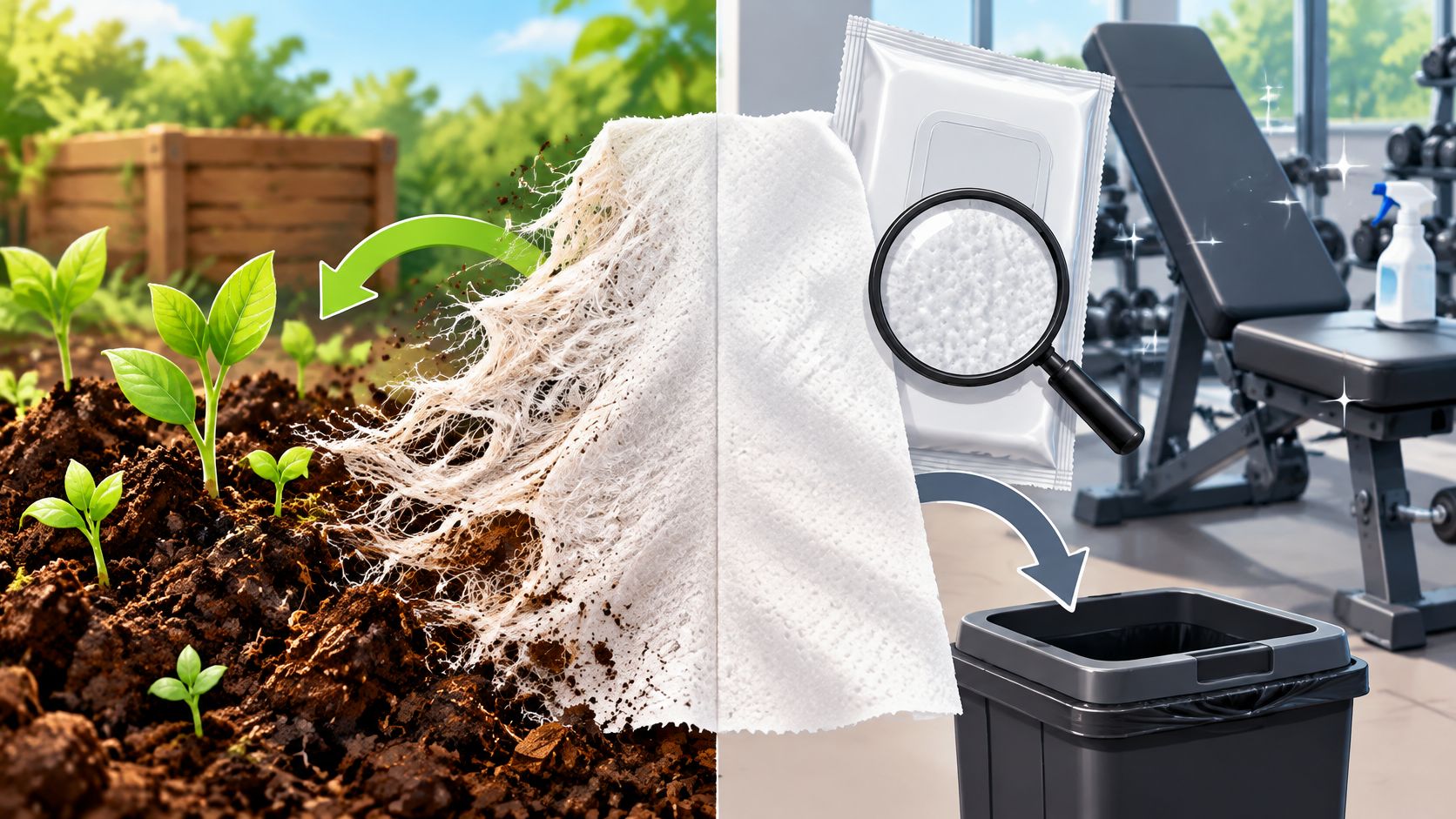
The standard advice about biodegradable disinfecting wipes is to swap the synthetic sheet for a plant-fiber one and treat the environmental question as settled. It isn't settled. A cellulose wipe and a polypropylene wipe can carry similar green language on the pack and behave nothing alike in a landfill, a compost windrow, or a river.
The fiber sets the ceiling on how fast the sheet breaks down. The disposal route decides whether that ceiling is ever reached. And the labeled contact time decides whether the sheet did its disinfecting job before it went in the bin.
Three things have to line up before a wipe earns its environmental claim: the fiber the sheet is built from, the route the used wipe travels, and a contact time your staff can hold while the sheet stays wet and intact. Miss one, and the claim on the label stops predicting what happens in your building. What follows is what the controlled test data shows, where disinfecting performance and biodegradability pull against each other, and how to specify, route, and buy biodegradable disinfecting wipes so the paperwork matches the practice.
Biodegradable Does Not Mean One Decomposition Rate
A biodegradable wipe is a material with a tendency, not a product with a speed. The rate depends on the fiber and on the environment the used sheet lands in, and the gap between those environments is wide enough to change a purchasing decision.
A 2025 review of wipe biodegradation data published by the Royal Society of Chemistry measured the spread. Cellulose wipes lost 89.4% of their weight after 120 days in aerobic soil, and viscose lost 98.1% over the same period. Under marine conditions, cellulose reached about 80% biodegradation within 30 days, and under compost at 55°C it produced roughly 90% carbon-dioxide evolution within 30 days after conditioning.
The synthetics tell the other half of the story. Polypropylene showed only about 4% carbon-dioxide evolution after 80 days under compost conditions. PLA, which plenty of buyers treat as the responsible middle ground, reached roughly 70% carbon-dioxide evolution under comparable compost conditions but only about 20% weight loss after 45 to 49 days in anaerobic landfill testing.
| Wipe fiber | Disposal setting | Reported result | Time frame |
|---|---|---|---|
| Cellulose | Aerobic soil | 89.4% weight loss | 120 days |
| Viscose | Aerobic soil | 98.1% weight loss | 120 days |
| Cellulose | Marine test | About 80% biodegradation | 30 days |
| Cellulose | Compost at 55°C | About 90% CO2 evolution | Within 30 days after conditioning |
| PLA | Compost at 55°C | About 70% CO2 evolution | Comparable compost conditions |
| PLA | Anaerobic landfill | About 20% weight loss | 45-49 days |
| Polypropylene (PP) | Compost | About 4% CO2 evolution | 80 days |

Read those columns together and the reason the label can't answer your question becomes obvious. These are controlled-test results, not guarantees for an ordinary landfill, a storm drain, or the soil behind a loading dock. Disposal route, temperature, oxygen availability, moisture, and microbial activity all move the number, so the same sheet can break down briskly in an industrial compost system and barely at all inside a sealed bag of trash.
Working rule for buyers: read the fiber and the disposal route as a pair. A cellulose or viscose sheet in a route that supports biological activity will break down on a scale of months. A polypropylene or polyester sheet will not, whatever the front of the pack says.
For a facility manager, the split that matters is by fiber family. A wipe built from cellulose, cotton, or viscose has substantially different end-of-life behavior from one containing polypropylene, polyester, or another synthetic fiber, and no amount of green packaging closes that distance.
Does a Biodegradable Wipe Still Disinfect?
A biodegradable wipe can disinfect effectively, but its fiber alone cannot prove that it will. Performance depends on how the sheet releases the formulation and whether the product passes an efficacy test for the intended use and labeled contact time.

The reformulation problem
Quaternary ammonium compounds, common disinfectant ingredients in facility wipes, can release differently from synthetic and cellulose fibers. A formulation designed for polyester or polypropylene may not transfer as effectively from cotton or another cellulose sheet. That makes a fiber change a formulation and testing question, not a simple material swap.
A review of cellulose wipe degradation and disinfectant release discusses research on a hospital-grade wipe made with 100% greige cotton and a formulation modified to release quaternary ammonium disinfectants from the sheet. The practical point is clear: ask whether the disinfectant formulation was developed and tested with the specific substrate, rather than assuming that results from a synthetic wipe apply.
A peer-reviewed review of disinfectant-impregnated wipes describes biodegradable constructions using cotton fibers bonded with bio-based biodegradable polymers. These designs must balance absorbency and sheet strength. The review also identifies higher material costs and inconsistent testing practices, which make direct product comparisons difficult, especially for healthcare-like conditions.
Why a weak sheet cancels good chemistry
Check the product specification for the properties that affect use:
- Wet tensile strength: The sheet should withstand a full pass over a rough surface without shredding. Tearing leaves fragments and can force staff to use another wipe.
- Linting: Low-lint sheets reduce fiber residue on glass, touchscreens, and stainless steel.
- Liquid release: The formulation must leave the sheet and wet the surface, rather than remain bound in the fiber.
- Saturation: Uneven moisture can leave parts of a surface without adequate coverage.
- Efficacy for the intended use: Check the tested organisms, surface type, formulation, and labeled contact time.
- Integrity through the pass: Confirm that the sheet stays intact and wet enough during use on your facility's benches, machines, and fixtures.
Contact time is part of the performance result. If a wipe leaves a surface dry before the labeled time has elapsed, the test claim does not show that the surface received the required exposure. A sheet that tears or releases liquid unevenly can make that failure more likely, even when the disinfectant itself has passed its test.
The disposal route also shapes the environmental result. A biodegradable claim does not establish how quickly a used wipe will break down in the conditions where it is discarded. For facility buyers, the relevant checks are therefore separate: substrate composition, disinfectant efficacy under the labeled conditions, and whether the intended disposal route supports the product's environmental claim.
How to Route Used Wipes Through Your Facility
A label answers a chemistry question. Routing answers an operations question, and the second one decides whether the first one means anything. The sequence is short enough to print and post inside a supply closet.

Write the route before you write the purchase order
- Read the label for flushability, then never flush the wipe. Biodegradability and flushability are separate properties, and a sewer line is not a compost system. Our guide to whether flushable wipes are actually safe covers what the "Do Not Flush" wording protects. If a dispenser sits in a restroom, put the bin next to it and say so on the sign.
- Confirm that your composting provider accepts disposable wipes. The EPA's Safer Choice and Design for the Environment standard recognizes composting test methods including EN 13432, ASTM D6400, ASTM D5338, and ISO 14855, and it also acknowledges that many composting facilities do not accept disposable wipes. A passing lab test and a willing hauler are two different approvals.
- Route to general trash or regulated waste when composting isn't accepted. Match the stream to your facility's waste rules and to what the sheet picked up, whether that's blood, bodily fluid, or a listed chemical.
- File the supplier's composition and disposal documentation with your waste records. Hauler questions, insurer questions, and audit questions all arrive months after the purchase order, usually from someone who wasn't in the room.
- Train staff to keep used wipes out of wet waste streams and to empty dispensers into the correct bin. A compost bin that receives coffee cups and gloves contaminates the load and can get the whole container rejected.
Staff areas are where routing breaks down first, because bins fill and labels fade. If overflowing break-room waste is already a problem, reduce break room vending waste covers source-reduction moves that shrink the volume long before it reaches the wipe bin.
The contrarian conclusion: for most buildings, better waste segregation and tighter procurement checks reduce more environmental harm than switching to a greener-labeled sheet. A standard wipe routed into the right stream beats a compostable wipe dropped into a wet trash bag.
That's also why the flushability warning keeps coming up in infrastructure reporting. A recent scientific review warns that flushability and degradability are different properties, and that inconsistent labeling continues to cause problems downstream, in pipes and pumps that never saw the product specification.
Where Gym Wipes and Office Wipes Fit Each Facility
A fitness center manager notices the same thing every evening. Members finish a set on the leg press, glance around for something to use, and walk to the locker room instead. The gym owns a cleaning contract, a spray bottle behind the front desk, and no rule about who wipes what, or when. Nothing in that picture is a product problem. It's a placement problem, and members read it as a cleanliness signal.

The gym fix is placement, not product
The CDC guidance for coaches and athletic directors recommends cleaning shared equipment after every use and letting it dry before the next use. Staff should focus daily on surfaces that come into direct contact with athletes' bare skin, and follow manufacturer instructions so the cleaner doesn't degrade upholstery, padding, or console plastics.
In practice that means gym equipment wipes stationed beside each cluster of weight machines and benches, yoga mat wipes at the mat rack, and a gym wipe dispenser at every shared touchpoint rather than one station at the front door. Fitness center wipes belong in the locker room too, near benches and fixtures, because that's where bare skin meets shared surfaces next. The workflow that survives a busy Tuesday is members or trainers cleaning equipment between sessions while custodians handle scheduled deeper cleaning. Visible dispensers, posted instructions, and a restocking log do more for compliance than any reminder email.
If the routine currently depends on one trainer remembering it, this gym sanitation schedule for trainers sets out a clean rotation that spreads the work across the team.
What schools, offices and retail stores should target first
CDC facility guidance names the surfaces that matter most: pens, counters, shopping carts, door handles, stair rails, elevator buttons, touchpads, restroom fixtures, and desks. High-traffic spaces may need more frequent cleaning or disinfection, and areas where someone has been visibly ill should be disinfected in addition to routine cleaning.
For frequency, borrow the ladder from CDC environmental cleaning procedures, where high-touch surfaces and floors in healthcare waiting or admission areas are cleaned at least once every 24 hours, consultation or examination areas at least twice daily, and procedure areas before and after each procedure. Commercial buildings carry lower risk, but the logic transfers directly: set a daily minimum for ordinary areas, twice-daily rounds for busy customer zones, and between-use cleaning for shared equipment.
| Facility | High-touch surfaces to target | Suggested wipe frequency |
|---|---|---|
| Gym | Weight machines, benches, mats, locker-room fixtures | After every use for shared equipment; deeper cleaning daily |
| School | Desks, door handles, stair rails, restroom fixtures | Daily minimum; twice daily in busy zones |
| Office | Pens, counters, desks, door handles, elevator buttons | Throughout the day; daily minimum for ordinary areas |
| Retail store | Shopping carts, counters, door handles, touchpads | Twice daily in customer zones |
| Restaurant | Dining tables, chairs, condiment dispensers, door handles, restroom fixtures | Between seating turns; restroom fixtures twice daily |
Restaurants need the tightest loop of the five, because tables turn and condiment dispensers get handled by every guest. Schools should hit desks, door handles, and stair rails first, since those carry the traffic. Offices and warehouses tend to concentrate risk at shared keyboards, counters, and elevator buttons, which is the mix we write for; WipesBlog names schools, gyms, warehouses and waiting rooms among the organizations it aims to help.
One constraint sits above all of it. The cleaner has to suit the equipment material, and staff must hold the label's wet contact time, which means a sanitizing wipe that dries in eight seconds on a warm bench isn't doing the job its registration claims. Test one machine before you commit a floor.
What Biodegradable Wipes Cost and When They Pay Off
The price gap is real and documented. The same review that credits bio-based bonding for mechanical strength also flags higher material cost as a significant limitation, so a biodegradable disinfecting wipe has to earn its premium through verified performance and fewer compliance problems, not through goodwill.
The per-wipe arithmetic that settles the argument
Run your own numbers before you argue about unit price. Say a fitness center has twelve shared stations, wipes them twice a day, uses one wipe per station per round, and operates 360 days. That's 8,640 wipes a year. Multiply by the per-wipe price from your supplier's case price and you have a controlled, forecastable line item.
Now compare that number to the alternative. Inconsistent cleaning doesn't appear as a budget line. It shows up as a lost membership, a complaint thread, an inspection finding, or a staff overtime spike before a health visit. The comparison isn't the per-wipe difference. It's the annual difference across 8,640 units weighed against the cost of one bad week.
Buying rule: negotiate the case price, never the contact time. A thinner sheet that forces two wipes per station costs more than the case you thought you were saving on.
That's how to buy bulk gym wipes and commercial disinfecting wipes without eroding performance. Case quantities and standing orders lower the per-wipe price, which is the right place to apply pressure. Sheet weight, saturation, and the labeled wet time are the wrong places to economize, because a wipe that fails mid-pass gets replaced by a second one and the saving disappears.
The market context your customers already know
Buyers arrive with some of this context, which changes the sales conversation. In 2024, synthetic materials accounted for 79.7% of global surface disinfectant-wipe revenue, according to Grand View Research. The U.S. biodegradable surface-disinfectant-wipes segment is projected to grow at a 5.6% compound annual growth rate from 2025 through 2033, per Grand View Research's U.S. market report. And in 2024, 74% of 600 professional cleaning-wipe end users surveyed by Kline + Company reported using environmentally friendly products, as published by Nonwovens Industry.
The sales implication is straightforward. Don't sell a green premium. Sell a verified hygiene decision: the test method, the registration number, the sheet specification, and the disposal route, all on one page. A buyer who can defend the choice to their own manager will renew it. That turns a hygiene-ROI conversation into an easy one, because the customer is no longer choosing between clean and green. They're choosing between documented and undocumented.
Verify Claims and Specs Before You Buy
A green label does not establish that a finished wipe biodegrades, disinfects, or can go in a compost bin. Those are separate claims, and each needs evidence that applies to the product being purchased.
Three claims, three different proofs
For a ready-biodegradability claim, ask for the test method and the pass result for the finished wipe. The product label record for a specific pesticide product illustrates why scope matters: a claim about an active ingredient or wipe fabric does not establish that the complete product has the same property.
Disinfecting performance needs its own documentation. Check the registration number and the product label for the pathogens, surfaces, and use directions covered. If a product carries the Design for the Environment label, confirm the label record for that exact product rather than assuming the designation applies to every wipe from the same supplier.
A biodegradable-substrate claim may cover only the sheet, not the liquid chemistry. Likewise, a compostability standard describes performance under defined test conditions; it does not confirm that a local composting provider accepts used wipes. The disposal route is part of the product decision, not an afterthought.
| Claim or label | What it covers | What to request |
|---|---|---|
| Ready biodegradability (OECD method) | Breakdown under the specified test conditions | Test method and pass result for the finished wipe |
| Design for the Environment label | The product identified by the label record | Label record for the exact product |
| Biodegradable fabric claim | The substrate, unless the claim explicitly covers more | Fiber composition and confirmation of claim scope |
| Compostable standards (EN 13432, ASTM D6400) | Composting under defined test conditions | Confirmation that the local provider accepts disposable wipes |
| EPA registration | Disinfecting claims listed for the product | Registration number, covered pathogens, and surfaces |
| Unqualified eco or green wording | No specific test or scope is established by the wording alone | Supporting documentation before purchase |
The pre-purchase checklist
- Finished-wipe test method and pass result. A fiber datasheet does not establish how the complete wipe performs.
- EPA registration number and label. Check the listed pathogens, surfaces, and directions. A general antibacterial claim does not substitute for the product's labeled disinfecting claims.
- Substrate specification. Review wet strength, linting, and liquid release, since these affect whether a wipe remains usable through the required contact time.
- Labeled contact time your team can maintain. If a surface dries before the labeled time is met, the disinfecting directions have not been followed.
- Disposal route confirmed with your waste or composting provider. A test standard does not guarantee local acceptance.
- Dispenser and placement plan. Put supplies where staff can use them at shared-touch areas, and make the disposal route clear.
Compare supplier documents side by side. A complete set should connect the finished-wipe test, disinfecting label, substrate specification, contact time, and disposal route to the same product. For help understanding what an EPA registration number covers, see this guide to reading an EPA registration number.
WipesBlog.com publishes sanitation and disinfection articles that break down best practices into practical guidance for facility managers and business owners. For a purchasing decision, that means judging the whole use case: a wipe's environmental claim depends on what was tested and where the used product goes, while its disinfecting result depends on following the labeled contact time.
Choose three high-touch clusters in your building and check whether dispensers are within reach. Post the required contact time and disposal route where staff can see them. Then request the test method, registration number, and sheet specification from the supplier. Add the product to your routine only when the documents support its claims and the disposal route works for your facility.
Leave a Reply