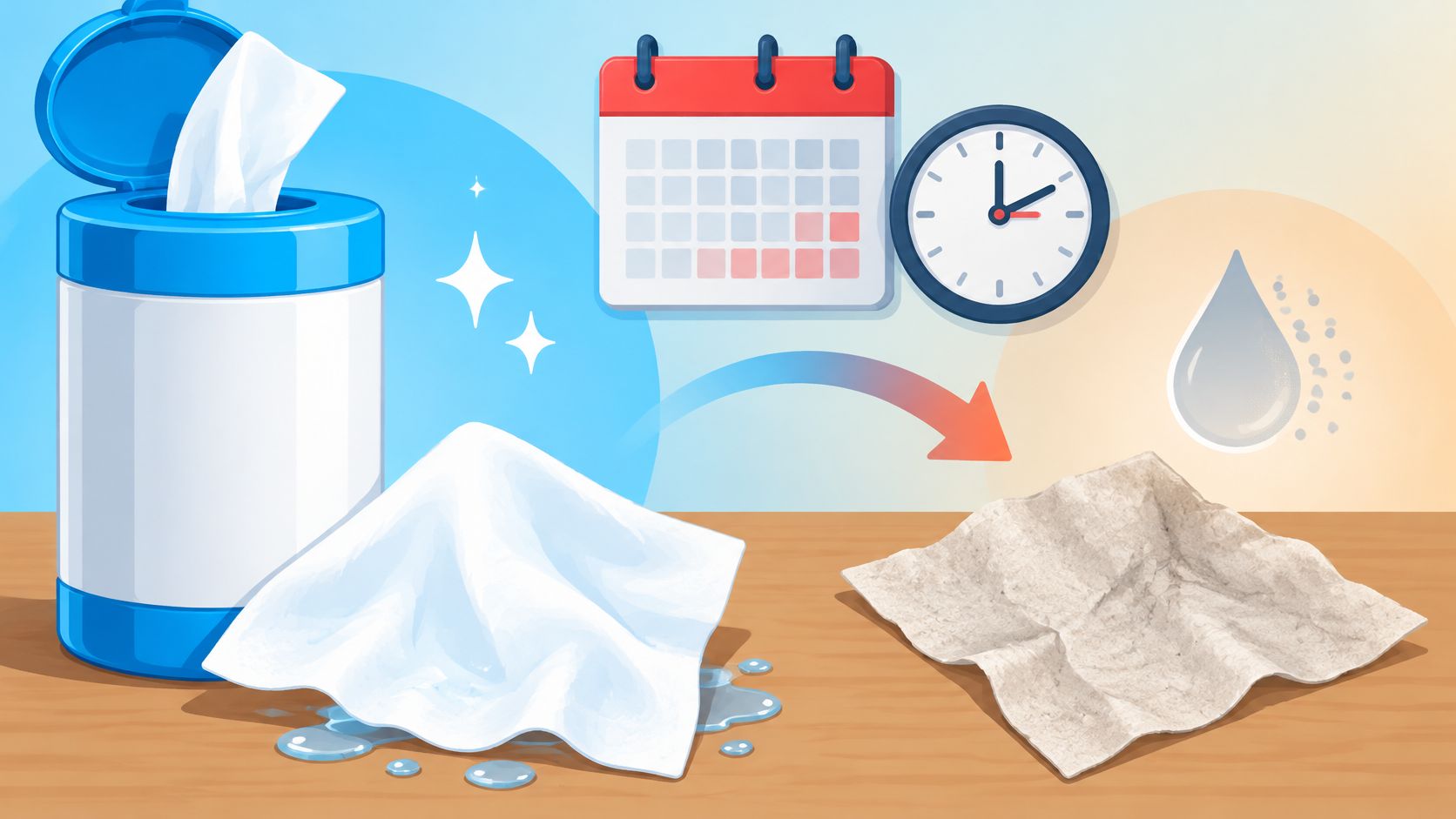
Yes, disinfecting wipes expire, and the printed date is the limit of validated strength for that specific product, such as 18 months from manufacture for an EPA-registered bleach towelette.
The less obvious problem is that an in-date wipe can still be unsuitable for disinfection. Poor storage, an open lid, or a hurried pass across too much equipment can undermine the job before expiration becomes relevant. For a gym owner or janitorial supervisor, checking the date is the starting point, not the whole inspection.
Disinfecting Wipe Shelf Life at a Glance
Shelf life depends on the product. Use the date and instructions on each manufacturer's label rather than applying one expiry rule to every wipe.
| Product | Labeled shelf life | What to check at expiry |
|---|---|---|
| EPA-registered bleach towelette | 18 months from manufacture | The label specifies at least 5,500 ppm bleach at expiration |
| Alcohol or quaternary disinfecting wipe | Follow the manufacturer's dated label or confirmed lot information | Follow the product's stability instructions |
| Ready-to-use wipe canister | Set by the manufacturer's stability data | Check that wipes remain saturated; discard dry wipes |
The EPA-accepted bleach towelette label sets an 18-month shelf life and a minimum of 5,500 ppm bleach at expiration for that specific formulation. It also says the expiration date is embossed on each individual pouch and printed on the outer carton.
Those terms apply to that product, not every container in a supply cupboard. Don't transfer the bleach towelette's shelf life to alcohol or quaternary ammonium wipes, even if their packaging looks similar.
Find the date before releasing stock
Check individual packages as well as shipping cartons. After a delivery is unpacked, the carton may be gone while its contents remain in service.
For a ready-to-use canister, inspect the label, base, lid area, and lot markings. A lot code alone is not an expiry date. If the date is unclear, ask the supplier to confirm the product's shelf life before releasing it for use.
- Record the product identity. Include the brand, formulation, lot code, and readable expiry in the inventory log.
- Keep dates visible. Mark the shelf position without covering the manufacturer's directions.
- Hold unclear stock. Keep packages with missing or unreadable dates out of active use until their shelf life is confirmed.
Use first-expire, first-out, not oldest delivery first. Compare expiry dates when new stock arrives, then place the soonest-to-expire product where staff will use it next.
Purchasing rule: A sealed package is not proof of indefinite usability. Buy stock based on the time available to use it, not just the space available to store it.
When supplies move between locations, keep expiry information with the product rather than only in a purchasing file.
Why Disinfectant Strength Fades Even When Wipes Look Fine
A wipe is like a sponge carrying a measured dose of medicine. The sponge can look unchanged after that dose weakens, so its appearance tells you little about the strength of what it carries.
Michigan State University explains that disinfectants generally degrade through chemical loss rather than microbial spoilage. An old wipe isn't necessarily spoiled in the way food spoils, and you can't visually confirm that its remaining active ingredient still supports its label claims.

Consider a sweaty treadmill handrail. A staff member uses an old wipe, removes the visible marks, and leaves a glossy film. The handrail looks cared for, but that visual result doesn't establish that the disinfectant can still act against the organisms named on its label.
The same distinction matters on rental-property kitchen handles, vehicle interiors, and shared event surfaces. Looking clean and completing disinfection aren't interchangeable outcomes.
Separate chemical strength from liquid delivery
There are separate ways a wipe can become unreliable:
- Potency loss. The chemical concentration may no longer meet the product's tested specification.
- Liquid loss. The material may no longer carry enough solution to wet the intended surface properly.
Bleach, alcohol, and quaternary ammonium formulations shouldn't be treated as identical chemistries. Their common operational requirement is that staff use the actual product under the conditions its manufacturer supports.
Odor isn't a concentration test. Neither is color, a damp feel, or a package that still looks new. Obvious damage should trigger rejection, but the absence of visible damage doesn't establish chemical strength.
A clean-looking wipe can remove a fingerprint without giving you a defensible disinfection result.
For facilities, expiry is therefore a performance-control limit. Remove expired pouches and canisters from service instead of asking staff to make a judgment by smell or appearance.
That approach is easier to audit, too. A supervisor can verify a printed date and a documented removal decision; they can't verify someone's impression that an old wipe seemed strong enough.
Storage Habits That Protect Shelf Life
Heat, light, and poor closure can shorten a wipe's usable life. Store each product according to its own label, and keep reserve stock in a location that protects it from unsuitable conditions.
| Storage factor | Target | Why it matters |
|---|---|---|
| Temperature | Within the range printed on the product label; cool and dry | Helps limit heat-related loss of active ingredient |
| Light | Away from direct sunlight | Protects the formulation from light exposure |
| Container lid | Closed after every use | Keeps wipes saturated and prevents drying |
| Container date | Use until expiry or empty; never top up | Prevents mixing stock with different use histories |
The CDC's cleaning supplies and equipment guidance advises following manufacturer storage instructions, keeping wipe-container lids closed, and discarding wipes that are no longer saturated. The label is the authority on storage conditions for that product.
A wipe can be within its date yet lose liquid through evaporation. That leaves less solution to transfer to the surface, and the printed expiry date cannot restore it.
Fix the storage location, not just the label
A gym that stores reserve stock in a cupboard beside a sunny window may expose it to repeated heat. Opened canisters left out between classes also make it easier for wipes to dry.
Move reserve stock to a protected interior storage area. Keep working supplies accessible, but choose locations that meet the product's storage instructions. Avoid loading docks, parked vehicles, boiler rooms, and sunny ledges when conditions there do not meet those instructions. The chemical storage safety guide can help teams review where supplies are kept.
Give someone ownership
Set these actions this week:
- Label a storage position. Identify where unopened stock belongs and keep the original product information attached.
- Check lid closure. Include a quick closure and moisture check when staff service each station.
- Log opened containers. Record the opening date alongside the manufacturer's expiry, without creating an unsupported after-opening lifespan.
If a container has had questionable heat exposure, isolate it and seek product-specific advice. Do not return it to service just because it feels cool again.
Good storage protects supplies from avoidable loss and helps staff find usable wipes when they need them.
Check and Use Each Wipe Correctly
Before each shift, use a short acceptance check rather than reaching straight for the nearest container.
- Read the expiry. Inspect the pouch or canister and the carton where available. Remove expired stock instead of leaving it for another employee to discover.
- Inspect packaging integrity. Torn pouches, leaking canisters, and broken closures can compromise the conditions the manufacturer intended.
- Check saturation. Inspect a dispensed wipe using any protective equipment the label requires. A dry or barely damp wipe isn't suitable for a task that requires visible wetness.
- Match the claim and surface. Choose wipes for gym equipment according to equipment compatibility and the required antimicrobial claim. EPA registration supports specific labeled uses, not unrestricted use on every material.

An opened canister isn't automatically unacceptable. What matters is whether the product permits continued use after opening and whether its closure, condition, storage history, and date remain acceptable.
Give the disinfectant enough wet time
Clean visible soil first. The CDC's cleaning and disinfecting guidance distinguishes cleaning with detergent or soap and water from disinfection and requires the disinfectant to remain wet for its label contact time.
For example, an EPA-registered disinfectant-wipe label requires surfaces to remain visibly wet for 1 minute. That is an example for that product, not a universal timing rule.
Don't wipe the surface dry immediately to make equipment available faster. Choose a compatible product and operating process that allow the required wet period, then follow any post-treatment directions before returning the surface to use.
A gym bench illustrates the common mistake. A wipe leaves the center wet but runs dry around the edges; staff count the bench as completed because they touched every part. Coverage without enough liquid isn't the same as the required wet contact.
How many surfaces can a wipe safely disinfect?
Only the area its label allows while delivering enough solution for the full contact time. There isn't a reliable universal count of benches, handles, or machines per wipe.
Use controlled, overlapping strokes from cleaner toward dirtier areas. Fold to expose a clean side where appropriate, avoid returning a dirty face to a clean zone, and replace the wipe when it becomes soiled or loses saturation.
A 2025 laboratory and clinical study found substantial variation in folding and wiping techniques and reported that microorganisms could remain viable within wipes and transfer to gloves. Reusing the same wipe across unrelated touchpoints can therefore introduce handling and cross-contamination risks.
For product selection, our guide to EPA-registered disinfectant wipes explains why label claims matter more than broad descriptions such as antibacterial wipes.
Schedule a technique spot-check alongside supply inspections. Have a supervisor observe coverage, label timing, wipe changes, and disposal, then record what needs correcting. A cupboard full of fresh stock won't compensate for rushed application.
How Often Facilities Should Clean and Restock Wipes
Cleaning frequency and restock checks by facility
| Facility | Baseline cleaning | Extra rounds | Restock check |
|---|---|---|---|
| Offices | Daily cleaning of high-touch surfaces | Shared kitchens and reception | Monthly date audit |
| Gyms | Cleaning between users on shared equipment | Weight racks, cardio rows, stretching areas | Verify wipe stations at each round |
| Schools | Daily cleaning of high-touch surfaces | Arrival, lunch, and dismissal | Verify wipe stations at each round |
| Retail stores | Daily cleaning of high-touch surfaces | Peak shopping hours | Check stations during peak-period rounds |
| Restaurants | Set by surface use and applicable food-service requirements | Guest turnover, busy service, and visible contamination | Check at shift changes and during service rounds |
The CDC guidance hosted by OSHA prioritizes high-touch cleaning at least once per day, with more frequent cleaning or added disinfection in higher-traffic spaces and other higher-risk conditions. The table turns that baseline into suggested operating checks, not a universal timetable.
For fitness facilities, CDC gym guidance recommends cleaning and disinfecting exercise equipment between patrons and making wipes or paper towels with disinfectant available where equipment is used.
Put supplies where hands go
Cover counters, desks, phones, keyboards, door handles, light switches, handrails, faucets, and toilets. Check compatibility before treating electronics, upholstery, touchscreens, or coated equipment.
In an office, shared kitchens and reception deserve attention beyond a quiet private workspace. A school can plan extra rounds around arrival and lunch; a retailer should watch checkout lanes, basket handles, and busy entrances.
For restaurants, count actual traffic and distinguish dining-area touchpoints from food-contact surfaces. A general-purpose wipe isn't automatically appropriate for a preparation counter, and required rinsing or other label directions still apply.
Place a gym wipe dispenser near the activity rather than expecting members to cross the building. Keep waste bins nearby so used material doesn't end up on benches or in cup holders.
Restock according to observed use, not according to when someone finally reports an empty station.
Our audience at WipesBlog includes schools, gyms, warehouses, and waiting rooms. Each needs a schedule that reflects how people use the building.
Managers seeking structured professional education can browse infection control CE courses from Premiere Education and check whether the course scope and eligibility fit their role.
Make the stock audit useful
Use a monthly inventory review as a management routine:
- Compare dates. Move the earliest-expiring usable stock into the next issue position.
- Reconcile quantities. Compare purchases with usage logs and discarded stock.
- Inspect working stations. Check closures, labels, package condition, and supply levels.
- Assign corrections. Give each empty station or storage problem a named owner.
Traffic counts and dispensing records can help adjust both cleaning rounds and order quantities. Don't interpret high wipe consumption alone as proof of good technique.
How to Dispose of Expired and Dried-Out Wipes
A wipe that's no longer saturated, or a container past its expiry, shouldn't remain available for disinfection. Remove it from service before someone uses it because it's within reach.
The CDC's environmental-cleaning guidance says containers should carry an expiry based on manufacturer stability instructions and be used until that date or until empty, whichever comes first. Never top up containers, and discard wipes that are no longer saturated.
Remove and document rejected stock
- Stop use and identify the reason. Mark the container expired, dry, or damaged so another employee doesn't return it to service.
- Close the lid. Keep the material contained while it awaits removal.
- Check disposal instructions. Follow the product label, safety data sheet, local requirements, and waste-hauler rules for chemically wetted materials and containers.
- Use the correct waste stream. Where ordinary waste disposal is permitted, place wipes in a lined bin, not loose in recycling. Follow separate instructions for containers.
- Record the loss. Enter the product, lot, quantity removed, and reason in the stock log.
Don't add water or another chemical to revive dry material. That doesn't recreate the manufacturer's formulation, liquid loading, or validated performance.
Reduce the next disposal pile
Order smaller quantities when turnover is slow. Keep opened-container dates visible, and investigate repeated losses at a particular station rather than treating them as unavoidable overhead.
- Dry stock suggests a closure problem. Inspect dispenser fit and staff handling.
- Expired reserve stock suggests overbuying. Reduce the order or rebalance supplies between locations.
- Damaged packages suggest handling trouble. Review delivery inspection and storage placement.
Don't move rejected wipes to supposedly low-risk areas and continue calling the work disinfection. Staff need an unambiguous distinction between approved working stock and material awaiting disposal.
For expired or dried-out disinfection stock, dispose, don't repurpose.
Set an Expiry Check Routine Before Your Next Bulk Order
Before approving another case, establish how much usable stock you already have and how quickly the facility consumes it. A lower case price isn't a saving when unopened packages expire before staff need them.
Use this release checklist for purchasing and daily operations:
- Read the dates. Check pouches, canisters, and cartons, and keep lot information attached to the inventory record.
- Confirm suitable storage. Use the product's specified temperature conditions, keep reserve stock cool and dry where directed, and protect it from sunlight.
- Verify readiness. Check saturation, closure condition, surface compatibility, and the label contact time before use.
Buy usable shelf life, not just volume
For each bulk gym wipes order, record the expiry at receipt and compare it with expected consumption. Ask the supplier for product-specific shelf-life information when dates or lot codes aren't clear.
Before ordering, compare candidate products on wipes.com and confirm which options have the EPA-registered claims your facility needs. Then verify printed dates, equipment compatibility, packaging format, and dispensing requirements for the actual product you're buying.
Don't assume sanitizing wipes and products with disinfection claims are interchangeable. Build the order around tasks: routine soil removal, appropriate sanitizing, and targeted disinfection each need suitable products and directions.
Make the sales conversation operational
For cleaning-industry sales professionals, expiry control provides a practical reason to review replenishment schedules with clients rather than push larger orders. Explain hygiene ROI through measurable operating details: discarded stock, empty stations, staff time, and completed cleaning checks. Offer compatible dispensers, cleaning chemicals, required gloves, waste supplies, signage, and training as a coordinated program, without promising unsupported financial or health outcomes.
At WipesBlog, our mission is to help organizations understand how disinfectant wipes contribute to better health outcomes, operational efficiency, and customer satisfaction. That starts with a process staff can follow and supervisors can verify.
Schedule an expiry audit this month, remove unsuitable stock, and place fitness wipes at the high-touch zones where people need them. Make pre-cleaning visible soil, respecting wet contact time, and closing every lid part of the daily routine, then build those same habits into your cleaning supply offering.
Leave a Reply