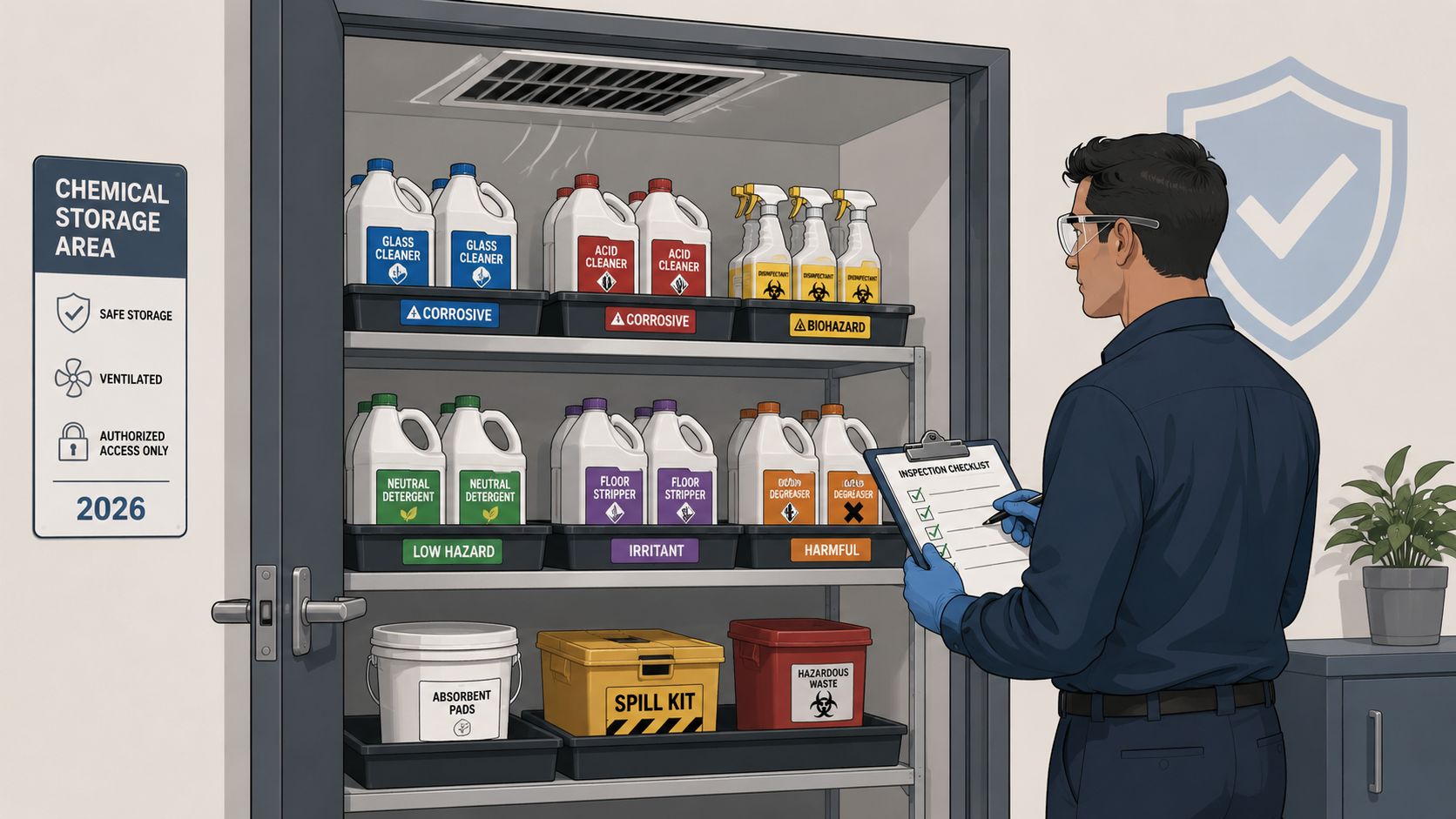
You probably have one right now. A narrow supply closet with a mop sink, a few half-used bottles of bleach, a toilet bowl cleaner somebody bought in a rush, extra spray bottles with handwritten labels, and a case of disinfectant wipes stacked wherever they fit. In gyms, offices, schools, rentals, and retail spaces, that closet usually gets treated like storage overflow.
It isn't overflow. It's a chemical storage area.
That distinction matters because the products most facilities use every day can still create serious risk when they're old, mixed, poorly labeled, overheated, or shoved into spaces with bad ventilation. The National Fire Protection Association linked 454 deaths and 3,910 injuries to flammable and combustible liquid fires, a reminder that storage mistakes aren't administrative details. They're life-safety issues with operational consequences, liability exposure, and reputational fallout (NFPA-related summary).
Cleanliness is part of the business model now. Guests notice it. Staff depend on it. Inspectors expect it. And the facilities that do this well understand something simple: better cleaning outcomes start with safer product handling, smarter inventory control, and products that are easier to use correctly, including disinfecting wipes, gym wipes, and other ready-to-deploy sanitation tools.
Rethinking the Janitor's Closet as a Chemical Hub
Most non-industrial facilities underestimate their own risk because the products feel familiar. Bleach isn't exotic. Neither are glass cleaner, restroom disinfectant, floor finish, or gym equipment cleaning wipes. But familiarity makes people casual, and casual handling is where preventable incidents start.
A janitor's closet becomes a chemical hub the moment you stock products with different hazard profiles in one place. Some are corrosive. Some are oxidizers. Some are flammable. Some degrade with age. Even a box of sanitizing wipes deserves attention if it's stored in the wrong temperature range or piled where kids, members, or untrained staff can grab it.
What managers should see on first inspection
When I look at a supply closet, I'm not asking whether it looks tidy. I'm asking whether the setup helps people make safe decisions under pressure.
Watch for these common warning signs:
- Floor storage: Cases and bottles on the floor get kicked, soaked, and forgotten.
- Mystery containers: Secondary bottles without clear labels create guesswork.
- Mixed shelving: Bleach next to general cleaners, acids near everything else, wipes jammed beside liquids.
- Dead inventory: Old stock nobody has checked in months.
- Bad access: Staff have to reach overhead or around clutter to retrieve products quickly.
Practical rule: If a new employee can't tell what belongs where in under a minute, the system isn't safe enough.
Why this matters beyond compliance
Chemical storage safety isn't just about satisfying a rulebook. It protects staff from burns and inhalation exposure. It protects guests from accidental access. It protects operations from shutdowns caused by spills, odors, damaged finishes, or product misuse.
It also protects cleaning quality. A poorly stored disinfectant may still look usable while delivering inconsistent results. That's a business problem, not just a safety problem.
Facilities that run well usually treat the closet like any other operational control point. They assign ownership, define locations, label clearly, and review stock routinely. That same mindset improves execution on the floor, especially in high-turnover settings like fitness centers, schools, and short-term rentals where consistency is hard to maintain.
Identifying the Hidden Risks of Everyday Cleaners
The products that cause the most trouble in public-facing facilities usually aren't the dramatic ones. They're the ordinary ones that sit too long, leak slowly, lose strength, or get moved into the wrong bottle. Old hydrogen peroxide, aging chlorine-based disinfectants, leftover sanitizer from a seasonal purchase, and damaged tubs of wipes all belong on the risk list.
Mass.gov states that aging chemicals can become unstable and present safety hazards, and the overlooked issue in non-laboratory settings is that outdated sanitation chemicals such as hydrogen peroxide and chlorine-based disinfectants can become volatile or ineffective after 12–24 months (Mass.gov guidance).

Age matters more than most teams think
A bottle doesn't have to be empty to be useless. It doesn't have to be leaking to be unsafe. In a lot of facilities, the oldest products sink to the back of the shelf because nobody wants to throw away paid inventory. That mindset creates a false economy.
Check three things during every inventory review:
- Expiration date: If the product has one, use it.
- Container condition: Swelling, residue, corrosion, cracking, and sticky caps are all warnings.
- Label legibility: If staff can't read it quickly, they can't use it safely.
If you rely on handwritten labels, invest in labeling that can ensure long-term scannability in damp, high-contact storage areas. A label system only works if it survives cleaners, humidity, and routine handling.
For teams reviewing general cleaning product risks, this related guide on professional cleaning chemicals is worth keeping in the same training library.
A quick audit that actually works
You don't need a complex EHS program to find obvious problems. Walk the closet with one cart and one trash bag. Pull every product forward. Group like with like. Remove empty containers, unidentified bottles, and anything clearly compromised.
Then separate what remains into a simple review table:
| Product condition | What it means | Action |
|---|---|---|
| In date, intact, readable | Usable stock | Return to designated shelf |
| In date, damaged container | Handling risk | Isolate and replace |
| Expired but stable-looking | Unreliable performance | Remove from active stock |
| Unlabeled or unclear | Unknown risk | Don't use until identified |
Old sanitation chemicals create two failures at once. They raise risk in the closet and lower confidence on the surface you're trying to protect.
That's why inventory isn't just purchasing control. It's part of cleaning quality. If you want staff using the right product every time, the first step is making sure the product is still worth using.
Mastering Chemical Compatibility in Confined Spaces
Big warehouses can assign whole aisles to one hazard class. Most gyms, office suites, pool clubs, and rentals get one cabinet and maybe half a shelf somewhere else. That's the practical-world challenge. People still need to keep incompatible products apart, even when space is tight.
Wisconsin EHS notes that chemical storage has “no one-size-fits-all plan,” and a 2024 study by the American Chemistry Council found that 45% of small-facility chemical incidents involved improper mixing in confined spaces due to lack of space for full segregation (Wisconsin EHS overview).

The shelf-first method doesn't work
A lot of facilities still store chemicals by convenience. Whatever arrives first goes on the nearest shelf. That approach breaks down fast in a cramped closet.
The safer method is to think in zones, even if all you have is one cabinet:
- Bleach and oxidizing products: Keep separate from flammables and from products that could react badly if containers leak.
- Acidic cleaners: Give them their own contained space away from general-purpose products.
- General cleaners and ready-to-use wipes: Keep these in a clearly marked section so they don't drift into corrosive storage.
- Employee-use products: Place day-to-day items in front so staff aren't reaching through more hazardous stock.
Creating safe islands inside one cabinet
Secondary containment is vital for safe chemical storage. AIHA recommends using secondary containment with a minimum 10% volume buffer when incompatibility is unavoidable, and hazardous liquids should be stored less than 60 inches (5 feet) from the floor (AIHA storage guidance).
Use bins, trays, and visual boundaries to create separation inside a shared space.
| Closet problem | Better fix |
|---|---|
| One shelf for everything | Divide shelf into labeled containment bins |
| Staff grab the wrong product | Place daily-use products at the front with clear labels |
| Bottles tip during retrieval | Use raised-edge trays and don't overpack |
| Small space forces risky adjacency | Split product groups across cabinet levels where possible |
In a small closet, “separate enough” usually isn't enough. If one leak can travel to the next product, the layout needs work.
This matters in fitness centers especially. Teams often store antibacterial wipes, floor cleaner concentrate, restroom acid, and laundry chemicals within arm's reach of each other because turnaround speed matters. Speed is important, but so is predictable placement. The fastest system is the one where staff never have to guess.
Designing a Safe and Efficient Storage Area
A safe storage area should help people work faster, not slow them down. Good layout reduces spills, shortens retrieval time, keeps products in usable condition, and makes reorder decisions obvious. If the room is organized only after a deep clean, it isn't organized enough.

In facilities like schools and gyms, bulk inventory of disinfectant wipes requires strict storage protocols including temperature limits and ventilation, and wipes must never be stored under sinks or on overhead shelving so they stay out of reach of children while maintaining chemical stability (UC ANR guidance on disinfectant wipes).
Build around access, ventilation, and control
Start with shelving that supports the way your team works. Heavy cases go low. Frequently used products go between knee and shoulder height. Nothing lives on the floor. Nothing that leaks or pours sits above eye level.
For flammables, proper cabinets matter. Verified guidance requires flammable storage cabinets to be built from at least 18-gauge sheet iron with a double-walled design and 1½ inch air space, labeled “FLAMMABLE – KEEP FIRE AWAY”, and meeting OSHA-related standards with FM and UL approvals (technical cabinet guidance). Even in smaller facilities, that's the standard to work toward when you keep flammable products on-site.
The practical layout most facilities need
A clean setup usually includes four zones:
Daily-use zone
Ready-to-use cleaners, disinfectant wipes, and routine restroom products.Controlled stock zone
Back-up inventory, sealed and dated on receipt.Higher-risk zone
Corrosives, flammables, and anything requiring extra review before use.Dispensing zone
A clear spot for refilling, relabeling approved secondary containers, and checking PPE.
For fitness spaces, wall-mounted systems help. A gym wipe dispenser keeps wipes where members use them, reduces clutter in the closet, and controls how much product gets consumed in a shift. If you're sourcing commercial disinfecting wipes or bulk gym wipes, it makes sense to pair the product format with the space it will live in. Facilities looking at operationally practical options can review bulk gym wipes and dispenser setups as part of a broader supply plan.
Use FIFO before stock goes stale
FIFO sounds basic, but it solves a lot of avoidable waste. Date every incoming case. Put newer stock behind older stock. Make one person responsible for monthly rotation. Don't let promotional buys or emergency over-orders bury older inventory.
A few storage rules are worth posting on the inside of the closet door:
- Keep products in original containers whenever possible
- Date all incoming cases
- Remove damaged packaging immediately
- Store wipes, sprays, and liquids in assigned zones
- Check ventilation before increasing bulk volume
The best storage rooms look boring. That's the point. Boring rooms produce fewer surprises.
Equipping Your Team as Your First Line of Defense
You can buy the right shelving, the right bins, the right cabinet, and the right products. If staff don't know what they're handling, the system still fails.
Training doesn't need to be dramatic. It needs to be clear, repeatable, and close to the job. A front-desk employee restocking fitness center wipes needs a different level of detail than a lead custodian handling concentrated chemicals, but both should know how to read a label, where the SDS lives, what PPE the task requires, and when to stop and ask a supervisor.
Simplify the products to simplify the risk
One of the smartest ways to reduce handling errors is to remove mixing steps wherever you can. Using pre-moistened disinfectant wipes eliminates the risk of improper chemical dilution and reduces staff exposure to airborne chemicals by 30-50% compared to spray-and-wipe or bucket methods because the disinfectant is factory-saturated at the correct concentration (pre-moistened wipe guidance).
That matters in busy environments. A rushed employee can overmix, undermix, or spray too broadly. Pre-saturated wipes reduce those variables.
Choose products that are hard to misuse. That's one of the cheapest ways to improve safety.
For gyms, that often means switching from shared spray bottles to wipes for gym equipment at stations members and staff can access quickly. For yoga studios, yoga mat wipes make more sense than asking guests to manage liquid spray around personal items and flooring.
Train to the task, not to the handbook
A practical team briefing should cover:
- What this product is for: Glass, restroom fixtures, high-touch equipment, mats, or general surfaces.
- How long it must stay wet: Disinfectant wipes only work when the surface stays wet for the label's required contact time, often 30 seconds to 4 minutes (contact time guidance).
- Where it belongs after use: Back to the right station, shelf, or locked closet.
- What not to combine: Staff should know which products are never interchangeable.
- When to escalate: Leaks, damaged packaging, missing labels, or symptoms after exposure.
For teams selecting EPA registered disinfecting wipes, train them to read the actual label claim instead of assuming every wipe does the same job. Product confidence comes from consistency, not branding.
Give sales teams a cleaner business case
If you sell to facilities, don't pitch wipes as a convenience item alone. Position them as part of labor control, safer handling, visible hygiene, and cleaner member experience. Business owners understand supply costs. They also understand complaint prevention, staff protection, and brand trust.
In gyms and offices, the strongest sales conversations usually connect wipes to:
- visible sanitation in shared spaces
- fewer handling steps for staff
- easier rollout across shifts
- cleaner replenishment systems than open spray bottles
For high-touch areas like handles, buttons, and workstations, CDC and EPA recommendations cited in workplace cleaning guidance call for disinfecting multiple times per day in shared spaces with higher transmission risk, while once daily cleaning is sufficient only when no known infections are present (workplace disinfection frequency overview). That makes wipes easier to justify as part of an everyday operating model, not a reactive add-on.
Proactive Audits and Emergency Preparedness
Chemical storage safety slips when managers assume the setup they fixed last quarter is still working today. Products change. Staff rotate. Deliveries get shoved into the wrong place. A quick audit catches problems while they're still small.

What to inspect every week or month
Your checklist doesn't need to be long. It needs to be used.
A practical walk-through should confirm:
- Labels are readable: No mystery bottles, no peeling identifiers
- Products are in assigned zones: Especially wipes, bleach, restroom chemicals, and back-up stock
- Containers are intact: No bulging, crusting, leaks, or damaged lids
- Dates are reviewed: Older stock is being used first
- PPE is available: Gloves and eye protection are where the work happens
- Spill response materials are accessible: Staff don't need to hunt for them
If you already use a broader facility review process, this complete warehouse maintenance checklist is a useful model for structuring recurring inspections and assigning accountability.
For teams tightening label systems, keep a current reference on GHS label compliance basics with your audit materials.
Keep spill response simple
Most non-industrial facilities don't need elaborate emergency playbooks for routine sanitation products. They do need a clear first response.
Use a short protocol:
- Stop access to the area.
- Identify the product if it can be done safely.
- Put on the right PPE.
- Contain the spill with the materials you've designated.
- Dispose of waste according to site procedure.
- Document what happened and fix the storage issue that caused it.
A spill plan should reduce hesitation. If staff are debating what to do, the plan is too vague.
Cleaning advice that supports both hygiene and storage control
A strong routine ties surface care to storage discipline. In offices, focus on door pulls, shared desks, breakroom handles, and restroom touchpoints. In gyms, prioritize benches, touchscreens, cardio handles, free-weight contact points, and check-in counters. In schools and rentals, keep wipes close to the point of use so staff don't improvise with the wrong product.
For day-to-day execution:
- use wipes where fast turnaround and visible hygiene matter
- replace open, messy spray setups when they create confusion
- restock by location, not by whoever notices first
- remove aging stock before it turns into a reliability problem
Clean facilities earn trust. Safe storage keeps that cleaning program dependable.
Prioritize cleanliness like it affects operations, because it does. Review your chemical closet this week, tighten product placement, check dates, and make disinfectant wipes, gym equipment wipes, or other ready-to-use sanitation tools part of a routine your staff can follow without guesswork. For more practical cleaning and sanitizing tips built for real facilities, visit WipesBlog.com.
Leave a Reply