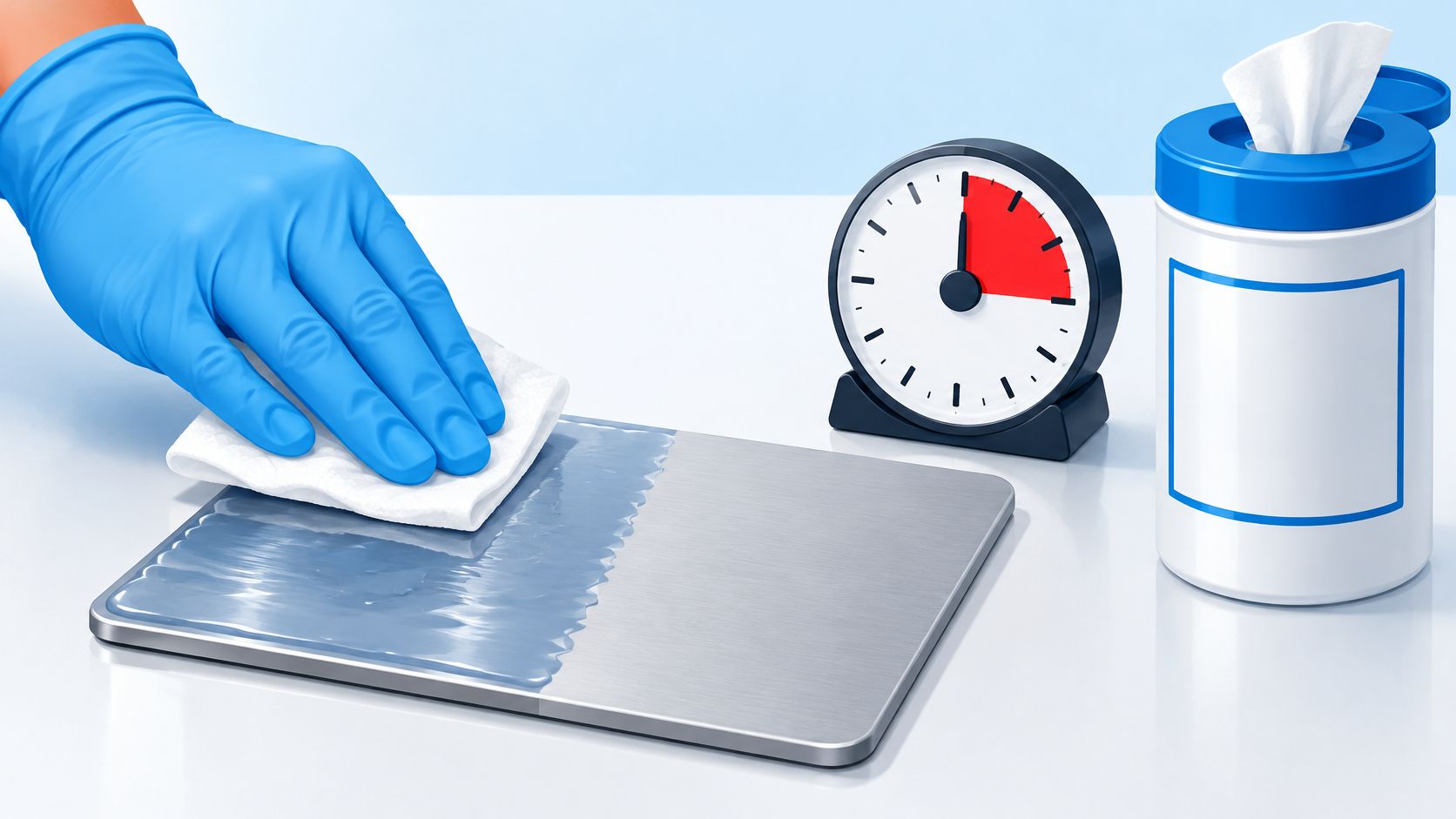
Ask a room of janitorial staff how long isopropyl alcohol needs to stay wet on a surface and most will say 30 seconds. Some will say a minute. Those answers get repeated in training decks, on checklists taped inside supply closets, and in gyms where a spray bottle and a rag live next to the cardio deck.
Neither answer is a label claim.
The number that governs your building isn't a concentration and it isn't a rule of thumb handed down between shifts. It's the wet contact time printed on the specific product in your hand, for the specific organism you're trying to kill, on a surface type the label allows. Get any of those three wrong and the clock you're counting doesn't mean what you think it means.
That gap between folklore and labeling is where most wipe programs fail without anyone noticing. The product is fine. The procedure isn't.
Contact Time at a Glance by Label Claim
No universal isopropyl alcohol disinfectant contact time exists. Four answers cover most of the questions facility managers bring me, and three of them come straight off a label.
| Product or claim | Wet contact time | Why the number differs |
|---|---|---|
| Wipe label listing bacteria and viruses | Printed in that label's directions | Set by that label's organism list |
| Wipe label with HIV-1 claim | Printed in that label's directions | Applies only to that claim, not to other germs |
| 70% isopropyl alcohol shorthand | 30 seconds to 1 minute | Not a validated label claim; alcohol evaporates fast |
| Any other registered product | The time printed on its own label | Each registration carries its own directions |
The first row is what people usually mean when they say "a one-minute wipe." Some registered labels do print a short wet time for their listed bacteria and viruses, but others require longer, so the exact time for any bacteria or virus claim has to be read from the product's own label, such as the directions block on this EPA-registered wipe label. Change the organism list and the number can change with it.
The second row catches experienced staff off guard. A longer wet time attached to a single claim, an HIV-1 listing is one example, belongs to that claim alone. It doesn't stretch across the rest of the label, and the shorter time a different canister prints for common bacteria doesn't shrink it back down.
The third row is convention dressed up as a claim. Thirty seconds to a minute roughly describes how long a thin alcohol film stays visible on a warm surface, which is exactly why nobody can show it to an inspector as a validated label number.
The three-step label check
- Find your organism. Scan the organism list for the pathogen you care about. "Kills 99.9% of germs" on a marketing page doesn't count; the registered label does.
- Find the wet time printed for that organism. Read the directions block, not the front panel. Different claims on the same product can carry different times.
- Confirm the surface type is allowed. Hard, nonporous surfaces are the usual scope. Porous mats, unfinished wood and fabric are often outside it.
What the table means in practice is simple and a little uncomfortable. The label time is a minimum you have to hold, not a target a fast swipe achieves. A pass that leaves the surface dry in eight seconds hasn't disinfected anything, no matter how clean it looks.
Why Alcohol Dries Before the Clock Runs Out
Watch someone work a spray bottle on a padded bench and the failure is visible in real time.

A thin film of 70% isopropyl alcohol on a nonporous surface at room temperature is gone in seconds. Put an HVAC vent or a floor fan nearby and it goes faster. The bench looks clean, feels dry under the hand, and the clock you promised a customer never ran.
Think about a sidewalk after a rain shower. It doesn't dry as one sheet. It dries from the edges inward, in patches, faster where the sun lands and slower in the shade. Alcohol behaves the same way across a wipe pass: it pulls back from the perimeter, leaves dry islands in the middle, and disappears long before a minute is up.
What visibly wet actually means
Visibly wet means a liquid film you can still see for the entire label time, not a surface that was wet when you started. The EPA-registered wipe label defines contact time as the period a surface must remain wet for the disinfectant to work, and warns that drying too soon can stop the product from reaching its labeled performance. The same directions require enough wipes to wet the whole hard, nonporous surface and reapplication when the surface starts to dry.
Spraying and wiping straight off does two things at once. It lifts soil, which is useful, and it removes the product, which ends the claim. A surface can come out spotless and never have been disinfected.
Practical rule: if the surface isn't visibly wet at the end of the label time, you didn't disinfect it. Reapply from a fresh wipe and restart the clock from zero.
One small wipe can't cover a metre of bench and stay wet, either. The product spreads thinner than the label assumes, so the fix is more wipes per zone, not a harder scrub.
Here's the check I'd teach first: at the end of the label time, touch the surface. Dry means the hold failed. Wet means the procedure worked.
Which Microorganisms Isopropyl Alcohol Misses
Alcohol works well on some germs and poorly on others, and thinking in layers explains why. Alcohol dissolves the fatty outer coat of many organisms the way a solvent lifts a sticker off glass. Germs wrapped in that coat come apart quickly. Germs with a bare protein shell, or a spore coat built like a seed husk, don't.
| Organism group | Isopropyl alcohol at 60% to 90% | What to do instead or next |
|---|---|---|
| Vegetative bacteria (e.g., Staphylococcus) | Generally inactivated on small surfaces | Confirm the organism on the product label |
| Enveloped viruses (e.g., influenza) | Generally inactivated on small surfaces | Confirm the organism on the product label |
| Hydrophilic non-enveloped viruses (poliovirus, coxsackievirus) | Not inactivated | Use a product with that specific claim |
| Bacterial spores (e.g., C. difficile) | Not inactivated | Use a registered sporicide; alcohol is not high-level disinfection |
Two rows matter more than the rest for a facility. The CDC guidance on disinfection and sterilization excludes alcohols as high-level disinfectants because they cannot inactivate bacterial spores, and it notes that isopropyl alcohol cannot inactivate some hydrophilic viruses, including poliovirus and coxsackievirus.
The non-enveloped problem reaches further than those two names. It's the same reason rubbing alcohol isn't a reliable answer for norovirus, which is the gap that opens in gyms, schools and rental properties every winter.
When a restroom, locker room or equipment mat has seen vomit, fecal material or a known illness, alcohol is the wrong tool. Clean the visible soil away first, then use a registered product whose label names the organism.
The risk isn't that alcohol does nothing. It's that a fast-drying pass feels complete. Staff see the surface go from grimy to gleaming in ten seconds, the shift log gets a tick, and everyone assumes the job is done. That substitution is how a facility ends up using a product with no claim against the germ that shut the building.
A simple decision path fixes it. Soil present, clean it first. Then check the registered label for the organism in front of you. Then choose a chemistry that carries the claim, and stop treating a short alcohol contact time as if it were sterilization or high-level disinfection.
Choosing Alcohol or Registered Wipes for Each Facility
Product choice follows the surface and the organism, in that order. Price comes third.

| Product type | Best-fit surfaces | Main limit | Facility fit |
|---|---|---|---|
| Isopropyl alcohol wipe (60% to 90%) | Small hard surfaces such as thermometers, handles and controls | Dries fast; no spore or poliovirus claim | Small offices and personal tools |
| EPA registered disinfecting wipe | Hard nonporous surfaces, gym equipment and counters | Covers only the organisms on its label | Gyms, schools, restaurants and retail |
| Sanitizing wipe | Food-contact surfaces and low-risk fixtures | Not a full disinfectant claim | Restaurant prep areas and retail fixtures |
Cleaning and disinfection are separate jobs. The CDC's facility cleaning and disinfection guidance recommends regularly cleaning high-touch surfaces such as door handles, elevator buttons, touchpads, restroom fixtures, desks, counters, shopping carts, pens and stair rails, and notes that busy spaces may need more frequent cleaning plus disinfection on top of the routine.
Where each product type belongs
Offices. Shared desks, phones, printer panels and conference tables. Alcohol suits the small devices where a wipe can hold the surface wet. Desks and counters want a registered wipe with a documented wet time, because the surface is large and the clock is longer.
Gyms and fitness centres. Handles, benches, machine screens, free weights and mats. An EPA registered disinfecting wipe is the default for shared machines, and a gym wipe dispenser within arm's reach of the equipment keeps the habit visible. Stock bulk gym wipes in the janitorial closet so refills never stall mid-shift, and keep fitness wipes out where members train.
Schools. Desks, shared supplies and restrooms. Spore and non-covered virus claims matter here more than anywhere else on this list, so buy against the organism list rather than the price per canister.
Restaurants and retail. Point-of-sale terminals, carts, baskets and pens. A sanitizing wipe fits food-contact areas and low-risk fixtures. High-touch fixtures that see hundreds of hands a day want a registered disinfectant.
Crews handling concentrates alongside wipes need to get the dilution and mixing right first, so point them at this guide to choosing safe cleaning chemicals for crews before the new stock lands.
How to Apply and Hold Contact Time Step by Step
The procedure below is what I'd put in a written work instruction, not just in a training session. Steps get forgotten; paper doesn't.
- Clean the visible soil first. Sweat, dust and grime block the disinfectant from reaching the surface, so a bench with a dried film on it needs a cleaning pass before anything else touches it. Skipping this step is the single most common reason a wipe fails on gym equipment.
- Read the label before the canister opens. You need three things from it: the organism claim, the surface types allowed, and the wet time attached to that claim. Two products from the same supplier can differ on all three.
- Count wipes against surface size. Use enough wipes to wet the whole hard, nonporous area, and take a fresh one for each zone on a long bench. A single wipe stretched across two metres thins out before the clock starts.
- Apply until the surface looks evenly wet. No dry patches at the edges, no puddles running onto the floor.
- Start the timer when the last area is wet. Not when you began wiping. On a long surface that mistake can cut the actual hold time by half.
- Re-wet anything that dries early. A warm room, a fan or a sunny window will pull moisture out of the film faster than the label assumes.
- Let it air dry. Wiping the surface down early ends the contact period and undoes the work.
- Log product, time and area. This is what turns a routine into something you can defend when a customer or an inspector asks.

EPA label directions are blunt about the first two steps. The registered wipe label directions tell users to clean heavily soiled surfaces with another wipe first, then apply enough disinfectant to make the surface visibly wet and leave it wet for the stated contact period. On sweaty benches, machine handles and touchscreens, that first cleaning pass is doing more work than most crews give it credit for.
The end-of-timer check: the surface should still be wet when the clock starts and dry only when it finishes. Anything else means the hold failed, not that the product was weak.
When a job runs past routine soil, such as a locker room after a sewage backup or a gym closed for water damage, decontamination for mold and smoke odors is specialist scope. A wipe program isn't the tool for it.
Large Surfaces, Electronics and Equipment Limits
Small areas are where alcohol earns its place. Thermometers, stethoscopes, door handles, kiosk touchpoints, vehicle controls and rubber grips are small enough that one wipe can hold the whole area wet for the full time. The EPA disinfectant registration guidance puts 60% to 90% alcohol in that small-surface category and warns that repeated or prolonged exposure can discolor, swell, harden or crack rubber and some plastics.
Zoning a long surface
Gym floors, long benches, mats and countertops don't fit a single wipe pass. Divide the surface into sections you can cross in one stroke, wet one section at a time with a fresh wipe, and run a timer per section. Wide floors usually want a registered disinfecting wipe with a documented wet time rather than alcohol, because you can't keep a volatiles-based film alive across that much area.
Materials before volume
Test a hidden corner on rubber grips, padded upholstery and the surfaces your yoga mat wipes will meet before committing to a full application. Then check that the wipes for gym equipment you've chosen list that material as compatible. Five minutes of testing beats replacing a bench pad.
Electronics
Dampen the cloth or wipe rather than spraying the device. Keep liquid out of seams, ports and speaker grilles, and power the screen down when the label allows. This guide to disinfectant wipes for electronics covers the screen-safe options in more detail. Where the surface is a bench, a hood liner or a coated panel, check the substrate before you commit: laboratory work surfaces from Labs USA show how much a finish choice changes chemical compatibility.
Hazards close the list. Pooled alcohol on a hard floor is a slip risk, and alcohol near heaters, motors or an open flame is a fire risk. Ventilate the area and keep wipe stations away from heat sources.
Build a Wipe Routine Around Contact Time
Adopt one written routine built on label wet time, and stop treating the clock as a suggestion.
Cleaning wipes handle visible soil at the start of each shift. Registered disinfecting wipes cover high-touch zones at set intervals through the day. At shift end, someone runs the touch test on the large areas and reports anything that dried early. That report is what separates a routine from a habit: it tells you which surfaces outgrew the product on them.
Placement does more than training. A gym wipe dispenser belongs where your staff work, not where members train. Mount one at the entrance for the front desk and along the route your cleaning rounds already follow, so staff carry a fresh wipe to the equipment rather than leaving canisters on the floor for members to grab mid-set. Bulk gym wipes stored near the janitorial closet keep refills on schedule instead of running dry at 6pm on a Monday.
Train three things: read the label before choosing the product, count wipes against surface size, and log product, time and area. Nothing else needs to be memorised. The label tells a staff member whether the canister in their hand even claims the organism they're wiping for, and the count tells them whether one wipe can stay wet across the whole bench or whether the job takes two. The log catches the gap: a product that claims a minute of wet time but flashes dry in seconds belongs on small touchpoints, not on large surfaces.
For suppliers, the label is the pitch
Sell the routine, not the canister. A facility manager who's been burned by a fast-drying spray responds to a specific wet time and an organism claim that matches what they clean, because a percentage on the front of the label says nothing about whether the surface stays wet long enough to deliver it. Bundle commercial disinfecting wipes with a dispenser and a refill schedule, and frame the spend against sick days, complaint logs and rework. That's the hygiene return on investment most buyers can take to an owner.
WipesBlog's mission is to help organizations understand how disinfectant wipes contribute to better health outcomes, operational efficiency and customer satisfaction, and label literacy sits at the centre of that.
Start this week. Pick one canister off your shelf, read the organism list and the wet time out loud at your next shift huddle, and time one bench or one front desk against it. If the surface dries before the label time ends, you've found your first fix, and it costs nothing but a second wipe. The alcohol percentage on the front of the label is rarely what facilities get wrong; the wet minutes on the back are, and no concentration fixes a germ the product never claimed. Put the wet-time rule into the daily routine, place dispensers where staff already pass, and hold the standard whether you run a gym, a school, an office or a retail floor.
Leave a Reply