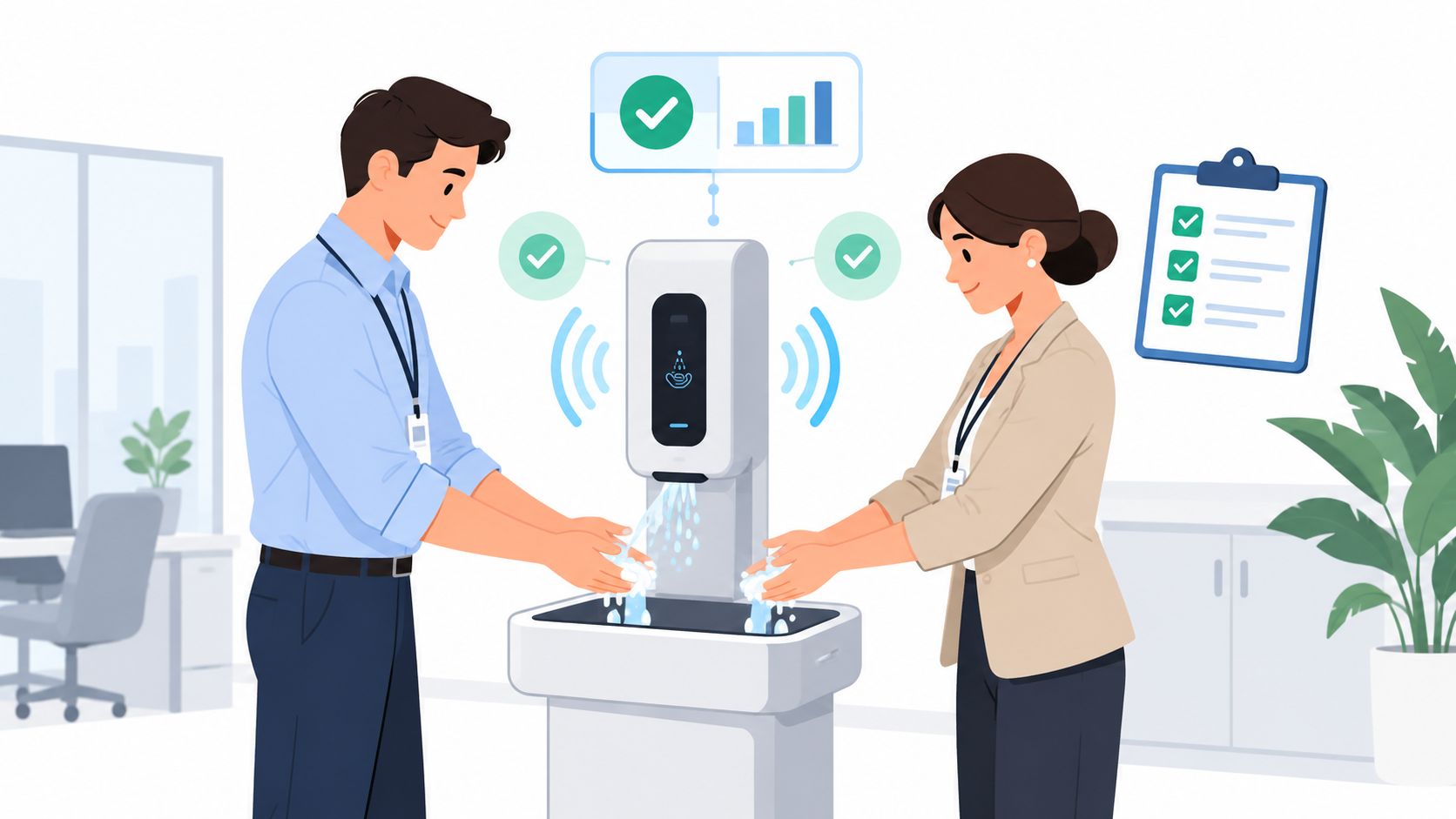
The number that should reset expectations is 59.6%. That's the average hand hygiene compliance reported by the World Health Organization in intensive care units through 2018, with a gap between 64.5% in high-income countries and 9.1% in low-income countries (WHO hand hygiene guidance). If highly controlled clinical environments still struggle to hit consistent performance, offices, gyms, schools, restaurants, and retail sites shouldn't assume posters and reminders are enough.
In practice, most facilities don't have a motivation problem first. They have a measurement problem. Teams may clean often, stock disinfectant wipes, refill sanitizer, and still have no clear read on whether people are cleaning hands at the right moments, or whether the technique removed contamination. That's why hand hygiene compliance monitoring matters. It turns a vague cleanliness goal into something operators can see, coach, and improve.
For commercial facilities, the strongest programs also connect hand hygiene to visible surface care. That means pairing monitoring with practical wipe routines, focusing on high-touch zones, and using tools like disinfecting wipes, gym wipes, and EPA registered disinfecting wipes where they fit the workflow. In a fitness center, for example, the question isn't just whether members used wipes for gym equipment. It's whether the facility made that behavior easy, visible, and repeatable.
Why Compliance Still Lags and What Monitoring Actually Fixes
The WHO still treats direct observation as the “gold standard” for hand hygiene monitoring, and it recommends measuring the percentage of observed opportunities in which staff clean their hands correctly, paired with feedback over time (WHO hand hygiene guidance). That matters because compliance isn't a feeling. It's a rate built from observed opportunities and actual performance.

In non-hospital settings, the gap is usually wider than leaders think. Most commercial buildings track cleaning tasks, not hygiene behavior. A janitorial lead can confirm that restroom counters were wiped, that a break room got serviced, and that commercial disinfecting wipes were restocked. None of that tells you whether staff sanitized after touching shared surfaces, whether front-desk teams cleaned hands at transition points, or whether gym members used fitness wipes before moving to the next station.
Cleaning happened is not the same as cleaning worked
Recent evidence makes that distinction hard to ignore. One 2026 study reported 74.9% overall compliance across 9,767 observed opportunities, yet correctness was 81.4%, showing that doing the action and doing it properly are separate issues (Frontiers study on compliance and correctness). Another 2025 study in healthcare cleaning staff found 33.75% had residual fluorescent contamination before training, with missed areas concentrated in fingertips and interdigital spaces (same source).
That's the part commercial operators often miss. A facility may have decent participation and weak technique at the same time.
Practical rule: If you only measure whether sanitizer or soap was used, you're only measuring presence, not quality.
What monitoring fixes in real facilities
Structured monitoring gives operators three things informal reminders never do:
- Visibility into moments: You can define when hand cleaning should happen, such as after restroom use, before food handling, after touching shared equipment, or at staff transition points.
- Visibility into technique: You can audit whether staff used the right product and covered hands properly, instead of treating every dispenser event as a success.
- Visibility into drift: You can spot the usual slide after launch week, when supplies are still present but habits loosen.
This is why I'd treat hand hygiene compliance monitoring as an operating control, not a morale campaign. Teams that want a model for how measurement gets turned into action can look at examples of healthcare analytics by ELECTE, where performance data is used to make operational issues visible instead of relying on assumptions.
For commercial sites, the business stakes are plain enough. Poor hygiene execution raises absenteeism risk, raises the chance that a localized illness issue becomes a facility-wide headache, and leaves managers exposed when guests or employees ask what the cleaning program verifies.
Choosing the Right Monitoring Method for Your Facility
There isn't one perfect method. There are trade-offs, and the wrong choice usually comes from buying technology before defining the behavior you need to measure. In most facilities, the best answer is a hybrid. Start with structured observation so you know what “good” looks like in your building, then add telemetry for trend data.
A useful companion read is this breakdown of real-time monitoring systems, especially if you're comparing low-friction rollout options.
What each method is good at
Direct observation remains the reference standard because it can capture sequence, timing, and technique. WHO guidance also notes a practical threshold of at least 12 to 15 observations in the denominator before a percentage is reported (WHO hand hygiene guidance). That's useful because it prevents teams from overreacting to tiny samples. The downside is obvious. When people know they're being watched, behavior changes.
Published reviews also warn that direct observation is vulnerable to the Hawthorne effect, while inconsistency in definitions and collection methods can make results hard to compare across programs (Journal of Nursing Management review).
Dispenser counters and product-volume tracking are easier to scale. They answer whether usage is rising or falling. They don't answer who cleaned, whether one person triggered repeated uses, or whether the timing matched an actual hygiene opportunity.
Wearables, computer vision, and proximity systems can fill that gap, but they bring integration, privacy, and workflow issues. A 2026 scoping review of 45 studies found the field shifting toward AI, with computer vision at 53.3%, wearable sensors at 24.4%, IoT-integrated systems at 13.3%, and radar/RF approaches at 8.9%, while barriers persisted around accuracy, data integration, privacy, usability, cost, and infrastructure (scoping review on automated monitoring).
Monitoring Method Comparison
| Method | Accuracy | Cost Band | Hawthorne Risk | Best Fit |
|---|---|---|---|---|
| Direct observation | High for technique and context when auditors are trained | Labor-based and ongoing | High | Pilot programs, audits, training validation |
| Dispenser counters and volume tracking | Moderate for trend direction, weak for individual attribution | Lower hardware burden than full sensor systems | Low | Offices, schools, retail chains needing simple trend data |
| Wearable, proximity, or vision systems | Can be strong, but varies by workflow and local validation | Higher setup and integration effort | Low to moderate | Hospitals, large campuses, complex fitness or multi-site operations |
The method should fit the decision you need to make. If you need coaching, observe people. If you need trends, instrument the environment. If you need both, combine them.
For non-hospital facilities, my default is simple. Use direct observation in the first quarter to define opportunities, teach technique, and find blind spots. Layer in dispenser telemetry once you want ongoing trend lines without putting an observer in every corridor.
Building a Monitoring Program That Sticks
Programs fail when the policy is loose and the data loop is weaker than the launch campaign. The buildings that keep gains are the ones that write down exactly what counts, exactly how it's measured, and exactly who acts when scores slip.
Start with a written policy people can actually use
The policy needs plain language, not infection-control jargon. Define the hand hygiene moments that matter in your facility. In an office, that might include restroom exit, pantry transitions, reception handoffs, and shared device zones. In a gym, it should cover staff transitions, equipment resets, cleaning between classes, and member-facing stations with gym equipment wipes or sanitizer access.
Include technique standards too. If your program only asks whether a dispenser was touched, it leaves out whether the right product was used and whether hands were cleaned correctly. WHO's monitoring framework is explicit that compliance and technique observations should be paired with feedback to track behavior change over time (WHO hand hygiene guidance).
Build the observation protocol before you buy more hardware
Decide who observes, where they stand, what counts as an opportunity, and how the event gets logged. Rotate observers so one person's habits don't become the building's measurement bias. If supervisors audit their own teams every time, the scores will drift toward comfort instead of accuracy.
A practical starter set usually includes:
- Compliance rate: Did the person clean hands when the moment occurred?
- Technique score: Was the action done correctly?
- Observation volume: Did the team collect enough observations to trust the trend?
A 2025 Leapfrog fact sheet cited in the literature also points toward concrete monitoring expectations such as at least 200 observed opportunities per unit per month plus electronic and/or direct observation methods, which is useful as a reference point for operators building a disciplined cadence (scoping review on automated monitoring).
Feedback beats software when it's timely
The score doesn't change behavior. The conversation around the score does.
Weekly huddles work better than quarterly slide decks because they're close enough to the actual workflow for supervisors to correct issues while they still recognize the situation. Monthly trend reviews are where site leaders should decide whether a problem is training, placement, supply access, or unrealistic routing.
If a team misses because the dispenser is around the corner, that's a placement problem, not a culture problem.
To keep the program alive after the first few months, tie review into routines managers already own. Add hygiene scorecards to shift handoffs, janitorial route reviews, fitness floor walks, or opening manager checklists. Don't create a separate meeting unless the building already has the discipline to maintain it.
For audit support, one practical option is to use a simple log structure like the compliance-record format discussed by WipesBlog.com, which tracks area, date, time, staff initials, product used, and exception notes. That's not a replacement for monitoring design, but it helps keep evidence usable when someone asks what happened on a specific shift.
Pairing Monitoring with Wipe and Surface Protocols
Hand hygiene programs break down when they ignore surfaces. People touch what the facility leaves behind. If your staff cleans hands reliably but the break room fridge handle, treadmill controls, restroom latches, and elevator buttons stay dirty between rounds, your numbers will look better than the actual experience.

Put supplies where the behavior should happen
Dispenser and wipe placement should follow transitions, not convenience for the supply closet. Entry points, restrooms, elevator banks, break rooms, reception counters, and shared equipment zones are the obvious anchors. In fitness spaces, place gym wipe dispensers where members naturally pause, such as near cardio clusters, free weights, and studio exits.
CDC guidance for facilities specifically calls out high-touch surfaces such as doorknobs, counters, shopping carts, stair rails, elevator buttons, touchpads, restroom fixtures, and desks for regular cleaning, with disinfection when someone is sick or at higher risk (CDC facility cleaning guidance). In care settings, CDC also recommends cleaning high-touch surfaces and floors at least twice daily and as needed, while lower-touch surfaces can wait until the last clean of the day (CDC environmental cleaning procedures).
Match the wipe format to the job
Not every surface should get the same tool.
- Pre-saturated disinfectant wipes: Best for desks, handles, touchscreens with compatible materials, and quick-turn shared equipment.
- Bucket-and-rag systems: Better for larger fixed surfaces where teams need coverage and controlled product use.
- Electrostatic spray: Useful for broad-area disinfection workflows, but not a substitute for targeted wiping on high-touch points.
- Specialty fitness center wipes: Good for member self-service on benches, machines, and mats, especially when paired with clear signage and visible refill discipline.
If you're sourcing products for public-facing spaces, a practical benchmark is to use EPA registered disinfecting wipes and train teams on contact time and surface compatibility. For a product category overview, operators can review disinfectant wipe options from Wipes.com.
Clean hands and dirty surfaces cancel each other out faster than most dashboards reveal.
WHO's community guidance also says disposable antimicrobial wipes are not recommended as substitutes for soap and water for hand hygiene, which is an important distinction for managers who stock wipes heavily (WHO community hand hygiene guidance). Use wipes as a surface-cleaning tool, not as a replacement for proper handwashing.
KPIs and Data Collection That Drive Real Change
The KPI set should be small enough to manage and sharp enough to expose weak execution. Most facilities collect too much activity data and not enough decision data. Three measures usually tell the truth.
Core Hand Hygiene KPIs Compared
| KPI | Calculation | Target Range | Common Misuse |
|---|---|---|---|
| Compliance rate | Hand hygiene events performed divided by observed opportunities | Use a locally defined target tied to your policy | Counting staff presence instead of true opportunities |
| Correctness rate | Correct technique divided by observed hand hygiene events | Use to coach quality, not just participation | Treating dispenser use as automatic correctness |
| Observations per unit per month | Total validated observations logged for each area | Enough volume to reflect routine behavior | Reporting tiny samples as if they represent the site |
The WHO framework is still the cleanest definition. Measure the percentage of observed opportunities where staff clean their hands correctly, and don't report a percentage until the denominator is large enough to be meaningful (WHO hand hygiene guidance).
Read the trend, not the snapshot
Single-day wins mislead operators. A strong shift after a supervisor walkthrough may only show that people respond when they're watched. Rolling trend lines are what expose drift, rushed shifts, supply gaps, and location-specific failures.
The reason to stratify by shift, zone, and role is simple. A building average hides trouble. Reception may look fine while loading dock staff struggle. Morning janitorial teams may be consistent while evening coverage misses high-touch resets. A gym floor may score well while locker room transitions lag.
Technology still needs local validation
Many buyers get overconfident. Technology can improve performance, but results vary by design and workflow fit. A meta-analysis found that intelligent hand hygiene interventions increased compliance by 56% relative to usual care with a risk ratio of 1.56 (95% CI 1.47 to 1.66) and reduced healthcare-associated infection rates by 75% with a risk ratio of 0.25 (95% CI 0.19 to 0.33), yet another large review still found only 32% pooled compliance prevalence across studies with I²=99.7%, which shows just how uneven results can be across sites and methods (JMIR review of intelligent interventions).
That same review notes that computer-vision models can reach 95% accuracy in a setting-specific ICU deployment while more generalizable models can fall to 56%, and wearable systems may run 5% to 10% lower specificity than vision-based approaches (same source).
Watch for this: If the dashboard looks precise but nobody has validated what counts as an opportunity in your building, the data may be neat and wrong.
Training Staff and Rolling Out Across Teams
The rollout usually works best when it feels operational, not punitive. In a mid-size office building, I'd start with one pilot floor, one restroom bank, one break room cluster, and one reception zone. That's enough to expose the workflow without turning the first month into a surveillance argument.

Days 0 to 30
The first month is for baseline observation and policy cleanup. Don't overteach yet. Watch what really happens. Are dispensers placed where traffic flows? Are cleaning teams refilling sanitizing wipes before peak occupancy? Do managers define opportunities consistently?
I also like to keep training short at this stage. A brief huddle, a technique demo, and a plain explanation of why the program exists usually land better than a long compliance presentation.
Days 31 to 60
This is the expansion window. Push training across shifts with short modules, live demonstrations, and peer coaching. If you need structure, a resource like this staff training program template can help standardize who gets trained, on what cadence, and how completion is documented.
For gyms and fitness centers, this is also where member behavior gets shaped. Stock workout wipes and yoga mat wipes where members finish the activity, not where staff wish they'd walk afterward. Staff should demonstrate the routine in the normal course of floor coverage instead of policing it from a distance.
Days 61 to 90
By the third month, the program has to prove it isn't just another launch. Supervisors should be reviewing trends during their normal operating rhythm, and teams should hear the same message across day, evening, and weekend coverage. Recognition helps. Punitive audits usually backfire unless there's a repeated refusal to follow policy.
The common objections are predictable:
- Staff feel watched: Explain that the goal is cleaner transitions and safer shared spaces, not personal scoring for its own sake.
- Cleaning teams worry about extra work: Show how better placement and clearer routes often reduce repeat cleaning and missed touchpoints.
- Managers doubt anything will change: Bring one month of baseline and one month of coached results into the same conversation.
A candid explanation works better than wall posters. Staff cooperate once they understand the reason is guest safety, workforce reliability, and operational credibility.
Reporting ROI and Closing the Loop
Executives don't need another hygiene speech. They need evidence that the program changes operations in a way they can defend. That means turning monitoring into a short monthly report that connects observed behavior, supply execution, and visible risk reduction.
Sample ROI Reporting Dashboard for Hand Hygiene Monitoring
| Metric | Source | Monthly Value | Narrative for Stakeholders |
|---|---|---|---|
| Compliance rate | Observation audits | Track locally | Shows whether staff and occupants cleaned hands at defined moments |
| Correctness rate | Technique audits | Track locally | Distinguishes rushed or incomplete execution from true compliance |
| Observations per unit | Audit logs | Track locally | Confirms whether the sample is large enough to trust |
| High-touch wipe completion | Cleaning route logs | Track locally | Connects hand hygiene behavior to environmental cleaning reliability |
| Supply exceptions | Refill and incident logs | Track locally | Identifies whether misses come from behavior or stock availability |
| Zone-level trend changes | Combined dashboard | Track locally | Helps operations leaders target coaching, placement, or scheduling changes |
Give each stakeholder a different cut of the same story
Operations directors usually want zone-level exceptions. They need to know where the process is breaking. Client success teams or account managers need guest-facing proof that the site is actively managing shared-space hygiene. Finance leaders usually want consistency and risk control, not technical detail.
The most persuasive report is one page. Show the trend. Name the exception. State the action taken. If the lobby had weak compliance and you responded by moving sanitizer placement, increasing wipe access, and tightening high-touch rounds, say that plainly.
A U.S. multicenter collaboration showed how repeated measurement and feedback can move results over time. Baseline compliance was 26% in ICUs and 36% in non-ICUs, rising after 12 months to 37% and 51% respectively. More recent reporting from the Leapfrog Group found hospitals achieving its Hand Hygiene Standard increased from 11% in the first year to 74% in 2023, while adoption of electronic hand hygiene monitoring rose from 4.7% in 2020 to 10% in 2023 (historical review and Leapfrog reporting).
That doesn't mean a commercial facility should copy a hospital playbook line for line. It does mean the principle is settled. Measurement plus feedback changes behavior more reliably than reminders alone.
For sales teams in the cleaning industry, antibacterial wipes, bulk gym wipes, and broader cleaning supply bundles become easier to position. Don't sell only the product. Sell the operating model. Help clients connect wipe format, dispenser placement, refill discipline, and audit evidence into one hygiene program they can manage.
Cleanliness in commercial and public facilities isn't just about appearance. It's about whether people can trust the environment. Prioritize hand hygiene compliance monitoring, tighten your high-touch cleaning routine, and make disinfectant wipes part of a daily system instead of a backup product. If you manage a gym, office, school, restaurant, or retail site, the simplest next move is to review your transition points, stock the right wipes, and coach teams on both hand and surface hygiene every shift.
Leave a Reply