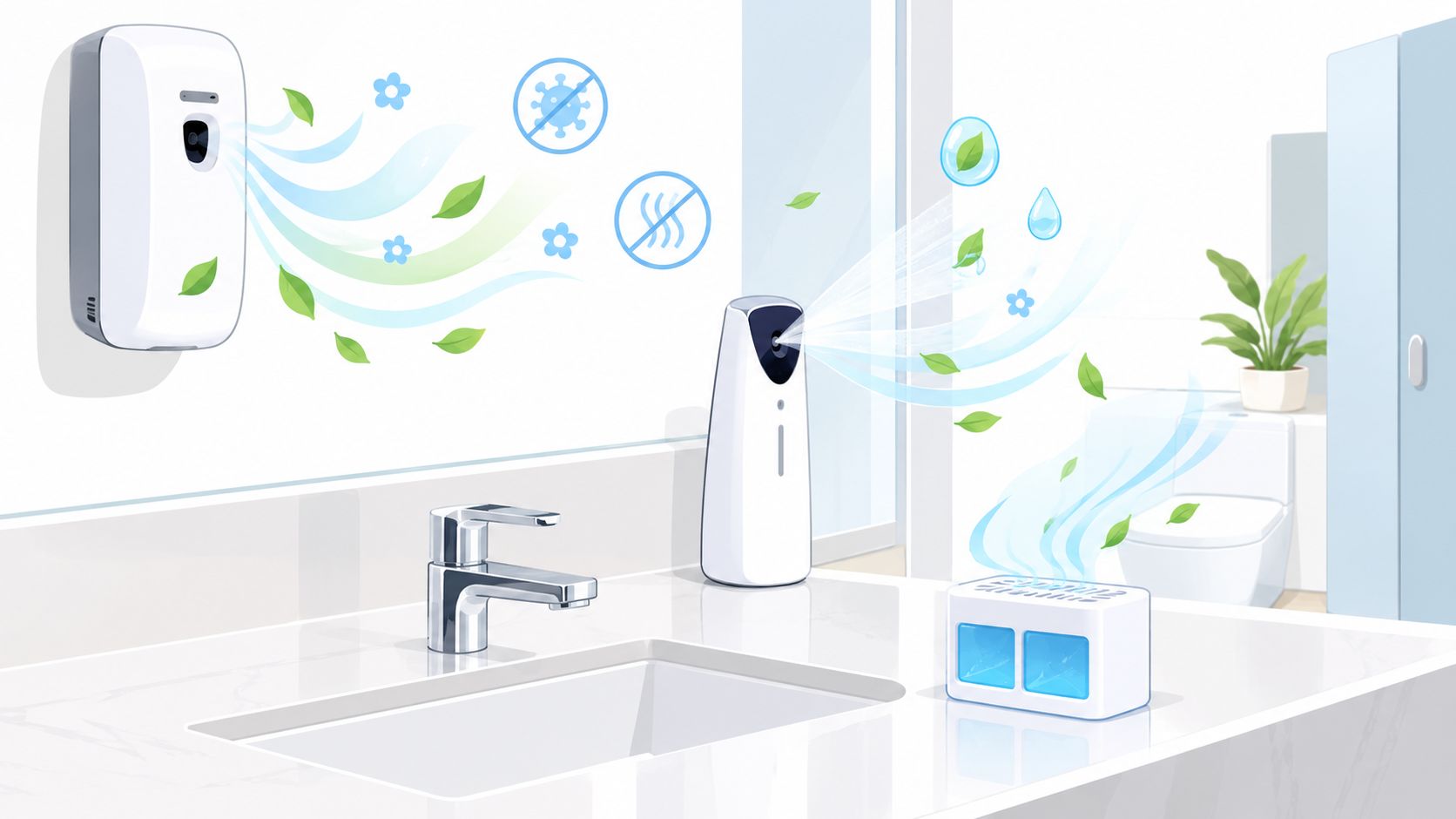
A restroom can look spotless and still lose a visitor's confidence within seconds. A stale odor near the entrance, an overflowing bin, or a sticky faucet tells guests that cleaning may be inconsistent, even when the floor has just been mopped. In airports, gyms, event venues, short-term rentals, restaurants, and dealerships, restroom freshness is therefore more than a fragrance decision. It's a coordinated system involving ventilation, source removal, surface disinfection, and carefully controlled scent.
A commercial air freshener for restrooms can support that system, but it can't replace it. The strongest programs pair measured fragrance with visible cleaning, reliable maintenance, and disinfectant wipes used correctly on high-touch surfaces. This guide explains how to choose equipment, control odor at its source, protect indoor air quality, and build a practical hygiene routine that works for both facility teams and cleaning-supply professionals.
Why Restroom Freshness Shapes Guest Trust and Revenue
A traveler walks into an airport restroom after a long flight. The sinks are polished, paper supplies are available, and the lighting is bright, but the air smells sour. That visitor may not identify the plumbing issue or missed cleaning task. They register the space as neglected.
The same reaction appears in a fitness center when a member notices odor around the changing area, or in a car dealership when a prospective buyer uses the customer restroom before speaking with a salesperson. Freshness becomes a cleanliness signal. It influences how people interpret the rest of the facility, from the lobby and equipment floor to the service counter.
A pleasant restroom experience can support confidence, reviews, repeat visits, and brand perception. It won't overcome visible grime or poor ventilation, though. Fragrance layered over urine residue, overflowing waste, or contaminated touchpoints often creates a more confusing impression rather than a cleaner one.

Freshness is part of the operating experience
Commercial restroom scent systems have developed through successive product generations rather than appearing as a recent niche. A 1977 patent for air freshener gels was followed by a 1980 patent for fragrance-containing polyurethane foam, then a 1987 patent for fragranced gel blocks designed for urinals and toilet bowls, as documented in the restroom air-freshener patent record.
The patent history continued with a 1993 filing for a toilet seat air freshener and an inline sanitary conditioning system filed in 1998 and published in 2000. That progression shows how the category moved from broad air treatment toward fixture-adjacent and facility-oriented odor management.
The commercial opportunity is also substantial. One market estimate placed the global air freshener market at USD 13.8 billion in 2025, while another estimated USD 13.4 billion in 2024 and projected USD 17.4 billion by 2033, with referenced CAGR ranges from 5.2% to 6.7% across segments (Accio market summary). These figures indicate sustained demand, but they don't prove that more fragrance solves a restroom problem.
Practical rule: Treat scent as the final layer of a cleaning program, not as evidence that cleaning has happened.
Visible hygiene reinforces the message
Guests notice what staff clean and what staff leave untouched. Door handles, faucet controls, stall latches, flush buttons, baby-changing surfaces, and dispenser levers deserve deliberate attention because many people contact them throughout the day.
For janitorial teams, a visible container of disinfectant wipes can support that message in gyms, offices, and shared facilities. In a gym, gym equipment wipes placed beside weight machines and cardio equipment make the sanitation expectation clear. In a restroom, wipes can help staff address touchpoints between deeper cleaning rounds, provided the product is approved for the surface and used according to its label.
If you're evaluating fragrance ingredients, sensitivity concerns, and safer product selection, the safe air-freshener guidance from Aroma Warehouse offers useful context. The purchasing decision should still begin with ventilation, cleaning chemistry, surface compatibility, and service procedures.
Comparing Dispenser Types and Refill Formats That Actually Work
Different restroom layouts call for different delivery methods. A metered aerosol may provide a noticeable burst in a busy public restroom, while a passive system can suit a quieter office where staff want low-maintenance diffusion. Gel blocks work well near specific odor sources, but they won't distribute fragrance evenly through every room.
The right choice depends on room volume, airflow, traffic, service access, and refill discipline. Buying by fragrance strength alone creates predictable problems. A dispenser may smell powerful near the entrance while leaving odor concentrated around urinals, waste bins, or poorly ventilated corners.
The main options at a glance
| System Type | Best For | Refill Life | Maintenance Effort |
|---|---|---|---|
| Metered aerosol | High-traffic rooms needing timed bursts | Varies by setting and spray interval | Moderate, with battery and cartridge checks |
| Continuous passive | Offices and steady, lower-intensity environments | Typically 30 to 60 days | Low, but placement matters |
| Gel block | Urinals, toilet bowls, or targeted odor zones | Often around 30 days | Low to moderate, depending on replacement access |
| Smart demand-based | Multi-zone facilities seeking occupancy or odor-responsive control | Variable | Higher, because sensors and data require oversight |
Automatic systems are commonly specified around 30 to 60 days per refill, while some continuous or metered spray products claim odor control for up to 90 days in spaces up to 6,000 cubic feet (UniFirst facility-care guidance). Treat those figures as planning benchmarks, not guarantees. Traffic, temperature, airflow, spray intervals, and staff behavior affect actual depletion.

Match the format to the maintenance route
Metered aerosols offer consistency because the timer controls release, but they add batteries, cartridges, and compliance checks to the service route. Passive units reduce mechanical complexity, though their output can feel too subtle in a large room with strong exhaust airflow. Gel blocks are useful for localized odor control, particularly near urinals, but they're not a substitute for drain maintenance or thorough fixture cleaning.
Smart demand-based units can reduce unnecessary release by responding to occupancy or odor conditions. They also demand better oversight. If the sensor fails, connectivity drops, or staff don't review depletion data, the extra technology becomes another maintenance liability.
Pair any fragrance system with EPA registered disinfecting wipes when staff need to control contamination on touchpoints rather than merely improve smell. A buyer comparing supply options can review commercial cleaning wipes at Wipes.com alongside dispenser and refill requirements. For a narrower comparison of small-room scenting, see this small-spaces air-freshener guide.
Scent Strategy Versus True Odor Control and Placement Rules
Fragrance covers perception. Odor control addresses the conditions producing the odor. Facility teams should work through those conditions in order: remove the source, move stale air, neutralize persistent compounds where appropriate, and use scent as a restrained finishing layer.
Restroom odor often comes from aerosolized waste and volatile compounds. A diffuser can't remove residue under a urinal, a blocked drain, a saturated waste bin, or inadequate exhaust. If staff increase fragrance before correcting those sources, the room may smell both dirty and heavily perfumed.
Build the control layers in the right order

Start with source removal. Empty waste containers, clean splash zones, flush and scrub fixtures, inspect drains, and address leaks. Use suitable disinfecting wipes on high-touch areas, but don't use them as a replacement for cleaning large contaminated surfaces or removing visible soil.
Ventilation comes next. Check whether exhaust grilles are obstructed, whether air moves consistently, and whether odor lingers in corners or stalls. A restroom with strong airflow may need a different dispenser position or output than a similarly sized room with limited circulation.
Neutralizing chemistry can help with persistent organic odors, but product compatibility matters. Some air freshener and cleaning-product combinations can increase indoor chemical load. Independent air-quality literature found that air-freshener use can raise indoor terpene exposures, and one study observed d-limonene concentrations dropping by up to 96% within two weeks after discontinuation (Ineris technical document).
Place equipment according to airflow
A commercial system may cover about 6,000 cubic feet, roughly comparable to a standard three- to four-stall restroom, although actual coverage depends on ceiling height, airflow, partitions, and odor sources (Business Hygiene Texas coverage guidance). A long restroom, divided layout, or multi-zone facility may need more than one unit.
Use these placement principles:
- Avoid direct spray near faces: Don't position a metered unit where the burst reaches guests at eye level or directly across a sink.
- Use airflow intelligently: Place passive or metered systems where air can distribute fragrance, but avoid mounting them directly beside a powerful exhaust point.
- Treat source zones separately: A gel block near a urinal can support localized control, while a room dispenser handles general ambient freshness.
- Observe sensitive areas: Keep fragrance away from baby-changing stations and areas where guests may remain close to the dispenser.
- Review the whole room: Ceiling height, partitions, stalls, and vestibules can create separate odor zones.
A useful operating reference is this commercial restroom odor-removal guide. Staff should record complaints, inspect likely sources, and compare refill depletion with the planned service cadence. A room that requires increasingly strong fragrance may be signaling a ventilation or source-removal failure.
Installation and Daily Upkeep That Keeps Restrooms Fresh
Installation affects both performance and guest comfort. Mount the dispenser where staff can service it safely and where the release can circulate without spraying directly at people. The maintenance team should also document the model, refill type, installation location, interval setting, and date of every cartridge change.
The infographic's installation reference places a dispenser at 60 to 70 inches and urinal blocks at 12 inches from the floor. Use manufacturer directions and facility safety requirements when deciding the final position, particularly in rooms used by children, people with mobility limitations, or guests with fragrance sensitivities.

The daily route
A strong route combines odor checks, replenishment, and touchpoint disinfection. Staff shouldn't wait for a complaint before checking the room.
- Remove waste and visible soil. Empty bins, clean spills, inspect floors and fixture bases, and address the source before applying fragrance.
- Wipe high-touch surfaces. Focus on handles, stall latches, faucet controls, flush buttons, dispenser levers, and other frequently contacted points.
- Verify the scent system. Check the cartridge, battery, release mechanism, and visible damage. A full refill is useless if the dispenser has stopped working.
- Record exceptions. Note recurring odor, low stock, clogged drains, damaged hardware, or guest complaints so the next shift can act on a pattern.
Disinfectant wipes must keep the treated surface wet for the full label contact time. The CDC explains that users may need more than one wipe to keep electronics or other touched items wet long enough to kill germs (CDC facility cleaning guidance). For electronic fixtures, use products approved for the surface and follow the equipment manufacturer's instructions.
Make the wipe routine efficient
Pre-stage supplies on the cart. Keep separate containers for restroom chemicals, gloves, waste bags, and fitness center wipes if the same team services nearby exercise areas. Wipe from cleaner surfaces toward dirtier ones, change direction methodically, and replace a wipe when it becomes dry or visibly soiled.
For gyms, wipes for gym equipment should sit close to the equipment they're intended to clean. Members need clear disposal instructions, and staff should inspect machines, benches, touchscreens, and adjustment handles during scheduled rounds. Restrooms require their own dedicated cleaning routine, even when the same disinfectant product is used.
The CDC's early-care guidance supports disinfecting wipes for frequently touched electronics such as phones and computers, with directions followed carefully and additional wipes used when needed (CDC early-care guidance). For hospital-grade products, label contact time can be 10 minutes, although CDC infection-control guidance notes that many studies have shown effectiveness with at least 1 minute under tested conditions (CDC disinfection recommendations). UNC SPICE further explains that wipe treatment time includes the wet wiping phase and the undisturbed period afterward. If the EPA registration time is 2 minutes, the surface should remain undisturbed for the full 2 minutes (UNC SPICE wipe guidance).
Cost Supply and Compliance Considerations You Cannot Ignore
The purchase price of a dispenser is only one part of the operating cost. A facility manager should account for refills, batteries, service time, emergency visits, waste handling, surface-compatible wipes, and the labor required to inspect performance. A low-cost system that needs frequent attention may cost more to operate than a simpler unit that matches the cleaning route.
Track three practical measures: refill depletion, odor complaints, and service completion. If cartridges empty before the scheduled visit, the interval or unit count may be wrong. If complaints continue while fragrance consumption rises, the team should investigate ventilation, drains, waste, and fixture cleaning instead of increasing scent.
Confirm VOC requirements before ordering
California's updated consumer-product VOC rules set category-specific limits of 30% for automatic aerosol air fresheners and 10% for manual aerosol air fresheners beginning January 1, 2023. The manual category is scheduled to tighten to 5% in 2027 (ISSA California VOC guidance).
Canada's federal VOC guidance also treats air fresheners as regulated consumer products and directs buyers to the applicable limits in the relevant appendices. Procurement teams should verify the product category, intended market, formulation, label, and safety documentation before approving a refill.
Purchasing discipline: A strong fragrance profile doesn't compensate for a product that fails regional requirements or creates avoidable indoor-air concerns.
Include the full hygiene supply system
For gyms and fitness centers, the supply plan may include a gym wipe dispenser, bulk gym wipes, restroom refills, gloves, liners, and compatible surface cleaners. Sales professionals can increase customer value by presenting these items as one service program rather than selling fragrance in isolation.
The same principle applies to offices, restaurants, schools, and retail stores. Buyers need a clear explanation of what each product does, where it belongs, how long it lasts, and which surfaces it can safely treat. If ventilation, extraction, or air purification is the need, say so. A credible recommendation may reduce a fragrance sale but strengthen the customer relationship.
For broader facility upkeep, the commercial property maintenance guide from EZ Plumbing provides useful context for treating plumbing and building systems as part of cleanliness management. Restroom odor frequently points beyond the dispenser cabinet.
Facility Tailored Recommendations and Your Next Steps to Cleaner Air
An office restroom usually benefits from restrained scent, dependable passive diffusion, and a documented touchpoint route. Staff can check supplies and wipe handles, faucets, latches, and dispenser controls during normal cleaning without creating an intrusive fragrance environment.
Gyms need a more visible program. Place gym equipment cleaning wipes beside machines, provide yoga mat wipes where shared mats are used, and train staff to distinguish member-use cleaning from the deeper disinfecting work performed by the janitorial team. A salesperson can explain the hygiene ROI in operational terms: easier staff routines, clearer member expectations, fewer missed touchpoints, and a supply program that includes both fitness wipes and restroom care.
Schools require extra attention to product directions, storage, supervision, and surface compatibility. Restaurants should prioritize waste removal, drain and fixture cleaning, and fragrance restraint near food-service areas. Retail stores and dealerships should keep customer restrooms presentable throughout the day because the restroom often becomes an unplanned test of overall management standards.
High-traffic venues, including airports and event facilities, may need multiple scent zones rather than one powerful dispenser. Pool clubs should account for humidity, wet floors, changing areas, and the interaction between ventilation and fragrance. Across every setting, staff should review airflow, source removal, touchpoint disinfection, refill depletion, and guest feedback together. For readers assessing broader environmental conditions, this resource on Mesa indoor air quality from Comfort Experts offers a useful building-services perspective.
Keep the cleaning routine simple enough to perform consistently. Remove waste, clean visible soil, disinfect touchpoints while maintaining label wet time, inspect ventilation, check dispenser function, and document recurring odor instead of masking it indefinitely. For product planning, teams can also consult WipesBlog.com for facility sanitation topics covering gyms, airports, event venues, rentals, and other shared environments.
Prioritize cleanliness before fragrance, then add a commercial air freshener for restrooms that matches the room, traffic, airflow, and service schedule. Restock reliable disinfectant wipes, place them where staff and users can reach them, train teams to follow contact-time directions, and review odor complaints alongside refill use. Visit Wipes.com to evaluate wipe supplies for your facility or product offering, then make visible cleaning and sanitizing part of every day's operating routine.
Leave a Reply