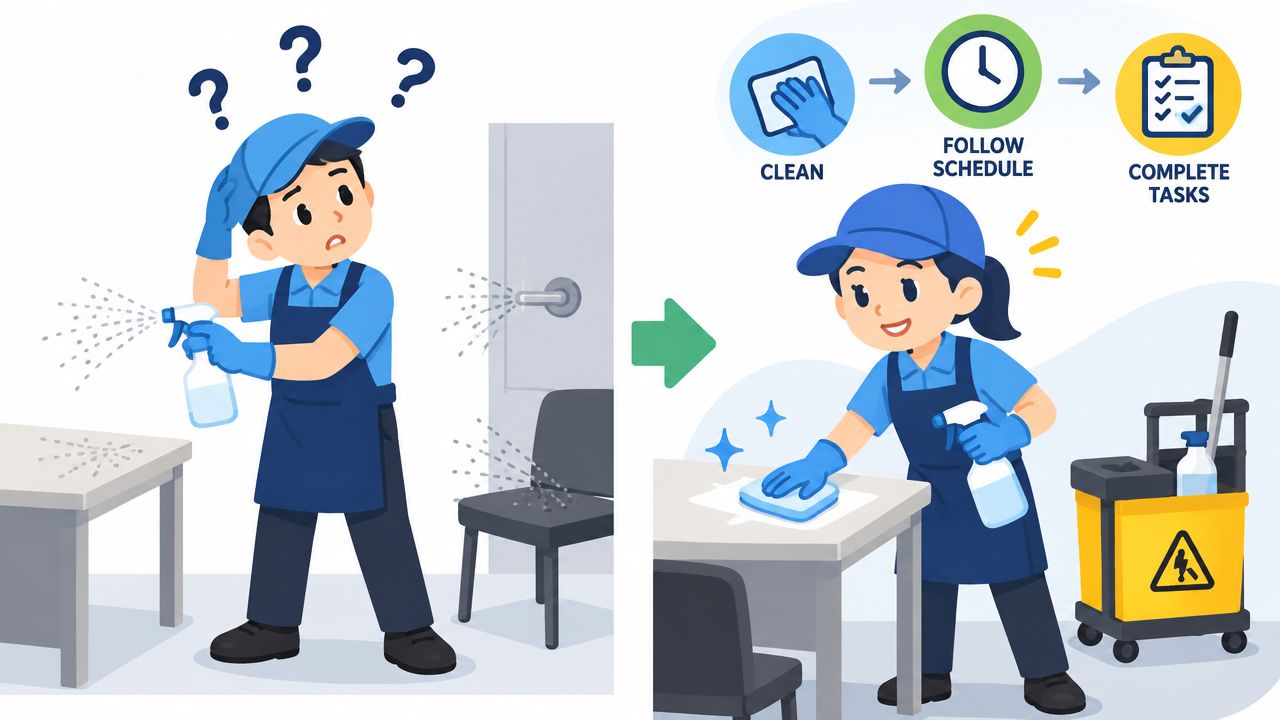
A member reports a sticky treadmill handle just as the morning rush begins. One employee wipes it quickly and returns to the front desk. Another cleans the visible soil, applies an appropriate disinfectant wipe, keeps the surface visibly wet for the labeled contact time, and records the completed checkpoint. Both employees appear busy, but only one has followed a process that another team member can repeat.
That difference answers what is employee training more clearly than an HR definition can. Training is the organized process that gives people the knowledge, skills, practice, and feedback required to perform a job consistently. In a commercial or public facility, that includes much more than watching an onboarding video. It means knowing which high-touch surfaces need attention, how to use disinfectant wipes correctly, when to repeat the task, and how to prove the work happened.
A Day Where Cleaning Training Made the Difference
At a busy airport terminal, a drink spills beside a bank of seats during the first wave of departures. A male custodian arrives with a cart while a female colleague cleans nearby. The team has minutes to restore the area without turning a visible spill into a recurring sanitation problem.

The trained custodian removes the visible spill first, then follows the product directions for disinfection. He applies enough product to cover the surface and keeps it visibly wet for the required contact or wet time. His colleague checks nearby armrests, tray tables, door handles, and other high-touch points, because the spill marks one problem area, not the whole cleaning route.
That sequence protects more than appearance. It gives the next worker a clear standard, helps the supervisor verify completion, and reduces the chance that staff or passengers encounter the same neglected touchpoint later. A quick wipe may look efficient, yet it can leave the surface untreated, undocumented, or ready for another complaint.
Training turns judgment into standard work
A useful cleaning lesson works like a route map. It tells employees what to check, in what order, and what to do when conditions differ from the routine:
- Identify the task: Decide whether the area needs cleaning, disinfection, or both.
- Select the product: Choose a surface-compatible wipe and follow its label.
- Apply the method: Cover the target area and maintain the required wet time.
- Work systematically: Move through assigned high-touch zones instead of cleaning only visible soil.
- Record completion: Log the checkpoint when the facility procedure requires documentation.
- Escalate exceptions: Report damaged surfaces, empty dispensers, missing labels, or recurring spills.
The CDC explains that disinfectant must remain on a surface for its labeled contact or wet time to kill germs. The surface should stay wet for the full labeled period, while the product directions and Safety Data Sheet identify the required time. CDC guidance on contact time and disinfecting facilities gives supervisors a practical coaching point: speed alone does not prove effective disinfection.
Employee training makes this routine repeatable through onboarding, supervised practice, shift feedback, and refresher coaching. Passengers may never see the lesson, but they notice its results in cleaner touchpoints, stocked stations, faster responses, and staff who can explain the work. Those consistent experiences support trust, repeat use, and retention because sanitation becomes a service standard rather than a last-minute reaction.
Defining Employee Training in Practice
Employee training is a business system for building job capability. It begins by identifying a performance need, then turns that need into instruction, practice, assessment, and reinforcement. Training is complete only when employees can perform the task reliably during their shift.
Consider a facility where cardio consoles are not being cleaned consistently. A manager identifies the gap and checks its cause. The training designer creates a short protocol covering the approved product, surface compatibility, application, contact time, disposal, and documentation. A lead porter demonstrates the routine. Employees practice with the actual wipe, dispenser, cart, and equipment, while a supervisor observes against a checklist. If an audit finds a missed step, coaching targets that behavior rather than repeating a generic lesson.
The six building blocks are:
- Needs assessment: Identify the performance gap and its operational cause.
- Curriculum design: Turn the required behavior into a clear lesson and job aid.
- Delivery: Provide instruction in a format that fits the staff's work pattern.
- Practice: Let employees perform the task with real tools and surfaces.
- Assessment: Confirm that workers can complete the task, not just define its terms.
- Reinforcement: Sustain the behavior through reminders, observation, feedback, and refreshers.

Training is larger than onboarding
Formal training has a defined objective, an organized procedure, practice time, and a method for checking competence. Informal shadowing can support it, but watching a coworker does not confirm that the coworker uses the approved method. A new hire can copy an inconsistent sequence and repeat it confidently.
Investment levels show that organizations treat training as an operating expense, not a one-time welcome activity. U.S. corporate training expenditure reached $101.8 billion in 2023, dipped to $98 billion in 2024, and rose to $102.8 billion in 2025, according to the employee training spending benchmarks. Average direct learning spend per employee was about $1,254 in 2024, while cost per learning hour rose to $165, a 34% year-over-year increase, from the same source.
Access is uneven. One 2026 compilation reported that 41% of U.S. employees currently receive formal training, while 60% say they've never had formal workplace training. It also reported an average of 47 training hours in 2024, down from 57 hours in 2023. Employee training access and retention statistics shows why facility managers need formats that reach frontline workers, including staff who spend little time at computers.
Why Sanitation Training Deserves a Real Seat at the Table
A crowded gym can expose weak training within minutes. A porter may wipe a treadmill handle, move on before the disinfectant's contact time is met, and miss the next high-touch zone. The policy may be stored in a compliance folder, but it cannot guide that decision at the moment it matters.
Sanitation work affects customer experience, staff workload, operating risk, and the credibility of a facility's service promise. Structured training gives hygiene work the same status as other operational skills. Employees learn why the sequence matters, then practice until they can repeat it reliably across gyms, schools, restaurants, offices, retail stores, airports, and public venues.
The retention case is practical. Ninety-four percent of employees say they'd stay longer if a company invested in their learning, and organizations with thorough training programs have been reported to generate 218% higher income per employee than organizations without formalized training. These figures should not be treated as a promise that every sanitation course will produce the same outcome. They do support treating useful learning as part of the employee experience rather than an interruption to it.
Productivity evidence points in the same direction. A panel study of German firms found that increasing the share of employees participating in training by one percentage point raised structural productivity by about 0.3%, with effects appearing in the same year and the following year. Formal internal and external courses showed the strongest short- to medium-term impact in the German firm training and productivity study.
| Metric | Generic Compliance Training | Structured Sanitation Training |
|---|---|---|
| Primary objective | Confirm that information was presented | Build repeatable cleaning behavior |
| Practice | Often limited or absent | Employees perform the task with real tools |
| Assessment | Completion or quiz result | Observation against a job-specific standard |
| Reinforcement | Occasional policy reminder | Shift coaching, checkpoints, and refreshers |
| Business connection | Difficult to trace | Linked to rework, complaints, audits, and service quality |
A trained worker understands how frequency, sequencing, and contact time affect the result. That knowledge supports better choices when a facility becomes crowded, a dispenser runs empty, or a spill interrupts the planned route. Consistent execution can reduce rework and complaints while helping staff see that sanitation is part of dependable service, retention, and revenue, not merely a compliance task.
Core Components of a Facility Sanitation Program
A working sanitation curriculum should follow the task from recognition to verification. Use gym cardio equipment as the example, because treadmills, bikes, ellipticals, and weight machines combine frequent hand contact with different materials and shapes.

Seven behaviors employees must demonstrate
Hazard identification comes first. Staff should recognize visible soil, bodily fluid concerns, damaged upholstery, and high-touch points such as handles, buttons, screens, adjustment levers, and locker handles. They also need to know when a situation requires a supervisor or a different procedure.
Chemical literacy means reading the product label, confirming surface compatibility, understanding required protective measures, and distinguishing a cleaning wipe from an appropriate disinfecting product. If a facility promotes commercial disinfecting wipes to fitness operators, sales staff should explain the intended use and directions rather than promising that any wipe works on every surface.
Contact time is a performance requirement, not a technical footnote. The EPA defines contact time as the period a product must remain visibly wet to work. If the surface dries early, more product should be applied, and label examples can range from 10 minutes to shorter listed conversions such as 10, 15, 30, 60, or 90 seconds, depending on the product. EPA information about registered disinfectants and contact time helps trainers teach employees to follow the exact label for the wipe in use.
Protocol development turns the knowledge into a route. A porter might clean the console and handles of one machine, discard the used wipe according to site procedure, and continue through the assigned row without jumping randomly between clean and visibly dirty equipment.
Frequency planning connects cleaning to traffic. The CDC recommends cleaning and disinfecting frequently touched surfaces such as door handles, desks, phones, light switches, and faucets at least daily in public and private facilities. CDC facility cleaning guidance supports routine attention to shared touchpoints, while a gym may add checks during busy operating periods based on its own risk assessment.
Tool selection and personal protection should be demonstrated at the point of work. Employees need the correct wipe grade, a suitable dispenser, gloves or other required protective equipment, and a clear disposal method. A wipe intended for gym equipment may not be suitable for a delicate screen, rubber flooring, or a yoga mat.
Monitoring and improvement close the loop. Supervisors can inspect completed routes, review logs, check supply levels, and coach missed steps. For a deeper planning framework, a training needs analysis for HR can help connect role requirements with learning objectives and assessment methods.
The CDC recommends cleaning with soap and water first, then disinfecting with an EPA-approved product. CDC reopening guidance for public facilities makes the sequencing clear. Wipes are valuable, but they shouldn't become a shortcut that skips soil removal when the surface needs a two-step process.
Delivery Methods That Fit a Working Facility
A busy facility cannot close every shift for classroom training. The delivery method should fit staffing, operating hours, risk, and the skill employees must demonstrate. A new hire learning how to clean a high-touch route needs a different experience from an experienced worker refreshing contact time.
| Method | Best For | Shift Coverage | Skill Retention | Supervisor Time |
|---|---|---|---|---|
| Live classroom session | Introducing policy and explaining risk | Limited unless repeated | Useful for concepts, weaker without practice | Moderate |
| On-the-job shadowing | Demonstrating routes and techniques | Strong when leads cover shifts | Strong when practice includes feedback | High |
| Microlearning by phone | Refreshing contact time or sequence | Flexible between shifts | Useful for short reminders | Low |
| Short video in an LMS | Showing a standard method consistently | Flexible for distributed teams | Stronger when paired with practice | Low to moderate |
A live session suits the launch of a sanitation program. Managers can explain why the sequence changed and connect correct cleaning with customer confidence, repeat visits, and staff retention. The classroom cannot show whether an employee can apply a wipe evenly to a curved treadmill handle while working around facility traffic.
Shadowing supplies that practical test. A lead porter models the route, watches the employee repeat it, and corrects missed coverage or poor sequencing immediately. The limitation is supervisor capacity. If the lead is repeatedly pulled into urgent cleaning, new hires may receive uneven instruction.
Microlearning supports short, timely refreshers. A phone prompt can ask an employee to select the required wet contact time or the correct order for cleaning a machine. These reminders work like route signs: they do not teach the whole journey, but they help prevent a wrong turn during a busy shift.
Short videos can show hand placement, surface coverage, and dispenser use consistently. Record the actual equipment and products used at the facility, so the lesson matches the work employees face. Teams producing their own clips can use these training video creation tips to keep demonstrations clear and focused.
Operational rule: Use video to show the standard, supervised practice to build the skill, and quick reminders to keep the procedure available during the shift.
A blended model usually fits a working facility best. Pair a brief introduction with lead-porter practice, then keep the procedure and refresher clips accessible without requiring employees to leave the floor for long periods. Managers can compare the setup with staff training best practices while building a routine for new hires and experienced staff.
Measuring Whether Training Actually Changed Anything
A completion certificate tells you that an employee finished a lesson. It doesn't tell you whether the employee cleaned the correct surface, maintained wet contact time, or followed the facility's sequence during a crowded shift.
Start with a behavior rubric. A supervisor can observe whether the employee identifies the right touchpoints, selects the correct product, covers the surface, maintains the labeled wet time, disposes of the wipe correctly, and records the checkpoint. Score the same behaviors across employees so the result reflects the process rather than a supervisor's general impression.
A useful measurement stack
- Reaction: Ask whether employees found the instruction clear and relevant to their work.
- Learning: Use a short knowledge check covering product directions, contact time, surface compatibility, and escalation.
- Behavior: Observe the employee on the floor with the actual equipment and score the procedure.
- Results: Compare operational indicators such as rework, customer complaints, incident reports, and cleanliness audit findings.
Where appropriate, an ATP swab test can provide a validation signal for surface cleaning. It should complement, not replace, direct observation and product-label compliance. A facility can also compare completed work per shift before and after training, review employee confidence through brief pulse checks, and track slips, cross-contamination events, supply gaps, or complaints.

The most common measurement failure is stopping at course completion. Leaders may know who watched a video but never return to the floor to see whether behavior changed. A better cadence includes re-audits at 30, 60, and 90 days, followed by targeted refreshers for the steps employees miss most often.
Only 25% of organizations track the business impact of learning, according to recent reporting on the shift from completion-based training toward performance ecosystems. Reporting on business impact measurement in learning highlights the gap facility leaders can address by connecting training records with operational evidence.
For a broader framework, review this guide to how to measure training impact. Use the findings as feedback, not punishment. If several employees miss the same step, the program may need a clearer demonstration, better placement of supplies, or a more realistic route.
Facility managers can also use this training effectiveness measurement resource to structure follow-up checks and connect learning activity with floor performance.
Business Outcomes and Your Next Move
Sanitation training belongs on the operational scorecard because employees' cleaning decisions affect labor, service quality, risk, and customer confidence. When a worker follows the correct sequence, the facility reduces avoidable rework. When staff know which surfaces require routine attention, supervisors spend less time correcting missed areas. When a gym keeps wipes available at the point of use, members can participate in the cleanliness routine instead of waiting for a porter to reach every machine.
The productivity case includes team spillovers. A large study found that training participation increased trained workers' productivity by 9%, while a 10 percentage point increase in the share of trained peers raised the productivity of untreated coworkers by 0.45%. The study of training and coworker productivity spillovers supports cross-training and shared procedures in interdependent work environments.
Put the program into the operating plan
Audit the current trainer-to-staff coverage first. If night and weekend employees rarely receive live coaching, add short video modules, shift huddles, or rotating lead coverage. Tighten onboarding by requiring a demonstrated sanitation route before a new hire works independently.
Then make supplies part of the standard work. A gym wipe dispenser should sit where members and employees can reach it without creating clutter or obstructing equipment. Fitness centers may evaluate wipes for gym equipment, while schools, restaurants, offices, and retail stores should map their own high-touch zones and select products according to the label, surface, and facility procedure.
Sales professionals can position wipes as part of a complete hygiene system rather than a standalone consumable. Ask customers about traffic patterns, current dispenser placement, staff coverage, contact-time compliance, and documentation. Then recommend a practical package that may include dispensers, refills, signage, gloves, cleaning tools, and training materials. Explain the value through reduced rework, visible cleanliness, easier standardization, and stronger customer confidence, without promising an outcome the facility hasn't measured.
A facility can also use the training program as a retention signal. Employees who receive useful instruction understand expectations, gain confidence in their work, and see that management values the quality of their contribution. That makes sanitation capability part of workforce development, not merely a compliance chore.
Benchmark your current program against the seven components above, schedule a sanitation refresher this quarter, and observe the result on the floor. Prioritize daily cleaning, maintain the labeled contact time, stock appropriate disinfectant wipes, and make high-touch sanitation a routine that every shift can execute.
Talk with your team this week, identify the high-touch areas that most often get missed, and integrate suitable disinfecting wipes into the daily cleaning route or your commercial product offering. Use the first refresher session to demonstrate the full process, verify it in practice, and turn cleanliness into a visible operational standard.
Leave a Reply