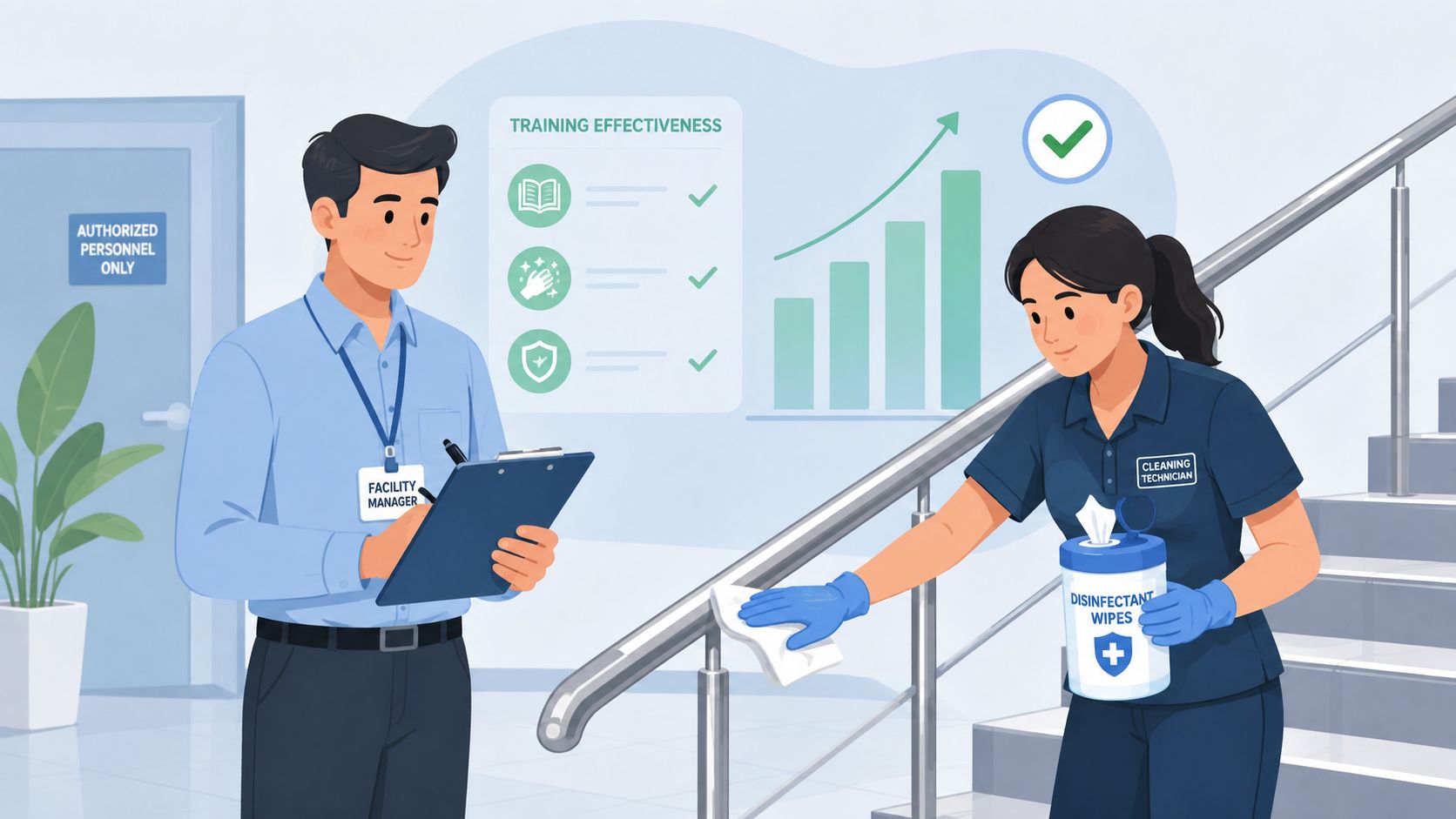
A cleaning crew can complete every assigned task, pass a product quiz, and still leave a facility with the same fingerprints on door handles, residue on gym equipment, and complaints in the manager's inbox. That's the uncomfortable reality behind many sanitation programs. Completion proves attendance. It doesn't prove that employees apply the correct technique when the building is busy.
Training effectiveness measurement connects instruction to what customers and operators experience, including cleaner high-touch surfaces, stronger audit results, fewer hygiene complaints, and more consistent guest confidence. In commercial and public facilities, that connection matters because cleanliness protects reputation as much as it supports health and safety. A visible supply of disinfecting wipes, paired with reliable staff routines, can make sanitation more practical in offices, gyms, schools, restaurants, and retail spaces.
Why Most Facility Training Programs Fail to Show Results
A facility manager may approve training after repeated complaints about sticky counters, neglected handles, or gym machines that aren't wiped between users. Staff attend a session on surface preparation, product selection, and wet contact time. They complete a quiz and rate the instructor favorably. Months later, the complaints continue, and leadership asks a difficult question: what did the training change?
The usual answer is unclear because the program measured activity instead of performance. Attendance records, completion rates, and satisfaction surveys are easy to collect, but they're weak evidence of operational improvement. A cleaner might know that a disinfectant must remain wet for the product's listed contact time, yet still wipe a treadmill handle once and walk away before the surface has stayed wet long enough.
That gap appears in many settings:
- Gyms: Staff understand that handles, seats, buttons, screens, benches, and grips need attention, but high traffic makes the routine inconsistent.
- Offices: Employees may receive guidance on shared desks and phones, while supervisors fail to assign ownership for cleaning between shifts.
- Public facilities: Janitorial teams may pass a written assessment but lack stocked supplies, usable checklists, or enough time to cover high-touch areas.
The CDC's facility guidance identifies tables, doorknobs, light switches, countertops, handles, desks, phones, keyboards, toilets, faucets, and sinks as high-touch surfaces. It also advises cleaning and disinfecting shared surfaces at least daily when multiple people touch them. That guidance only helps if training changes what staff do during the shift.
Operational reality: A passed quiz tells you what someone can recall. An observation tells you what they actually do when the facility is open.
The transfer problem is substantial. A critical review summarized by Berkeley Lab notes that sustained transfer from classroom learning to workplace practice is often only about 10-12% of what is taught (Berkeley Lab training evaluation guidance). Immediate test gains can therefore create false confidence. Effective programs measure the path from knowledge to behavior, then connect behavior to cleanliness and guest experience.
The Four-Level Framework for Measuring Training Impact
A sanitation program can show perfect completion rates while high-touch surfaces remain dirty during operating hours. The Kirkpatrick model provides a practical way to trace that gap from employee response to measurable facility outcomes. Donald Kirkpatrick developed it in the 1950s and published it in a 1959 series of articles. The framework established four evaluation layers, reaction, learning, behavior, and results, and later updates included a 1975 book and the New World Kirkpatrick Model in 2016 (Chief Learning Officer's history of the Kirkpatrick model).
For sanitation operations, apply the levels in sequence:
- Reaction: Ask whether the training was relevant and usable. Did janitorial staff find disinfectant wipe procedures practical? Did gym employees understand why equipment touchpoints need attention after use? This feedback improves delivery, but it does not prove competence.
- Learning: Test knowledge and technique with a pretest, posttest, and practical demonstration. Employees should identify high-touch areas and explain how to maintain the wet time listed on the product label. Multiple-choice questions alone cannot verify technique.
- Behavior: Check application during normal operations. Observe whether staff use gym equipment wipes correctly on handles, seats, screens, and grips. Verify that office teams follow assigned routines and that school or restaurant employees handle shared surfaces according to the approved procedure.
- Results: Connect behavior with operating outcomes, including cleanliness audit scores, guest satisfaction feedback, hygiene complaints, incident reports, and other facility-specific indicators. The selected results should match the business problem the training was intended to address.
The EPA's disinfectant guidance states that a surface must remain wet for the full contact or wet time listed in the product directions or Safety Data Sheet. If the surface dries early, staff must apply more product. Training that covers this rule without checking it during work stops at Level 2.
Facility leaders can use these practical tips from LearnStream to strengthen evaluation planning and connect employee behavior with cleanliness and guest experience.

Choosing the Right Metrics for Sanitation Training
A fitness center can report full training attendance while members still find dirty equipment. The useful metric exposes the operational decision behind that result. If staff identify high-touch points but coverage remains poor, the remedy may be staffing, supply placement, or supervisor follow-up rather than another classroom session.
Use a small measurement set tied to the cleanliness problem. Establish a baseline before training and keep the definitions consistent afterward. A gym might record whether sampled machines were wiped correctly. An office could review desks, keyboards, phones, and door handles, while a restaurant might focus on shared service areas and restroom touchpoints. The method must fit the workflow so staff can collect reliable information without adding an impractical administrative burden.
| Measurement Level | Metric Type | Example for Cleaning Training | Collection Method |
|---|---|---|---|
| Reaction | Relevance and usability | Staff rating of wipe procedure instruction | Short post-session survey |
| Learning | Knowledge and demonstration | Identifying high-touch areas and explaining wet time | Pretest, posttest, and practical demonstration |
| Behavior | Procedure adherence | Correct use of wipes to disinfect gym equipment during active operations | Structured observation checklist |
| Results | Facility outcome | Audit findings, hygiene complaints, and guest satisfaction feedback | Routine reports and trend review |
Leading indicators and operating outcomes
Learning metrics show whether employees understood the lesson. Behavior metrics show whether they apply it during work. Results metrics connect that application to facility cleanliness, hygiene complaints, and guest satisfaction. Keep the categories separate so a strong quiz score does not get mistaken for an operating improvement.
For gyms, spot checks can record cleaning of machine handles, seats, buttons, screens, benches, and grips after use. Review whether a gym wipe dispenser is close enough to equipment for convenient use, because supply placement can affect adherence. In offices and schools, observers can sample shared surfaces during normal activity. Retail teams can check checkout counters, cart handles, touchscreens, and fitting-room surfaces.
A practical observation sheet should cover:
- Surface identified: Did the employee select the correct high-touch point?
- Product used: Did the employee choose the approved disinfectant?
- Coverage: Did the wipe reach the full surface?
- Wet time: Did the surface remain wet for the labeled duration?
- Completion record: Was the task documented without treating the record as proof of performance?
The CDC recommends checking workplace transfer later. Berkeley Lab's evaluation guidance also recommends evaluating behavior at 90 days or more after training, using a random sample of 20+ participants and treating work observation as the strongest method. These checks require more effort than a survey, but they show whether sanitation procedures hold up under real operating pressure and whether training contributes to cleaner facilities and better guest experiences.
Designing Assessments That Measure Real Behavior Change
A useful assessment recreates the decisions employees make during a normal shift. It doesn't ask only, “What is the contact time?” It asks what the employee does when a surface is visibly dirty, a wipe dries too quickly, or a machine becomes available for the next member.
Build the assessment in four parts.
Establish the baseline before instruction
Observe the existing routine without correcting staff during the sample. Record which surfaces employees select, whether they cover the entire area, and whether they maintain the product's wet time. The CDC cleaning and disinfection guidance makes clear that the label's wet time controls the procedure. A wipe designed for about 30 seconds differs materially from one requiring about 4 minutes, according to University of Arizona disinfectant wipe guidance.
Test judgment, not memorization
Use scenarios such as:
- A treadmill handle has visible soil. Should the employee clean the soil first, then disinfect?
- A staff member wipes a bench, but the surface dries before the listed wet time ends. What happens next?
- A yoga class ends and several mats are returned at once. How does the employee stage yoga mat wipes and avoid skipping edges?
Pair the scenarios with a hands-on demonstration. An employee should show product application, complete coverage, safe disposal, and the response to early drying.
Recheck after the training has had to survive
Immediate posttests measure short-term learning. They don't prove sustained transfer. Berkeley Lab recommends behavior evaluation at 90 days or more, while a useful operating schedule can include an earlier check and a later audit to identify decay before it becomes a complaint pattern.
Use a consistent checklist
Managers should score the same observable actions across employees and sites. Keep the checklist short enough to use during operations, and add a comment field for barriers such as empty dispensers, missing signage, or insufficient shift time.
The competency assessment guide for sanitation training can help facility teams structure practical demonstrations and follow-up checks.

Calculating and Presenting Training ROI to Stakeholders
Leadership rarely rejects sanitation training because measurement is impossible. Leaders reject it when the business case is vague. A completion report shows that an activity occurred. An ROI report explains whether the activity produced benefits that justify its cost.
The standard formula is:
ROI = (Net program benefits ÷ program costs) × 100
A published review reported an average return of $2.27 in benefits for every $1 invested in learning and development, while another study summarized in the same literature found ROI on 100 hours of new-hire training ranging from 11% to 38% (IJRTI review of training ROI). Those findings demonstrate why context matters. Results vary by program design, operating environment, and the quality of the measurement method.
Build the business case before training starts
Choose 2-3 business KPIs before launch, establish a baseline, and decide how you'll compare performance afterward. Possible measures include:
- Customer experience: Hygiene complaints, satisfaction feedback, and membership concerns.
- Operational quality: Audit scores, missed-task records, and documented incident reports.
- Resource efficiency: Rework, wasted product, equipment damage linked to improper cleaning, and supervisor correction time.
Include the full cost of the program. That means instruction, materials, manager time, participant time away from duties, follow-up observations, and reporting. Some guidance estimates participant time can represent 60-70% of total training cost (TechClass training ROI playbook).
Separate training from other causes
A cleaner facility may reflect a new supervisor, better supply availability, lower occupancy, or a revised cleaning schedule. Compare results against a control group, a trend line, or another site where the intervention didn't occur. You won't eliminate every variable, but you can make attribution more credible.
Present leadership with a concise chain:
Training action → observed behavior → operational change → financial or customer benefit
Don't claim that training caused every improvement. State what changed, what else changed, and where the evidence remains uncertain.

When Training Isn't the Answer to Cleanliness Problems
A failed cleanliness result doesn't automatically indicate a skills gap. Sometimes employees know the correct procedure and still can't complete it because the system makes the behavior difficult.
Use measurement to separate four causes:
- Knowledge: Can the employee explain the procedure and identify the correct surfaces?
- Capability: Can the employee demonstrate the technique with the available product?
- Environment: Are wipes, gloves, signage, and disposal bins available where work happens?
- Management: Does the supervisor protect time for the task and reinforce the standard?
Suppose a gym employee correctly explains wet contact time but reaches an empty dispenser between classes. Another employee may know the protocol but have no realistic opportunity to keep a bench wet while managing a queue. Retraining either person won't fix stock control or workload design.
ATD reports that only 29% of organizations measure whether training changes on-the-job behavior, while 90% say isolating training's impact is difficult (ATD research on training impact). Those findings reinforce the need to inspect the work system, not just the learner.
A useful diagnostic: If staff know the standard, can demonstrate it, and still fail during live operations, investigate the workflow before scheduling another class.
This approach can reduce training spend. A process redesign, better dispenser placement, clearer ownership, or a supervisor audit may solve the problem more effectively than repeating information employees already understand. Measurement earns its value when it tells you what not to buy.
Building a Continuous Improvement Cycle for Sanitation Training
Effective programs treat evaluation as an operating rhythm rather than a final report. Collect performance evidence, identify the constraint, revise the intervention, and check whether the change holds under normal pressure.
A practical cycle has five stages:
- Collect performance data: Combine pretests, demonstrations, observations, audits, complaints, and supply records.
- Analyze gaps and trends: Separate knowledge errors from missed behaviors and system barriers.
- Update training content: Add practice where employees struggle, such as full-surface coverage or wet contact time.
- Implement and monitor: Give supervisors a brief checklist and schedule follow-up observations.
- Review and repeat: Compare results with the baseline and decide whether to reinforce, redesign, or stop the intervention.

A simple 90-day action plan can make the cycle manageable. Begin by defining the facility outcome and recording a baseline. Deliver focused instruction with demonstrations. Follow with live observations, review the findings with supervisors, and update the checklist or workflow where needed. Keep reporting consistent across sites, but allow local managers to document constraints that affect execution.
Organizational learning works best when employees see measurement as support for competent work, not surveillance. These organizational learning tips from MyCulture.ai offer useful perspective on building that feedback culture.
For practical implementation ideas, review this guide to the continuous improvement process.
In daily operations, place approved commercial disinfecting wipes near the surfaces employees must clean, verify that the product is appropriate for the material, and train staff to follow the label's wet time. In fitness settings, target touchpoints after each use where the workflow allows, while maintaining daily or twice-daily treatment for high-touch equipment as recommended by facility guidance (fitness equipment wipe practices). For offices, schools, restaurants, and retail stores, align wipe stations with doors, shared work areas, counters, and other high-contact zones.
A clean facility is the outcome. Training is only one possible lever. Measure both, then keep the routine that makes the standard visible and repeatable.
Prioritize cleanliness in every shift by pairing hands-on sanitation training with observation, follow-up, and clear operational metrics. If you manage a gym, office, school, restaurant, or retail facility, integrate appropriate disinfectant wipes into daily routines, and explore the practical sanitation resources available from WipesBlog.com to help your team turn cleaner surfaces into a consistent guest experience.
Leave a Reply