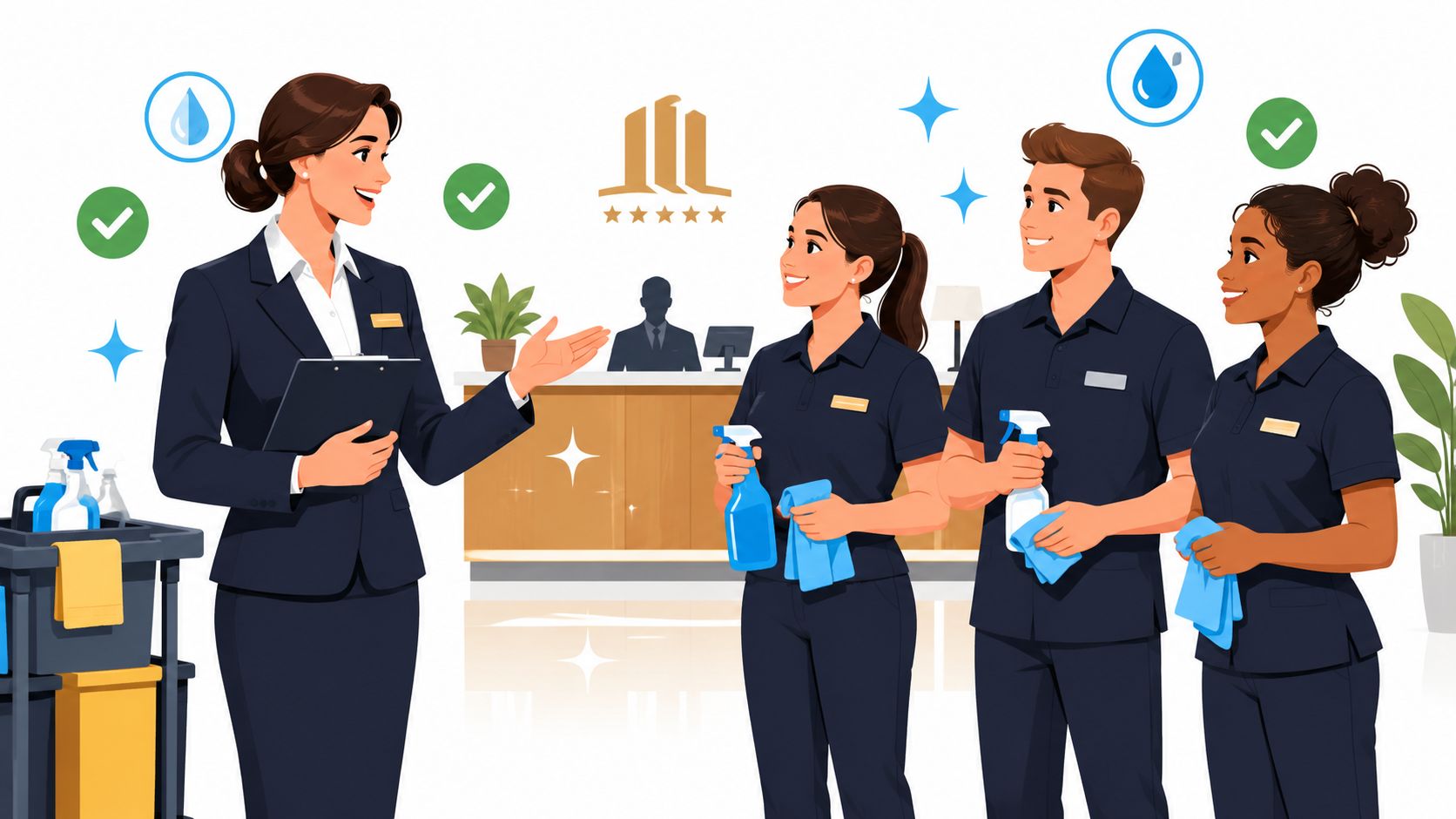
A guest arrives after a long journey, checks in, and notices fingerprints on the reception counter, a smudged elevator button, or a remote control that looks untouched but feels questionable. The front-desk employee may be friendly and efficient, but the guest has already formed an opinion about the facility's standards. In hospitality, cleanliness is communicated through hundreds of small details, and staff training determines whether those details are handled consistently.
A reliable sanitation program does more than remove visible dirt. It teaches employees how to identify high-touch surfaces, choose the right product, respect contact times, document completed work, and respond when a guest reports a hygiene concern. That combination protects the guest experience while giving owners, managers, janitorial teams, and cleaning suppliers a practical operating system.
Why Cleanliness Drives Hospitality Success
A guest may forgive a slow elevator or a delayed table, but a visibly dirty touchpoint can change how they judge the entire operation. A smudged door handle, marked payment terminal, or neglected fitness bench suggests that standards vary when supervisors are not watching. Cleanliness belongs in the same operating conversation as check-in speed, food quality, complaint handling, and staff courtesy.
Each hospitality setting has its own sanitation pressure points. Hotel guests notice bathroom fixtures, elevator controls, bedside tables, remote controls, and door handles. Restaurant customers look at menus, tables, condiment bottles, payment terminals, and restrooms. In gyms, members assess benches, lockers, handles, and shared accessories before deciding whether the space is ready for use. Training must therefore connect disinfectant wipe routines to specific roles instead of giving every employee the same general checklist.

Cleanliness is an operating standard
Sanitation cannot be treated as work that begins after guest service ends. A 2024 hospitality training report found that 100% of surveyed organizations used an e-learning platform, compared with 86% in 2019. It also reported substantial increases in training hours and spending of roughly $1,242 on front-of-house training and $1,229 on back-of-house training. Manager-level budgets reached $4,918 for unit-level managers and $6,241 for general managers. The hospitality training report connects this investment with scalable learning, service consistency, compliance, and retention.
Those figures support a practical conclusion: sanitation training needs a repeatable delivery system. A short demonstration at a housekeeping station, restaurant pass, or gym equipment area can show employees which surfaces require attention, which approved wipe to use, how long the surface must remain wet, and where to record completion. Supervisors can then verify performance during normal shifts rather than relying on an annual reminder.
Turnover makes that consistency harder to maintain. One graduate study cited 87.4% U.S. hotel industry turnover, using Bureau of Labor Statistics data from 2019, while broader research in the same source described worldwide hospitality turnover ranging from 30% to 73%. The study also discusses links between training perceptions, self-efficacy, and lower turnover intention. The hospitality labor and training study reinforces the operational risk: if a sanitation standard exists only in one supervisor's memory, it can vanish when that supervisor leaves.
Practical rule: If a new employee cannot explain what to clean, which product to use, how long the surface must remain wet, and where to record the task, the facility does not yet have a dependable sanitation program.
A visible hygiene routine builds confidence
Disinfectant wipes work well for targeted, high-touch tasks because they keep a defined action close to the point of use. A housekeeper can wipe a phone and door handle during a room reset. A restaurant employee can address a payment terminal between users. A fitness attendant can stock wipes at each station and show members how to use them responsibly.
Wipes do not replace full cleaning, laundering, or trained janitorial work. They support those activities between broader cleaning cycles, helping teams make high-touch sanitation a repeated part of service delivery rather than an issue discovered during inspection.
Designing Your Sanitation Training Program
Start with the work area, not the presentation format. Walk through a guest room, restaurant shift, reception desk, or fitness floor. List the surfaces employees touch, the products they handle, and the points where missed sanitation could affect guests. Assign each task to a named role, then give a supervisor responsibility for verification. “The facility team” is too vague to support consistent execution.
Set outcomes employees can demonstrate
A useful learning objective describes an action the employee can perform and a supervisor can observe. A housekeeper should identify high-touch points in a room, select approved disinfecting wipes, keep each surface wet for the stated contact time, dispose of used materials correctly, and complete the cleaning log. A restaurant employee should know when a table reset requires more than removing crumbs. A gym attendant should prepare wipes for members and respond appropriately to a visibly soiled machine.
Build training around actual work:
Product handling: Explain the difference between cleaning, sanitizing, and disinfecting. Show the label directions for every product in use. The guide on when to sanitize versus disinfect gives managers a practical way to frame this distinction during onboarding.
High-touch mapping: Mark handles, switches, phones, counters, faucets, payment terminals, remote controls, equipment grips, and shared tools by department. The map should show who handles each point and when the task is recorded.
Role-play and practice: Have staff rehearse a guest complaint, a spill, a missed log entry, and a product shortage. Demonstration followed by supervised practice gives trainers a clearer view of performance than a slide deck alone.
Assessment before independent duty: Ask the employee to clean a representative area. Check the sequence, surface coverage, wet time, disposal, and documentation before assigning unsupervised work.
Refreshers that fit shifts: Use short mobile lessons, printed job aids, toolbox talks, and manager-led observations. The 2024 hospitality training report found that training hours had increased substantially versus 2019, supporting a shift from one-time onboarding to continuing skill development. The same 2024 report cited earlier provides useful context for planning recurring instruction.
The staff training program template can help organize modules, ownership, observations, and follow-up. Keep the framework consistent while adapting examples to each department's surfaces, traffic patterns, and products.
Match depth to responsibility
A Cornell field study of 15 hotel firms and 16 restaurant companies found that pre-opening training commonly used similar timeframes across hotels and restaurants, while restaurant managers received significantly more training days than other frontline roles. The Cornell hospitality training study supports assigning training depth according to responsibility rather than giving every employee the same orientation.
| Role | Training Focus | Duration |
|---|---|---|
| Housekeeping | Room touchpoints, product use, linen workflow, inspection standards | Role-dependent, with supervised room practice |
| Front desk | Counter and device hygiene, guest communication, escalation | Short modules reinforced during shifts |
| Food and beverage | Table resets, payment terminals, food-contact boundaries, spill response | Task-based practice before independent duty |
| Gym or fitness staff | Equipment stations, wipe placement, member guidance, incident reporting | Station-by-station demonstration |
| Supervisors and managers | Audits, coaching, supply control, corrective action, service recovery | Deeper training tied to accountability |
Restaurant teams building a wider curriculum can review proven strategies for restaurant training for ideas on practical learning materials. Adapt those ideas to the facility's surfaces, guest flow, disinfectant wipe program, staffing model, and reporting process. A front-desk employee needs different practice from a housekeeper, while both need clear product rules and a defined way to document completed work.
Effective Cleaning Techniques and Protocols
A wipe program fails when employees treat every wipe as a quick pass. The product must be suitable for the surface and intended use, the staff member must cover the entire target area, and the surface must remain visibly wet for the label's contact time. The CDC guidance on cleaning and disinfecting facilities explains that wet or contact time is the period the disinfectant must remain on a surface, and the surface should stay wet for that full period to kill germs.

Teach the sequence, not just the product
Use a repeatable sequence that supervisors can observe:
Prepare the area. Remove visible soil and clear objects that block access. Disinfection works poorly when dirt or residue prevents full contact with the surface.
Read the label. Staff should confirm the product is approved for the intended surface and use. If the operation requires EPA registered disinfecting wipes, the team should still follow the specific label directions for that product.
Apply enough product. A single wipe may not cover a large counter or keep it wet for the required time. Use additional wipes when coverage or wetness requires it.
Wipe deliberately. On gym equipment, train staff to wipe in one direction rather than moving back and forth. Gym-specific guidance also notes that multiple wipes may be needed to maintain wetness for the required period. The fitness professional disinfection guidance provides a useful training reference.
Respect the contact time. Don't wipe the product away immediately. For a surface that dries too quickly, the employee needs to reapply according to the label rather than assuming the first pass was sufficient.
Finish and record. Dispose of the wipe correctly, wash or sanitize hands as required by the facility procedure, and complete the log when documentation is part of the control system.
Prioritize high-touch zones
CDC examples of high-touch surfaces include door handles, desks, phones, light switches, and faucets, and guidance for shared facilities recommends cleaning and disinfecting those surfaces at least daily. The facility guidance summary also supports adding attention during periods of heavier traffic.
A practical schedule separates routine work from event-driven work:
- At opening: Check reception surfaces, restrooms, shared devices, fitness stations, and service counters.
- During active service: Address high-use surfaces when they become visibly soiled, after a reported concern, and according to department traffic.
- Between users where appropriate: In gyms, clean and disinfect exercise equipment and tools between patrons, and provide wipes or paper towels with disinfectant at stations. CDC employer guidance for gyms also recommends encouraging patrons to clean equipment before and after exercise.
- At closing: Complete the deeper scheduled clean, restock dispensers, inspect logs, and report supply or equipment problems.
For offices, focus on shared desks, meeting-room controls, phones, and kitchen touchpoints. Schools need consistent attention to door hardware, faucets, shared devices, and activity equipment. Restaurants should separate food-contact procedures from general surface disinfection and follow product directions carefully. Retail stores should include baskets, payment terminals, fitting-room handles, and service counters.
The efficient workflow: Put the right wipe at the point of use, pair each station with a simple instruction card, and audit the result rather than asking staff to remember a long checklist.
Building a Culture of Cleanliness
A sanitation program becomes dependable when employees see it as part of hospitality, not as a punishment imposed by management. Guests don't experience departments separately. They experience one lobby, one room, one meal, or one workout, so a strong front-desk interaction can't compensate for an unclean shared surface.
Managers establish the standard through their own behavior. They should use the same process expected from employees, respond to missed work without humiliation, and correct the method immediately when a surface is wiped incorrectly. Recognition also helps. A supervisor can acknowledge a team member who notices an empty dispenser, identifies a recurring touchpoint, or reports a product that isn't compatible with a surface.
Give every department ownership
Housekeeping may own guest-room touchpoints, but reception staff control the condition of their counter and devices throughout the shift. Restaurant servers see table turnover first. Fitness attendants see which machines receive repeated use. A program that assigns all sanitation work to janitorial staff will miss the moments between scheduled visits.
Create simple ownership rules:
- The person who notices a risk reports it.
- The person assigned to the area completes the immediate action.
- The supervisor verifies patterns, not just isolated tasks.
- The manager removes barriers, such as empty dispensers, unclear labels, or inaccessible storage.
This model also improves communication between front and back of house. A guest complaint about a dirty handle isn't merely a cleaning issue. It may reveal a shift handoff problem, an understocked station, an unclear responsibility, or a schedule that doesn't reflect actual traffic.
Make the standard visible
Visible sanitation can reassure guests when it looks deliberate rather than theatrical. A stocked gym wipe dispenser near equipment, a clearly labeled cleaning station, or a staff member calmly resetting a shared area shows that the business has a routine. The routine must still be technically correct. Wiping a surface quickly for appearance while ignoring contact time creates theater, not disinfection.
Use short team discussions to connect sanitation with service recovery. Staff should know how to apologize without making unsupported health claims, how to isolate a visibly contaminated item, whom to notify, and how to document the response. A clean environment supports trust, but honest communication protects it when something goes wrong.
Measuring Success and Continuous Improvement
A sanitation program can look healthy on paper while leaving high-touch surfaces poorly managed. Managers need measures that show both whether work was recorded and whether staff used disinfectant wipes correctly. Logs confirm that a task was documented. Direct observation shows whether the employee covered the full surface, followed label directions, and respected the required contact time.

Compare measurement methods
| Method | Strength | Limitation | Best Use |
|---|---|---|---|
| Cleaning logs | Fast, simple, easy to review | May confirm paperwork without confirming technique | Routine accountability |
| Direct observation | Shows whether staff perform the process correctly | Requires manager time and clear criteria | Initial training and coaching |
| Guest feedback | Reveals what visitors notice | Comments may be subjective or incomplete | Finding recurring experience problems |
| Inspection scores | Creates a comparable internal standard | A single inspection can miss problems between checks | Trend review and corrective action |
| Short assessments | Tests knowledge and decisions | Knowledge does not always become correct execution | Refreshers and role changes |
Use the methods together. Review missed tasks, recurring touchpoints, supply interruptions, guest comments, inspection findings, and completed coaching. Avoid treating every result as an individual employee score. If several people miss the same wipe-down step, examine the training content, product instructions, dispenser access, storage location, or staffing plan before blaming execution.
Managers can apply the consistency found in their service quality assurance process to sanitation reviews. Define acceptable work, record exceptions, assign a corrective action, and check that the correction remains in place. The same standard should apply across housekeeping, food service, recreation, and front-of-house touchpoints, while observations should reflect each role's actual tasks.
Improve the system after every finding
An inspection finding should trigger diagnosis, not an automatic lecture. Ask:
- Did the employee receive training for the exact surface and product?
- Was the correct disinfectant wipe available where the task occurred?
- Did the shift allow enough time to complete the work properly?
- Could the employee reach the equipment safely?
- Did a supervisor provide feedback soon enough to change the next attempt?
The answer may call for a revised checklist, clearer product instructions, a different dispenser location, supervised practice, or a broader training effectiveness measurement process. Role-specific review matters because a housekeeper, server, fitness attendant, and maintenance technician encounter different surfaces, traffic patterns, and contamination risks.
Hospitality research has associated positive training perceptions with stronger self-efficacy and lower turnover intention. The Johnson & Wales graduate study cited earlier also supports treating feedback and development as operating tools rather than administrative extras. Use those findings to justify regular coaching, then rely on workplace observations and inspection trends to decide what the program should change.
Implementing Your Program Effectively
Launch the program in a controlled sequence. First, map surfaces and assign owners. Next, select products, place dispensers and supplies where work occurs, and write short procedures that employees can follow during a busy shift. Then train one department, observe the work, correct the process, and adapt the materials before expanding across the property.
Don't buy bulk gym wipes, commercial disinfecting wipes, or other supplies without checking surface compatibility, label directions, storage needs, and expected use. A gym wipe dispenser should be easy to reach and simple to restock. In hotels and restaurants, place supplies near the touchpoints staff manage, not in a distant storeroom.
Communicate the reason for each task. Employees are more likely to follow a procedure when they understand how it protects guests, coworkers, and the operation. Use a brief shift huddle, supervised practice, and a follow-up observation rather than relying on a single onboarding session.
Keep the final standard simple: clean visible soil, use the appropriate disinfectant wipes correctly, keep surfaces wet for the required contact time, complete the cleaning log, and report barriers immediately. Review the program regularly, and update training whenever products, equipment, layouts, or guest-use patterns change.
Prioritize cleanliness as a daily hospitality practice, not an occasional inspection exercise. Train each role on its real responsibilities, keep disinfectant wipes available at high-touch stations, and review whether staff can perform the process correctly. Owners, facility managers, and cleaning suppliers can explore wipe solutions for commercial and fitness settings and build them into a broader sanitation routine that guests can see and trust.
Leave a Reply