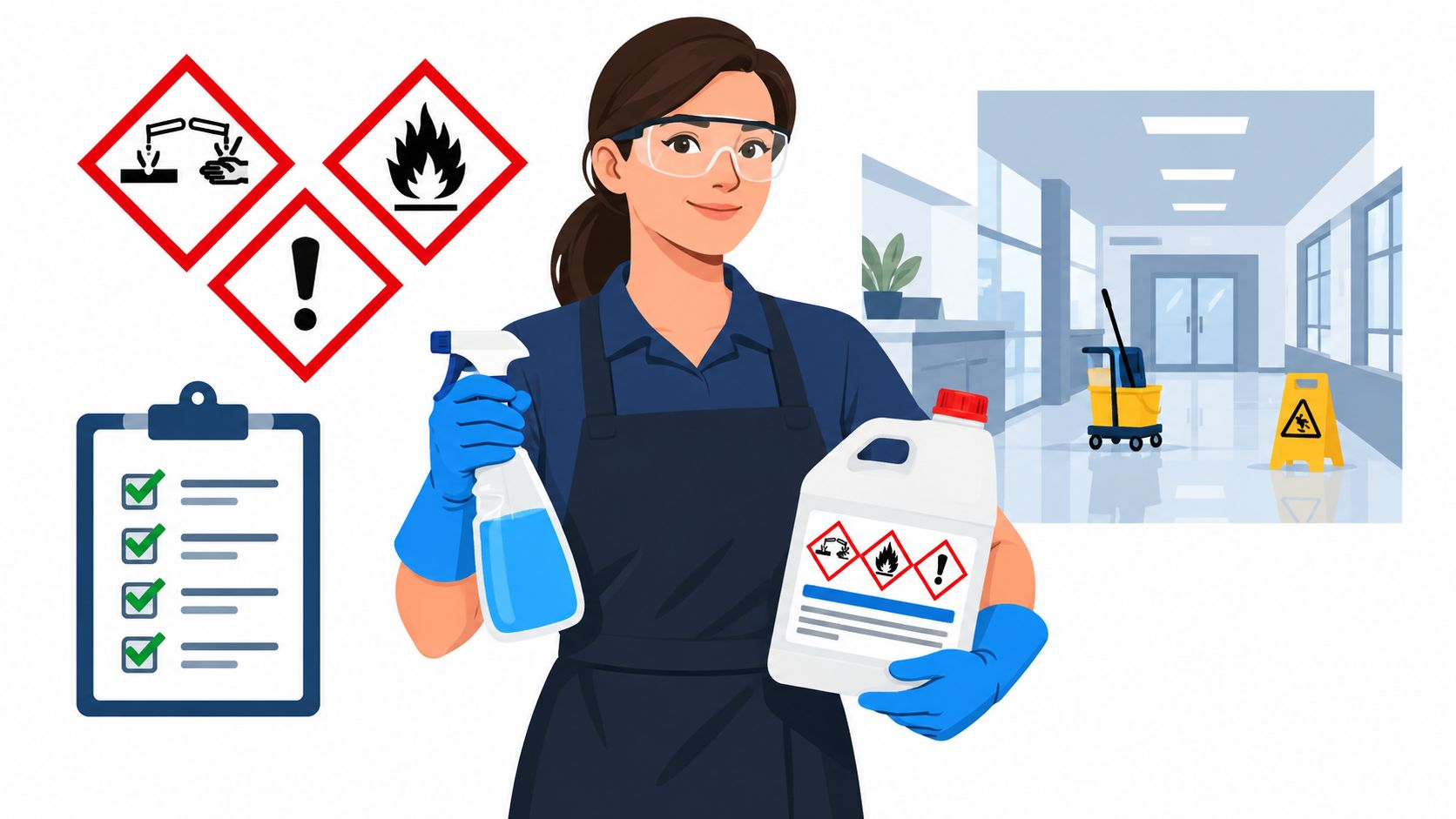
A cleaner is halfway through a restroom turnover when a supervisor calls about a spill at the entrance. Two bottles sit beneath the sink, one in an unmarked spray bottle and the other with a label partly covered by residue. The worker reaches for both because the next crowd is already arriving.
That moment is where cleaning product safety becomes an operations issue, not a poster on the chemical-room wall. A clear labeling system, sensible dispenser placement, correct wipe technique, and a practiced response plan can keep a rushed decision from becoming an exposure incident, service interruption, or inspection finding.
Why Cleaning Product Safety Matters in Busy Facilities
Commercial facilities rarely fail because nobody has heard that chemicals can be dangerous. They fail when a shift changes, a contract cleaner starts work, or a restroom backs up before a flight, game, class, or sales appointment. The person responding may know the products individually but still grab the wrong bottle, miss an unfamiliar secondary container, or assume that two cleaners can be used in sequence without a rinse.
Those decisions can cause skin burns, eye injuries, coughing, breathing difficulty, contaminated floors, and extended closures. A spill in a gate area, showroom, locker room, or restaurant can also force staff to isolate part of the site while managers locate the product label and determine what happened.
Where routine work breaks down
I look for four operational weaknesses during a facility walk-through:
- Unclear handoffs: The outgoing team knows which product is in a bottle, but the incoming team doesn't.
- Unlabeled containers: A spray bottle has a color or scent that workers recognize, but no product name, hazard information, or dilution instruction.
- Poor placement: The correct disinfectant wipes are stored far from the surfaces staff need to treat, so workers substitute a nearby chemical.
- No second check: One person mixes, decants, or applies a product without anyone confirming the label and intended use.
The fix isn't to make every employee a chemist. It's to make the safe action the easiest action. Keep products in original containers where possible, place disinfectant wipes at the point of use, separate incompatible chemical families, and make labels and Safety Data Sheets accessible on every shift. OSHA guidance identifies inadequate ventilation, incorrect mixing, and spray or aerosol use as recurring exposure routes for cleaning chemicals, including inhalation and dermal contact for cleaning workers. OSHA's chemical hazards guidance supports treating application method and airflow as part of the hazard assessment.
Practical rule: If a new or temporary worker can't identify the product, its purpose, and the required PPE without asking three people, the system isn't ready for a busy shift.
The reliable program combines hazard literacy, label fluency, storage discipline, facility-specific routines, and a short emergency response card. It also recognizes that cleanliness affects operations. A visible wipe station near gym equipment, a stocked dispenser at an office entrance, or a documented high-touch routine gives staff a practical way to maintain hygiene without reaching for an improvised chemical solution.
What the Exposure Numbers Show on a Facility Floor

A busy facility can turn a manageable chemical risk into an exposure incident within one shift. During the first COVID-19 quarter of 2020, U.S. poison centers received 45,550 calls about cleaners and disinfectants from January through March. The total included 28,158 cleaner exposures and 17,392 disinfectant exposures, with year-over-year increases of 20.4% and 16.4% against the comparison benchmarks used in the CDC analysis. The same report recorded 4,747 cleaner inhalation cases and 1,188 disinfectant inhalation cases during those three months. CDC chemical surveillance information shows why controls must continue working when cleaning demand suddenly intensifies.
Four hazard groups on the facility floor
Corrosives include some acidic and alkaline products. A splash can burn skin or eyes. Residue left on a poorly rinsed surface can injure the next person who touches it.
Irritants and sensitizers may cause sore throats, coughing, eye discomfort, skin redness, rashes, or breathing complaints. Repeated low-level exposure matters for workers cleaning enclosed spaces throughout a shift.
Reactive chemicals require strict separation. Bleach and ammonia must never be combined. OSHA states that the combination can cause severe lung damage or death, and CDC guidance warns that the reaction can release vapors dangerous to breathe. OSHA's bleach safety bulletin explains why using “just a little” of each product remains unacceptable.
Flammable solvents create fire and vapor hazards near ignition sources. Storage, dispensing, and PPE requirements must come from the product label and SDS, not from assumptions about a familiar solvent.
The failures seen on facility floors are predictable: refilling spray bottles from bulk drums without a complete label, leaving a bottle beside an incompatible product, spraying disinfectant in a poorly ventilated restroom, or using one chemical family for every task. Professional Window Cleaning advice on ammonia window cleaner helps teams recognize why familiar glass-cleaning products still require controlled handling.
Poison-center data show that cleaning and disinfectant exposures rise when product use intensifies. Facility controls therefore need to work during peak demand, not only during routine operations. Product form, container labeling, ventilation, and task-specific handling all affect how an exposure develops and how quickly staff can respond.
Reading Labels and Safety Data Sheets the Right Way
A label tells the worker what the product is allowed to do and how to use it. The Safety Data Sheet adds the hazard, first-aid, storage, and PPE context that a small container label can't always contain. Supervisors should keep both available at the point where products are issued, diluted, or applied.
Start with the product identity and intended surface. Then find the signal word, hazard statements, precautionary statements, required PPE, first-aid directions, and contact time. Contact time means the surface must remain wet for the period stated on the product label. A disinfectant that dries immediately may not have completed its intended process.
The SDS is most useful when a worker knows where to look. Section 1 identifies the product and supplier. Section 2 describes hazards. Section 4 covers first aid. Section 7 addresses handling and storage. Section 8 covers exposure controls and PPE. The final section records revision information, which helps a manager identify an outdated document.
For a practical guide to understanding the 16 SDS sections, train supervisors to open those sections first rather than scrolling through the document without a question in mind. Keep the current SDS accessible in a language and vocabulary employees understand. An outdated binder, a missing translation, or a one-page supplier summary in place of the full SDS leaves a gap during an incident.
GHS pictograms facility teams must recognize
| Pictogram | Signal Word | What It Means | Facility Action |
|---|---|---|---|
| Skull and crossbones | Danger | Acute toxicity may cause serious harm | Restrict access, follow the label and SDS, and use required PPE |
| Corrosion | Danger or Warning | May burn skin or eyes or damage metal | Use splash protection, control dispensing, and provide eyewash access |
| Flame | Danger or Warning | Product may ignite | Keep away from ignition sources and store as directed |
| Exclamation mark | Warning | May cause irritation or other less severe health effects | Limit contact, improve handling, and use the specified gloves or eye protection |
| Environment | Warning or no signal word | May harm aquatic life | Prevent drains or environmental release unless the label directs otherwise |
Run a short toolbox drill before assigning a new product. Hand each employee the actual container and ask them to locate the signal word, contact time, and glove requirement. If anyone guesses, correct the process immediately. Supervisors can also use the SDS training reference to reinforce that label reading is a task skill, not a one-time orientation topic.
Storage, Dispensing, PPE, and the Mixing Rule That Saves Lives
Storage should make incompatible choices difficult. Keep acids away from bases, bleach away from ammonia and acids, and flammable products away from ignition sources. Use secondary containment where a leaking container could reach a drain, lock chemical cabinets when public access is possible, and keep labels facing outward so a worker doesn't have to pick up an unknown bottle.
A dilution station should have marked containers, clear instructions, and a way to measure. “Glug-glug” is not a dilution method. Workers should follow the product label, use the specified measuring device, and identify every diluted container with the product name, hazard information, dilution, and preparation details required by the site procedure.
PPE follows the actual exposure
Gloves, goggles, aprons, and respiratory protection aren't interchangeable. Select them from the label, SDS, and task assessment. Chemical splash goggles make sense where a dispenser can splash. Gloves need to match the chemical and exposure route. Aprons protect clothing during wet restroom work. Respiratory protection requires a proper workplace program, medical evaluation, fit testing, and the product-specific assessment. A dust mask isn't a substitute for controls designed for chemical vapors or aerosols.
The mixing rule is simple: Never combine cleaners unless the product label explicitly allows it. Bleach and ammonia are not compatible, and the correct response to a suspected mixture is evacuation, not investigation.
An airport crew can create a serious event without intending to mix chemicals. One worker uses a chlorine product on a restroom fixture while another applies an ammonia-containing glass cleaner nearby. Residue, overspray, or a shared bucket can create an unsafe combination. The crew needs separated products, labeled tools, ventilation, and a supervisor who stops the job when chemical identity is uncertain.
For additional context on safe drain cleaning with bleach, managers should still defer to the exact product label and site wastewater procedures. Advice for one application doesn't authorize a different use in your facility.
The chemical storage safety reference can support a written storage inspection, but the physical setup matters most. A worker should be able to return each product to an assigned shelf without debating where it belongs.

Indoor Air Quality and the Aerosol Trap Most Teams Miss
A surface can look clean while the air around it becomes uncomfortable or unsafe. Trigger sprays and aerosol products disperse droplets and vapors into the breathing zone, particularly in restrooms, concourses, corridors, and back-of-house rooms with limited fresh air. OSHA identifies inhalation of vapors and aerosols as a relevant exposure route for cleaning workers, while the indoor-air research on cleaning products describes how product choice and application method influence exposure. This technical analysis of cleaning-product emissions is useful when evaluating repeated cleaning cycles.
Repeated spraying also changes the task. A worker may apply product, move a few feet, and spray again before the first area has cleared. Poor airflow, enclosed geometry, and back-to-back applications can increase discomfort and exposure even when every individual spray seems small.
Choose the method for the occupied zone
| Method | Inhalation Risk | Best Use Zone | Ventilation Required |
|---|---|---|---|
| Pre-wetted wipes | Lower airborne release than spraying | High-touch points in occupied areas | Maintain normal airflow and follow the label |
| Ready-to-use trigger spray | Higher than a wipe because it creates droplets | Controlled, unoccupied or well-ventilated zones | Use strong airflow and avoid breathing the mist |
| Diluted concentrate | Depends on mixing and application | Dedicated dilution areas and mop work | Follow SDS controls during dilution |
| Electrostatic or other mechanized dispersion | Can increase airborne uptake if misapplied | Restricted areas with trained operators | Use the equipment assessment and required controls |
For offices, gyms, and retail floors that remain occupied, pre-wetted wipes often offer better control than an aerosol product because the liquid is delivered directly to the cloth and surface. A floor applicator can also reduce spray drift during large-area work. Product substitution doesn't remove the need for label compliance, but it can reduce unnecessary airborne release.
Set local ventilation rules by room and product instead of inventing one universal target. Keep occupants away during applications that create mist, use fans or mechanical ventilation when the label and site assessment allow it, and pause work when staff report coughing, eye irritation, dizziness, or breathing discomfort. A ventilation plan should be part of the cleaning method, not an afterthought.
Facility-Specific Protocols That Actually Hold Up
A facility routine works when it matches the site's traffic, surfaces, staffing, and dwell time. CDC guidance identifies pens, counters, shopping carts, door handles, stair rails, elevator buttons, touchpads, restroom fixtures, and desks as high-touch surfaces that facilities should clean regularly. CDC's facility cleaning guidance gives operators a useful starting point for selecting targets.
For a gym, place a gym wipe dispenser beside popular machines rather than inside a distant janitorial closet. Stock wipes for gym equipment at strength equipment, cardio consoles, benches, and shared handles. Staff should remove visible soil first, use a compatible product, and protect screens, upholstery, and coated surfaces from excessive moisture. A dispenser near the exit can support a final hand and equipment routine without encouraging members to carry chemical bottles.
Offices should prioritize elevator buttons, door handles, shared desks, phones, light switches, and faucets. CDC guidance says objects touched by multiple people should be cleaned and disinfected at least daily, providing a baseline for a routine wipe program in commercial facilities. The CDC facility PDF also supports adjusting the routine when traffic, illness, or a specific contamination event changes the risk.
| Facility Type | Top 5 High-Touch Surfaces | Recommended Product Family | Minimum PPE | Frequency per Shift |
|---|---|---|---|---|
| Airport | Rails, kiosks, gate seats, tray surfaces, restroom fixtures | Label-approved wipes or low-aerosol products compatible with the surface | Gloves, with eye protection when splash risk exists | At routine service points and after high-use periods |
| Gym or sports facility | Handles, consoles, benches, mats, locker-room fixtures | Surface-compatible gym equipment wipes and cleaner for visible soil | Gloves for staff, eye protection for splash tasks | At opening, during service rounds, and at closing |
| School | Door handles, desks, faucets, light switches, shared devices | Cleaner first, then an approved disinfectant where required | Gloves and task-specific eye protection | Daily routine with extra attention after heavy use |
| Restaurant | Door pulls, counters, touchpads, restroom fixtures, service rails | Food-area-compatible products and label-directed disinfectants | Gloves and eye protection for splash tasks | During service transitions and closing |
| Retail store | Carts, baskets, payment screens, counters, door handles | Surface-compatible wipes and cleaner | Gloves where chemical contact is possible | During trading hours and closing rounds |
A short-term rental needs turnover staff who understand contact time in small bathrooms. Event venues benefit from separate pre-event, mid-event, and post-event assignments. Car dealerships should keep detail-bay solvents separate from paint-safe cleaners and match PPE to the product, not to the job title.
For all sites, don't confuse a quick wipe with completed disinfection. CDC guidance says to clean a surface before disinfecting it and keep the surface wet for the product's contact time. The CDC cleaning and disinfection guide notes that alcohol-based wipes or sprays should contain at least 70% alcohol when no other guidance is available. EPA label language for one disinfectant wipe product requires a hard, nonporous surface to remain visibly wet for 4 minutes, using enough wipes to maintain wetness. The EPA product label is a useful training example, but staff must follow the label for the specific product in use.
Emergency Response When Something Goes Wrong
The first five minutes after exposure should be familiar enough to run without a manager standing beside the worker. Stop the task, protect other people from the area, identify the product if it can be done safely, and use the label and SDS first-aid instructions. Don't send an exposed employee back to work to “see if it passes.”
Skin splash
Remove contaminated clothing and flush the affected skin with running water. A brief rinse isn't enough for a significant exposure, so continue flushing for the period stated by the SDS and seek medical guidance. Don't apply a neutralizing chemical to the skin.
Eye contact
Get to the eyewash immediately and flush continuously while holding the eyelids open. Don't delay to find the bottle or rub the eye. Call emergency services for severe pain, vision changes, corrosive exposure, or symptoms that persist, and bring the product information to responders.
Inhalation exposure
Move the person to fresh air without entering a contaminated area yourself. Don't send another worker into a vapor cloud for a closer look. Call 911 for breathing difficulty, chest symptoms, confusion, collapse, or worsening exposure signs, and contact Poison Control when the product or symptoms require expert guidance.
Suspected chemical mixing
Evacuate the immediate area, isolate access, and call emergency services if anyone has respiratory symptoms or the vapor is strong. Don't add another chemical, attempt a cleanup without authorization, or restart ventilation in a way that spreads contamination. The bleach-and-ammonia warning from OSHA and CDC makes this a life-safety event, not a routine spill.
Supervisors should laminate a card for each chemical closet and eyewash station. It should show the first action, second action, prohibited response, emergency phone numbers, eyewash location, spill-kit location, and the steps for obtaining the product label and SDS. Log every event, including minor splashes and symptoms that resolve, so recurring tasks and products can be reviewed.

Daily Habits and Compliance Habits That Keep Teams Safe
Safety programs fail when they live only in a binder. The habits that hold up during an OSHA, health department, or brand audit are small, visible, and tied to a specific failure.
Before a new product enters the building, a supervisor should confirm its identity, label, SDS, intended use, storage location, PPE, and disposal process. Before each shift, staff should inspect wipe dispensers, verify that containers are labeled, return chemicals to assigned shelves, and check gloves or goggles for damage.
A practical operator checklist
- Product check: Confirm the label and SDS are available before using an unfamiliar product.
- Container check: Reject any unlabeled or badly damaged secondary container.
- Storage check: Return products to their assigned chemical family and keep incompatible products separated.
- PPE check: Select protection for the task and replace damaged equipment.
- Application check: Clean visible soil, apply the disinfectant correctly, and maintain the label's contact time.
- Air check: Use ventilation and avoid aerosol application in occupied or poorly ventilated spaces.
- Dispenser check: Keep wipes stocked where high-touch work occurs, not only in the supply room.
- Incident check: Record splashes, symptoms, spills, and near misses before the shift ends.
Managers can schedule routine dispenser inspections, eyewash checks, respirator-program reviews, and refresher training according to the facility's risk assessment and legal obligations. The purpose is prevention: a stocked station prevents substitution, a current SDS prevents guesswork, and a readable label prevents a rushed worker from treating an unknown liquid as harmless.
The same discipline helps sales professionals present commercial disinfecting wipes responsibly. Explain the intended surfaces, contact time, compatibility, PPE, storage, and disposal requirements. Customers need a complete hygiene program, not a promise that one wipe solves every contamination problem. WipesBlog.com publishes operational guidance on sanitation, high-touch surfaces, and facility cleaning that can be considered alongside the product label and the customer's own site assessment.
A clean facility earns trust when the process is consistent, visible, and safe for the people doing the work. Review your highest-touch areas today, place sanitizing wipes where staff and customers can use them correctly, verify every product label and SDS, and build the routine into each shift. For facility supplies and wipe options, review the relevant wipes.com cleaning product resources and choose products that match your surfaces, contact-time requirements, and cleaning product safety program.
Leave a Reply