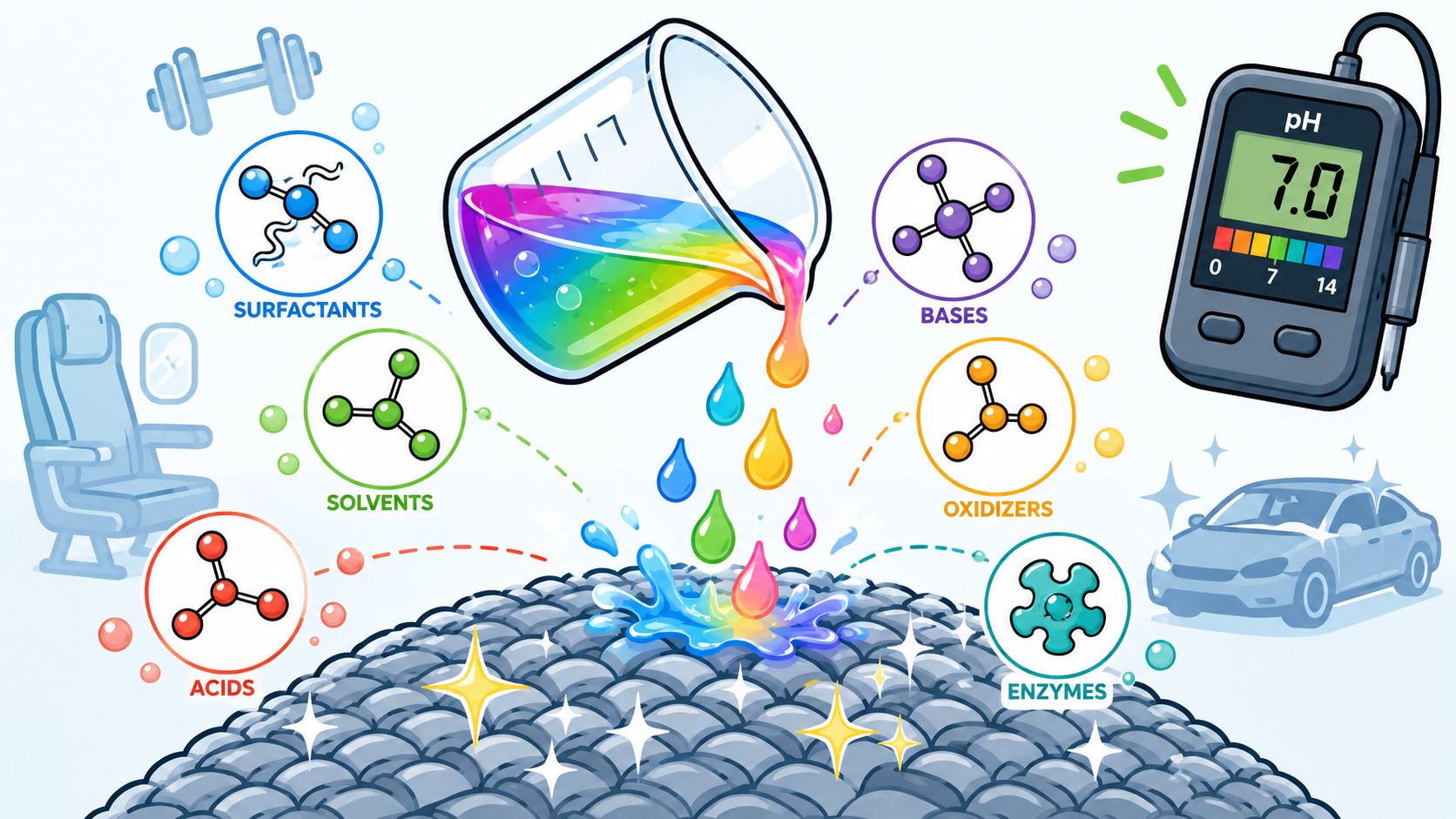
A member finishes a set, wipes a dumbbell, and walks away. Minutes later, another person grips the same handle, then touches a phone, a locker, and the front desk. In an airport, the equivalent sequence happens around security trays and touchscreens. At a dealership, it happens across door handles, steering wheels, and counters. A surface can look spotless while still carrying grease, body soil, and residue that interfere with disinfection.
That's why chemistry in cleaning agents matters. Surfactants lift soil, solvents dissolve materials that water can't handle, and disinfectants act only when the formulation, contact time, pH, and surface conditions are right. For facility managers, janitorial teams, gym owners, and cleaning-supply professionals, product selection isn't a laboratory exercise. It's an operational decision that affects appearance, hygiene confidence, material life, and staff performance.
Why Clean Surfaces Start with Molecular Science
A facility manager walking through a busy gym sees the obvious targets first: dumbbell grips, treadmill rails, exercise-bike handles, locker-room faucets, and door pulls. In an airport terminal, the priority shifts to security trays, armrests, kiosks, and handrails. A dealership adds steering wheels, gear selectors, showroom counters, and vehicle door handles. These surfaces differ in material and use, but they share one problem: many people touch them, often after touching their own skin, food, phones, or personal items.
Visible soil is only part of the issue. Sweat contains salts and organic material. Body oils create thin films that repel water. Dust adheres to those films, and repeated wiping can spread the residue when the product lacks enough surfactant action or the cloth becomes overloaded.
What the molecules actually do
Surfactants act as molecular bridges. One part interacts with water, while another interacts with grease and oily soil. That structure lowers surface tension, improves wetting, and helps detach contamination so it can be removed rather than merely redistributed.
Disinfectants work differently. Depending on the active ingredient, they may disrupt cell membranes, damage proteins, or oxidize essential cellular components. The product must reach the target surface, remain wet for the label-specified contact time, and work under the conditions for which it was validated.
Practical rule: A clean-looking surface isn't proof of effective disinfection. Soil removal and microbial control are related tasks, but they aren't interchangeable.
The distinction drives better purchasing and training. A neutral detergent is generally appropriate for routine surface cleaning because it's soluble and sits in the pH 6–8 range. The CDC's cleaning and disinfection guidance explains why cleaning should come before disinfection. Organic matter can shield microorganisms and reduce the disinfectant's contact with the surface.
The scale of the industry reflects how central this chemistry has become. One independent estimate valued the global detergent chemicals market at USD 67.31 billion in 2024 and projected USD 71.4 billion in 2025, a 6.1% year-over-year increase. Surfactants represented 32% of market share in one 2025 estimate, while another market breakdown placed them at about 42% of detergent chemical consumption. These figures come from the detergent chemicals market report.
The Major Classes of Cleaning Agents Explained
A product label becomes much easier to evaluate when you understand the job assigned to each chemical class. No single ingredient handles every soil type or surface safely.
Surfactants and solvents
Surfactants loosen oily films and particulate soil by improving wetting and dispersion. They're common in gym equipment wipes because rubber grips, vinyl pads, plastic housings, and painted metal often collect sweat and body oils. A surfactant-containing wipe can lift that film so the cloth captures it.
Solvents dissolve substances that water and surfactants may struggle to remove. Alcohol-based solvents can help with some oily residues and may evaporate quickly, but fast evaporation can also shorten wet contact time. That makes a solvent useful for soil removal without automatically making it a reliable disinfectant.
Acids and bases
Acidic cleaners target mineral deposits, scale, and certain hard-water residues. They can be useful around restroom fixtures, but they require careful material checks. Acid can dull or etch sensitive stone and damage incompatible metals.
Alkaline cleaners are better suited to many greasy and protein-rich soils. A stronger alkaline degreaser can help in service bays, commercial kitchens, and maintenance areas, but it may damage floor finishes, soft metals, coatings, or sensitive gym materials if used indiscriminately.
Oxidizers and enzymes
Oxidizers, including peroxide systems and chlorine chemistry, chemically alter stains and microorganisms through oxidation. They can provide strong antimicrobial action, but their reactivity makes label compliance and surface compatibility essential.
Enzymatic cleaners use biological catalysts to break down specific organic soils such as proteins or starches. They're useful where residue accumulates in kitchens, bathrooms, and rental properties. Enzymes aren't a universal substitute for disinfection, and their performance depends on matching the formulation to the soil and allowing suitable conditions for the reaction.
The same principle applies to disinfectant families. Quaternary ammonium compounds, often called QACs or quats, are cationic surfactants used widely for disinfection. Their performance depends on formulation, molecular structure, soil load, and contact conditions. The overview of quaternary ammonium compounds provides useful background for teams comparing active ingredients.

When reading a label, identify three things before focusing on marketing language: the active ingredient, the intended soil and surface, and the required wet contact time. A product can be excellent for grease removal yet unsuitable for disinfection. Another can disinfect well on a pre-cleaned surface but fail when staff use it on heavy soil without a cleaning step.
How pH Levels Determine Disinfectant Performance
pH tells you whether a solution is acidic, neutral, or alkaline, but it doesn't tell you everything about safety or performance. The active ingredient, concentration, oxidation behavior, formulation, soil load, and substrate all matter.
Chlorine provides the clearest example. In water, chlorine chemistry exists in forms that include hypochlorous acid, HOCl, and hypochlorite ion, OCl−. HOCl is the more microbicidal species. As pH rises, more HOCl converts to OCl−, and the CDC's chemical disinfectant guidance notes that chlorine efficacy decreases as pH increases.
That means a bleach solution with the same free-chlorine concentration can perform differently at different pH levels. Operators should use the manufacturer's validated formulation and shouldn't improvise by mixing products or adjusting pH without approved procedures.
Start with the soil, then choose the active
Routine hard-surface cleaning generally starts with a compatible neutral detergent in the pH 6–8 range, as described in the earlier CDC guidance. This step removes films, grease, dust, and body soils that can reduce disinfectant contact. Applying disinfectant to a visibly clean surface isn't enough if the cleaning process left behind a chemically active residue or pushed contamination into seams and textured areas.
A practical framework looks like this:
- Routine soil: Use a compatible neutral detergent or a product that combines cleaning and disinfecting functions under its label.
- Mineral deposits: Consider an appropriate acidic cleaner, but confirm compatibility with stone, grout, metals, and finishes.
- Grease and organic buildup: Use an alkaline cleaner where the surface and label permit it.
- Disinfection: Apply the registered product after cleaning when soil could interfere with efficacy.
Surface compatibility deserves equal attention. An acidic bathroom product may be unsuitable for marble in a hotel lobby. A strong alkaline degreaser may dull a floor finish or affect certain coatings on gym equipment. A chlorine product can also create compatibility concerns around metals, fabrics, and colored materials.

Use the neutral pH cleaner guide when reviewing routine-maintenance products. The useful question isn't “Is this cleaner powerful?” It's “Does this chemistry match the soil, surface, and required hygiene outcome?”
Matching Cleaning Chemistry to Facility Environments
The right product changes with the environment. A gym, airport, dealership, and short-term rental may all need hard-surface disinfection, but the soil profile and material risks aren't the same.
Gyms and fitness centers
Gyms deal with sweat, skin oils, rubber, vinyl, molded plastic, painted metal, and constant hand contact. Gym wipes, fitness wipes, and other gym equipment cleaning wipes should remove oily films without leaving a slippery or sticky residue. A QAC-based or peroxide-based product may be appropriate when its label covers the surface and use condition.
Put wipes for gym equipment near the areas where members finish using machines. Treadmill rails, cable-machine handles, benches, mats, and free weights need different compatibility checks. Don't assume a product approved for stainless steel is suitable for a coated touchscreen or synthetic leather pad.
Airports and transport terminals
Airport surfaces include plastic seat arms, stainless steel rails, tray materials, glass, painted fixtures, and touchscreens. Staff need a formulation that supports fast workflow without sacrificing wet contact time. A wipe that dries immediately may feel efficient, but it can't complete a label-required contact period once the surface is dry.
Use cleaning chemistry that tolerates varied hard, nonporous surfaces, and establish separate procedures for screens, electronics, and materials that require manufacturer-specific care. High-touch locations should receive at least daily cleaning and disinfection, with extra attention based on traffic and visible soil. The CDC high-touch surface guidance identifies door handles, desks, phones, light switches, and faucets as examples of priority surfaces.
Dealerships and short-term rentals
Dealerships need appearance control as well as hygiene. A product that leaves streaks on glass, haze on glossy trim, or residue on leather can undermine the showroom experience. Use a lower-residue cleaner for display areas, and verify compatibility on steering wheels, dashboards, touchscreens, and vinyl before broad use.
Short-term rentals benefit from a soil-based approach. Enzymatic cleaners can help break down organic residues in kitchens and bathrooms, while disinfectants should be reserved for labeled applications after cleaning. The same rule applies across facilities: don't buy one aggressive chemical and force it into every room.
Practical Cleaning Tips and Sales Strategies for Disinfectant Wipes
Effective wipe programs depend on placement, technique, and replenishment. A high-quality product won't perform if staff use one wipe across an entire room or allow the surface to dry before the label contact time ends.
The operating routine
Prioritize surfaces touched by many people: door handles, equipment grips, touchscreens, phones, counters, light switches, faucets, and shared tools. In gyms, add adjustment pins, locker handles, rowing-machine grips, yoga blocks, and frequently handled spray bottles.
Use EPA registered disinfecting wipes on hard, nonporous surfaces only where the label permits. The surface must remain visibly wet for the full label-specified contact time. The guidance for cleaning and disinfecting high-touch surfaces reinforces that wet time is part of the process, not an optional detail.
- Place supplies at the point of use: A gym wipe dispenser at equipment clusters reduces the distance between finishing a workout and wiping the machine.
- Use fresh material: Change wipes when they're visibly soiled or no longer wet enough to do the job.
- Match frequency to use: Clean high-touch areas at least daily, then increase attention during busy operating periods, after visible contamination, or when facility policy requires it.
- Train by demonstration: Have staff show the full wipe path, the required wet time, and the correct disposal method.

Selling the program, not just the package
Sales professionals should connect bulk gym wipes and commercial disinfecting wipes to workflow outcomes. Ask where staff lose time, which surfaces generate complaints, and whether customers can see a clear sanitation routine. The conversation should focus on correct use, surface compatibility, replenishment, and documented procedures rather than promising an unsupported health outcome.
For offices and schools, position wipes as part of a high-touch maintenance system. For gyms, explain why accessible gym equipment wipes help members participate in routine cleaning while staff handle scheduled disinfection. For healthcare-adjacent environments, buyers may also need coordinated patient care hygiene supplies, with separate product requirements and compliance checks.
A sourcing page such as wipes.com's commercial wipe options can help buyers compare formats and supply needs. The strongest sales pitch is practical: the right wipe makes the correct action easier to perform consistently.
Sustainable Chemistry and Common Product Misconceptions
“Green” doesn't automatically mean weak, and “strong” doesn't automatically mean suitable. Buyers should evaluate the whole formulation, including soil removal, residue, hard-water behavior, material compatibility, worker handling, packaging, and disposal.
GLDA-based chelating agents illustrate the shift. In 2025, BASF announced Trilon G, a GLDA-based chelating agent positioned as a more sustainable alternative. The BASF announcement reflects broader formulation work around lower-impact ingredients, lower-temperature cleaning, and multifunctional systems.
Where newer chemistry helps
Chelating agents bind minerals that can interfere with cleaning performance, especially in hard water. A GLDA-based system may support residue control and cleaning consistency in the right formulation. It won't automatically outperform every legacy ingredient in every facility, particularly where heavy soil, repeated contamination, or difficult water conditions demand a different balance.
Ask suppliers for application-specific evidence, not broad environmental language. Test the product on the actual floor finish, rubber, vinyl, stainless steel, glass, and painted surfaces used in the facility.
The wipe-reuse mistake
Never re-immerse a used wipe textile into a disinfectant solution. Soil and microorganisms transferred into the container can reduce the solution's effectiveness and spread contamination to subsequent surfaces. Use fresh wipes or clean cloths according to the product procedure, and create a disposal or laundering process that staff can follow without improvising.
The same discipline applies to reusable cloth programs. A sustainability goal doesn't justify cross-contamination. For window and glass maintenance, teams can also review specialized resources such as best window cleaners for Flagstaff while still verifying that any chosen product matches the facility's surfaces and cleaning objectives.
Your Facility Hygiene Checklist and Next Steps
A hygiene program should be simple enough for a new team member to follow and specific enough for a supervisor to audit. Start with the surfaces people touch most, then assign the chemistry and frequency that match the soil and material.
Daily controls
- Identify priority surfaces: List handles, rails, counters, switches, phones, faucets, equipment grips, kiosks, and shared tools.
- Clean before disinfecting: Remove visible soil and organic films with a compatible detergent when the disinfectant label or facility procedure requires it.
- Confirm wet contact time: Read the label and keep the surface wet for the complete specified period.
- Use the correct wipe: Confirm that the product is intended for the surface, especially screens, coated equipment, leather, vinyl, and sensitive metals.
- Prevent cross-contamination: Use fresh wipes and never return a used wipe to a shared disinfectant solution.
- Document completion: Record the area, responsible staff member, product used, and any surface or supply issue.
Weekly and supervisory checks
Review high-use equipment, corners, seams, floor edges, locker areas, and restroom fixtures for residue and buildup. Check dispensers, lids, refill practices, storage conditions, labels, Safety Data Sheets, and staff understanding of contact time.
Before changing products, test an inconspicuous area and confirm compatibility with the manufacturer's instructions. A simple surface audit can include visual inspection and appropriately selected swab testing. Swab results should support your quality program, but they shouldn't replace label compliance, staff training, or correct cleaning technique.
Make sanitation visible
A clean facility earns more confidence when customers can see that staff maintain it. Place dispensers where users naturally finish with shared equipment, post a concise cleaning schedule in the lobby or staff area, and teach employees to explain the process without making unsupported claims.

Supervisor check: Ask staff to demonstrate where the product is used, how long the surface stays wet, when the wipe is discarded, and which materials require a different cleaner.
Clean high-touch surfaces at least daily, increase attention when traffic or soil demands it, and use sanitizing wipes or disinfectant wipes only according to their labels. Review your current products this week, install accessible dispensers where they'll be used, and explore bulk commercial wipe solutions that fit your facility's surfaces, staff routine, and supply schedule. Make cleanliness a visible daily practice, not an afterthought.
Leave a Reply