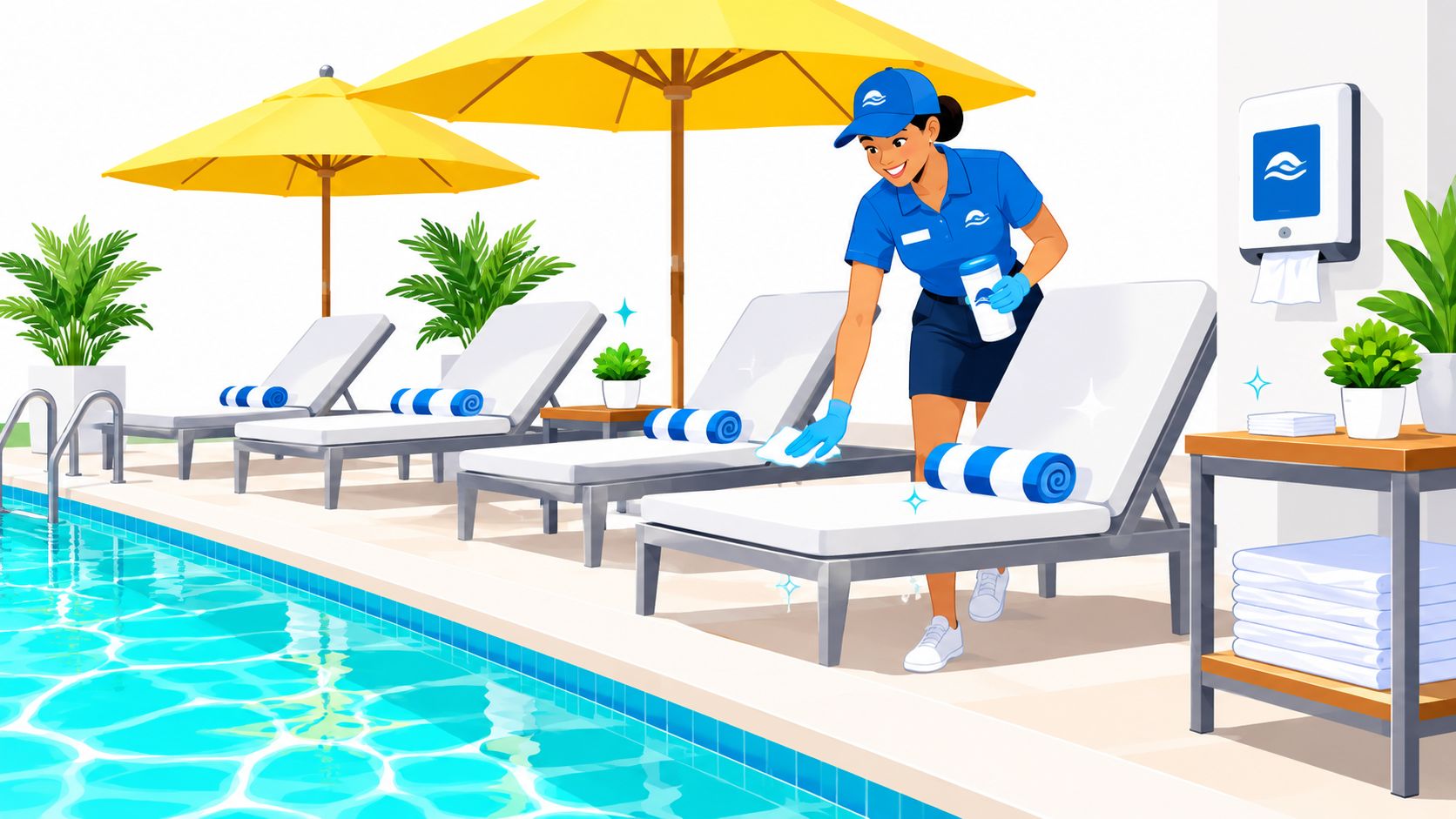
A family can decide whether your pool club feels worth renewing before anyone reaches the water. They notice the entrance glass, the check-in counter, the smell in the changing area, the condition of the benches, and whether a staff member is wiping a busy touchpoint or walking past it. On a crowded summer Saturday, those details become part of the product.
A clean deck supports more than compliance. It makes members feel looked after, gives sales staff a credible story to tell, and helps guests stay comfortable in the spaces where they eat, change, exercise, and relax. Visible sanitation also reassures parents, fitness users, and older members who may judge the entire operation by one neglected restroom handle or sticky locker.

Introduction Why Cleanliness Decides Your Pool Club Success
A pool club competes on atmosphere, convenience, safety, and trust. Cleanliness connects all four. Members might come for swimming lessons, family time, food service, fitness, or a social evening, but they remember whether the environment felt controlled and cared for.
The commercial opportunity is easy to miss because cleaning happens in the background. A janitorial team may complete excellent work before opening, yet members will still form opinions during the day if wet floors remain around the lockers, bins overflow beside the lounge, or equipment lacks an obvious way to be wiped down. Sanitation has to be both effective and visible.
The first minutes shape the visit
The arrival sequence deserves the same attention as the pool basin. Keep the entrance handles, wristband station, payment terminal, check-in tablet, and nearby seating clean throughout operating hours. A welcoming employee at a tidy desk creates a stronger first impression than a polished sales pitch delivered beside a cluttered counter.
That first impression continues through the locker room. Guests see whether dispensers are stocked, whether benches are dry, and whether restroom fixtures receive regular attention. For a practical reference on presentation and comfort in washroom areas, managers can review these guest satisfaction restroom tips.
Practical rule: If members can see a surface, they can use it to judge the whole facility.
Cleanliness affects retention conversations
When a member questions a renewal, staff rarely get a second chance to explain the club's value. A consistently clean environment makes the membership easier to defend because the benefit is experienced rather than promised. It can also support referrals, especially when families feel comfortable inviting guests into shared spaces.
The playbook is operational. Identify the zones that receive the most contact, keep water treatment within the applicable rules, place disinfecting wipes where people naturally pause, train staff to follow a repeatable path, and record what was done. The result is a pool club that feels ready for use even during its busiest periods.
What a Modern Pool Club Really Is
A modern pool club isn't a swimming pool with changing rooms. It operates more like a compact hospitality venue, combining aquatic amenities with food service, lounge seating, social areas, and sometimes a fitness corner. Members move between these zones quickly, carrying water, food, sunscreen, towels, personal devices, and shared equipment with them.

Map the facility by activity
Start with an operational map rather than a floor plan. Mark where people enter, queue, sit, eat, change, exercise, and touch shared controls. A pool deck may have handrails, ladders, loungers, tables, gates, storage handles, and splash-pad controls. A locker room adds lockers, hairdryers, faucets, shower controls, toilet fixtures, benches, and door pulls.
Food service introduces another standard. Counters, menus, condiment stations, payment devices, tray handles, and dining tables need a routine that fits food-contact requirements and the product label. A cleaning method suitable for a dry lounge table may not be appropriate for a food-preparation surface.
The fitness area creates a separate expectation. Members will look for gym equipment wipes near bikes, treadmills, resistance machines, mats, and benches. If the dispenser is far away, hidden behind a desk, or empty, self-service cleaning won't happen consistently.
Treat wet and dry zones differently
Wet areas create slip, biofilm, and odor concerns. Dry areas collect skin oils, dust, food residue, and frequent hand contact. The same employee may work across both environments, but the tools, chemical compatibility, dwell time, and inspection points can differ.
A pool club also serves different audiences at once. Parents need confidence in family areas, athletes want practical access to equipment cleaning, and social guests expect a pleasant scent without an overpowering chemical odor. Owners need records and predictable labor, while front-desk teams need simple routines they can complete without abandoning check-in.
Build one hygiene standard across the guest journey
The strongest approach follows the member from arrival to departure. Check-in, lockers, showers, deck furniture, pool access points, fitness equipment, dining areas, and restrooms should each have an owner and a defined inspection trigger.
Don't rely on a single deep clean to carry the day. Combine scheduled cleaning with responsive wiping after visible spills, heavy use, food service, or a reported incident. This hybrid model protects the facility's appearance while directing labor toward the places where guests interact.
High Touch Danger Zones and Water Chemistry Essentials
Surface hygiene and water treatment are separate controls, but members experience them as one safety promise. A clean handrail doesn't compensate for poorly managed pool chemistry, and compliant water doesn't excuse a neglected restroom or sticky lounge table.
Find the surfaces that absorb the most contact
Prioritize the points people touch repeatedly and the places where moisture or residue remains. Use a route that covers the entrance, check-in, locker rooms, deck, lounge, fitness corner, food service, and restrooms.
| Zone and Surface | Why It Matters | Wipe Frequency |
|---|---|---|
| Entrance handles, gates, and check-in counters | Nearly every visitor interacts with them, often before entering the pool area. | At opening, during operating hours, after visible soiling, and at closing |
| Payment terminals, tablets, pens, and wristband stations | Shared devices transfer contact between members and staff. | Repeatedly during service, following the product label and device guidance |
| Locker handles, benches, faucets, and shower controls | Moisture and constant hand contact make these high-priority inspection points. | During active periods, after heavy use, and during closing service |
| Pool ladders, handrails, loungers, and side tables | Wet hands, sunscreen, food, and repeated contact leave residue on guest-facing surfaces. | Throughout the day and whenever residue is visible |
| Fitness machines, mats, and adjustable controls | Shared exercise surfaces receive direct skin contact and need an easy self-service option. | Before or after use, with staff checks during busy periods |
| Restroom handles, flush controls, faucets, and sinks | These areas strongly influence perceived facility quality. | On a scheduled route, after visible contamination, and at closing |
North Carolina public-pool rules specify a pH range of 7.2 to 7.8, free chlorine of at least 1.0 ppm while the pool is open or in use, and cyanuric acid of no more than 100 ppm. The same rules specify at least 2.0 ppm residual bromine for bromine systems and 30 to 50 ppm residual for biguanide systems. Managers can review the North Carolina public-pool requirements when comparing their local operating procedures.
Keep primary and secondary treatment connected
Sanitizer performance depends on both concentration and pH. A drifting pH can reduce hypochlorous acid activity, while a low residual means the disinfectant may no longer be present in sufficient quantity after bather load, splash-out, and ultraviolet degradation.
Primary disinfection also has limits in busy aquatic environments. Health.vic guidance says secondary disinfection should achieve at least 3-log10, or 99.9%, inactivation of Cryptosporidium oocysts as water passes through the system. The guidance identifies filtration, turnover, and secondary treatment as important parts of a multi-barrier approach because chlorine-tolerant organisms and biofilms can challenge primary systems. Operators can explore pool water treatment guidance alongside their local rules.
Test records, dosing equipment, filtration performance, and make-up water planning should work as one control loop. Cleaning the deck and wiping touchpoints protects the dry side of the member experience. Chemistry, filtration, and turnover protect the water side.
How to Use Disinfecting Wipes for Maximum Impact
Disinfecting wipes work when staff use them as a disinfectant, not as a general-purpose damp cloth. Begin by removing visible dirt where necessary, then apply enough product to cover the surface and maintain the label's required wet contact time.

Follow the label instead of guessing
EPA disinfectant wipe labels require the surface to be wiped until visibly wet and kept wet for the stated contact time. One EPA label example specifies 1 minute, but the correct time depends on the registered product, so staff must follow the label for the exact wipe in use. See this surface disinfection guidance when reviewing procedures.
Use this sequence:
- Pre-clean visible soil. Remove sunscreen, food, dust, and other residue before disinfecting when the label or surface condition calls for it.
- Use enough product. A single wipe may not cover a large machine, table, or check-in counter while staying wet. Add wipes rather than spreading a drying sheet too thinly.
- Wipe systematically. Work from high to low and from clean to dirty. For a broad surface, use overlapping passes in one direction instead of scrubbing randomly.
- Respect contact time. Don't wipe the disinfectant away before the label allows. The surface needs to remain visibly wet for the full stated period.
- Let it air dry. Don't rinse or dry the surface unless the label or material instructions require it.
- Dispose and secure the container. Close the lid after use, prevent drying, and discard used wipes in the correct waste stream.
The CDC recommends folding cloths into eighths, rotating and unfolding them as you clean so each side can be used. The same clean-to-dirty discipline can improve wipe efficiency, even though disposable wipes aren't folded and reused. CDC cleaning procedures also support a systematic path that reduces recontamination.
Make self-service easy
Place a gym wipe dispenser beside fitness machines, near the entrance to the exercise corner, and close to shared mats. Members shouldn't need to cross a wet deck or ask the front desk for access. For yoga mat wipes, check material compatibility and label directions before placing them in a self-service station.
Phones, computers, tablets, and check-in electronics need extra care. CDC guidance allows disinfecting wipes on frequently touched electronics when users follow the product directions, and more than one wipe may be needed to keep a surface wet for the full contact time. Give staff a device-safe procedure, and never let liquid pool around openings or controls.
Seasonal Protocols Staffing and Operational Checklists
A pool club's cleaning standard is only as reliable as its busiest shift. Seasonal planning should change staffing, inspection frequency, supply placement, and maintenance priorities without changing the core expectation that every guest-facing zone remains ready.

Build the day around three check points
At opening, staff should inspect entry touchpoints, restrooms, locker rooms, deck furniture, waste containers, wipe dispensers, and visible water conditions. During service, assign zone ownership rather than telling everyone to “keep an eye on things.” At closing, complete a documented reset that includes high-touch wiping, floors, bins, replenishment, and equipment checks.
A workable assignment might look like this:
- Front desk lead: Handles check-in surfaces, payment devices, pens, wristband supplies, and the arrival area.
- Pool attendant: Monitors deck furniture, rails, ladders, bins, standing water, and guest reports. A pool attendant at MAJC listing offers a useful view of how guest-facing pool duties can be defined.
- Lifeguard team: Follows the facility's safety role and reports contamination, unsafe surfaces, and equipment concerns without treating surveillance as a cleaning task.
- Cleaning team: Owns restrooms, locker rooms, waste removal, replenishment, and scheduled disinfection.
- Fitness lead: Checks machines, mats, controls, and the availability of bulk gym wipes or other approved supplies.
Adjust the playbook by season
During summer peak, increase visible patrols and rapid response. Heavy bather loads affect both water chemistry and surface residue, so test and record according to local requirements, with additional checks when usage conditions demand them.
Shoulder season is the time to repair dispensers, replace damaged signage, inspect furniture, refresh training, and review supply consumption. Winter maintenance should focus on systems, equipment servicing, deep cleaning, and documented inspections appropriate to the facility's operating model.
Control labor and administrative leakage
Managers increasingly need more than a cleaning checklist. A 2026 industry review highlights photo-ID gate check-in, centralized member databases, automated billing, and reporting, with full-featured club platforms estimated at about $1,000 to $3,500 per year. That source is club software guidance for 2026, and the operational question is whether automation reduces duplicate entry, billing errors, access disputes, and manual reporting for your club.
Regulations also vary by jurisdiction. CDC guidance emphasizes testing at least twice daily, hourly checks during heavy use, pH between 7.0 and 7.8, and strict recordkeeping, while local rules may set different requirements for cyanuric acid, spas, closure triggers, and test frequency. Build the checklist around the rule that applies to your location, then have a qualified operator verify the procedure.
Turning Cleanliness Into Member Trust and More Revenue
Cleanliness becomes a revenue lever when members can see the system working. A stocked wipe station beside shared equipment, a dry and orderly lounge, clean-smelling restrooms, and staff who respond quickly to spills all communicate operational control without a sales employee making the claim.
Scent needs restraint. A fresh environment should smell clean, not heavily perfumed or like a chemical cloud. Odor usually signals a source problem, such as wet textiles, blocked drains, neglected bins, or poorly ventilated changing areas. Masking the source with fragrance doesn't solve the member's concern.
Sell the outcome, not the container
Sales professionals can position disinfectant wipes as part of a complete hygiene program rather than as a standalone commodity. Ask where members touch shared equipment, how often staff replenish supplies, what happens during peak periods, and whether managers can prove that scheduled work was completed.
A practical offer might combine:
- Commercial disinfecting wipes: For front desks, locker rooms, lounges, and staff-controlled routes.
- Wipes to disinfect gym equipment: For treadmills, bikes, benches, handles, and adjustment controls.
- Workout wipes: For member self-service after exercise, subject to material compatibility and facility policy.
- Dispensers and signage: To make the expected behavior obvious and reduce requests at reception.
- Inspection logs: To connect product usage with staff accountability and supply planning.
Link the recommendation to labor, member experience, and risk control. Don't promise a precise financial return without the club's own labor and retention data. Instead, help the owner compare product cost with the time spent handling complaints, the staff effort required to fetch supplies, and the reputational cost of visibly neglected zones.
Adapt the message to each facility
An office buyer may care about shared keyboards, phones, desks, and meeting-room touchpoints. A gym owner needs equipment access, floor routines, and member participation. A school looks for clear supervision and age-appropriate procedures. A restaurant needs strict separation between general touchpoint cleaning and food-contact requirements. Retail managers may prioritize carts, counters, payment terminals, handles, and fitting-room touchpoints.
A pool club combines all of these patterns. It has the gym's shared equipment, the restaurant's guest-facing service, the school's family traffic, and the hospitality sector's expectation of comfort. That makes a broad commercial wipes offering more useful than a single product placed in a storeroom.
The historical record supports the connection between improved aquatic amenities and demand. The Singapore Swimming Club grew from 65 men in 1894 to 79 in 1895 and 116 in 1899, with $835 in its coffers at that stage, then reached 2,821 members by 1928 and peaked at 4,645 in 1955 after the pool opened, as documented by the National Library Board Singapore. Cleanliness isn't the only amenity that drives demand, but it helps protect the value of every amenity the club sells.
Your Next Steps to a Cleaner More Profitable Pool Club
Start with a walk-through during the busiest part of the day, not only after the morning clean. Follow the member route from entrance to locker room, deck, water, lounge, fitness area, food service, and restroom. Record every touchpoint that looks wet, sticky, empty, damaged, or difficult to clean.
Then set a short operating standard:
- Assign ownership. Name the person responsible for each zone and each shift.
- Place supplies at the point of use. Install dispensers where members and staff naturally stop, especially near shared fitness equipment and high-contact entry points.
- Use the label correctly. Keep disinfected surfaces visibly wet for the required contact time, and verify material compatibility.
- Track the work. Record inspections, replenishment, water tests, incidents, and corrective actions.
- Review the guest experience. Check scent, restroom condition, deck appearance, bin levels, and staff response, not only chemical readings.
- Adjust for demand. Increase patrols and replenishment when traffic rises, then use quieter periods for maintenance and training.
For supply planning, compare formats and dispenser options through Wipes.com cleaning products, and choose products that match the surfaces, label requirements, storage conditions, and usage pattern in your club. A good program doesn't place wipes everywhere without control. It makes the right product available, teaches people how to use it, and gives staff a simple way to confirm that stations stay ready.
Clean the visible touchpoints, sanitize shared equipment correctly, keep restrooms fresh, and maintain water chemistry as a documented multi-barrier process. Make disinfecting wipes part of the daily pool club routine and part of your broader cleaning supply offering, starting with the zones members judge first.
Prioritize cleanliness on your next shift. Walk the facility, refill the wipe stations, coach the team on contact time, and review the highest-touch areas before guests arrive. If you're building or upgrading a supply program, explore the appropriate options at Wipes.com and turn visible sanitation into a routine members can trust.
Leave a Reply