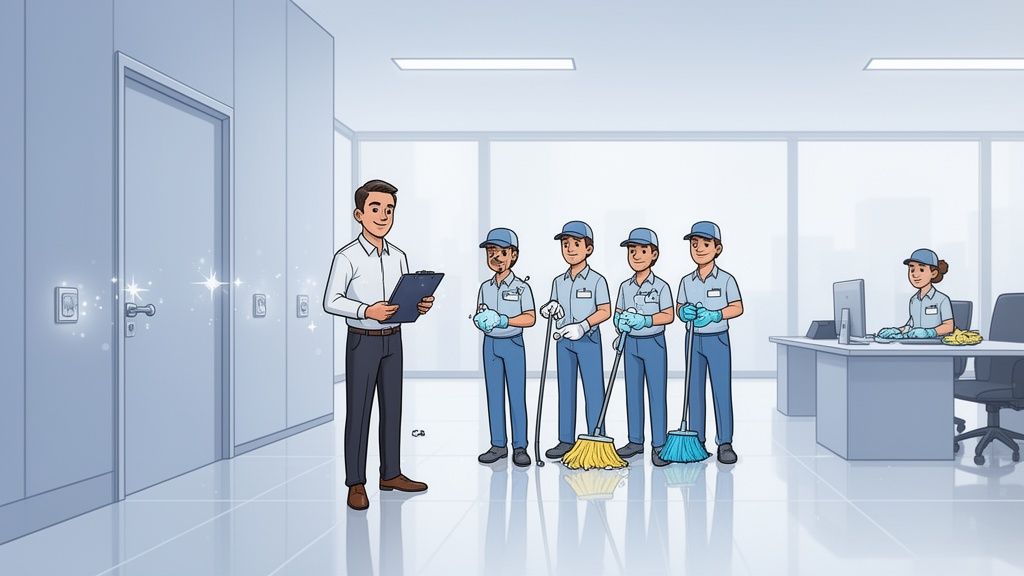
A customer walks into your lobby, reaches for the door pull, and notices a tacky film on the metal. They may never mention it. They will still judge the rest of the building by that one touch.
That is why the cleaning of facilities matters far beyond appearance. In commercial and public spaces, cleanliness affects trust, safety perception, repeat visits, staff confidence, and the credibility of your operation. A polished floor helps, but what people remember is whether the space feels cared for.
Disinfectant wipes deserve special attention in that conversation. They are not a replacement for a full cleaning program. They are a practical tool for rapid response, visible hygiene, and better control of high-touch surfaces that traditional schedules often miss. Used well, they close the gap between scheduled cleaning rounds and real-world traffic.
Beyond the Mop Bucket The Business Case for Facility Cleaning

Most facility managers already know dirty spaces create complaints. The bigger issue is that visible cleanliness influences buying behavior and confidence before anyone reads a sign or speaks to staff.
A gym member notices sweat residue on a bike handle. A retail shopper sees fingerprints all over the payment terminal. A patient family member touches a waiting room armrest that feels sticky. In each case, the problem is not only sanitation. It is the loss of trust.
Clean is visual and tactile
Many teams focus on whether a surface was technically disinfected. Occupants judge something else too. They judge whether it looks clean and feels clean.
High-level disinfectants can leave residue that “feels strange to the touch,” and that sensory mismatch can hurt comfort and revenue perception. The same source notes that 42% of workers are worried about workplace safety (UG2). That matters because people do not separate hygiene from business quality. They treat them as the same signal.
If a conference room table feels filmy, the client assumes shortcuts. If a restroom fixture is clean but streaked, the guest assumes neglect. In practice, the standard is not just microbial control. It is credible cleanliness.
Tip: When choosing products and procedures, test not just efficacy but finish. If a surface attracts complaints for residue, your protocol is failing in public view.
Cleaning protects more than health
Good facility cleaning reduces obvious risks, but its commercial role is just as important. It supports three things every operator cares about:
- Revenue protection: Clean spaces keep customers in the building longer and make them more comfortable spending money.
- Reputation control: Guests may forgive wear and age. They rarely forgive grime.
- Risk management: Consistent cleaning lowers the chance that one neglected surface becomes a complaint, a bad review, or an escalation.
Disinfectant wipes fit this business case because they make corrective action immediate. A staff member can reset a touchpoint in seconds without pulling a cart through a full public area. That speed matters in lobbies, front desks, gyms, classrooms, dining areas, and retail counters.
What does not work
There are a few patterns I see repeatedly in underperforming facilities:
- Treating cleaning as back-of-house only: If guests can see the failure point, it is a front-of-house issue.
- Relying on nightly service alone: High-touch surfaces degrade throughout the day.
- Ignoring residue complaints: “It was disinfected” is not a useful answer when the user experience says otherwise.
Facility cleaning becomes strategic when leaders stop asking, “Was it cleaned?” and start asking, “What impression did that surface create?”
How Strategic Cleaning Drives Revenue and Guest Loyalty
Cleaning earns its budget when leaders connect it to labor stability, customer confidence, and repeat business. The return is not abstract. It shows up in healthier teams, fewer avoidable complaints, and stronger customer retention.
Health outcomes affect payroll and continuity
In office settings, absenteeism accounts for 15-20% of direct and indirect payroll expenses (Facility Executive). That gives cleaning a direct connection to business health.
The same source reports that surface disinfection alone can reduce viruses by 42%, and that result rises to 58% when combined with hand sanitization. It also notes that thorough cleaning can mitigate up to 85% of residual contamination. Those are operational numbers, not housekeeping trivia.
For a business owner, the takeaway is simple. Hygiene affects whether people show up, whether service levels stay stable, and whether managers spend their week handling shortages instead of customers.
Loyalty starts with consistency
Customers rarely compliment a floor that looks acceptable. They notice inconsistency. One dirty entrance handle, one neglected checkout station, or one poorly maintained restroom can outweigh a hundred surfaces that were fine.
That is why strategic programs focus on repeatable touchpoint control, not just general appearance. Disinfectant wipes are useful here because they support visible, in-the-moment maintenance between larger cleaning cycles. In a fitness center, that may mean wiping touchscreens and machine grips throughout the day. In a retail setting, it may mean quick resets of pin pads, counters, and basket handles during traffic lulls.
A similar principle applies to exterior presentation. Clear glass and clean entryways shape trust before a visitor touches anything, which why many operators pair interior hygiene protocols with professional commercial window cleaning as part of a broader first-impression standard.
Key takeaway: Customers do not separate cleanliness into categories. They experience the whole environment at once.
Where disinfectant wipes add the most value
Wipes work best when they are placed where delay is costly. That usually includes:
- Front-facing service points: Reception counters, payment devices, pens, clipboards, and self-check kiosks.
- Shared equipment: Gym machines, training tools, tablets, handheld scanners, and remotes.
- Between-use turnover surfaces: Breakroom tables, exam seating, waiting room armrests, and dining touchpoints.
They are less effective when teams use them as a substitute for proper floor care, restroom deep cleaning, or broader surface protocols. Wipes are a precision tool. They are not a whole program.
Sales advice for cleaning professionals
If you sell wipes, janitorial service, or bundled hygiene products, stop leading with the container count. Lead with the business problem.
Use language like this:
| Client concern | Better sales framing |
|---|---|
| “We already clean at night” | “Night cleaning does not protect surfaces that are touched all day.” |
| “Wipes cost more than spray bottles” | “Wipes help staff respond fast in public areas where delays turn into complaints.” |
| “We only need basic supplies” | “You need tools that protect both sanitation and customer perception.” |
The strongest sales conversation is not about chemicals. It is about continuity, confidence, and the ability to keep visible surfaces guest-ready at all times.
Developing Your Facility Cleaning Playbook
A workable playbook is specific. If your SOP says “clean high-touch surfaces regularly,” staff will interpret that ten different ways. Good playbooks remove ambiguity.
Start with a risk map
Walk the building and sort spaces by three factors:
- Traffic volume
- Touch frequency
- Consequence of failure
A side office with one user does not need the same cadence as a reception desk, school restroom, or gym entrance gate. Generic advice fails because facilities vary so much. Industrial locker rooms can accumulate “the greatest amount of dirt and debris,” while other venues face entirely different turnover demands (Benman).
That is why the cleaning of facilities has to be written by zone, not by vague building-wide rules.
Build SOPs around surfaces and timing
Your playbook should list the exact surface, the method, the product, and the trigger. For example, “front desk counter” is clearer than “lobby.” “Wipe after shift change” is clearer than “clean often.”
Use a simple structure like this:
- Daily opening tasks: Entry handles, reception surfaces, counters, restroom touchpoints, shared electronics.
- During-use tasks: Equipment handles, payment terminals, breakroom appliances, tables, railings.
- End-of-day tasks: Full resets, refill checks, trash removal, floor care, restroom detail cleaning.
For food service operations, the level of detail should be even tighter. If you manage dining spaces or support hospitality clients, this overview of restaurant cleanliness standards is a useful companion reference when writing task-specific SOPs.
Standardize chemistry and tools
In larger programs, manual mixing creates too much variation. Dilution control systems matter because manual mixing can lead to 20-50% waste or ineffective sanitation, while automated dispensers can cut chemical overuse by up to 30% and help prevent damage caused by improper ratios (Midlab). The same source notes that residue from poor dilution can accelerate floor wear by 15-25% annually.
That has operating consequences. Overmixed chemicals leave film. Undermixed chemicals underperform. Both create callbacks.
A practical setup usually includes:
- Wall-mounted dilution control units for back-of-house fill stations
- Color-coded microfiber to separate restroom, food, and general-touch surfaces
- Disinfectant wipes at point-of-use stations for quick response
- Clear labels and dwell-time instructions in janitor closets and utility rooms
Tip: If two employees can prepare the same product two different ways, the SOP is not finished.
Make the playbook usable on the floor
The best SOP is the one the team can follow during a busy shift. Keep checklists short, visible, and tied to the route staff walk.
A strong operational guide should answer:
- What gets cleaned?
- With what product?
- How often?
- By whom?
- How is completion verified?
If you need a broader operational framework beyond cleaning tasks alone, this guide on facility management best practices is useful for aligning sanitation with staffing, vendor control, and day-to-day oversight.
What strong playbooks avoid
Weak systems usually fail in familiar ways:
- Too many categories: Staff stop reading.
- No trigger points: Teams wait for complaints.
- No product clarity: The wrong wipe or chemical gets used on the wrong surface.
- No ownership: Everyone assumes someone else handled it.
A playbook should make good performance easier than bad performance. When it does, consistency improves fast.
Targeting High-Touch Hotspots in Your Facility
The fastest way to waste labor is to clean everything with the same intensity. Smart programs focus on the surfaces that carry the highest perception and contamination risk for that specific venue.

Offices and administrative spaces
Office buildings look controlled, but the traffic pattern is deceptive. Hotspots are not always obvious.
Shared devices and breakroom touchpoints often create more complaints than conference tables. Focus on:
- Door hardware and push plates: Main entrances, suite entries, and restrooms
- Shared electronics: Desk phones, keyboards, mice, printer touchscreens
- Breakroom points: Refrigerator handles, microwave buttons, coffee stations, sink fixtures
- Meeting spaces: Chair arms, remotes, table edges
Disinfectant wipes work especially well in offices because teams can use them without carrying multiple bottles and cloths through occupied areas. They also support quick resets between meetings.
Gyms and fitness centers
Gyms need a different standard because users expect visible hygiene in real time. They are watching the condition of grips, benches, mats, and locker areas while they decide whether the facility is well managed.
Critical targets include:
- Machine contact points: Handles, seat adjustment levers, touchscreens
- Free weight zones: Dumbbells, kettlebells, benches
- Studios: Mats, blocks, resistance equipment
- Locker rooms: Bench tops, locker pulls, faucet handles, hair dryer controls
In this setting, wipes are not just a janitorial product. They are also a member-facing hygiene tool. Place them where members can use them before and after contact, but do not rely on members alone. Staff still need routine verification rounds.
Tip: In gyms, the visible availability of wipes supports confidence. The staff follow-through determines whether that confidence is justified.
Retail environments
Retail has a different failure point. Customers move quickly, touch a lot, and make purchase decisions under subtle environmental pressure. Dirty touchpoints create friction that does not always show up as a complaint.
Prioritize:
- POS terminals and pin pads
- Shopping cart and basket handles
- Fitting room handles and benches
- Service counters and sample displays
- Entry doors and self-check stations
A practical retail rule is to station wipes within easy reach of employees at checkout, service desks, and fitting room zones. If a tool is locked in a closet, it will not protect the selling floor.
Restaurants and food-adjacent spaces
Restaurants and cafes carry both hygiene risk and perception risk. Guests watch tabletops, condiment zones, restroom fixtures, and host stands closely. They also notice residue immediately.
Target these areas carefully:
- Menu holders, buzzers, tabletop touchpoints
- Host stand counters and pens
- Restroom latches, faucets, flush handles
- High-touch back-of-house crossover points, such as cooler handles and shared hand-contact surfaces
In dining spaces, the wrong wipe can create streaking or leave a scent that competes with the guest experience. Train teams to match the product to the surface and to finish with a clean presentation, not just a completed task.
Schools and public venues
Schools, community buildings, and event spaces face waves of occupancy rather than steady patterns. That changes timing.
Focus on:
- Classroom shared tools and desk edges
- Auditorium armrests and rails
- Restroom touchpoints
- Vending and concession interfaces
- Entry rails and interior door hardware
The lesson across all these spaces is the same. Generic advice misses the operational reality. Each facility type has its own rhythm, pressure points, and complaint triggers. The most effective use of disinfectant wipes is to place them where a delayed response would be visible to the next user.
Training and Empowering Your Frontline Hygiene Staff
A cleaning program rises or falls with frontline execution. Good people fail in weak systems all the time. They are handed vague instructions, too many products, and no explanation of why certain surfaces matter more than others.
Train for judgment, not just repetition
Staff need to know how to clean a surface. They also need to know why that surface matters to the business.
A university campus serving 88,000 students and 17,000 staff used a data-driven approach that produced a 30% reduction in water usage and a 20% decrease in chemical consumption through process optimization. In the same program, a school district reported a 20% reduction in cleaning times and a 15% increase in overall cleaning efficiency through better resource allocation (ISSA).
Those results point to a lesson many managers miss. Training is not only about compliance. It is how teams learn to get better outcomes with less waste.
What frontline teams should practice
Give every new hire and every retrained employee a short set of repeatable skills:
- Surface identification: What can be wiped, what needs a different method, and what is damage-prone
- Product selection: Which disinfectant wipe belongs on electronics-adjacent surfaces, fitness equipment, counters, or restroom fixtures
- Contact and dwell awareness: Staff should know that wiping fast is not the same as disinfecting correctly
- Presentation standards: No residue, no streaks, no half-finished replenishment stations
- Escalation rules: When to handle an issue immediately and when to report maintenance, damage, or repeated abuse
If you are tightening onboarding or refresher routines, these staff training best practices are a practical reference for structuring role-based training around consistency and accountability.
Build ownership into the route
Strong supervisors do not only inspect failure. They create ownership by assigning zones clearly and reviewing results with the employee who handled them.
That means:
- assigning named responsibility for public touchpoints
- checking quality during the shift, not just after it
- showing staff how their work affects guest comments, member retention, and operational flow
When employees understand that a clean front desk supports sales, or that a well-managed locker room protects memberships, the work stops feeling invisible.
Tip: Praise specificity. “Good job” is forgettable. “You kept the front entry hardware and check-in screens consistently reset during peak traffic” teaches the standard.
Sales tips for janitorial reps and distributors
If you sell disinfectant wipes or managed cleaning services, your best clients want business language. Give it to them.
Use practical talking points such as:
- Tie wipes to speed: “Your team can address touchpoints immediately instead of waiting for the next full round.”
- Tie wipes to perception: “Customers see active hygiene, not just after-hours cleaning.”
- Tie wipes to consistency: “Pre-portioned wipes reduce variation compared with improvised on-the-spot setups.”
- Tie wipes to broader systems: “This works best as part of your SOP, not as a stand-alone product.”
We recommend Wipes.com Disinfectant Wipes as one option for facilities that need a wipe-based tool in a larger hygiene program, especially where teams want a ready-to-use format for high-touch surfaces.
The strongest hygiene teams are not passive labor. They are trained operators who understand risk, timing, finish quality, and customer impact.
Measuring What Matters Cleaning KPIs and Audit Checklists
If you do not measure the outcome, cleaning stays trapped in opinion. One manager says the building looks fine. Another says standards are slipping. An audit system settles that argument.

Use both visible and objective measures
Start with a balanced scorecard. A good one combines:
- Visual inspection results
- Task completion checks
- Occupant or guest feedback
- Spot verification on high-risk surfaces
For objective verification, ATP testing is one of the most practical tools available. ATP swabbing measures organic residue, and a reading below 100-250 RLUs typically indicates a clean surface. The same source states that putting ATP data into a dashboard has improved cleaning consistency by 25-40% (Janitorial Manager).
That matters because some surfaces pass a visual check and still fail a hygiene check.
KPIs that help managers
Track only measures that drive decisions. A short KPI set is better than a spreadsheet nobody uses.
| KPI | What it tells you |
|---|---|
| High-touch completion rate | Whether critical touchpoints are being serviced as scheduled |
| Inspection failure themes | Which rooms, routes, or staff assignments need correction |
| ATP spot-check results | Whether visual cleanliness matches actual residue control |
| Supply station readiness | Whether wipes, paper goods, and soap are available when needed |
A simple audit checklist template
Use a checklist your supervisor can complete quickly during a live walk.
- Entry zone: Door handles clean, glass free of heavy soil, reception counter reset
- Restrooms: Fixtures clean, dispensers stocked, no residue on touchpoints
- Shared equipment: Wiped and presentable, no visible buildup, proper product used
- Breakrooms or waiting areas: Tables reset, appliance handles clean, waste managed
- Supply readiness: Wipe canisters or refill packs in place where staff need them
- Documentation: Assigned staff completed tasks and exceptions were logged
Key takeaway: Audit the surfaces people touch first. A perfect back hallway does not offset a dirty front counter.
What to do with failed audits
Do not jump straight to blame. Failed checks usually point to one of four issues:
- The schedule is unrealistic.
- The product is wrong for the surface.
- The task ownership is unclear.
- The standard was never trained properly.
An audit system should improve the operation, not just produce paperwork. The best managers use data to tighten routes, reset supply placement, and retrain small failure points before they become visible problems.
Make Cleanliness Your Competitive Advantage
Customers, members, guests, and employees read your facility through its surfaces. They notice what is clean, what is neglected, and what feels off. That judgment affects whether they trust your business.
The cleaning of facilities works best when it is managed as an operating system. That means clear SOPs, high-touch targeting, trained staff, and verification that goes beyond appearance alone. Disinfectant wipes are part of that system because they give teams speed where speed matters most. They help bridge the gap between scheduled service and real-time use.
The payoff is practical. Cleaner touchpoints support stronger first impressions. Better hygiene habits help protect staff continuity. More consistent presentation reduces complaints and protects reputation. For cleaning professionals and distributors, this also creates a better sales conversation. You are not selling a consumable. You are helping clients protect revenue, reduce risk, and strengthen customer loyalty.
Review your current program with fresh eyes. Check the surfaces people touch first. Look for residue, inconsistency, and delay points. Tighten the playbook. Retrain the team. Place disinfectant wipes where they solve operational problems, not where they just look convenient.
Make cleanliness a daily business decision, not a periodic chore. If you manage a facility or sell into one, prioritize high-touch hygiene and consider adding disinfectant wipes to your routine or product mix where they can improve speed, consistency, and customer confidence.
Leave a Reply