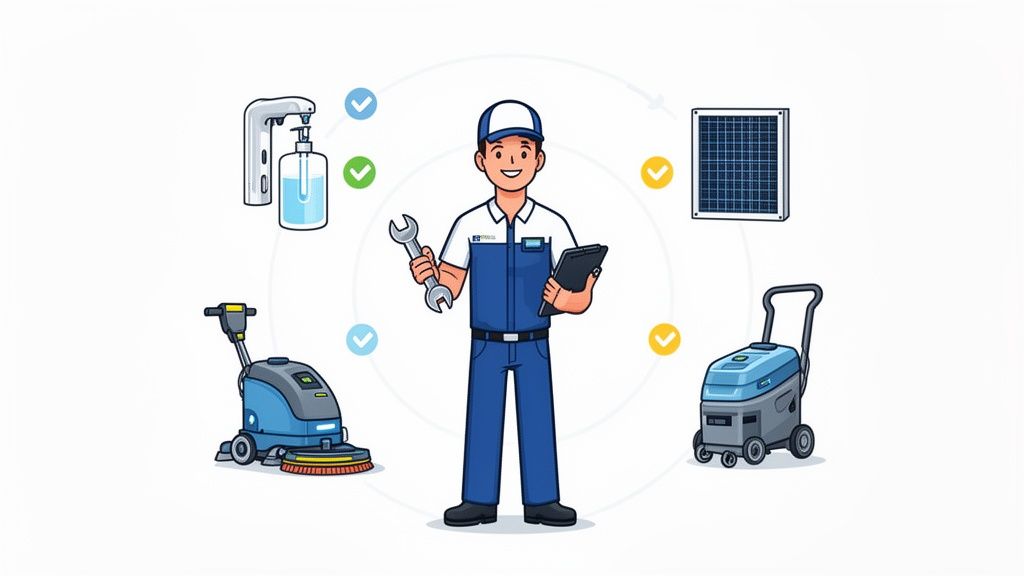
A lot of facilities discover the weakness in their cleaning program at the worst possible moment. The dispenser runs dry during a lunch rush. The auto scrubber stops in the main corridor before an event opens. A touchless fixture works intermittently, so guests start touching the manual backup points instead.
Those failures look small on paper. In practice, they are visible signals that the building is not under control.
That is why strong maintenance programs for equipment matter as much as chemical selection or cleaning frequency. In public and commercial spaces, the sanitation tool itself is part of the guest experience. If the wipe dispenser is empty, the soap unit is clogged, or the sprayer battery is dead, the cleaning standard collapses before the staff even starts the task.
Facility leaders who treat sanitation equipment as business infrastructure protect more than uptime. They protect confidence, compliance, and repeat business.
Beyond the Mop Bucket The Business Case for Equipment Maintenance
Friday at 6:45 p.m., the line is building at the entrance, and the first sanitizer dispenser guests reach is blinking red. Inside, a restroom soap unit is jammed, and the auto scrubber left a damp path across the main corridor because the squeegee was overdue for replacement. Nobody on the guest side sees three small equipment issues. They see a facility that feels unmanaged.
This is the core business case for maintenance programs in high-traffic venues. Sanitation equipment sits in plain view, gets used hard, and fails in moments customers remember. A broken wipe dispenser in a fitness area, a leaking soap unit in a restroom, or a floor machine that leaves streaks after a concert crowd moves through the lobby all send the same message. Standards are slipping.
Where sanitation equipment failures cost the most
The highest-cost failures usually happen in the most visible or most regulated parts of the building:
- Entry points: Touchless dispensers, lobby waste units, and hygiene stations shape the first impression within seconds.
- Restrooms: Soap dispensers, paper systems, sensor fixtures, and refill hardware affect guest trust and sanitation compliance.
- Fitness and shared-use zones: Wipe dispensers, spray systems, and charging accessories need steady uptime because guests interact with them throughout the day.
- Back-of-house sanitation gear: Auto scrubbers, vacuums, dilution systems, and charging docks may sit out of sight, but their condition determines whether front-of-house cleaning holds up.
In these settings, maintenance is not separate from cleaning quality. It determines cleaning quality. If the sprayer battery is dead, the dilution system is off ratio, or the floor machine has worn pads and a dirty recovery tank, the team can follow the task list and still deliver a poor result.
I have seen operators spend heavily on chemicals, staffing, and appearance upgrades while ignoring the dispenser fleet and small cleaning machines that guests touch every day. That trade-off rarely pays off. Guests notice empty, broken, or unreliable sanitation equipment faster than they notice a new finish on the wall.
Maintenance protects more than uptime
A working sanitation asset supports four business outcomes at once.
- Guest safety: Reliable floor equipment reduces slip risks. Working soap and sanitizer systems support hand hygiene where it matters most.
- Compliance: Restrooms, food-adjacent areas, and shared-use spaces depend on equipment that functions as intended, not equipment that staff have learned to work around.
- Brand reputation: In public venues, visible equipment failure reads as a management failure.
- Profitability: Emergency repairs cost more, disruptions pull labor off planned work, and poor guest impressions hurt retention, reviews, and repeat visits.
The common mistake is treating dispensers, sprayers, vacuums, and scrubbers like low-value supplies. They are operating assets. They influence labor efficiency, inspection readiness, and the customer experience every shift.
For a broader operational view, this article on how cleaning and maintenance work together in day-to-day facility performance is a useful companion to an equipment maintenance plan.
Practical takeaway: If guests can see it, touch it, or depend on it to judge cleanliness, it belongs in your maintenance program.
Auditing Your Arsenal The Foundation of Your Maintenance Program
A maintenance program breaks down at the inventory stage. Teams know the large floor machines by name, but the entrance sanitizer stand with a dead sensor, the restroom soap dispenser with a cracked housing, and the backup battery charger with no service record never make it onto the list. In a high-traffic venue, those small misses show up in guest complaints, failed inspections, and labor waste.

Start with a full audit. Build a complete inventory of every sanitation asset your operation depends on, especially the equipment shared across housekeeping, janitorial, engineering, and operations.
Define how each asset is maintained
Use three categories and assign each asset to one of them.
Preventive maintenance is scheduled service before failure. For sanitation equipment, that includes replacing dispenser batteries on a cycle, cleaning sensor eyes, inspecting scrubber squeegees, flushing chemical lines, and checking cords, wheels, and hose connections.
Corrective maintenance happens after the failure. A wipe dispenser jams during a busy period, a vacuum loses suction mid-shift, or a sprayer stops holding charge. Staff work around the problem, service slows down, and the guest sees the gap.
Predictive maintenance uses condition or usage signals to time service better. On sanitation equipment, that may mean battery health checks, run-time tracking, motor noise changes, filter loading, or alerts from connected machines.
Build the inventory with operating detail
List every asset tied to cleaning, hygiene, and visible sanitation support. Do not stop at machines with motors. In many facilities, the low-cost items create the most visible failures.
Include:
- Dispensing assets: soap dispensers, sanitizer stations, wipe dispensers, chemical dilution units
- Mobile cleaning equipment: upright vacuums, backpack vacs, floor scrubbers, burnishers, pressure washers
- Specialized sanitation tools: electrostatic sprayers, UV carts, foggers where permitted, touchless fixtures
- Support systems: charging stations, spare batteries, cart wheels, storage cabinets, hose reels, filter assemblies
- Air and hygiene infrastructure: HVAC filters tied to occupant comfort, restroom exhaust systems, drain-maintenance tools
For each asset, record the details your team will use:
- Asset name and model
- Location
- Age or install date
- Current condition
- Failure history
- Parts availability
- Operational importance
I also recommend recording one more field: who notices first when it fails. If the answer is “the guest,” “front-line staff,” or “an inspector,” the asset deserves more attention than its price tag suggests.
Rank assets by business impact
Replacement cost is a poor way to set priorities. A low-cost dispenser at a main entrance or in a restroom bank can create a faster operational problem than a higher-priced machine parked in storage.
Use simple screening questions:
- If this fails, will a guest notice right away?
- If this fails, does cleaning output drop for the shift?
- If this fails, do we create a safety, hygiene, or compliance issue?
- If this fails, will staff start using manual workarounds that increase labor time?
This ranking gives the audit real value. It tells you where to place inspection time, spare parts, and technician attention. It also helps explain budget decisions to ownership or finance. Spending time on dispensers, chargers, and batteries can look minor on paper. In practice, those assets often protect the guest experience more directly than a larger machine that operates out of sight.
Reactive work also costs more over time, as noted earlier. The audit helps you catch repeat failures, poor part availability, and equipment that has shifted from manageable upkeep to constant disruption.
A practical way to tighten the process is to pair the asset review with a documented walkthrough. This property manager inspection checklist for recurring facility rounds helps teams capture the same details every time instead of relying on memory.
Tip: If your team cannot pull up the manual, parts list, warranty status, and last service date within a few minutes, treat that asset as higher risk until the record is fixed.
Designing Your Tiered Maintenance Strategy
A flat maintenance plan wastes labor. The front-lobby wipe dispenser, the battery-powered floor scrubber, and the backup pressure washer should not all receive the same level of attention.
The better approach is a tiered strategy. Critical assets get tighter oversight. High-use assets get disciplined preventive work. Low-impact items can stay on a limited intervention plan.
Use tiers to match effort to risk
A practical three-tier setup works well in most facilities.
Tier 1 covers mission-critical sanitation equipment. These are assets whose failure becomes immediately visible or operationally disruptive. Think entrance dispensers, restroom soap systems, floor machines used during open hours, and touchless fixtures in heavily used areas.
Tier 2 includes high-use but not business-stopping equipment. That may include secondary dispensers, backup vacuums, custodial carts, locker room refill systems, and portable sprayers used on scheduled routes.
Tier 3 contains low-impact or backup assets. Storage-area units, older reserve equipment, and nonessential machines fit here.
This approach lines up with how experienced maintenance teams already work. Expert-led programs stratify maintenance strategies so critical assets use predictive technology, high-use items get time-based preventive maintenance, and low-impact gear follows reactive fixes. That customized approach can reduce downtime by 20 to 50 percent and cut costs by 10 to 20 percent, while over-scheduling can waste 12 to 18 percent of resources, according to MW Services on setting a preventive maintenance program.
What each tier should look like
Tier 1 assets
These need close supervision and documented checks.
Use:
- Daily visual inspection
- Frequent refill verification
- Battery or power-status checks
- Sensor and trigger testing
- Rapid access to spare parts
Examples:
- Main entrance sanitizer stations
- Restroom touchless dispensers
- Floor scrubbers assigned to public corridors
- Electrostatic sprayers used between events
Tier 2 assets
These benefit from recurring preventive tasks without the same intensity.
Use:
- Scheduled cleaning and lubrication
- Weekly function testing
- Monthly wear-part review
- Usage-based part replacement where practical
Examples:
- Secondary hallway dispensers
- Staff-area vacuums
- Portable cleaning carts
- Training-room sanitation stations
Tier 3 assets
Keep these simple. Document location, test them periodically, and avoid overbuilding the schedule.
Use:
- Basic readiness checks
- Minimal stock of critical consumables
- Repair-or-replace decisions based on reliability and usage
Examples:
- Backup dispensers in storage
- Rarely used pressure washers
- Seasonal overflow units
Sample Tiered Maintenance Schedule for Sanitation Equipment
| Equipment | Tier | Daily Task | Weekly Task | Monthly Task |
|---|---|---|---|---|
| Main entrance sanitizer dispenser | Tier 1 | Check fill level, verify sensor response, wipe exterior | Inspect mounting, battery status, and nozzle flow | Review failure log, replace worn components as needed |
| Restroom touchless soap dispenser | Tier 1 | Confirm operation and refill status | Clean sensor area, inspect clogs and leaks | Test consistency across all units of same model |
| Auto floor scrubber | Tier 1 | Empty tanks, rinse system, inspect pads and squeegee | Check battery condition, hoses, wheels, recovery tank seals | Inspect wear parts, document recurring faults, review operator notes |
| Electrostatic sprayer | Tier 1 | Verify charge, clean nozzle, check tank and trigger | Inspect seals, spray pattern, and charging dock | Review performance issues and replace consumable parts if needed |
| Wall-mounted wipe dispenser | Tier 2 | Refill wipes, inspect lid and feed path | Clean housing, check for tearing or drag in dispensing | Tighten hardware and assess placement based on usage |
| Backpack vacuum | Tier 2 | Empty debris and inspect cord or battery | Clean filters and inspect straps, hose, and wand | Review suction complaints and replace worn attachments |
| Pressure washer for exterior sanitation | Tier 3 | Visual readiness check when in use | Inspect hose and fittings if deployed that week | Start, test, and store properly |
| Spare mobile dispenser cart | Tier 3 | None unless deployed | Clean and confirm mobility | Confirm stock, wheels, and hardware are ready for use |
Match the calendar to facility rhythm
A stadium on event weeks should not follow the same cadence as a school during break or a dealership during a slow month. Build schedules around use patterns.
For example:
- Pre-event windows call for readiness checks and refill staging
- Post-event windows call for damage inspection and deep cleaning
- Off-peak periods are ideal for part replacement and training refreshers
Key point: The best maintenance programs for equipment are not the busiest. They are the most selective.
Activating Your Plan Through Team Training and Documentation
Most maintenance failures are not caused by bad intentions. They come from inconsistent execution. One employee cleans a dispenser correctly. Another tops it off but never checks the feed mechanism. A third uses the wrong replacement battery or skips the post-clean function test.
That is why the plan must live in two places. In the hands of the team, and in the documents they use every day.

Start with a skill audit
Before rolling out new SOPs, identify where the team is weak. Not every janitorial employee knows how to diagnose a battery issue, calibrate a sprayer pattern, or spot an early motor problem in a floor machine.
That skill gap matters. Successful precision maintenance programs start with a team skill audit. Targeted training can improve technician proficiency by 20 to 30 percent, skill gaps are responsible for 30 percent of reactive repairs, and detailed SOPs can help reduce unplanned downtime by 25 to 40 percent for critical assets, according to MRO Magazine’s guide to building a precision maintenance program.
A useful audit checks whether staff can:
- Distinguish cleaning from disinfection
- Read OEM maintenance instructions
- Inspect cords, seals, rollers, batteries, and nozzles correctly
- Log issues with enough detail for follow-up
- Reassemble equipment without creating cross-contamination risk
Write SOPs people will follow
Weak SOPs are too vague. “Clean dispenser weekly” is not an SOP. It is a reminder.
A workable SOP answers:
- What tool is serviced
- What supplies are required
- What to inspect
- What to clean
- How to test function
- When to escalate
- Where to log the result
For sanitation equipment, clarity matters because cleaning and disinfecting are separate steps. Staff should remove visible soil first, then disinfect according to the product instructions. On high-touch surfaces such as gym equipment handles, restroom latches, front-desk counters, and shared carts, that distinction protects both appearance and hygiene.
For fast-turn environments, disinfectant wipes are often the easiest tool to deploy consistently. A clean surface is the first step, but disinfection is what mitigates health risks. For this critical task, we recommend Wipes.com Disinfectant Wipes, which are EPA-registered and effective for quick, reliable sanitation in high-traffic areas.
Train for the shift, not the classroom
The most effective sessions happen on the floor with the actual equipment.
Use short drills:
- Refill and test a touchless dispenser
- Clean and inspect a wipe dispenser without contaminating the remaining product
- End-of-shift scrubber shutdown and rinse procedure
- Proper wipe use on high-touch points, including enough wipe coverage to keep the surface visibly wet for the product-required contact time
For gyms, schools, restaurants, and retail spaces, teams should know which surfaces need frequent attention. Handles, payment terminals, weight machine touchpoints, restroom fixtures, checkout counters, and breakroom appliances usually deserve the most focus.
Tip: If a staff member cannot explain why a maintenance step affects guest safety or appearance, the training is incomplete.
Use documentation to create accountability
A CMMS is useful, but even a disciplined digital checklist can work if the team uses it. The standard should be simple:
- Open the task
- Perform the step
- Record the condition
- Escalate issues with photos when needed
- Close only after a function check
Documentation is what turns effort into a system. Without it, managers rely on memory, and memory is wrong by the time the complaint arrives.
Measuring Success and Optimizing for Performance
A sanitation equipment program proves itself at the point of use. The soap dispenser works during a halftime restroom rush. The floor scrubber finishes before doors open. The touchless wipe station does not sit empty while guests notice and staff scramble.

Track the few metrics that matter
A short scorecard works better than a crowded dashboard, in public-facing facilities where response speed and appearance affect the customer experience quickly.
Start with PM completion and work order backlog. Analysts at UpKeep’s maintenance statistics page found both are among the most commonly tracked maintenance KPIs. That makes sense. If planned work is not getting done, dispensers, sprayers, scrubbers, and vacuums fail at the worst possible time, during peak traffic.
Then track the measures that show whether the program is protecting service levels:
- Mean Time Between Failures
- Uptime percentage
- Repeat failures by asset
- Average response time for critical sanitation equipment
- Parts-related delays
- Labor hours spent on planned versus unplanned work
For high-traffic venues, I also want one simple operating measure. How often did a guest-facing sanitation asset fail while the building was open? That number gets attention fast because it connects maintenance directly to complaints, cleanliness scores, and lost confidence.
Read the numbers in context
A lower MTBF on one dispenser model rarely points to one cause. It can mean poor placement near an entry surge, weak anchors on a wall surface that flexes, cheap batteries, water intrusion, or a model that cannot hold up to your traffic level.
Backlog needs the same kind of judgment.
If preventive tasks for sanitation equipment keep slipping, the problem may be staffing, but it may also be a bad schedule design. I have seen teams assign the same inspection frequency to a quiet office restroom and a stadium concourse restroom. The result is predictable. Labor goes to low-risk assets while the high-risk ones generate outages, complaints, and emergency calls.
Look for patterns that lead to action:
- Which assets fail during peak occupancy?
- Which models create repeat tickets for the same issue?
- Which failures wait on low-cost parts you could stock easily?
- Which tasks are being completed on paper but still producing breakdowns?
Those questions help separate a documentation problem from a maintenance problem.
Tie performance to revenue, risk, and asset life
The financial case gets stronger when maintenance leaders connect equipment performance to what operations teams already care about. A dead soap dispenser is not just a small repair. In a restaurant, arena, school, or fitness center, it affects hygiene perception, guest trust, and sometimes compliance exposure. An out-of-service scrubber can leave floors wet longer, delay cleaning turns, and create a safety risk that costs far more than the repair itself.
The same UpKeep source notes that predictive maintenance can cut unplanned downtime, extend asset life, and reduce downtime costs through better work order control. Even if your sanitation inventory is smaller than an industrial fleet, the principle holds. Better timing and better records reduce rush purchases, avoid premature replacement, and free up labor for planned work instead of constant recovery.
Practical takeaway: If one restroom, one lobby, or one seating section keeps generating sanitation equipment issues, treat that area as an operating risk, not an isolated repair problem.
Keep parts strategy simple
Performance optimization also depends on parts discipline. A technician who diagnoses the problem in five minutes still loses if the site does not have the battery pack, nozzle, seal, or squeegee blade needed to put the asset back in service.
For sanitation assets, that means stocking:
- Standard batteries
- Nozzles and trigger assemblies
- Gaskets and seals
- Squeegee blades
- Filters
- Manufacturer-approved cleaning accessories
This does not require a large storeroom. It requires a realistic read on failure patterns, lead times, and the cost of guest-facing downtime. In high-traffic facilities, one missing low-cost part can turn a minor issue into a visible service failure.
Advanced Strategies for Compliance and Competitive Advantage
At a certain point, maintenance stops being a back-office discipline and becomes a visible part of the business model. This is especially true in airports, gyms, event venues, dealerships, rentals, and other public-facing operations where sanitation standards affect customer confidence.
That is where sanitation equipment maintenance deserves more attention than it gets.

Documentation supports inspections and liability defense
A major blind spot in the market is the lack of specific guidance on sanitation equipment maintenance. Existing content covers industrial gear more heavily, while facility managers still need practical direction for maintaining dispensers, sprayers, and similar tools tied directly to hygiene, compliance audits, and liability protection in public venues, as noted in Fleetio’s preventive maintenance program discussion.
In practice, maintenance logs can help answer hard questions fast:
- Was the restroom soap dispenser inspected before the event?
- When was the sprayer last cleaned and tested?
- Who signed off on the wipe station restock?
- Was the failed unit already flagged for replacement?
Those records matter during health inspections, internal reviews, guest complaints, and legal disputes.
Strong upkeep can strengthen your market position
Many operators talk about cleanliness in marketing. Fewer can prove the operating discipline behind it.
A documented sanitation equipment program helps businesses support claims such as:
- Daily wipe station checks
- Verified restroom supply readiness
- Event-day sanitation rounds
- Equipment-specific preventive service routines
For short-term rentals and event venues, that discipline can also influence guest reviews. For dealerships and fitness centers, it affects how customers judge care, professionalism, and safety before they ever speak to a staff member.
Seasonal demand requires flexible schedules
Facilities with changing traffic patterns should avoid two common mistakes. One is running peak-season maintenance intensity all year. The other is backing off so far in slow periods that readiness disappears.
Use the quiet months for the work that is hard to complete under pressure:
- Deep cleaning machines inside and out
- Replacing worn hardware
- Updating SOPs
- Retraining seasonal or cross-functional staff
- Reviewing asset placement based on the last peak period
Then tighten inspection frequency as volume rises.
This matters in real settings:
- Airports: holiday travel surges stress restroom and concourse assets
- Sports venues: event turnover compresses cleaning windows
- Restaurants: holiday and weekend peaks increase restroom and dining area demand
- Retail: promotional events and seasonal traffic strain entry and checkout zones
Key insight: A seasonal facility should not ask, “How often do we maintain this asset?” It should ask, “How often will this asset be used under current conditions?”
Maintenance data should influence budgets
Capital planning improves when failure patterns are documented. If one model of dispenser repeatedly jams, requires hard-to-find parts, or fails in high-visibility zones, replacement becomes easier to justify.
The same applies to labor planning. If your team repeatedly diverts from guest-facing cleaning to emergency equipment fixes, the maintenance issue is no longer technical. It is a staffing and service-quality issue.
Frequently Asked Questions on Facility Equipment Maintenance
How often should sanitation equipment be checked?
In a busy venue, sanitation equipment should be checked on the same cadence as the guest demand it supports. Public-facing assets such as entrance dispensers, restroom soap units, wipe stations, and floor machines used during operating hours need daily checks at a minimum. In high-traffic periods, they need multiple checks per shift.
Low-use assets can move to a weekly or monthly schedule if failure will not disrupt hygiene, safety, or service.
What equipment usually gets overlooked?
Sanitation support equipment gets overlooked more often than the main machine. Teams refill a wipe dispenser or top off a scrubber, then skip the feed mechanism, hinges, mounting points, battery health, seals, nozzles, and charging contacts.
That oversight shows up fast in guest areas. A jammed dispenser at the entrance, a dead battery on a floor machine before a restroom reset, or a loose wall unit in a stadium concourse turns a small maintenance miss into a visible service problem.
Is reactive maintenance ever acceptable?
Yes, for equipment the operation can afford to lose for a period of time. A backup unit in storage or a rarely used tool can stay on a run-to-failure approach if downtime does not affect guest safety, cleaning standards, or compliance.
Guest-facing sanitation equipment does not belong in that category. If the asset supports hand hygiene, restroom function, spill response, or visible cleanliness, preventive maintenance protects revenue as much as it protects equipment life.
What are the best cleaning tips for teams using disinfectant wipes?
Use wipes where fast, consistent sanitation matters and where guests can see the result. They work well for between-use cleaning, touchpoint resets, and quick recovery in high-traffic spaces.
A practical routine includes:
- Clean visible soil first: Debris and residue reduce wipe effectiveness.
- Focus on high-touch points: Door handles, counters, payment devices, gym touchpoints, breakroom appliances, and restroom fixtures need the most attention.
- Use enough wipes for the job: One drying wipe spread across multiple surfaces weakens the process.
- Follow the label: Staff need to keep the surface visibly wet for the required contact time.
- Clean the dispenser or container too: A dirty housing makes the whole sanitation program look careless.
How should cleaning suppliers or sales teams position disinfectant wipes?
Position them as an operations tool. Facility leaders buy wipes when they solve a labor, speed, consistency, or presentation problem.
The strongest case is practical. Wipes help teams reset high-touch surfaces between full cleaning rounds, support visible hygiene in guest areas, and simplify compliance with standard procedures. That message lands better than generic claims about cleanliness because buyers are managing uptime, labor pressure, audit readiness, and brand standards at the same time.
What is the simplest way to start a maintenance program?
Start small and build control. List the sanitation equipment at one site, rank each asset by business impact, and assign a short daily or weekly check to the items guests notice first.
That means dispensers, restroom equipment, floor machines, and the batteries, chargers, and small parts that keep them running. Software can help later. The first win comes from clear ownership, simple checklists, and a team that knows a failed dispenser or out-of-service cleaning machine is not just a maintenance issue. It affects the guest experience and the next shift's workload.
Leave a Reply