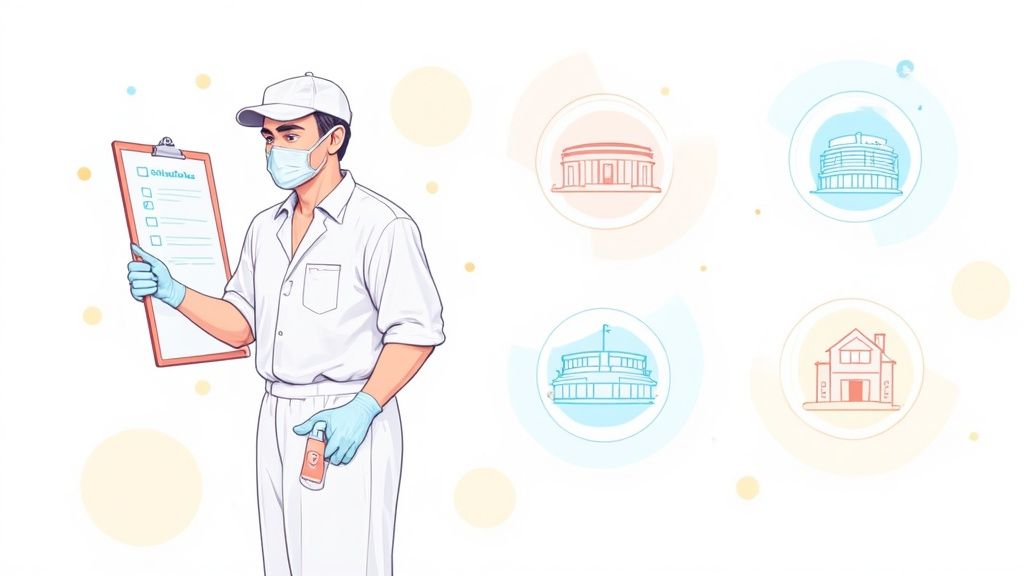
In today's competitive landscape, the definition of a well-run facility has evolved. It's no longer just about keeping the lights on and the floors swept; it's about creating environments that are efficient, safe, and visibly clean. This shift places a new emphasis on sanitation as a core business strategy, directly impacting customer trust, employee well-being, and brand reputation.
For business owners, janitorial staff, and sales professionals in the cleaning industry, understanding the return on investment (ROI) of advanced hygiene is paramount. A pristine facility isn't just a cost center; it's a powerful asset that attracts and retains customers. This is where strategic sanitation, particularly the effective use of disinfectant wipes on high-touch surfaces, becomes a non-negotiable component of modern operations. Integrating this simple tool can dramatically enhance perceived and actual cleanliness, reassuring occupants and visitors alike.
This article dives into ten essential facility management best practices, offering a comprehensive roundup of top strategies that place cleanliness and intelligent sanitation at their heart. We will move beyond generic advice to provide actionable insights, including:
- Effective Cleaning Tips: Learn how to properly use disinfectant wipes, identify critical high-touch areas, and establish efficient cleaning frequencies for different environments.
- Facility-Specific Suggestions: Discover tailored advice for offices, gyms, schools, restaurants, and retail stores.
- Sales & ROI Strategies: Uncover how to promote hygiene products like disinfectant wipes, educate clients on the value of cleanliness, and integrate sanitation into a larger service offering.
This guide provides the practical knowledge needed to elevate your operations, transforming your space into a benchmark of excellence and safety.
1. Master High-Touch Point Disinfection Protocols
The foundation of any visibly clean and healthy facility is a systematic approach to disinfecting high-touch surfaces. These surfaces, like door handles, light switches, payment keypads, and elevator buttons, are the primary vectors for germ transmission. Mastering a high-touch point disinfection protocol is one of the most critical facility management best practices, as it moves beyond simple cleaning to actively eliminate harmful pathogens.
This practice involves using EPA-registered disinfectant wipes to kill bacteria and viruses. A well-documented protocol ensures consistency across shifts and staff members, mitigates health risks, and provides powerful visual cues of cleanliness to occupants. For customers in a retail store or members at a gym, seeing staff actively wiping down surfaces builds immense trust and boosts their perception of your brand's commitment to safety.
Implementation in Your Facility
- Offices & Schools: Place disinfectant wipe dispensers in common areas like break rooms, near copiers, and in classrooms. Encourage a "wipe-in, wipe-out" policy for shared desks and equipment.
- Gyms & Fitness Centers: Make it mandatory for members to wipe down equipment before and after use. Supplement this with hourly staff wipe-downs of cardio machine consoles, free weights, and locker room handles during peak times.
- Restaurants & Retail: Implement a strict post-interaction cleaning routine. After a table turns or a customer uses the payment terminal, staff should immediately disinfect the surface. Prioritize shopping cart handles, checkout counters, and dressing room fixtures.
Sales Tip (Hygiene ROI): When selling cleaning supplies, frame this practice as proactive brand protection. A minor investment in a consistent disinfection program using quality wipes can prevent costly staff absences or a single negative online review about cleanliness that impacts thousands in potential revenue.
Actionable Tips for Success
- Cleaning Technique: Use the 'S' or 'Z' pattern when wiping surfaces. This methodical motion prevents re-contaminating areas you have already cleaned and ensures full coverage.
- Dwell Time is Crucial: For a disinfectant to be effective, the surface must remain visibly wet for the required contact time, or "dwell time," listed on the product label. This is often between 30 seconds and several minutes. Educating janitorial staff on this is key.
- Frequency Hack: For offices, disinfect shared equipment like copiers and coffee makers twice daily. In high-traffic retail stores or restaurants, prioritize entry door handles and checkout counters with hourly cleanings.
2. Energy Management and Sustainability
Effective facility management extends beyond visible cleanliness to encompass the building’s operational efficiency and environmental impact. Strategic energy management and sustainability initiatives are a core component of modern facility management best practices, directly reducing operating costs while enhancing corporate responsibility. This practice involves a systematic approach to minimizing energy consumption, lowering the carbon footprint, and optimizing resource use through smarter systems and behavioral changes.
Adopting these initiatives, as seen in landmarks like the LEED Platinum-certified Salesforce Tower, transforms facilities from cost centers into assets that reflect a brand's commitment to the future. It addresses the dual goals of financial prudence and environmental stewardship, creating healthier, more cost-effective spaces for occupants and guests.

Implementation in Your Facility
- Offices & Schools: Upgrade to smart HVAC and lighting systems that adjust based on class schedules and real-time occupancy data. Install solar panels on rooftops to generate renewable energy.
- Gyms & Fitness Centers: Use motion-activated lighting in locker rooms and less-frequented areas. Upgrade to energy-efficient cardio machines that consume less power during operation and standby modes.
- Restaurants & Retail: Transition showroom and store lighting to high-efficiency LEDs on timers. Implement a strict power-down policy for kitchen equipment and office computers at the end of each day.
Sales Tip (Hygiene ROI): Frame sustainability as an operational and brand advantage. Reducing energy waste directly boosts your client's bottom line, while publicizing their "green" initiatives—including the use of eco-friendly cleaning products—can attract environmentally conscious customers and top-tier talent.
Actionable Tips for Success
- Audit First: Before investing in major upgrades, conduct a professional energy audit to identify the most significant sources of waste. This data provides a clear roadmap for improvements.
- Track Everything: Utilize a building management system (BMS) or tools like ENERGY STAR Portfolio Manager to monitor consumption in real-time. To streamline your maintenance efforts and ensure consistency, consider using a specialized preventive maintenance schedule template.
- Engage Occupants: Launch awareness campaigns to encourage staff and guests to turn off lights, report energy waste, and participate in recycling programs. This effort pairs well with effective waste management, which you can read more about here.
3. Implement an Integrated Facility Management System (IFMS)
To elevate operations from reactive to predictive, a modern facility must centralize its data. An Integrated Facility Management System (IFMS) is a software platform that unifies all core facility operations, including maintenance requests, space allocation, asset tracking, and vendor management, into a single, cohesive dashboard. Implementing an IFMS is a crucial facility management best practice because it replaces siloed spreadsheets and disconnected processes with real-time, data-driven decision-making.
This powerful consolidation provides a single source of truth for your entire operation. For example, it can connect a work order for a broken restroom fixture to the specific asset's maintenance history, cleaning schedule, and the assigned janitorial staff member’s route. This level of integration streamlines workflows, optimizes resource allocation, and provides comprehensive visibility into operational health and spending.
Implementation in Your Facility
- Offices & Schools: Use an IFMS to manage classroom cleaning schedules, track maintenance on HVAC systems for better air quality, and allocate resources for event setups and teardowns efficiently.
- Restaurants & Retail: Track the maintenance and cleaning status of kitchen equipment or display cases. A manager can instantly see which areas are ready for customers, which are being serviced, and which are scheduled for deep cleaning, optimizing daily operations.
- Gyms & Fitness Centers: Manage equipment maintenance schedules, track member check-ins to understand space utilization, and handle janitorial work orders from a single platform. This ensures assets like treadmills receive timely service before they fail.
Sales Tip (Efficiency ROI): For cleaning industry professionals, an IFMS is a key selling point. It demonstrates a sophisticated, data-driven approach to facility hygiene, allowing you to prove the effectiveness of your services with hard data and justify investments in better cleaning protocols and products.
Actionable Tips for Success
- Start with Core Modules: Begin by implementing essential functions like work order management and asset tracking. Once your team masters these, you can expand into more complex modules like space planning or energy management.
- Prioritize Integration: Ensure the chosen IFMS platform can seamlessly integrate with your existing ERP, accounting, or HR systems. This creates a truly unified data ecosystem and prevents information silos.
- Invest in Training: A powerful system is only effective if your team knows how to use it. Allocate sufficient resources for comprehensive staff training and ongoing support to drive user adoption and maximize the platform’s value.
4. Occupant Safety and Compliance Management
Beyond visible cleanliness, a truly well-managed facility prioritizes the foundational safety and well-being of every person who enters. A comprehensive safety and compliance program is a non-negotiable facility management best practice, encompassing everything from fire safety and accessibility to emergency preparedness. It’s a systematic framework for meeting regulatory requirements like OSHA and ADA standards while proactively protecting occupant health.
This practice moves facility management from a reactive to a proactive state. Instead of just responding to incidents, you build a resilient environment designed to prevent them. A well-documented compliance program mitigates legal risk, reduces insurance premiums, and demonstrates a deep commitment to occupant welfare, which enhances brand reputation and stakeholder trust.
Implementation in Your Facility
- Offices & Schools: Develop detailed emergency evacuation plans for various scenarios (e.g., fire, security threats) and conduct regular drills with staff and students. Ensure all pathways, exits, and restrooms are fully ADA-compliant and clearly marked.
- Gyms & Fitness Centers: Implement a rigorous equipment inspection schedule to prevent mechanical failures and injuries. Maintain clear, slip-resistant pathways and ensure all staff are certified in First Aid and CPR.
- Restaurants & Retail: Enforce strict protocols in the kitchen and stockrooms to comply with OSHA standards. Ensure customer areas are free of trip hazards and meet accessibility requirements.
Sales Tip (Hygiene ROI): View compliance not as an expense, but as an investment in operational continuity. A single major safety incident or compliance fine can cost exponentially more in legal fees and reputational damage than a robust, preventative safety program that includes high standards of hygiene.
Actionable Tips for Success
- Establish a Safety Committee: Create a cross-functional team with representatives from management, maintenance, and frontline staff to review safety protocols, investigate incidents, and champion a culture of safety.
- Conduct Regular Audits: Perform routine self-audits against relevant standards like the NFPA (National Fire Protection Association) Life Safety Code or local building codes to identify and correct potential violations before they become problems.
- Document Everything: Maintain meticulous records of safety training, equipment inspections, incident reports, and compliance checks. This documentation is crucial for demonstrating due diligence and protecting your organization from liability.
5. Space Optimization and Utilization Analysis
Beyond surface-level cleanliness, a hallmark of elite facility management best practices is maximizing every square foot of physical space. Space optimization moves facility management from a cost center to a strategic asset by using data to align real estate with actual user needs. This data-driven approach analyzes how occupants interact with their environment to eliminate wasted space, reduce overhead, and boost functionality.
This practice involves deploying tools like occupancy sensors and analytics software to gather real-world utilization metrics. A clear understanding of peak usage times, underutilized areas, and popular collaboration zones allows for informed decisions about right-sizing, implementing flexible layouts, or adopting models like hot-desking. For occupants, a well-optimized space feels intuitive and supportive, directly improving their experience and productivity.
Implementation in Your Facility
- Offices & Schools: Use sensor data to analyze classroom or meeting room usage. This can inform where to place amenities, adjust cleaning schedules, or reconfigure layouts to reduce congestion and improve the user experience.
- Gyms & Fitness Centers: Track equipment usage to identify which machines are most popular and which are underutilized. This data can guide future purchasing decisions, justify removing unpopular equipment, and optimize the gym floor layout for better traffic flow.
- Restaurants & Retail: Analyze how customers move through the store or dining room. Optimizing these layouts can create a more comfortable and efficient customer journey, while also ensuring all areas meet safety codes. A critical best practice for occupant safety and compliance within facility management is to understand how to prevent electrical fires.
Sales Tip (Hygiene ROI): Frame this as maximizing return on real estate. Optimizing space can uncover savings on rent and utilities, freeing up capital for critical investments in hygiene programs—like more disinfectant wipe stations or enhanced janitorial services.
Actionable Tips for Success
- Data First: Deploy occupancy sensors or Wi-Fi analytics to gather a baseline of how your space is currently used before making any changes.
- Pilot Programs: Test new layouts or concepts like hot-desking with a single department or area first. This allows you to gather feedback and refine the approach before a full-scale rollout.
- Design for Flex: Use modular furniture and create multi-purpose areas that can easily adapt to changing needs, from large meetings to quiet focus work. This is crucial for supporting modern hybrid work models.
6. Vendor and Contractor Management
No facility operates in a vacuum; success often depends on a network of external service providers, from janitorial staff to HVAC technicians. Effective vendor and contractor management is a crucial facility management best practice that transforms these relationships from simple transactions into strategic partnerships. It ensures you receive high-quality, consistent service, control costs, and mitigate potential liabilities.
This practice involves establishing structured processes for selecting, evaluating, and overseeing all external providers. By implementing formal agreements, clear service-level agreements (SLAs), and performance metrics, you create a system of accountability. This proactive approach guarantees that specialized tasks, like deep cleaning or security, are performed to your exact standards, protecting your facility’s operations and reputation.
Implementation in Your Facility
- Offices & Schools: Maintain a network of pre-vetted vendors for large-scale needs. A primary vendor handles routine cleaning, while pre-approved secondary vendors are on standby for specialized tasks like post-event deep cleans or emergency spill response, ensuring seamless operations.
- Restaurants & Retail: Contract with a certified cleaning service that uses specific, brand-approved cleaning and disinfecting products. The SLA should mandate a detailed checklist for each cleaning, including sanitizing high-touch surfaces, ensuring a consistently premium customer experience.
- Gyms & Fitness Centers: Use a centralized vendor management platform to manage contracts for equipment maintenance, laundry services, and sanitation across multiple locations. This provides a unified view of performance, spending, and compliance.
Sales Tip (Hygiene ROI): A well-managed sanitation vendor is a direct investment in a brand's image. Enforcing strict SLAs for cleanliness and disinfection protocols—including the use of specific, high-quality disinfectant wipes—ensures that every corner of a facility reflects a commitment to health and safety, directly influencing customer trust and loyalty.
Actionable Tips for Success
- Establish Comprehensive SLAs: Your service-level agreements should include measurable key performance indicators (KPIs) for cleanliness, such as specific response times for restroom cleaning requests or required frequencies for high-touch point disinfection.
- Implement Vendor Scorecards: Regularly evaluate your providers on quality, timeliness, cost, and communication. Use this data to conduct quarterly performance reviews and foster a culture of continuous improvement.
- Verify Credentials and Insurance: Always confirm that your vendors carry adequate liability insurance and that their staff have the necessary certifications and training, especially for specialized cleaning and disinfection tasks. This protects your facility from risk.
7. Indoor Environmental quality (IEQ) and Wellness Focus
Beyond surface-level cleanliness, a focus on Indoor Environmental Quality (IEQ) represents a holistic approach to occupant health and well-being. This practice involves strategically managing factors like air quality, lighting, thermal comfort, and acoustics to create an environment that enhances productivity and satisfaction. Prioritizing IEQ is one of the most impactful facility management best practices because it directly influences how people feel, think, and perform within your space.
A comprehensive IEQ strategy moves beyond reactive maintenance to proactively cultivate a healthy building. This includes everything from advanced air filtration and circadian-rhythm-friendly lighting to ergonomic design and biophilic elements that connect occupants with nature. For patrons at a restaurant or employees in an office, a space that feels comfortable, fresh, and invigorating elevates their entire experience and reinforces the quality of your brand.
Implementation in Your Facility
- Offices & Schools: Invest in high-MERV air filters to capture fine particles and allergens, improving air quality in classrooms and common areas. Use lighting systems that mimic natural daylight to create a more welcoming and energetic atmosphere.
- Gyms & Fitness Centers: Manage humidity and ensure high rates of fresh air exchange to control odors and reduce the transmission of airborne pathogens. Incorporate living plant walls or natural materials to create a restorative, wellness-focused environment.
- Restaurants & Retail: Install noise-dampening acoustic panels in high-traffic dining rooms or lobbies to reduce stress. Provide guests with comfortable seating and adequate lighting to enhance their experience.
Sales Tip (Hygiene ROI): View IEQ investments as a direct investment in human capital and customer experience. A facility with superior air quality, achieved through better HVAC maintenance and reduced chemical odors from cleaning products, can lead to measurable gains in employee productivity and higher customer satisfaction scores.
Actionable Tips for Success
- Monitor Air Quality: Install continuous air quality monitoring systems to track key metrics like CO2, volatile organic compounds (VOCs), and particulate matter. Use this data to make informed adjustments to your HVAC system.
- Optimize Lighting: Design lighting that supports circadian rhythms, providing brighter, blue-toned light (400-600 lux) during the day and warmer, dimmer light in the evening.
- Incorporate Biophilia: Strategically place plants, use natural materials like wood and stone, and maximize views of nature. Even small additions can reduce stress and improve cognitive function.
8. Leverage Data Analytics and Performance Metrics
Moving beyond anecdotal observations to data-driven decision-making is a hallmark of modern facility management best practices. This involves systematically collecting, analyzing, and interpreting facility operations data to optimize resource allocation, justify budgets, and drive continuous improvement. By establishing Key Performance Indicators (KPIs), you can transform abstract goals into measurable outcomes.
This practice allows managers to quantify the effectiveness of their cleaning protocols, track asset performance, and predict future needs. A data-centric approach provides a clear, objective view of operations, enabling you to prove the value of hygiene initiatives and secure necessary resources. For stakeholders, seeing data that links cleaning frequency to reduced absenteeism or higher customer satisfaction scores makes the investment undeniable.
Implementation in Your Facility
- Offices & Schools: Use sensor data and analytics platforms like Tableau or Power BI to track space utilization. This helps optimize cleaning schedules based on actual occupancy patterns, focusing resources on high-traffic zones while reducing service in underused areas.
- Restaurants & Retail: Monitor restroom traffic with people counters to trigger cleaning alerts based on usage thresholds rather than fixed schedules. This ensures restrooms are consistently clean during peak times, directly improving the guest experience.
- Gyms & Fitness Centers: Track maintenance costs and uptime for critical assets like HVAC systems. Predictive analytics can forecast potential failures, allowing for proactive maintenance that prevents costly downtime and ensures a safe environment for members.
Sales Tip (Hygiene ROI): Frame data collection as a strategic intelligence tool. Tracking metrics like cleaning supply consumption (e.g., disinfectant wipes used per week) against customer satisfaction scores can directly correlate your hygiene investments with positive business outcomes, proving its value to executive leadership.
Actionable Tips for Success
- Define Clear KPIs: Establish specific, measurable goals. Examples include reducing cleaning-related complaints by 15% or increasing hand sanitizer dispenser usage by 20% in a quarter.
- Establish a Baseline: Before implementing a new protocol, collect baseline data for at least 30 days. This allows you to accurately measure the impact of your changes.
- Visualize Your Data: Use dashboards with charts and graphs to make complex data easily understandable for all stakeholders, from cleaning staff to the C-suite. This fosters transparency and alignment.
9. Technology Integration and Smart Building Systems
Moving beyond manual processes, modern facility management best practices now heavily lean on the implementation of smart building technologies. This involves integrating Internet of Things (IoT) sensors, automation, and AI-powered systems to create responsive, efficient, and connected facilities. These systems can monitor everything from HVAC performance and energy usage to occupancy levels and restroom supply needs in real-time, often with minimal human intervention.

The core benefit is a shift from reactive to predictive maintenance and operations. For instance, sensors can alert cleaning crews when a soap dispenser is low or a trash can is full, optimizing routes and ensuring a consistently high standard of cleanliness. This data-driven approach not only enhances the occupant experience but also provides valuable insights for resource allocation and operational efficiency, directly impacting the bottom line.
Implementation in Your Facility
- Restaurants & Retail: Use IoT sensors to monitor foot traffic in restrooms. This data can trigger automated alerts to janitorial staff for service based on actual usage, not a fixed schedule, ensuring high-traffic areas remain pristine.
- Offices & Schools: Implement smart lighting and HVAC systems that adjust based on real-time occupancy data, significantly reducing energy consumption in unused meeting rooms or office zones.
- Gyms & Fitness Centers: Many locations now use mobile-first systems allowing members to check in, book classes, and receive alerts, providing valuable usage data to facility managers.
Sales Tip (Hygiene ROI): Frame smart technology as an efficiency multiplier. An investment in IoT restroom sensors can reduce unnecessary staff checks by 50% or more, reallocating labor hours from simple inspections to detailed disinfection tasks in high-impact areas. This is a powerful selling point for a comprehensive cleaning contract.
Actionable Tips for Success
- Start with a Pilot: Test a new technology, like smart soap dispensers, in one specific area of your facility to measure its impact and work out any issues before a full-scale deployment.
- Prioritize Interoperability: Choose technologies built on open standards to ensure different systems (e.g., from Siemens, Johnson Controls) can communicate with each other, creating a truly integrated smart building.
- Invest in Cybersecurity: As you connect more devices to your network, a robust cybersecurity infrastructure is non-negotiable to protect facility operations and sensitive data from potential threats.
10. Implement Robust Change Management and Stakeholder Engagement
Even the most brilliant facility management initiatives can fail without buy-in from the people who use the space every day. Robust change management provides a structured approach to transition individuals, teams, and organizations from a current state to a desired future one. It’s a critical facility management best practice that ensures new protocols, technologies, or layouts are adopted smoothly rather than met with resistance.
This practice is about managing the human side of change. Whether introducing a new cleaning protocol or reconfiguring a floor plan, the goal is to communicate benefits, provide training, and address concerns proactively. Effective stakeholder engagement turns employees, tenants, and visitors from passive recipients of change into active participants, securing long-term success for your operational improvements.
Implementation in Your Facility
- Offices & Schools: When introducing new cleaning responsibilities (like wiping down personal desks), create a team of "Hygiene Champions." These are staff members who receive early training and can encourage peers, reducing pushback and speeding up adoption.
- Gyms & Fitness Centers: Transitioning to a mandatory "wipe-down-after-use" policy requires extensive communication. Use signage, email newsletters, and staff reminders to explain the importance of the new rule for everyone's health.
- Restaurants & Retail: Implementing a new digital ordering or payment process changes routines for both staff and customers. Run a phased rollout, starting with one section or location, to identify and fix issues before a company-wide launch.
Sales Tip (ROI of Adoption): Frame change management as an insurance policy on a hygiene investment. A new disinfectant wipe station is worthless if no one uses it correctly. Proper engagement ensures you realize the full health, safety, and operational benefits promised by the change.
Actionable Tips for Success
- Executive Sponsorship: Ensure senior leadership is visibly and vocally supporting the change. Their commitment signals the initiative's importance and encourages buy-in from all levels.
- Communicate Early and Often: Use multiple channels like emails, signage, and team meetings to explain the "what," "why," and "how" of the change. Transparency minimizes rumors and anxiety.
- Provide Tailored Training: Different groups have different needs. Janitorial staff require in-depth training on dwell times for new disinfectants, while office staff may only need a short tutorial on a new desk-booking system. Customize your approach.
10-Point Facility Management Comparison
| Initiative | 🔄 Implementation complexity | ⚡ Resource & time requirements | 📊 Expected outcomes | ⭐ Ideal use cases | 💡 Key advantages / tips |
|---|---|---|---|---|---|
| Preventive Maintenance Programs | Medium — process-driven, requires scheduling & training | Moderate upfront systems and staff time; CMMS recommended | Reduces failures ~35–45%; extends asset life 20–40%; lower downtime | Critical equipment sites (data centers, healthcare, large portfolios) | Implement CMMS, track MTBF, balance preventive vs reactive |
| Energy Management and Sustainability | High — infrastructure upgrades + occupant behavior change | High capital; audits, BMS, possible long payback (3–7 yrs) | Cuts energy costs ~15–30%; lowers carbon footprint; may qualify for incentives | Large campuses, corporate sustainability targets, energy-intensive buildings | Start with audits and LED retrofits; install sub‑metering and set measurable targets |
| Integrated Facility Management Systems (IFMS) | High — complex integration, data migration, phased rollouts | Significant implementation cost, training, ongoing maintenance | Boosts operational efficiency 25–40%; improves transparency & scalability | Multi-site portfolios, hospitals, enterprise offices with complex ops | Do needs assessment, phase modules, ensure ERP/IoT integration and staff training |
| Occupant Safety and Compliance Management | Medium–High — continuous vigilance and regulatory updates | Moderate ongoing investment in audits, training and documentation | Protects occupant health, reduces liability; lowers insurance/comp costs | Healthcare, public buildings, highly regulated facilities | Maintain regular audits, drills, detailed documentation and incident tracking |
| Space Optimization & Utilization Analysis | Medium — sensor deployment + cultural change | Moderate investment in sensors/analytics and change management | Reduces real estate costs 20–40%; improves flexibility and ROI on space | Organizations with high real-estate spend or hybrid work models | Pilot sensors, run employee surveys, start with modular/flexible layouts |
| Vendor & Contractor Management | Medium — process-heavy (SLAs, vetting, reviews) | Moderate administrative effort; contract systems and performance monitoring | Improves service quality/consistency; reduces costs through competition | Large portfolios, outsourced services, regulated procurement environments | Use vendor scorecards, clear SLAs, centralize contract management |
| Indoor Environmental Quality (IEQ) & Wellness | High — design upgrades and monitoring systems | High capital and ongoing monitoring/operations costs | Increases productivity 6–16%; reduces absenteeism 20–35%; boosts retention | Talent-focused companies, healthcare, campuses prioritizing wellness | Conduct baseline IEQ, install continuous monitoring, provide ergonomic controls |
| Data Analytics & Performance Metrics | Medium — data governance and tooling required | Moderate–high investment in analytics tools and skilled staff | Enables data-driven decisions, predictive maintenance, benchmarking | Portfolios seeking optimization, FM providers, strategic planning teams | Define KPIs, automate data collection, visualize dashboards and review regularly |
| Technology Integration & Smart Building Systems | High — IoT/AI integration, cybersecurity, vendor coordination | High capital and specialized skills; ongoing updates and security needs | Reduces ops costs 15–30%; enables predictive capabilities and remote management | New builds, tech campuses, sustainability-driven projects | Pilot small, prioritize interoperability/open standards and strong cybersecurity |
| Change Management & Stakeholder Engagement | Medium — people-centric, continuous communication | Moderate time and skilled change managers; training programs | Raises adoption 40–60%; reduces resistance; shortens effective rollouts | System rollouts, workspace reconfigurations, mergers and large change programs | Secure executive sponsorship, form cross-functional teams, communicate early and train |
Make Exceptional Cleanliness Your Competitive Advantage
Navigating the complexities of modern facility management requires more than a checklist. It demands a strategic approach that transforms operational necessities like cleaning into tangible business assets. As we have explored, a comprehensive strategy built on facility management best practices is the cornerstone of a safe, efficient, and welcoming environment, whether you're managing a busy office, a high-energy gym, a restaurant, or a retail store. The journey from good to exceptional begins by integrating these principles into a cohesive, data-driven system.
We've covered the critical pillars: proactive maintenance, intelligent energy management, and the unifying power of smart technology. We’ve detailed the non-negotiable importance of occupant safety, the financial wisdom of space optimization, and the art of effective vendor management. By embracing these concepts, you move beyond reactive problem-solving and begin to architect an environment defined by reliability and foresight. This proactive stance is not just about avoiding failures; it's about building a foundation of operational excellence that every stakeholder can see and feel.
From Strategy to Actionable Cleanliness
The more advanced practices, such as enhancing Indoor Environmental Quality (IEQ) and leveraging data analytics, represent the next frontier. They empower you to make smarter decisions, anticipate needs, and create spaces that actively promote wellness and productivity. Yet, within this high-tech framework lies a fundamental truth: perceived cleanliness is the ultimate metric of a well-managed space.
This is where macro-level strategy connects with micro-level action. All the smart systems in the world can be undermined by a sticky door handle or a visibly soiled surface. The simple, deliberate act of using a high-quality disinfectant wipe on a high-touch point is a microcosm of a successful facility management strategy. It is:
- Proactive: It addresses potential health risks before they become problems.
- Visible: It provides tangible, immediate assurance to occupants that their well-being is a priority.
- Effective: It directly contributes to a healthier environment by reducing the presence of pathogens.
- Efficient: It empowers staff, tenants, or even customers to participate in maintaining a clean environment.
Your Next Steps: Building a Culture of Hygiene
Translating these facility management best practices into daily operations is your ultimate goal. The path forward involves a commitment to making hygiene a shared responsibility and an integral part of your brand identity.
- Re-evaluate High-Touch Points: Go beyond the obvious. Use the detailed checklists and examples from this article to audit every interactive element in your facility, from office coffee machines and gym equipment to restaurant menus and retail payment terminals.
- Integrate and Empower: Place disinfectant wipe stations strategically to empower occupants and staff. For sales professionals, this isn't just about selling a product; it’s about providing a complete hygiene solution that boosts your clients' operational integrity and customer confidence. Educate them on the tangible return on investment that comes from a visibly clean environment.
- Communicate Your Commitment: Use signage, digital displays, and staff communication to highlight your dedication to cleanliness. When customers see your team actively wiping down surfaces or have easy access to wipes themselves, it reinforces their trust and enhances their overall experience.
Ultimately, exceptional cleanliness is no longer just a line item in an operational budget. It is a powerful competitive advantage. By mastering these facility management best practices and embedding them into your culture, you create an environment that people actively choose to be in. Prioritize cleanliness today by integrating high-quality disinfectant wipes into your daily routine or product offerings, and turn your unwavering commitment to hygiene into your most valuable asset.
Leave a Reply