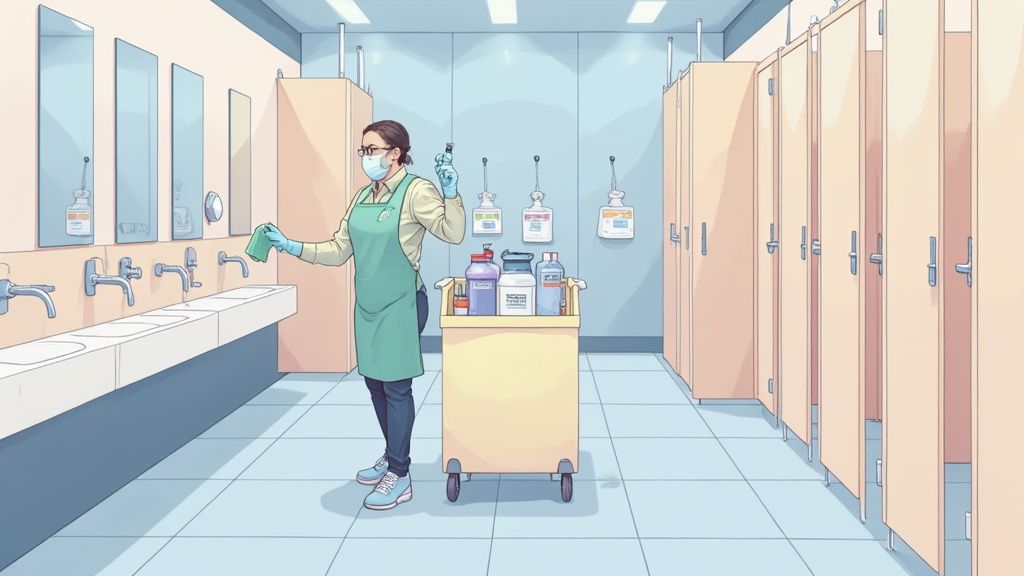
Cleaning a public bathroom effectively goes beyond just tidiness; it’s a critical strategy centered on disinfection, especially for high-touch surfaces. This requires a solid protocol and professional-grade supplies, like EPA-approved disinfectant wipes, to mitigate health risks and build customer confidence. The goal isn’t just a visually clean space, but a verifiably hygienic one. That difference directly impacts your business's reputation, customer loyalty, and ultimately, its success.
Why a Clean Restroom Is Your Best Marketing Tool

A public restroom is a direct reflection of your business. It’s often the first or last impression you leave on a customer, client, or employee. A dirty, neglected bathroom silently communicates a lack of care and attention to detail—a message people will mentally attach to your entire brand.
Conversely, a spotless restroom does more than meet basic expectations; it actively builds trust. When a visitor enters a clean, well-stocked, and fresh-smelling facility, it creates a sense of safety and respect. That positive feeling reinforces their decision to do business with you, whether they're at your restaurant, gym, or retail store.
The Undeniable Hygiene ROI
Viewing restroom maintenance as just an operational cost is a mistake. Instead, facility managers and business owners should see it as the "Hygiene ROI"—a direct investment in public health, customer loyalty, and business growth. A proactive approach to cleaning public bathrooms with the right tools, like disinfectant wipes, pays off in several key ways:
- Enhanced Brand Perception: A consistently clean facility becomes a real competitive advantage. Customers notice and remember businesses that prioritize their well-being.
- Increased Customer Loyalty: People are far more likely to return to places where they feel comfortable and safe. A pristine restroom is a subtle but powerful driver of repeat business.
- Reduced Negative Reviews: Unclean restrooms are a common reason for dreaded one-star online reviews that can tarnish a brand's reputation. Proactive cleaning stops that problem before it starts.
Bridging the Expectation Gap
Public standards for cleanliness have never been higher, but many businesses are failing to keep pace. A global survey revealed a massive disconnect: while 74% of people expect high levels of hygiene in public restrooms, only 20% of facilities actually meet that standard.
That gap is a big deal because 52% of individuals will take action after a negative restroom experience, which can directly torpedo a business's revenue and reputation.
This data highlights a clear opportunity. Facilities that not only meet but exceed sanitation standards will stand out. For sales professionals, this gap is a powerful talking point when promoting disinfectant wipes or cleaning services. It's about showing clients how a small investment in hygiene can prevent significant losses. Beyond just wiping things down, think about other factors like maintaining a hygienic environment with technologies that contribute to a positive overall impression.
The message is simple: a clean restroom isn't just a janitorial task; it’s a critical business strategy. By prioritizing hygiene, you protect your customers, strengthen your brand, and ultimately, support your bottom line.
To see what sets the best facilities apart, you can learn more about what goes into creating the cleanest public bathrooms in our detailed guide. A great first step is integrating high-quality disinfectant wipes into your daily routine or sales offerings. This simple move transforms a basic necessity into a memorable, positive experience for every single visitor.
Building Your Professional Cleaning Toolkit

You can't achieve a professional clean with a household mop and a spray bottle. Effective cleaning public bathrooms starts with preparation, and that means a well-stocked, professional-grade cleaning cart is non-negotiable. This isn’t just about working faster; it’s about hitting a verifiable standard of clean that keeps people safe and protects your reputation.
Think of your toolkit as the foundation of your entire cleaning protocol. Without the right gear, even your best-trained staff will be fighting a losing battle against germs, grime, and cross-contamination.
Core Supplies for Every Cart
Every modern cleaning cart is built around a reliable disinfectant. EPA-approved disinfectant wipes are a must-have for wiping down high-touch surfaces quickly and effectively. They offer portion control, reduce chemical waste, and are easy for any staff member to use correctly.
But wipes are just the beginning. Your cart needs a few specialized chemical workhorses:
- Glass Cleaner: Nothing says "clean" like a streak-free mirror.
- Neutral pH Floor Cleaner: This is key for cleaning floors thoroughly without damaging the grout or tile finish over time.
- Enzymatic Bowl Cleaner: This is essential. It breaks down the organic matter and uric acid crystals that cause stubborn, lingering restroom odors.
Using the right chemical for the right surface is what separates a quick wipe-down from a professional-level clean.
The Power of Color-Coded Cleaning
One of the biggest hazards in restroom cleaning is cross-contamination—transferring germs from a toilet to a sink faucet. It’s a huge risk, but there's a simple, effective fix: a color-coded microfiber system. This visual system assigns colors to specific cleaning zones:
- Red cloths and tools are strictly for high-risk zones like toilets and urinals.
- Yellow cloths are used on lower-risk surfaces like sinks, countertops, and mirrors.
- Blue cloths are usually reserved for general dusting and glass cleaning.
- Green cloths can be set aside for food service areas, ensuring restroom germs stay far away from where people eat.
Putting a system like this in place creates a powerful, intuitive barrier against spreading bacteria. Staff instantly know which tool to grab for which job, dramatically cutting down on human error.
Essential Gear and Protective Equipment
A professional toolkit goes beyond chemicals and cloths. You also need the right gear for deep cleaning and, just as importantly, for keeping your staff safe. Personal Protective Equipment (PPE) is not optional. This means high-quality, reusable rubber gloves to shield hands from chemicals and germs, plus safety goggles to protect against splashes.
Equipping your team is not just about providing supplies; it's about creating a system. From color-coded cloths to disinfectant wipes, every item should have a clear purpose that contributes to a safer, more efficient, and ultimately more hygienic cleaning process.
The right specialized tools can make all the difference. A stiff-bristled grout brush, for example, is the only way to really scrub away the grime that mops miss. A high-duster with an extendable pole lets staff safely clean vents and light fixtures, removing dust and allergens. Having tools like these on the cart elevates a standard clean to a deep, professional service.
Sanitizing High-Touch Hotspots Effectively
The real battle against germs in a public bathroom isn't won by scrubbing the toilet bowl; it's won on the dozens of small surfaces people touch without a second thought. These are the high-touch hotspots, the primary transfer points for bacteria and viruses. Mastering how to sanitize them is what separates amateurs from pros.
Think about the journey through a restroom: entry door handle, stall lock, toilet paper dispenser, flusher, faucet, and paper towel dispenser. Every contact point is a chance for germs to spread. This is why a targeted strategy using high-quality disinfectant wipes is so critical for public health.
Mastering Dwell Time for True Disinfection
The biggest mistake teams make is treating disinfectant wipes like they’re just for cleaning. A quick swipe to remove a smudge does little to kill pathogens. The secret to actual disinfection is a concept called dwell time.
Dwell time is the amount of time a surface must remain visibly wet with a disinfectant to kill the germs listed on the label. This can range from 30 seconds to 10 minutes, depending on the product.
If you wipe down a countertop and it’s dry in five seconds, you haven’t disinfected it. You’ve just moved germs around. Achieving the correct dwell time is the only way to make a surface hygienically safe, not just visually clean.
To get it right every time:
- Use enough wipes. One wipe won’t cut it for a large surface. Use enough to leave the area glistening wet.
- Read the label. Every disinfectant is different. Know the specific dwell time your product requires.
- Let it air dry. Wiping it dry early neutralizes the disinfectant’s power.
This isn’t just a suggestion; it’s non-negotiable for critical spots like the baby changing station in a department store or the faucet handles in a busy restaurant bathroom.
Identifying the Most Common Hotspots
Toilets and sinks are obvious, but a professional cleaning plan digs deeper. Your checklist needs to prioritize the less obvious surfaces that get touched constantly, especially in high-traffic facilities like a school or gym.
A smart workflow prevents cross-contamination. Always clean from the cleanest areas (mirrors, countertops) to the dirtiest (toilets, flushers). This prevents dragging germs from a high-risk zone back over to a "clean" one.
High-Touch Hotspot Cleaning Frequency
The right cleaning schedule depends entirely on foot traffic. A small office restroom has different needs than one at a bustling airport. Use this table as a starting point to build a custom plan.
| Surface / Hotspot | Low-Traffic Facility (e.g., small office) | Medium-Traffic Facility (e.g., restaurant, retail) | High-Traffic Facility (e.g., gym, school) |
|---|---|---|---|
| Door Handles (entry & stall) | At least 2-3 times daily | Every 1-2 hours during peak times | Hourly or more frequently |
| Faucet & Soap Dispensers | At least 2-3 times daily | Every 1-2 hours | Hourly |
| Toilet Flushers & Stall Locks | At least 2-3 times daily | Every 1-2 hours | Hourly |
| Countertops | Once daily | Every 2-4 hours | Every 1-2 hours |
| Baby Changing Stations | After each known use / 2-3 times daily | Every 1-2 hours | Hourly |
| Paper Towel/Hand Dryer Controls | Once daily | Every 2-4 hours | Every 1-2 hours |
Remember, these are minimums. The real goal is to clean surfaces before they ever look dirty. If you can see grime, you're already behind.
Sales Tips and Facility-Specific Advice
When talking to clients, educating them about these hotspots is a game-changer. You’re not just selling disinfectant wipes; you’re selling a risk reduction strategy. Frame the conversation around their "Hygiene ROI."
- For a Gym Owner: Highlight how sweat and bacteria travel from workout equipment to locker handles and restroom stalls. Frequent, visible wipe-downs are an investment in member health and retention.
- For a Restaurant Manager: Connect restroom cleanliness to perceptions of kitchen hygiene. A spotless restroom, including door handles and baby changing stations, sends a powerful message: "We care about hygiene everywhere."
Shift the conversation from, "How much do the wipes cost?" to, "How much does a bad review or a sick employee cost?" A high-frequency cleaning routine focused on these hotspots becomes a powerful tool that protects health and builds a stronger business reputation.
A Top-to-Bottom Restroom Cleaning Protocol
Consistency is the key to professional-level public bathroom cleaning. A random approach leads to missed spots and uneven results. A systematic, top-to-bottom workflow ensures every surface is addressed in a logical order, preventing cross-contamination and saving time. This repeatable process is the bedrock of a hygienic space.
Before you start, post "Wet Floor" signs at every entrance. This is non-negotiable for safety. Once the area is secure, empty all trash cans and sweep up loose debris from the floor to prevent dust from resettling on clean surfaces.
From High Vents to Gleaming Mirrors
The real cleaning starts at the highest point. Dust high vents, light fixtures, and the tops of partitions first. This ensures any falling debris lands on surfaces that haven't been cleaned yet. Working from the top down is a core principle that saves you from redoing work.
Next, tackle mirrors and glass with a quality, streak-free glass cleaner and a fresh microfiber cloth. After the mirrors, move on to the countertops and sinks.
- Sinks and Faucets: Spray disinfectant generously, focusing on faucet handles, soap dispensers, and the drain area.
- Countertops: Use disinfectant wipes or a spray-and-wipe method. Remember to let the disinfectant sit for the proper dwell time to kill germs.
- Restocking: Before moving on, refill all soap dispensers, paper towel holders, and other amenities.
This sequence creates a clear workflow for the top half of the restroom, preparing you for the highest-risk areas next.
Sanitizing Toilets and Partitions
The toilet area demands meticulous attention. This zone is a breeding ground for bacteria and requires a dedicated set of tools—ideally color-coded red—to stop cross-contamination. Start by applying an enzymatic bowl cleaner and letting it sit while you clean the exterior.
Use disinfectant wipes or a designated cloth to sanitize every part of the toilet's exterior: the flusher, tank, seat (both sides), lid, and base. Once the outside is clean, scrub the inside of the bowl and flush. For a deeper dive into stall-specific challenges, check out our guide on maintaining public restroom stalls. Don't forget to wipe down the partitions, stall doors, and locks—these are some of the most frequently touched surfaces.
A simple three-step process for using disinfectant wipes is a great visual reminder for staff training.
This visual drives home that true disinfection is a process. That "Wait" step is the most critical and the one most often skipped.
The Floors and Final Inspection
The last major task is the floor. Since you already swept it, the floor is ready for mopping. Start at the farthest corner and work your way toward the door, ensuring you get behind toilets and under sinks. This method prevents you from walking over freshly mopped areas.
Every solid cleaning protocol needs a precise final step in cleaning and sanitizing to eliminate pathogens. In practice, this means doing a final walkthrough after the floor is dry.
A final inspection isn't optional—it's your quality control. Look for any missed spots, double-check that all dispensers are full, and ensure the room smells fresh and clean. This last check separates an adequate job from an exceptional one.
By following this systematic protocol, you build a repeatable system that guarantees a high standard of hygiene every time. It turns a routine chore into a professional process that protects public health and boosts your facility’s reputation.
Selling the Value of Superior Hygiene
Convincing a business owner to invest more in cleaning can be challenging. Too often, hygiene is seen as a cost to be minimized, not a strategic investment. To connect, you must shift the conversation from price to value and demonstrate how a cleaner facility directly impacts their bottom line.
This means you’re not just selling disinfectant wipes or janitorial hours. You’re selling risk mitigation, a stronger brand reputation, and a tangible return on investment.
It All Comes Down to ROI
First, connect cleanliness to cash flow. A visibly clean public bathroom is one of your client's most powerful marketing tools. It sends a clear message that the business cares about their health, which builds trust and encourages repeat business.
When talking to a potential client, use talking points that hit their specific industry needs.
- For a Restaurant Owner: "Did you know a dirty restroom makes 60% of customers question the safety of your kitchen? We ensure your front-of-house hygiene reinforces your high standards, protecting your reputation with every guest."
- For a Gym Manager: "In a gym, stopping the spread of germs is everything. Using EPA-approved disinfectant wipes on high-touch surfaces actively protects your members and shows you take their health seriously."
- For a Retail Store: "A great restroom experience keeps people in your store longer. A quick, visible wipe-down of handles and counters shows you're on top of things, making shoppers feel comfortable enough to stick around."
This reframes the cost of better supplies from an expense into an investment in customer loyalty.
It’s Not Just Clean, It’s Risk Mitigation
Top-tier hygiene is also a core part of managing risk. For places like schools and offices, preventing the spread of illness is a major operational concern. Position disinfectant wipes as a key part of a proactive health strategy. Explain how a consistent cleaning schedule reduces employee sick days, minimizes the risk of a reputation-damaging outbreak, and creates a healthier environment.
Bundling disinfectant wipes into a larger service contract or supply package moves the focus away from a single product's cost. Instead, you're offering a comprehensive hygiene solution. You're no longer just a vendor; you're a partner in their success.
The market backs this up. The global bathroom cleaning service market was valued at $39.25 billion and is growing, driven by a spike in hygiene awareness. Businesses are ready to invest in professional solutions. You can find more market trends and analysis on professional cleaning solutions.
Different Facilities, Different Pitches
The "why" behind superior hygiene isn't one-size-fits-all. A school principal cares about different things than a hotel manager. Tailor your pitch accordingly.
| Facility Type | Primary Concern | Key Talking Point |
|---|---|---|
| Schools | Student & Staff Health | "Consistent disinfection of hotspots like door handles and desks reduces absenteeism, keeping more students in the classroom and staff on the job." |
| Offices | Employee Productivity | "A healthier workplace means fewer sick days. Our program helps you maintain a productive environment and shows your team you value their well-being." |
| Hotels | Guest Experience & Reviews | "Five-star reviews almost always mention cleanliness. We help ensure your restrooms exceed guest expectations, preventing negative feedback and boosting your online reputation." |
Ultimately, selling hygiene is about selling peace of mind. Help clients see disinfectant wipes not as a line item, but as an essential tool for building a safer, more reputable, and more profitable business. Prioritize cleanliness, and the results will speak for themselves.
Don't let a preventable issue tarnish your reputation. Elevate your standard of clean by integrating high-quality disinfectant wipes into your daily routine or product offerings. A commitment to hygiene is a commitment to your customers, your employees, and your business's future.
Leave a Reply