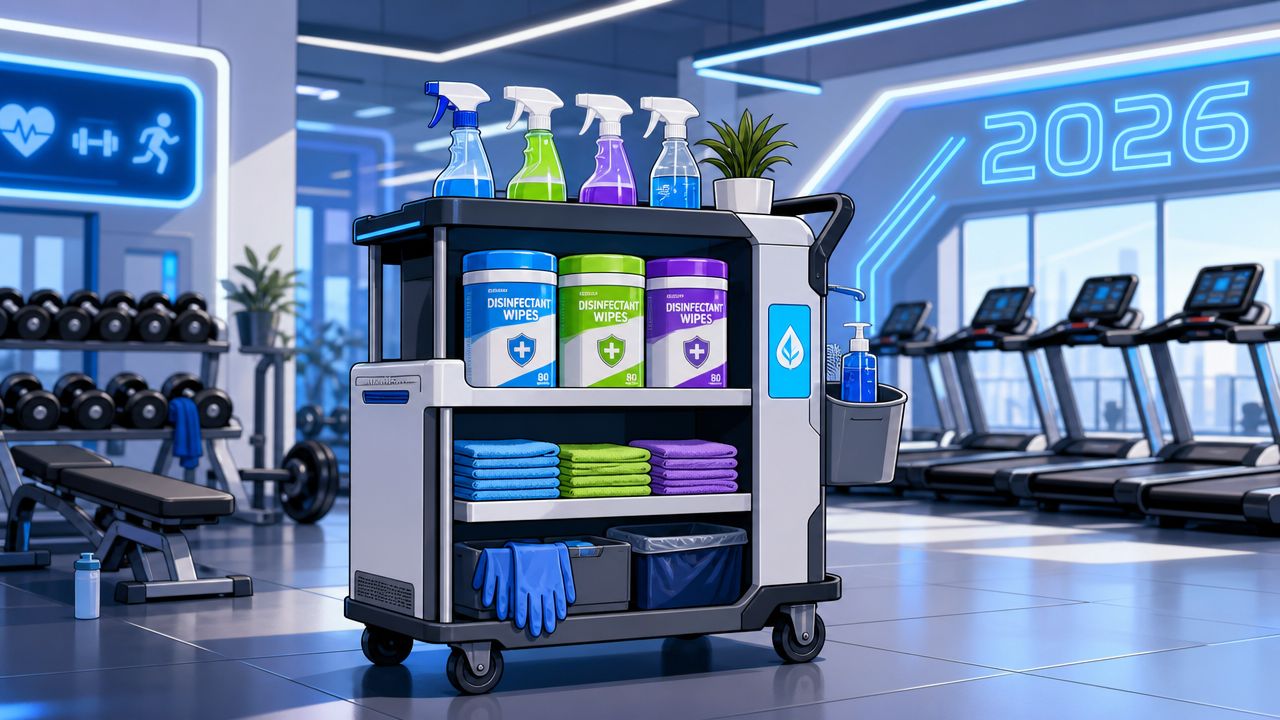
A lot of gym owners think members join because of equipment quality, class variety, or price. Those things matter. But the first trust test usually happens before a prospect touches a treadmill.
They notice the front desk, the smell near the entrance, the condition of the locker room hallway, and whether cleaning supplies are visible and stocked. If a wipe station is empty or a check-in counter feels sticky, the message is simple: if the basics are being missed, what else is being missed?
That's why fitness center cleaning supplies shouldn't be treated as a back-room purchasing task. They're part of operations, risk control, member confidence, and brand positioning. The strongest facilities don't just buy wipes, sprays, gloves, and floor care products. They build a system that makes cleanliness visible, repeatable, and easy for both staff and members to follow.
Beyond the Basics Why Strategic Cleaning Builds Your Brand
A prospective member can forgive an older cable machine. They won't easily forget a dirty entrance, a smudged touchscreen, or an empty sanitizer dispenser.
That reaction is rational. People associate visible cleanliness with professionalism, safety, and consistency. In a fitness environment, where members share benches, mats, dumbbells, touchscreens, lockers, and restrooms, every cleaning choice becomes part of the customer experience.

Cleanliness signals management quality
Members rarely say, “I'm staying because your disinfectant program is well structured.” They show it another way. They renew. They recommend the club. They stop worrying that the facility is cutting corners.
That's one reason the category keeps expanding. The global market for cleaning chemicals in fitness facilities is projected to grow from USD 1.0 billion in 2026 to USD 1.8 billion by 2036 at a 5.8% CAGR, and equipment surface disinfectants hold the largest product share at 36%, according to Future Market Insights' fitness facility cleaning chemicals report. That isn't the profile of a temporary expense. It's the profile of a permanent operating priority.
Practical rule: If members can't see your cleaning system, many of them will assume you don't have one.
Owners also miss how closely cleanliness and environmental comfort work together. Odor control, dust management, and airflow shape perceived cleanliness just as much as shiny floors do. If your facility struggles with stale air in studios or locker-adjacent corridors, resources on Orlando indoor air quality are useful because air handling directly affects how clean the space feels to members.
Why supply decisions affect revenue
A cleaning supply budget isn't just about buying enough product to get through the week. It's about protecting the moments that drive retention:
- First visits matter because prospects form opinions fast.
- Peak-hour experience matters because crowded conditions amplify every hygiene problem.
- Locker room confidence matters because members often judge the whole brand by the most sensitive spaces.
- Equipment presentation matters because high-touch surfaces are where trust breaks down first.
When gym owners reduce supply decisions to “find the cheapest wipes,” they usually create hidden costs. Staff improvise. Members skip wipe-downs. Equipment gets cleaned with the wrong product. Stations run empty at rush hour.
The better approach is simple. Treat fitness center cleaning supplies as a visible service layer that supports sales, retention, and reputation.
Develop Your Fitness Center Cleaning Blueprint
Before you buy another case of wipes or change chemical vendors, map the building. Most supply waste happens because facilities order by habit instead of by zone, surface, and traffic pattern.
A usable cleaning blueprint starts with an audit. Walk the club the way a new member would. Then walk it again the way a closing supervisor would. Those are usually two very different experiences.
Map the facility by risk and material
Break the building into operational zones, not just rooms. A cardio deck has a different cleaning profile than a stretching area, and a shower entrance behaves differently than a dry locker aisle.
Use a simple audit list like this:
- Identify traffic intensity. Mark which areas stay busy all day, which spike before and after work, and which only need scheduled service.
- List high-touch points. Handles, pins, rails, benches, tabletops, dispensers, and touchscreens should be named specifically.
- Note surface materials. Vinyl, rubber, chrome, painted metal, glass, tile, stone, laminate, and electronics all need different handling.
- Flag moisture and odor zones. Locker rooms, showers, sauna-adjacent corridors, and bottle-fill stations need different supply support than dry spaces.
- Assign ownership. Decide what members handle, what floor staff handles, and what janitorial staff handles.
Many programs fail in this way. They buy one “gym-safe” product and expect it to do everything.
Build around compatibility, not just kill claims
Facility operators have to balance strong cleaning with equipment safety. Guidance for fitness centers warns against spraying cleaner directly on treadmill belts because it can create slipperiness and safety hazards, and against direct application on touchscreens because it can damage electronics. A surface-specific plan matters, as noted in Americhem's guidance for fitness centers.
That trade-off changes what belongs in your supply closet. You need products and tools matched to use cases, including:
- Member-facing disinfectant supplies for quick post-use wipe-downs
- Staff-applied cleaners for deeper routine cleaning
- Microfiber cloths for controlled application on sensitive equipment
- Floor care products chosen by flooring type and residue risk
- Restroom and locker room chemistry built for moisture, odor, and soil load
- PPE and disposal supplies so staff can follow protocols consistently
A stronger cleaning program usually starts with fewer wrong products, not more products.
Textiles deserve a place in the blueprint too. Towels, mop heads, microfiber, and reusable cleaning cloths can undermine the whole system if they aren't processed reliably. Facilities that outsource part of that workflow often benefit from reviewing commercial laundry options, especially when towel service or high-volume cloth rotation is creating operational drag.
A simple blueprint that works in the real world
A good blueprint answers three questions for every zone:
| Zone question | What you need to define | Business result |
|---|---|---|
| What gets touched most | Specific surfaces and traffic windows | Better member confidence |
| What can be damaged | Electronics, belts, finishes, upholstery | Lower repair risk |
| Who cleans it and when | Member, attendant, porter, night crew | Fewer missed tasks |
Once those answers are clear, purchasing gets easier. You stop buying generic inventory and start building a cleaning system that protects both hygiene standards and expensive assets.
A Zone-by-Zone Checklist for Gym Cleaning Supplies
Once the blueprint is done, stocking gets much easier. You're no longer asking, “What supplies should we keep on hand?” You're asking, “What does each zone need to stay member-ready all day?”
That shift matters because a front desk doesn't need the same kit as a cardio aisle, and a mat studio shouldn't be stocked like a shower area.

The core checklist by zone
The table below keeps the supply conversation practical.
| Zone | Primary Supplies | Key Focus |
|---|---|---|
| Lobby and reception | Disinfectant wipes, glass cleaner, floor cleaner, hand sanitizer, paper towels | First impression and visible touchpoint care |
| Cardio zone | Equipment-safe disinfectant, microfiber cloths, wipe dispensers, sanitizer stands, trash liners | High-touch consoles, rails, handles, and quick turnover |
| Weight area | Surface disinfectant, wipes, degreaser for appropriate surfaces, microfiber, mop system | Benches, dumbbells, bars, racks, and chalk or sweat residue |
| Studio spaces | Mat cleaner or wipes, floor product, microfiber, storage bin cleaning supplies | Shared accessories, mats, mirrors, and between-class resets |
| Restrooms and locker rooms | Restroom cleaner, disinfectant, grout or tile care supplies, odor control, gloves | Moisture, odor, fixtures, drains, and member perception |
| Staff and office areas | All-purpose cleaner, dusting supplies, disinfectant wipes | Shared desks, break surfaces, and internal hygiene discipline |
What to stock where
In the lobby and reception area, the mission is visual confidence. Keep wipes near check-in hardware, front-desk counters, door hardware, and seating. This isn't where you want overspray, messy bottles, or half-used cloths visible to incoming prospects.
In the cardio zone, speed and control matter more than brute-force chemistry. Professionals recommend spraying cleaner onto a microfiber cloth rather than directly onto the machine. That helps prevent damage to touchscreens and avoids making treadmill belts slippery. It also helps to work from the top of the machine down so debris doesn't fall back onto cleaned areas, as shown in this equipment-cleaning demonstration video.
For the strength area, the supply mix needs to match the actual mess. Benches, rack touch points, dumbbells, kettlebells, and adjustment handles need easy-access disinfecting supplies. Bars often need more specific care than people realize. If your staff needs a practical maintenance reference, this guide on how to clean your barbell is worth sharing with the team.
Don't forget the non-obvious zones
Some of the most important fitness center cleaning supplies aren't used on the workout floor at all.
- Locker room support items include odor control products, drain-area tools, gloves, and enough paper goods to prevent visible stockouts.
- Studios need quick-turn supplies that instructors or attendants can grab between classes without breaking rhythm.
- Office and back-of-house areas need their own cleaning kit so staff spaces don't become the least disciplined part of the building.
If members see discipline in the hidden spaces, they trust the visible spaces more.
A lot of operators also benefit from keeping one standardized checklist for opening, mid-shift, and close. If you need a broader operational reference, this fitness center cleaning checklist is a useful way to align supply placement with actual recurring tasks.
Efficiency habits that save equipment and labor
Use these habits consistently:
- Apply product to the cloth first when cleaning sensitive equipment, especially consoles and control panels.
- Replace cloths when they're soiled so staff don't spread residue from machine to machine.
- Separate member-use supplies from staff-use supplies so your attendants aren't left empty-handed during rush periods.
- Stock by zone, not by closet. A full storeroom doesn't help when the wipe canister on the strength floor is empty.
The best stocked facility isn't the one with the most products. It's the one where the right product is within reach at the moment someone needs it.
Stocking and Deploying Supplies for Maximum Impact
Buying supplies in bulk doesn't guarantee a clean gym. Deployment does.
Many facilities have enough product on site but still struggle with member complaints and uneven hygiene because the supplies are in the wrong place, the dispensers run empty, or staff treat inventory as a storage issue instead of a behavior issue.

Set par levels by zone
Every club should know the minimum on-hand amount for its critical consumables. That includes wipes, sanitizer, gloves, paper products, trash liners, and the staff-applied chemicals that support daily resets.
A simple method works well:
- Start with usage observation over normal operating weeks
- Track rush-hour depletion points instead of just end-of-day totals
- Set reorder triggers before member-facing stations hit empty
- Store backup stock near the point of use when possible
The biggest mistake is centralizing everything in one janitor closet. That creates delay, and delay kills compliance.
Placement changes behavior
A peer-reviewed study found that making cleaning materials available wasn't enough. The highest post-use cleaning levels, 53%, were achieved when facilities combined easy access to cleaning materials with prompts and signage, according to this peer-reviewed gym cleaning behavior study.
That finding matches what operators see on the floor. If wipes are hard to find, members skip them. If signage is vague, they assume the staff will handle it. If the station is obvious, stocked, and placed where the decision happens, compliance goes up.
Don't place cleaning supplies where they're convenient for storage. Place them where members decide whether to clean.
That usually means putting stations at equipment transitions, near exits from turf or studio areas, beside clusters of high-touch strength equipment, and at the edges of cardio rows.
What smart deployment looks like
Wipes often outperform spray-only setups in busy public areas. They're fast, portable, easy to understand, and less likely to create overapplication on sensitive equipment.
For a member-facing station, a strong setup includes:
- Disinfectant wipes in a dispenser that's easy to open and easy to monitor
- Clear prompts that tell members what to wipe and when
- Nearby trash access so used materials don't end up on cup holders or floors
- Backup product within quick reach for staff refills
Because this article calls for a direct recommendation, it's worth saying plainly: we recommend Wipes.com Disinfectant Wipes for facilities that want a commercial-ready wipe option that fits into a visible sanitation program.
If you're refining station placement or dispenser choices, this guide to a gym wipe dispenser can help translate inventory decisions into cleaner member behavior.
The operational lesson is straightforward. Cleaning supplies create value only when people use them, and people use them when access is obvious and friction is low.
Training Staff and Members on Proper Hygiene Protocols
Even the best supply program breaks down without training. A shelf full of quality products won't protect member confidence if attendants rush the process or members don't understand what's expected of them.
That's especially important in gyms because user behavior is inconsistent. A survey of 13,000 people reported by Garage Gym Reviews found that 64% said they “barely ever” clean gym equipment, and only 7% cleaned after every workout, according to this survey summary on gym cleaning habits. That gap explains why staff training and member education have to work together.

Train staff on the full workflow
A common failure in gym cleaning is stopping at “wipe it down.” That isn't a protocol. It's a vague instruction.
A rigorous workflow includes cleaning the surface before disinfecting, wearing PPE where appropriate, keeping the disinfectant wet for the full label contact time, and using one-direction wipe strokes to reduce recontamination. NASM also notes that skipping the wet contact time is a common failure point, as outlined in NASM's gym cleaning guidance.
Staff training should cover:
- Sequence so employees clean first, then disinfect correctly
- Application method so they don't oversaturate electronics or leave slip hazards
- Contact time discipline so product labels are followed
- Wipe technique so contamination isn't spread back across the surface
- Documentation so supervisors can verify completion in high-touch zones
Teach members what “good hygiene” looks like
Members usually won't read a long policy sign. They will respond to short, visible prompts that appear where action should happen.
Good member education uses:
- Simple wording on or near equipment
- Visible supplies within immediate reach
- Positive reminders from staff during floor walks
- Consistent reinforcement in classes, onboarding, and facility etiquette
Cleanliness culture is built through repetition. Members copy what they see your staff doing every day.
Many facilities overcomplicate the message. “Please sanitize all equipment and shared accessories after use” is less effective than “Wipe handles, seat, and touchscreen after use.”
Make training observable
If a manager can't tell whether the protocol was followed, the protocol is too loose.
Use short competency checks. Watch an attendant clean a treadmill. Watch another reset a bench area. Check whether they know where backup supplies are kept, how to handle full trash at wipe stations, and when to swap out soiled cloths.
Member behavior improves when staff behavior is consistent, visible, and calm. That culture is what turns fitness center cleaning supplies into an actual operating system instead of a box-checking exercise.
Transforming Cleanliness into Your Competitive Advantage
A clean gym doesn't happen because you ordered enough product. It happens because the facility has a system.
That system starts with a blueprint. It gets stronger when each zone has the right supplies, when stations are placed where members will use them, and when staff follow a repeatable workflow instead of improvising. The difference shows up in trust. Members feel it when the front desk is clean, the cardio floor is orderly, the wipe station is stocked, and the locker room smells maintained instead of masked.
For owners, that means cleanliness is tied directly to retention and reputation. For janitorial teams, it means fewer shortcuts and less confusion. For cleaning sales professionals, it changes the conversation from product price to operational value. The most useful sale isn't “buy more wipes.” It's “build a visible, repeatable hygiene program that protects the member experience.”
A rigorous workflow matters here. Staff need to wear PPE when appropriate, clean surfaces before disinfecting, keep disinfectants wet for the full label contact time, and use one-direction wipe strokes to reduce recontamination. Those details are what separate a credible cleaning program from a cosmetic one.
If you run or support a fitness facility, prioritize the system, not just the shopping list. Audit your zones. Tighten your training. Put supplies where behavior happens. Keep disinfectant wipes visible and easy to use. And if you want more practical guidance on turning sanitation into a business asset, explore additional resources from WipesBlog.com.
Leave a Reply