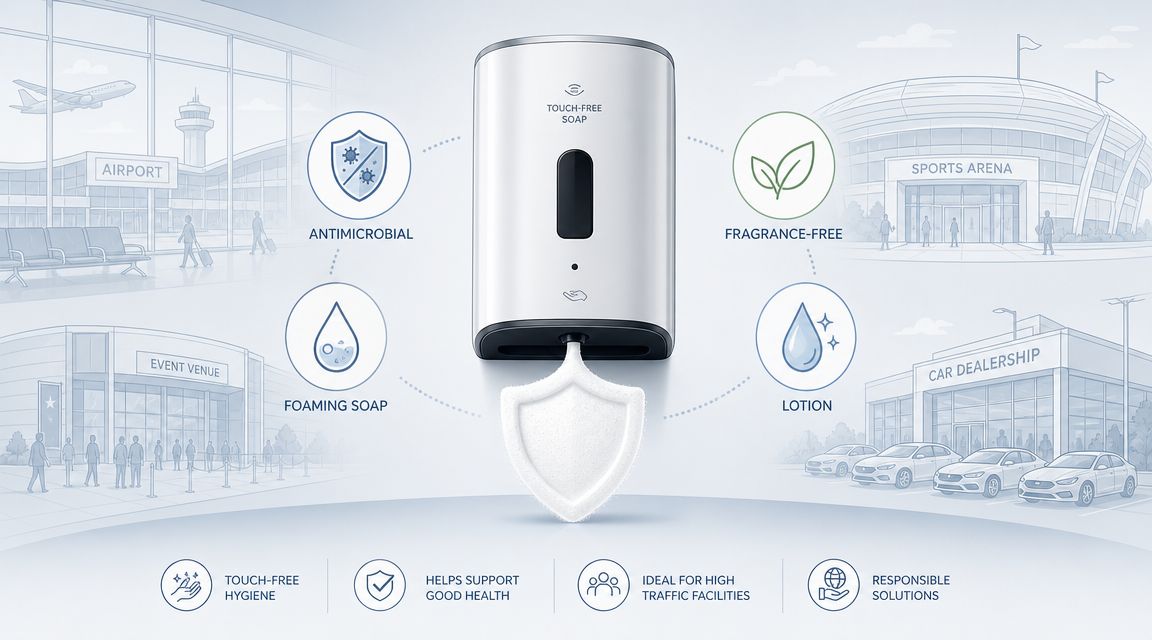
A lot of facilities get this wrong in a very ordinary way. They invest in polished floors, clean glass, fresh paint, and better lighting, then hand visitors a cheap, irritating soap through a dispenser that clogs, drips, or runs empty halfway through the day.
That single touchpoint carries more weight than most buyers admit. People judge cleanliness by what they can feel. If the soap feels harsh, the dispenser looks neglected, or the sink area is messy, the whole building suddenly feels less controlled. In a gym, that hurts confidence. In a restaurant, it raises doubts. In an office, it undercuts the message that the company is professional and well run.
A strong hygiene program needs two things working together. First, people need a handwashing setup they'll use. Second, staff need a fast, visible way to keep high-touch surfaces under control with disinfectant wipes. Commercial hand soaps sit at the center of that system because they affect user comfort, refill labor, dispenser reliability, and the overall impression your facility leaves behind.
Beyond the Basics Why Hand Soap is a Strategic Asset
The easiest mistake is treating soap like a commodity. Procurement buys whatever fits the dispenser, custodial staff refill it when they can, and nobody thinks about it again unless complaints start.
That approach ignores how much the category has changed. The global liquid hand soap market is projected at USD 9.6 billion in 2026 and expected to reach USD 16.4 billion by 2035, according to Global Market Insights. That isn't the profile of a throwaway supply item. It reflects a product class that facilities now rely on as part of visible, everyday risk management.
The restroom doesn't just serve hygiene
It also communicates standards.
When guests walk into a spotless restroom and get a weak, watery product from a sticky dispenser, they notice. When staff wash their hands repeatedly with a formula that leaves skin tight and irritated, they notice that too. Over time, that affects compliance, complaints, and the amount of effort your team spends fixing avoidable problems.
Here's where commercial hand soaps become strategic:
- Brand perception: Premium environments need hand soap that feels consistent with the rest of the space.
- Operational control: The right soap-dispener match reduces drips, clogs, emergency refills, and sink-area mess.
- Staff adoption: If employees hate the product, they use less of it or avoid washing as often as they should.
- Public trust: In customer-facing spaces, visible hygiene standards influence how safe and well managed the facility feels.
Clean floors impress people. Clean hands reassure them.
Soap and wipes solve different problems
Soap handles hand hygiene. Disinfectant wipes handle the surfaces people touch between formal cleaning rounds. That distinction matters in airports, gyms, retail counters, school reception desks, and shared office kitchens.
A complete program usually includes:
| Hygiene task | Best tool | Why it matters |
|---|---|---|
| Handwashing at sinks | Commercial hand soap | Supports routine hand hygiene and user comfort |
| Quick cleaning of high-touch surfaces | Disinfectant wipes | Helps staff respond fast between scheduled cleanings |
| Guest-facing sanitation stations | Soap plus wipes | Signals visible control and preparedness |
If you manage public or commercial space, don't buy hand soap as if it's just another refill. Buy it the way you'd buy any frontline operating asset. It shapes experience, influences behavior, and protects the reputation you've already spent money building.
Decoding Commercial Soap Formulations
The label on a soap jug doesn't tell you much unless you know what job the formula is supposed to do. In practice, most commercial hand soaps are a balance of cleaning agents, thickness control, and skin comfort.
A typical liquid hand-wash formulation uses surfactants such as SLES and SLS for cleaning and foam, common salt (NaCl) to build viscosity, and citric acid to bring the pH to about 6 to 6.5, as described in this hand-wash formulation reference. That chemistry matters because it determines whether the soap cleans effectively, feels acceptable during repeated use, and moves properly through the dispenser.

Four common formulations and where they work
Antimicrobial soap fits environments where hygiene expectations are high and users want visible reassurance. Healthcare-adjacent spaces, locker rooms, and busy sports facilities often prefer this category because the positioning is clear and easy for staff and guests to understand.
Foaming soap is usually the right fit when speed, neatness, and consistent user experience matter more than heavy soil removal. It spreads quickly, looks clean at the sink, and tends to feel intuitive in public restrooms where people don't want to spend extra time building a lather.
Lotion soap earns its place in settings with frequent handwashing. Employee restrooms, staff breakrooms, front desks, and dealership service areas all benefit when the product is more comfortable to use throughout the day. If hands feel dry after every wash, people rush or skip. That's an operations problem, not a cosmetic one.
Heavy-duty soap belongs in industrial and back-of-house environments where people are dealing with grease, grime, or stubborn residue. It's usually the wrong choice for a polished public restroom because the user experience can feel harsher than the setting requires.
What the chemistry means in practice
Surfactants do the cleaning. Salt changes body and flow. Citric acid adjusts skin feel through pH. Those aren't abstract formulation notes. They decide whether a soap feels thin, rich, slippery, harsh, or balanced.
Use this as a quick selection filter:
- Choose foaming when you want easier spread and a cleaner sink presentation.
- Choose lotion-style liquid soap when repeat use by staff is the main concern.
- Choose fragrance-free when sensitivity complaints are likely or the environment needs a neutral profile.
- Choose heavy-duty only when hand soil justifies it.
Field note: The best soap isn't the strongest formula on paper. It's the one people will use correctly, repeatedly, without fighting the product.
A good facility manager also looks beyond the restroom category itself. If you're evaluating how detergents, surfactants, and soap behavior affect cleaning performance in other building maintenance tasks, these Sparkle Tech window cleaning tips offer a useful parallel on how formulation choice changes results.
Fragrance-free deserves more attention
Many buyers focus on scent because they want the restroom to feel fresh. But in practice, scent can become the wrong kind of signal if it clashes with the setting or irritates frequent users.
Fragrance-free soap makes sense when:
- You serve mixed audiences: Schools, clinics, and offices all see a wide range of sensitivities.
- You already use scented products nearby: Air care, disinfectant wipes, and cleaning chemicals can stack sensory load fast.
- You want a cleaner brand impression: Neutral products often feel more modern and less “institutional.”
When commercial hand soaps are matched to the actual use case, compliance improves and complaints drop. When they aren't, even a high-quality building can feel neglected at the sink.
Dispenser Systems and Operational Compatibility
A good soap can fail in a bad dispenser. That's one of the most common reasons facilities end up with drips on the counter, wasted product, and staff constantly responding to minor restroom issues.
Soap performance depends on physical properties, not marketing language. One commercial antibacterial hand soap lists a pH of 5.5 to 6.5, specific gravity of 1.020 to 1.030 at 25 °C, and viscosity below 5,800 cPs, with water solubility and nonflammable labeling in its published product specifications. Those specs affect whether the product pumps cleanly, drips after dispensing, or struggles inside the hardware.

Bulk-fill and cartridge systems solve different problems
The first decision is the refill method. Buyers often frame it as a cost question, but it's really a labor and risk question.
| System | Strength | Weakness | Best fit |
|---|---|---|---|
| Bulk-fill top-up | Familiar and simple | Higher chance of messy refills and inconsistent upkeep | Budget-driven, lower-complexity sites |
| Sealed cartridge | Cleaner changeout and controlled product pairing | Less flexibility across brands and dispenser models | High-traffic or image-sensitive facilities |
Bulk-fill systems can work, but they require discipline. Staff need clean refill practices, consistent schedules, and attention to residue around the dispenser head and reservoir. Cartridge systems simplify that process by giving the team a closed, matched refill.
Manual and touch-free affect user trust
The second decision is activation. Manual pumps are simple and serviceable. Touch-free units create a more modern hygiene impression and reduce another contact point in the handwashing sequence.
Here's the practical trade-off:
- Manual dispensers are straightforward, easier to troubleshoot, and often cheaper to replace.
- Touch-free dispensers improve perceived cleanliness and can encourage use in public-facing spaces.
- Battery-powered systems need consistent maintenance discipline or they fail at the worst possible moment.
- Poor sensor calibration frustrates users fast. If people wave twice and get nothing, confidence drops immediately.
If users have to fight the dispenser, they stop trusting the whole hygiene program.
Match the soap to the hardware
This is where many rollout plans break down. A thicker lotion soap may feel excellent in the hand but perform poorly in a dispenser designed for thinner liquid. A foaming refill won't work in standard liquid hardware. Even pH and viscosity influence buildup patterns and cleaning frequency over time.
For teams planning upgrades, this commercial hand soap dispenser guide is a useful starting point for comparing hardware options against operational needs.
Use a short compatibility checklist before standardizing:
- Confirm format: Foam, liquid, and lotion products aren't interchangeable.
- Review viscosity specs: A product that's too thick or too thin creates service issues.
- Test one pilot restroom: Watch actual user behavior before full rollout.
- Audit sink splash and drip patterns: The mess around the dispenser often tells you more than the label does.
The smartest dispenser program is the one your staff can maintain consistently and your guests can use without hesitation.
Calculating the True Cost of Your Hand Soap Program
Most buyers still compare hand soap by container price. That's incomplete. The full cost sits in waste, labor, service interruptions, stock management, and the guest complaints nobody tracks back to the dispenser.
A cheap soap can become expensive if it drips, empties faster than expected, irritates frequent users, or creates extra cleaning around the sink. A more expensive refill can save money if it shortens service time and reduces the number of problems your custodial team has to chase during the day.
Price per container isn't the same as cost per usable wash
When I review a hand soap program, I look at the whole chain:
- Refill frequency: How often does staff have to stop and replenish units?
- Mess load: Does the product leave residue on counters, sink decks, and walls?
- Downtime risk: How often is a dispenser empty, clogged, or partially functional?
- Staff acceptance: Are employees using it comfortably through the day?
- Storage and handling: Does the system simplify inventory or create extra back-room clutter?
Those factors shape the true operating cost far more than a line item on a supply order.
Contamination risk changes the equation
Healthcare guidance is direct on one point. Top-up refilling should be avoided because it can contaminate product, and sealed cartridge systems are preferred to reduce that risk, according to this published healthcare review on hand hygiene products and dispensers.
That matters well beyond hospitals. If a refill practice turns a hygiene product into a contamination risk, the cost isn't just procedural. It can affect trust, complaint handling, and liability exposure.
Use this operational lens when evaluating systems:
| Cost area | Bulk top-up system | Sealed cartridge system |
|---|---|---|
| Refill labor | More handling judgment required | Faster, more standardized changeout |
| Contamination control | Weaker if procedures slip | Stronger by design |
| Product compatibility | More flexible | More controlled |
| Brand consistency | Varies with refill discipline | Usually more uniform |
Sustainability needs a practical view
A lot of sustainability discussions focus only on packaging. Packaging matters, but so do product waste, refill errors, and whether the system causes premature disposal or service disruptions.
You're not looking for the greenest claim on a sales sheet. You're looking for the setup that creates the least avoidable waste in actual operation.
For a more complete hygiene program that covers both hands and high-touch surfaces, we recommend Wipes.com Disinfectant Wipes. They fit well into facilities that need a quick, visible response for counters, equipment touchpoints, door hardware, and shared-use stations between deeper cleaning rounds.
The lowest bid often wins the order. It rarely wins the full operating year.
Build your business case the right way
If you need approval from ownership or finance, don't argue from soap quality alone. Tie the decision to outcomes they care about:
- fewer dispenser complaints
- less custodial rework at sinks
- cleaner guest experience
- safer refill process
- more consistent presentation across locations
That turns commercial hand soaps from a commodity discussion into an operations discussion. That's where better decisions usually get made.
Implementing a Successful Hand Hygiene Program
A better product won't fix a weak rollout. Facilities lose value on hand hygiene when dispensers are placed poorly, staff refill them inconsistently, or the user experience feels inconvenient enough that people skip the sink altogether.
That's why compliance matters more than the label alone. Guidance on dispenser use notes that placement, accessibility, and user experience influence whether people wash their hands consistently, especially in public-facing environments, as outlined in this hand soap dispenser usage discussion.

A rollout checklist that works
Start with the physical reality of the building, not the catalog.
Walk the traffic path
Watch how people enter, use, and exit the restroom or wash area. If the dispenser is hidden, awkwardly mounted, or too close to splash zones, usage suffers.Standardize by zone
Public restrooms, staff-only wash areas, locker rooms, and food-adjacent sinks may need different soap formats. Don't force one specification onto every space if the use pattern is different.Train refill procedures clearly
Custodial teams need specific instructions on what to refill, when to replace, and what to do when a unit starts dripping or under-dispensing. “Top it off when low” is not a procedure.Track failures, not just inventory
Empty dispensers, sticky buttons, dead sensors, and user complaints tell you more than how many cases were ordered.
Placement and experience drive compliance
People use what's easy, visible, and comfortable. They avoid what feels inconvenient, harsh, or unreliable.
That means your implementation plan should include:
- Entrance-adjacent sinks in busy facilities: The easier the handwashing path, the stronger the use rate.
- Visible, clean dispenser housings: A dirty dispenser discourages the very behavior it's supposed to support.
- Soap that matches the setting: Public-facing spaces often benefit from a more polished feel than warehouse utility rooms.
- Surface wipe support nearby where appropriate: In gyms, reception areas, and shared equipment zones, wipes complement handwashing rather than replace it.
For broader operating discipline across cleaning, maintenance, and building presentation, this guide for facility operators offers useful management principles that align well with hygiene program execution.
Good hand hygiene programs are easy to use and hard to misuse.
A practical support tool for staff education is this proper hand hygiene techniques resource, which can help reinforce the behavior side of the program after the hardware is installed.
Train for consistency, not just completion
The goal isn't to say every restroom has soap. The goal is to make sure every user finds a working dispenser, gets a product they're willing to use, and leaves with a stronger impression of cleanliness than when they walked in.
That standard takes supervision, periodic review, and small adjustments based on real use. But when teams build hand hygiene that way, commercial hand soaps stop being a procurement detail and start acting like part of the facility's service standard.
Scenario-Based Soap Recommendations
A strong soap program looks different in an airport than it does in a dealership or school. The building type changes the traffic pattern, the user expectation, and the tolerance for mess or downtime.
The right move is to decide based on use conditions, not habit.

Airports and event venues
These spaces need speed, resilience, and a setup that still looks acceptable late in the day. Foam soap in high-capacity touch-free dispensers usually makes the most sense because it supports fast use and helps keep sink areas from looking sloppy.
Add disinfectant wipes to podiums, check-in counters, gate desks, queue rails, and other touch-heavy surfaces. In these environments, visible surface cleaning helps reinforce confidence between full janitorial rounds.
Gyms and sports facilities
Gyms deal with sweat, repeat traffic, and high user sensitivity to visible cleanliness. Antimicrobial-positioned soap in durable dispensers works well in locker rooms and public restrooms, especially when paired with frequent wipe-down stations for equipment touchpoints.
Practical setup for fitness spaces:
- Locker rooms: Heavy-duty liquid or foam soap with easy-to-clean dispensers
- Front desk and check-in points: Disinfectant wipes for counters, pens, and payment devices
- Equipment zones: Wipe stations for user-led cleaning between uses
Offices and schools
These spaces benefit from consistency more than complexity. A fragrance-free or mild lotion-style soap often works best where staff or students wash hands repeatedly and complaints about harsh products can spread quickly.
Manual dispensers can still work well here if the maintenance team is disciplined and the units are easy to inspect. What matters most is that they stay full, clean, and predictable.
In schools and offices, reliability beats novelty. Users remember whether the dispenser worked, not whether the housing looked expensive.
Restaurants and food-adjacent facilities
Back-of-house staff may need a stronger cleansing formula than front-of-house restrooms. That's a good example of why one-site standardization can backfire. The public restroom should feel comfortable and presentable. Prep and utility areas should be selected for the work being done there.
Disinfectant wipes are especially useful at host stands, payment terminals, waiting benches, and other high-contact surfaces outside the handwashing sink.
Retail stores, dealerships, and short-term rentals
Retail and showroom environments are brand-sensitive. Soap should feel aligned with the space. In a luxury dealership, a lotion-style soap in a sleek sealed dispenser supports the premium environment better than a generic bulk-fill unit with visible residue around the nozzle.
Short-term rentals have a different challenge. Hosts need simple products that look tidy, are easy to restock, and don't confuse guests. A compact, refined soap presentation paired with disinfectant wipes for kitchen and bathroom high-touch points gives guests both utility and reassurance.
The point isn't to overengineer every sink. It's to pick a hand soap program that fits the promise the facility is making.
Transforming Cleanliness into a Competitive Advantage
Commercial hand soaps affect more than handwashing. They influence what guests think about your standards, how often staff need to service restrooms, and whether your hygiene program feels polished or patched together.
The wrong setup creates friction. Users get an unpleasant product, counters get messy, dispensers fail, and your team spends time reacting. The right setup supports comfort, reliability, and a cleaner visual impression with less operational drag.
That's why hand soap should sit inside a broader cleanliness strategy. Hand hygiene covers one part of the risk. High-touch surfaces create another. Facilities that pair a smart soap program with disciplined, visible wipe-based disinfection create a stronger message: this place is managed, cared for, and safe to use.
If you run an office, gym, school, restaurant, retail space, airport area, or event venue, now's a good time to audit every handwashing station with fresh eyes. Check the soap feel, dispenser reliability, refill method, sink-area mess, and user experience. Then look at your surface cleaning routine and where disinfectant wipes can improve speed and consistency.
Prioritize cleanliness where people notice it most. Upgrade your handwashing setup, tighten your refill practices, and add disinfectant wipes to your daily routine or product offering where high-touch surfaces need fast attention. For more practical sanitation guidance across commercial facilities, visit WipesBlog.com.
Leave a Reply