A clogged toilet in a commercial restroom changes the mood of a facility fast. Staff get pulled off their normal work. Guests notice the stall closure immediately. If the problem backs up onto the floor, you're no longer dealing with a simple maintenance task. You're managing a hygiene event in a public space.
That's why the question isn't just whether a drain cleaner for a clogged toilet can open the line. The better question is whether using one is the safest response for your staff, your plumbing, and your reputation. In commercial settings, a quick fix that leaves chemical risk, odor, or surface contamination behind isn't a win.
The Real Cost of a Clogged Toilet in Your Business
An out-of-order toilet is visible proof that something in the building isn't under control. In a restaurant, it affects guest confidence. In a gym, it clashes with the brand promise of cleanliness. In an office or dealership, it sends a message that details are slipping.
People rarely separate restroom conditions from the rest of the operation. If they see standing water, odor, or a blocked stall, many assume the same standards carry into the lobby, locker room, breakroom, or service area. That judgment may not be fair, but it's real.
Why facility teams should treat it as a reputation issue
A toilet clog in a home is annoying. A toilet clog in a public building becomes a customer experience problem. It can force line formation in remaining restrooms, frustrate staff, and trigger complaints before anyone asks what caused the blockage.
For operators, the risk calculation goes beyond plumbing.
- Customer perception: A dirty or unusable restroom can overshadow an otherwise clean facility.
- Staff distraction: Employees end up crowding around one problem instead of handling guests, inventory, or front-of-house duties.
- Liability exposure: Splashing, overflow, and rushed cleanup can create slip hazards and sanitation failures.
- Brand damage: A single restroom issue can stick in a visitor's memory longer than a polished sales floor or fitness area.
Practical rule: In commercial buildings, the job isn't “get it flushing.” The job is “restore safe, usable, sanitary conditions without creating a bigger problem.”
Why the fast answer isn't always the right one
Chemical products became popular because they're marketed as quick, easy, and hands-off. That appeal is understandable when a restroom is down and a manager wants the stall reopened fast. But commercial restrooms have higher stakes than a spare bathroom at home.
A bad choice can leave corrosive product in standing water, expose employees during follow-up work, or fail entirely if the clog is a foreign object. In public facilities, the wrong response often costs more time than starting with the right method.
Diagnosing the Clog Mechanical vs Chemical Solutions
A backed-up toilet in a commercial restroom creates a decision point fast. Send someone in with the wrong tool or the wrong chemical, and the problem can spread from one blocked fixture to an employee exposure incident, a floor cleanup, or a customer complaint that outlasts the repair.
Diagnosis comes first. Staff should answer one question before they touch a bottle. Does this look like an organic blockage that can break down, or a solid object that has to be pushed through or pulled out? In public restrooms, that distinction matters more than it does in a private home because misuse is common and the cost of a bad guess is higher.

Read the fixture before choosing the method
The bowl usually gives enough information to choose a safe first response.
| Sign you observe | What it often suggests | Best first response |
|---|---|---|
| Bowl drains slowly after partial flush | Soft blockage near trapway | Flange plunger |
| Water rises immediately and stays high | Dense blockage or foreign object | Stop flushing, use closet auger |
| Repeated clog in same toilet | Ongoing misuse or partial obstruction | Auger, then inspect usage pattern |
| Multiple fixtures nearby acting oddly | Bigger line issue | Escalate to plumber |
One more clue matters in commercial buildings. If staff or customers report paper towels, wipes, feminine products, soap wrappers, or small trash items in the stall, treat the event as a mechanical clog until proven otherwise. Chemical cleaners do not remove a bottle cap.
Mechanical tools should lead the response
For facility use, the safer starting point is simple. Try to clear the obstruction without adding a reactive product to standing water.
A basic restroom response kit should include:
- A flange plunger: Built to seal on toilet openings and clear common paper and waste blockages.
- A closet auger: Better for deeper obstructions, partial retrieval, and repeat clogs that a plunger cannot move.
- PPE and containment supplies: Gloves, eye protection, absorbent materials, and wet-floor signage.
- A log sheet or digital incident note: Repeat clogs in one stall usually indicate misuse, a partial obstruction, or a fixture-specific problem.
Mechanical clearing protects staff and keeps options open. If the plunger fails, the next employee is not walking into a bowl full of unknown chemical residue. That matters in a busy facility where shifts change and handoffs are imperfect.
Teams that want a maintenance-oriented alternative for slow organic buildup can review these bio-enzymatic cleaners for drain maintenance, but those products belong in planned upkeep more than active toilet-clog response.
Mechanical tools are safer for staff, safer for porcelain and piping, and more likely to solve the kinds of toilet clogs commercial facilities see.
If your team needs a broader refresher on prevention and inspection mindset, Engle Services has a useful homeowners guide to vital drain care that translates well to facility thinking, especially around matching the method to the actual drain condition.
Chemical cleaners have a narrow role
Chemical use in a toilet should be a last-resort decision, not a convenience decision. The toilet should show signs of an organic clog, mechanical attempts should have failed, and the person applying the product should be authorized to handle hazardous cleaners.
That caution lines up with consumer guidance from Drano's toilet unclogging guidance, which points users toward plunging and augering before any chemical approach. In commercial settings, the reason is even stronger. If the clog is a toy, hygiene product, wad of paper towels, or other foreign object, adding chemicals only increases exposure risk and complicates the next repair step.
For facility managers, the trade-off is straightforward. A chemical cleaner may save time when the blockage is organic and localized. It can also create a harsher cleanup, raise staff safety risk, and worsen the outcome if the diagnosis is wrong. That is why the right sequence is diagnose first, try mechanical removal second, and reserve chemical treatment for the few cases where the evidence supports it.
Selecting a Drain Cleaner for Facility Use
A clogged customer restroom is rarely just a plumbing problem. In a commercial building, the wrong product choice can put an employee in the splash zone, damage older piping, close a restroom during peak traffic, and leave you explaining an avoidable incident to tenants or guests. Product selection should reflect that risk.
There is no universal drain cleaner that belongs in every facility closet. For toilet clogs, the useful split is between enzymatic products and chemical products, and the right choice depends on urgency, staff capability, and the likely makeup of the blockage.

Compare response time against facility risk
Enzymatic cleaners work more slowly and are better suited to buildup management than emergency reopening. Chemical cleaners act faster, but that speed comes with a sharper safety and misuse profile.
In practice, that leads to a simple facility rule:
- Enzymatic products fit planned maintenance, odor support, and lower-urgency organic buildup when the restroom can stay out of service.
- Chemical products fit a narrow last-resort case: a suspected soft organic clog, failed mechanical attempts, and a trained person available to apply the product under site controls.
- Neither option belongs anywhere near a foreign-object clog such as hygiene products, paper towels, toys, or dense disposable wipes.
Speed matters. So does the cost of a bad call.
A toilet that stays blocked for a few more hours is inconvenient. A chemical exposure incident, overflow, or damaged fixture is a reportable operational failure in many facilities. For public-facing businesses, guests do not separate restroom conditions from brand standards. They treat both as evidence of how the site is run.
A practical buying lens
Use this filter before approving any product for stock:
| Cleaner type | Best fit | Main trade-off |
|---|---|---|
| Enzymatic | Routine maintenance, lower-risk environments, septic-sensitive systems | Slow action |
| Chemical | Time-sensitive soft organic clogs | Higher hazard and misuse risk |
If your team is reviewing lower-risk maintenance options, this guide to bio-enzymatic drain cleaner options for routine buildup control can help you decide whether aggressive chemistry really belongs in standard inventory.
What experienced operators should look for
The label matters, but the building matters more. A product that is acceptable in a staff-only back-of-house restroom may be the wrong choice in a high-traffic lobby restroom with constant customer exposure.
Ask these questions before buying:
- Who will apply it? If use may fall to janitorial staff or shift supervisors, choose the product category that your site can train, supervise, and store safely.
- What plumbing are you protecting? Older piping, mixed drain systems, and septic-connected sites justify a more conservative product standard.
- How often do clogs recur? Repeated toilet clogs usually point to user behavior, fixture mismatch, or a downstream line issue. Stronger chemistry does not fix those root causes.
- Can the restroom stay offline? If yes, a slower product with a lower hazard profile may protect both staff and infrastructure.
- Will the team follow the instructions exactly? If that answer is uncertain, do not stock the most aggressive cleaner available.
The best facilities do not buy for the rarest emergency. They stock for the safest repeatable decision. In toilet applications, that usually means keeping chemical cleaners on a short leash and treating every use as a controlled exception, not a standard response.
Safe Application Protocol for Chemical Cleaners
A clogged customer restroom can turn into a liability event fast. If a chemical cleaner is the last remaining option, the job has to be handled like a controlled maintenance task with one owner, one procedure, and a clear reopening standard. In a commercial setting, the question is not only whether the toilet will clear. The question is whether staff, guests, and the building stay safe while you solve it.
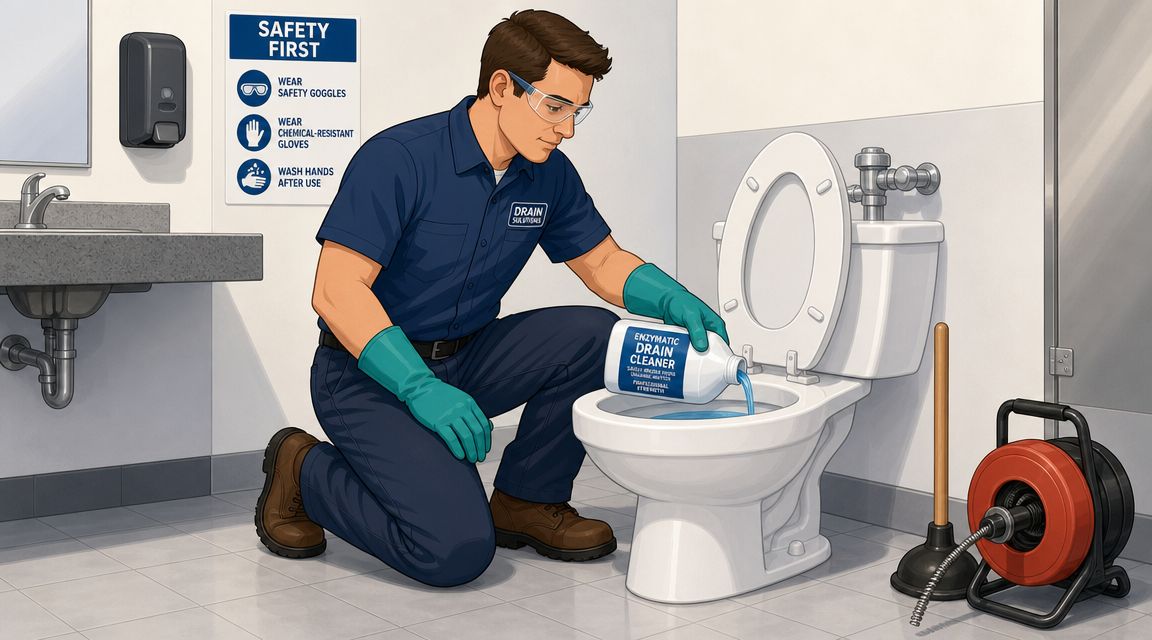
Chemical toilet and drain cleaners can burn skin, injure eyes, and create dangerous splash exposure if the bowl is already holding water. The hazard rises in public restrooms because people work under pressure. A manager wants the stall back in service. A custodian wants the overflow risk gone. That urgency causes mistakes, and mistakes in a customer-facing restroom can become an injury report, a cleanup claim, or a reputation problem. Canyon Plumbing outlines those toilet-specific risks in its safety discussion of chemical drain cleaners in toilets.

Setup before opening the bottle
Do not start until one trained person is assigned to the task and the restroom is under control.
Use this checklist:
- Close the restroom or isolate the stall. Put signage at the entrance, not just on the stall door.
- Put on the right PPE. Chemical-resistant gloves and splash protection for the eyes are the minimum. Follow site policy for face protection.
- Run ventilation if available. Air movement matters, especially in smaller restrooms with poor exhaust.
- Read the product label in full. Confirm dose, contact time, flushing instructions, and any product-specific warnings.
- Verify that no other chemical was added earlier. If the answer is uncertain, stop and escalate.
- Check the water level. If the bowl is already close to the rim, adding liquid may increase the immediate overflow risk.
A hotel operator dealing with a guest-facing bathroom outage has even less room for improvisation. The service pressure described in this guide to a clogged toilet in a hotel restroom applies to any commercial site where the restroom problem quickly becomes a customer confidence problem.
Application steps that reduce exposure
Apply the cleaner slowly and exactly as labeled. Do not free-pour from shoulder height. Keep the bottle close to the bowl, pour with control, and avoid any motion that could throw contaminated water back toward the operator.
Then wait the full labeled dwell time. Some products act faster than others, but guessing shortens the chance of success and increases the chance that someone will interfere mid-process. During that waiting period, keep the area secured and document the time the product went in.
When the label calls for flushing, stand clear of the bowl path and flush once, carefully. If the fixture does not clear, stop treating it like a chemistry problem. At that point, the risk of a second application may outweigh the benefit, especially if the obstruction is a foreign object or a downstream line issue.
Actions that are off-limits
These mistakes cause the worst incidents:
- Do not mix chemicals. Never combine drain cleaner with bleach, toilet bowl cleaner, or any other product.
- Do not plunge after adding cleaner. Force plus standing chemical water creates direct splash risk.
- Do not hand the problem to the next shift without records. The next employee needs to know what product was used and when.
- Do not leave the restroom accessible during dwell time. Customers and untrained staff should not be able to enter.
- Do not keep reapplying cleaner to avoid a service call. Repeated doses add hazard without fixing an object lodged in the trap or a blocked branch line.
Make authorization and documentation part of the protocol
Chemical use in a commercial toilet should require approval, not improvisation. Set a facility rule that defines who can authorize the product, who can apply it, what PPE is required, and when plumbing service becomes mandatory.
A simple log is enough if the team uses it. Record the product name, time applied, employee name, flush result, and whether the restroom was cleared for reopening or held for further service. That record protects the next staff member, supports incident review, and shows that the business treated the event with discipline instead of guesswork.
Post-Clog Cleanup and Restroom Sanitization
A toilet may flush again and still leave the restroom unfit for use.
In a commercial setting, the cleanup decision is bigger than housekeeping. If a guest sees splash residue on the floor, touches a contaminated latch, or smells wastewater after staff removed the out-of-order sign, the plumbing problem turns into a credibility problem. The facility fixed the blockage but failed the reopening standard.

Reset the entire exposure area
Treat the affected stall like an incident zone, not a single dirty fixture. Any surface touched during the response, and any surface exposed to splash or aerosol, needs attention before the room goes back into service.
Start at the toilet and work outward in a controlled order:
- Sanitize the fixture first: Seat, lid, outer bowl, rim edge, base, flush handle or sensor housing, and any nearby wall surface that caught spray.
- Disinfect contact points around the stall: Latch, partition edge, grab points, door pull, and light switch if staff used it during the response.
- Inspect the floor by sight and by angle: Small droplets near the base or just outside the stall are easy to miss and easy for guests to notice.
- Replace exposed supplies: Toilet paper, liners, paper products, or any item that may have been contaminated during the clog event.
A hotel team sees this problem clearly because the guest judges the whole property by one restroom moment. This clogged toilet in hotel case shows why cleanup standards affect operations, reviews, and trust, not only maintenance.
Reopening requires sanitation, not just drainage
Staff often focus on whether the bowl clears. Managers need a stricter standard. Reopen the restroom only after the toilet is working, the area is dry, and high-touch surfaces have been disinfected. If one of those steps is skipped, the business still carries the risk.
That trade-off matters in restaurants, clinics, retail stores, offices, and schools. A five-minute shortcut after a messy clog can lead to a customer complaint, a staff exposure report, or a photo shared online. Those consequences cost more than the extra few minutes it takes to finish the cleanup properly.
Use a simple reset checklist before removing the sign
Before returning the stall or restroom to service, confirm each item below:
| Reopening check | Yes or no |
|---|---|
| Toilet flushes normally | |
| No residue remains on fixture or nearby surfaces | |
| Floor is dry and safe | |
| High-touch surfaces are disinfected | |
| Odor is under control | |
| Supplies are restored | |
| Incident log is complete |
For facilities trying to reduce repeat incidents, prevention still does more for uptime than any emergency product. The practical habits in how to avoid drain clogs support the same goal from the front end. Fewer clog events mean fewer sanitation failures, fewer closures, and fewer chances to damage customer confidence.
Prevention and Knowing When to Call a Professional
The best commercial clog strategy is boring on purpose. Clear signage. Good paper choices. Staff who know what belongs in a toilet and what doesn't. Routine checks before guests complain.
That approach beats repeated emergency decisions about whether to use a drain cleaner for clogged toilet problems in the first place.
Prevention habits that reduce ugly surprises
In high-traffic restrooms, small controls do a lot of work:
- Post simple flush guidance: Keep it direct and visible. People ignore wordy signage.
- Stock products that fit the fixture and traffic level: If paper use overwhelms the toilet, the problem isn't just user behavior.
- Train staff to report slow drains early: A sluggish bowl today becomes a closure tomorrow.
- Use maintenance methods intentionally: If your building benefits from biological maintenance products, schedule them as prevention, not panic response.
If you want a practical outside resource on proactive habits, Harrlie Plumbing and Heating offers a solid overview on how to avoid drain clogs that lines up well with preventive facility management.
When repeated chemical use becomes the warning sign
Facility managers also need to think about repeated use in shared environments. Some consumer-facing products mention second applications or overnight dwell time for stubborn clogs, but that doesn't answer the key facility question. In high-traffic restrooms, repeated chemical use raises concerns about residue, odor complaints, and cumulative corrosion risk, as discussed in Good Housekeeping's drain cleaner roundup.
If your team keeps reaching for chemicals, treat that as a symptom. Something upstream in the maintenance process is off.
Call a plumber when these signs appear
Stop internal troubleshooting and escalate when you see any of the following:
- Multiple fixtures backing up: That points beyond a single toilet.
- The same toilet clogs repeatedly: A partial obstruction or fixture issue may be present.
- You suspect a foreign object: Mechanical retrieval or disassembly may be required.
- Water levels behave unpredictably in nearby drains: That can signal a larger drain line problem.
- Staff can't confirm what chemical was already used: Safety uncertainty is enough reason to stop.
A good facilities team knows how to solve minor problems. A strong facilities team also knows when not to push its luck.
A clogged toilet can become a sanitation problem, a staff safety problem, and a reputation problem in one shift. Treat it that way. Use mechanical methods first, reserve chemical options for tightly controlled last-resort situations, and finish every response with full surface sanitization.
If you manage a facility or sell cleaning programs to operators, make disinfectant wipes part of the daily routine and the incident-response plan. For more practical hygiene guidance and product-focused cleaning insights, visit WipesBlog.com and consider adding Wipes.com Disinfectant Wipes to your standard restroom cleanup process.
Leave a Reply