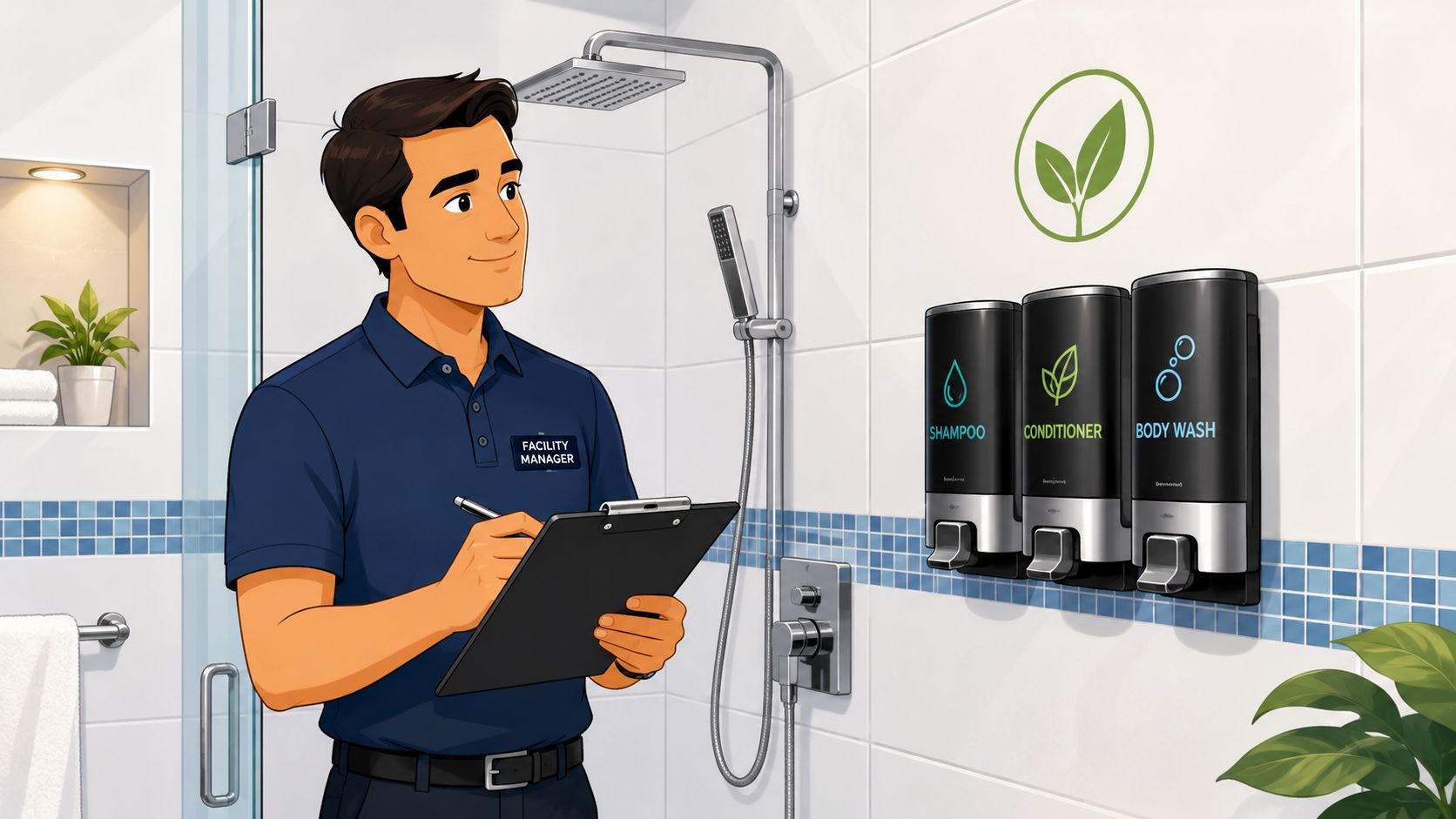
A lot of hotel managers are in the same spot right now. They're staring at rising amenity costs, guest expectations that pull in two directions, and a bathroom setup that still depends on tiny bottles that create waste, clutter, and refill work every single day.
The dispenser shampoo hotel decision looks simple from a distance. Swap bottles for pumps, call it sustainable, and move on. In practice, that's not how it works. The properties that get good results treat dispensers as an operating system, not a bathroom accessory. They choose the right hardware, install it in the right location, train housekeeping on a repeatable refill routine, and clean the units like any other high-touch fixture.
When that discipline is missing, dispensers become a complaint magnet. Guests notice sticky nozzles, empty chambers, mislabeled product, or residue around the mount faster than managers expect. When the system is managed properly, the opposite happens. The bathroom looks more modern, room turns become more consistent, and the amenity program starts supporting both cost control and brand standards.
The Modern Amenity Dilemma
The old single-use setup still feels safe to many operators because it's familiar. Each guest sees a sealed bottle, housekeeping swaps it out, and the process seems straightforward. But the actual burden shows up in purchasing, storage, disposal, and room presentation.

What changed is that guests now judge the bathroom on two standards at once. They want a property to reduce obvious waste, and they also want visible cleanliness. A wall-mounted dispenser can satisfy both, but only if the unit looks maintained, full, and intentional. A poorly managed dispenser signals neglect faster than a tray of mini bottles ever did.
Why the shift became mainstream
This isn't a niche boutique concept anymore. A major turning point came when Marriott began enforcing wall-mounted toiletry dispensers in the showers of its managed North American properties, helping normalize bulk systems at scale. One case study tied to that broader industry transition reported that a mid-sized hotel chain saved about $558,000 in annual amenity expenses and prevented roughly 7 million pieces of plastic waste each year after switching from single-use bottles to dispensers, according to this hotel shower dispenser case study.
That matters because it reframes the conversation. The issue isn't whether dispensers are trendy. The issue is whether your property is still operating an outdated amenity model that costs more to maintain and creates more visible waste.
Practical rule: Guests rarely praise the hardware itself. They notice whether the amenity setup feels clean, full, and easy to trust.
What managers often miss
The decision isn't bottles versus pumps. It's whether your team can support a daily execution standard. If your housekeeping cadence is strong, dispensers usually work well. If room checks are inconsistent, dispensers expose that weakness immediately.
Managers should evaluate the switch through three lenses:
- Guest experience: The unit has to feel premium, not institutional.
- Operations: Refill and wipe-down tasks must fit into existing housekeeping flow.
- Reputation: A clean dispenser reinforces brand care. A dirty one undermines it.
That's why the dispenser shampoo hotel program needs ownership from operations, housekeeping, and procurement at the same time. It touches all three.
Choosing the Right Dispenser System for Your Facility
The wrong dispenser creates work. The right one reduces it. Most selection mistakes happen because buyers focus on appearance or unit price instead of service conditions.
A common commercial wall-mounted format is a refillable 12-ounce (375 mL) chamber, measuring roughly 11.1 inches high and projecting about 3.1 inches from the wall, based on this commercial hotel soap dispenser specification. That compact footprint is one reason wall-mounted units fit standard showers without overwhelming the space.
Start with the operating environment
A business hotel, resort, gym locker room, and short-term rental don't have the same risk profile. Hotels with consistent housekeeping can manage refillable systems well. Facilities with irregular service intervals may need a more controlled format or larger chambers to avoid empty units during occupancy peaks.
Manual pumps are still the practical default for many properties because they're simple and easy to train around. Automatic sensor models make more sense where touch reduction is a priority, but they also add another maintenance variable. If your engineering bench is already overloaded, more electronics may not be the upgrade you think it is.
Here's the decision table I use when advising operators.
Hotel Shampoo Dispenser Type Comparison
| Dispenser Type | Upfront Cost | Maintenance Level | Best For | Primary Risk |
|---|---|---|---|---|
| Wall-mounted manual refillable | Moderate | Moderate | Hotels with daily housekeeping and stable brand standards | Refill inconsistency, residue buildup |
| Wall-mounted automatic | Higher | Higher | Premium properties and health-sensitive facilities prioritizing reduced contact | Sensor or power-related service issues |
| Freestanding countertop | Lower | Moderate | Low-commitment trials and limited retrofit situations | Movement, tampering, visual clutter |
| Sealed cartridge style | Higher | Lower to moderate | Operators focused on product control and reduced refill handling | Less flexibility, replacement logistics |
Match product format to guest expectations
The product inside matters almost as much as the dispenser. Cheap formulas in a sleek unit still feel cheap. If you're reviewing brand standards or selecting formulations, this guide on Morfose tips for perfect hair care is useful because it highlights how hair type, scalp sensitivity, and formula choice shape user perception. That matters in hospitality because guests don't judge shampoo in a lab. They judge it in one shower, under time pressure, often after travel.
If the dispenser looks premium but the product feels drying or weak, guests blame the hotel, not the supplier.
What usually works best
For most full-service and limited-service hotels, the strongest setup is a wall-mounted three-product system with secure brackets, easy visual fill checks, and enough clearance for housekeeping to refill without awkward handling. That balances presentation, product control, and routine serviceability.
What doesn't work well is choosing the smallest unit to save wall space, or placing the system where water spray hits the pump all day. Those choices seem minor during procurement and become daily irritants once the rooms go live.
Calculating the Real ROI of Shampoo Dispensers
A dispenser program pays off or backfires in housekeeping.
That is the part many budget discussions miss. Purchase price matters, but guest-facing results come from the full operating system behind the fixture: product purchasing, refill control, cleaning standards, inspection habits, and staff consistency. Hotels that treat dispensers as a simple swap from miniatures often underestimate labor drift, product waste from poor refills, and the speed of guest complaints when one bottle is empty or messy.

Where the savings actually show up
In practice, cost improvement usually starts with replenishment. Bulk formats cut the repeated work tied to ordering, storing, placing, removing, and discarding hundreds or thousands of small bottles. They also reduce stockout risk at the room level when refill checks are built into standard service.
I advise managers to measure ROI across four operating buckets:
- Product purchasing: Larger-volume buying can lower cost per occupied room, but only if refill loss, overfilling, and shrink are controlled.
- Housekeeping time: Staff spend less time replacing full sets of miniatures, but that gain disappears if refilling is disorganized or units are hard to open and inspect.
- Waste stream volume: Fewer single-use containers reduce trash handling and back-of-house waste volume.
- Guest perception: A clean, full, well-labeled dispenser supports a more orderly bathroom presentation and can reduce complaints about missing amenities.
Supply model matters here. This guide to hotel toiletries in bulk is useful if you are comparing refill purchasing, storage, and replenishment workflows rather than looking at fixture cost alone.
ROI is wider than the product line
Hotels often approve dispensers on packaging savings, then miss the larger operating effects. Fewer SKUs can simplify ordering. Cart setup becomes cleaner. Housekeeping supervisors can audit fill levels and presentation faster when room setups are standardized across the property.
There are trade-offs. Refillable systems can save money over time, but they demand tighter controls. If staff top off inconsistently, mix products, skip nozzle cleaning, or fail to flag low stock on the floor, the property gives back part of the savings through waste, rework, and service recovery.
A sealed-cartridge program usually costs more upfront, yet it can reduce handling errors and make quality control easier. That choice makes sense for properties with high room counts, limited supervisor coverage, or frequent staff turnover.
Category growth supports the investment case
The broader toiletries category is still active, and dispensers remain part of that shift. Analysts at Grand View Research outline the scale of the U.S. hotel toiletries market in this hotel toiletries market report, which supports a practical point for operators: suppliers are continuing to build around updated amenity formats rather than treating them as a short-term experiment.
That helps with budget approval. Procurement teams want proof that replacement parts, refill formats, and supplier support will still be available in a few years. A growing category gives operators more confidence in long-term standardization.
The actual ROI depends on execution
Guest satisfaction decides whether the program works.
A dispenser that is clean, full, functioning, and matched to a decent formula strengthens confidence in room quality. A dispenser with dried residue on the pump, unclear labels, or an empty chamber creates a stronger negative impression than missing mini bottles ever did. Guests read poor dispenser upkeep as poor hygiene control.
Include these costs in the business case from the start: supervisor inspections, refill tools, cleaning materials, bottle or cartridge replacement schedules, and staff training time. Hardware does not produce savings by itself. The operating discipline around it does.
A Step-by-Step Installation and Refill Process
Most dispenser failures start long before the first guest uses the room. They start at installation. Poor placement, rushed mounting, and sloppy first fills create problems that housekeeping then inherits every day.

A branded hotel program guide recommends a three-bottle system for shampoo, conditioner, and body wash, installed away from direct shower spray. That same guide calls for daily fill-level checks, daily wipe-downs, and mandatory bottle replacement every 6 months to support sanitation and pump performance, as shown in this hotel dispenser program guide.
Step 1
Choose the wall location before you order in bulk. The best placement is usually on the wall opposite the shower head or on a side wall with enough clearance for staff to open the unit and refill it without fighting the enclosure.
Direct spray is the enemy. Constant water exposure leaves more residue, speeds up cosmetic wear, and makes the area look dirty faster even when the room was cleaned correctly.
Step 2
Mount the bracket securely and standardize the position property-wide. Don't let each room become a custom installation. Uniform height and placement make training easier, speed inspection, and give the bathroom a controlled look.
A mixed installation pattern creates service errors. Staff lose time locating the latch, checking fill windows, or reaching around awkward corners.
Step 3
Load product using a gallon pump or funnel, and make the transfer process a trained task rather than an improvised one. Spills around the neck, threads, and pump head are one of the main reasons new installations look bad within days.
For teams reviewing room amenity setup more broadly, this guide to hotel room toiletries helps connect dispenser rollout to the rest of the bathroom presentation standard.
Step 4
Build the refill check into the daily room sequence. Don't treat it as an occasional task. The operational model only holds if housekeeping can confirm each chamber is usable during normal service.
A practical room attendant checklist should include:
- Visual level check: Confirm each chamber has enough product for the next guest use cycle.
- Exterior wipe-down: Remove drips, fingerprints, and water spots.
- Label confirmation: Make sure shampoo, conditioner, and body wash are clearly identified.
- Pump test: Confirm the mechanism dispenses cleanly and isn't sticking.
The pump usually isn't the first thing to fail. The routine is.
Step 5
Replace bottles on schedule, even if they still appear functional. Six-month replacement rules exist for a reason. Repeated refill handling, residue buildup, and normal wear eventually affect both hygiene and dispensing performance.
Properties that skip this step often end up chasing recurring nozzle issues, sticky chambers, and inconsistent guest experience room by room.
Critical Hygiene and Maintenance Protocols
The hardest objection to a dispenser shampoo hotel program isn't cost. It's trust. Managers need to know the units won't become a contamination risk or a visual signal that sanitation standards have slipped.

That concern is valid. A key issue for facility operators is cross-contamination risk in shared dispensers. Product pages usually stress convenience, but often don't explain how often units should be cleaned, checked for tampering, and sanitized, especially in health-sensitive settings such as gyms and pool clubs, as discussed in this video on shampoo dispenser hygiene concerns.
Treat the dispenser like a high-touch asset
A common oversight for many properties involves classifying the dispenser as an amenity and only thinking about product levels. In reality, the exterior housing, pump area, and surrounding wall zone should be handled like any other guest-touch surface.
That means your protocol should separate three different jobs:
| Task | Purpose | Who should own it |
|---|---|---|
| Daily exterior cleaning | Remove residue, fingerprints, splash marks, and visible grime | Housekeeping |
| Refill control | Prevent overfilling, spills, mixing errors, and empty chambers | Housekeeping or supervisor |
| Periodic sanitation check | Identify tampering, buildup, labeling issues, and wear | Supervisor or facilities lead |
Build a cleaning routine that survives busy days
The best protocol is the one your team will complete on high-occupancy days. If the routine is too complex, it gets skipped. If it's too light, the units degrade quickly.
A workable daily standard looks like this:
- Wipe the housing first: Clean the outside before refilling so product drips don't get spread across the unit.
- Focus on the pump head: This is the area guests touch and where residue collects fastest.
- Inspect the mount point: Check for looseness, gaps, or signs the unit has been pulled on.
- Look for tampering: Mismatched product, broken seals, or altered labeling should trigger replacement, not a quick cosmetic fix.
For daily exterior sanitation, we recommend Wipes.com Disinfectant Wipes because they're practical for quick wipe-downs of high-touch surfaces like dispenser housings during routine room service.
A clean dispenser doesn't just support hygiene. It tells the guest your standards are controlled, not improvised.
Don't confuse sustainability with sanitation
A refillable system can reduce packaging waste and still fail operationally if the cleaning standard is weak. That's the trade-off many teams underestimate. The sustainability story only holds up when refill handling is tidy, nozzles stay clean, and staff know when to replace a bottle instead of topping it off indefinitely.
This is the same mindset used in broader restroom and room restoration work. If your supervisors need a stronger framework for periodic deep-clean tasks beyond daily wipe-downs, this comprehensive deep cleaning guide is useful for thinking through the difference between surface maintenance and full sanitation control.
Common failure modes to stop early
Most complaints trace back to a short list of preventable issues:
Residue around the pump
Guests read this as “not cleaned,” even when the room is otherwise spotless.Low fill levels
An almost-empty chamber creates anxiety because guests can't tell whether they'll get enough product mid-shower.Loose or crooked mounts
This instantly cheapens the bathroom and raises concerns about tampering.Product mix-ups
Conditioner in the shampoo chamber is a small operational mistake that creates a big trust problem.
Managers in hotels, gyms, and other shared facilities should audit for these issues visually, not just by checklist. If the unit looks questionable from the doorway, guests will notice it too.
Communicating the Change to Guests and Staff
Even a well-run dispenser program can stumble if people don't understand what changed and why. Communication shapes whether the system feels upgraded or downgraded.
Guests usually accept dispensers when the presentation is polished and the message is simple. They don't need a sustainability lecture taped to the mirror. They need a short explanation that tells them the products are intentionally provided in refillable dispensers as part of the property's standards for cleaner, lower-waste bathroom amenities.
What to tell guests
The best in-room language is brief and calm. Something like this works well:
Our shower amenities are provided in refillable dispensers to support a cleaner, more consistent guest experience while reducing single-use packaging.
That wording does two things. It frames the change around guest experience first, then sustainability second. That order matters because guests care most about what affects their stay.
If your property serves business travelers, event attendees, or fitness-focused guests, convenience matters too. Mounted dispensers are easier to use than a clutter of small bottles sliding around a wet shelf. That's worth communicating in brand voice, not corporate jargon.
What to teach staff
Staff buy-in matters more than signage. Housekeepers, room inspectors, and front desk teams should all know the basic failure points so they can respond quickly and consistently.
Train around practical scenarios, not abstract policy:
- Empty chamber found during inspection: Refill immediately and confirm the pump works before closing the room.
- Visible residue on nozzle: Clean it on the spot rather than assuming the next shift will handle it.
- Guest concern about hygiene: Explain the cleaning and inspection routine clearly and confidently.
- Mislabeling or product mismatch: Remove the issue from service and correct it fully.
Make ownership visible
The strongest programs assign accountability by role. Housekeeping owns daily checks. Supervisors own compliance. Engineering owns hardware stability. Front desk owns guest explanation when questions come up.
When nobody owns the system, small failures linger. When each team knows its part, the dispenser program becomes routine and reliable.
That's the goal. Not just replacing bottles, but running a bathroom standard that guests trust and staff can maintain without friction.
Frequently Asked Questions About Hotel Shampoo Dispensers
Are shampoo dispensers less sanitary than single-use bottles
They can be if the property has weak cleaning and refill controls. They can also be clean and reliable when the unit is treated as a high-touch fixture with scheduled wipe-downs, refill discipline, tamper checks, and bottle replacement on schedule.
Should hotels choose manual or automatic dispensers
Manual units usually make more sense when durability and straightforward maintenance matter most. Automatic units fit properties that place a higher value on touch reduction and have the support capacity to manage more complex hardware.
Where should a dispenser be mounted in the shower
Away from direct shower spray, with enough clearance for easy refilling and inspection. Consistent placement across rooms helps housekeeping work faster and reduces service mistakes.
What's the most common operational mistake
Inconsistent daily checks. Empty chambers, sticky pump heads, and visible drips usually point back to a missed housekeeping step, not a flawed concept.
Do guests dislike dispensers
Some do at first, especially if they associate dispensers with low-end facilities. Clean installation, quality product, secure mounting, and clear communication usually change that perception quickly.
Are dispensers only for hotels
No. The same operating logic applies in gyms, pool clubs, short-term rentals, airports, and other high-traffic facilities. The maintenance standard has to match the traffic pattern.
Clean bathrooms don't happen by accident. If you're upgrading your amenity program, make the dispenser system part of a wider hygiene routine that includes visible surface sanitation, strong staff training, and fast daily checks. For more practical sanitation guidance, visit WipesBlog.com, and consider adding disinfectant wipes to your daily facility routine or cleaning supply lineup.
Leave a Reply