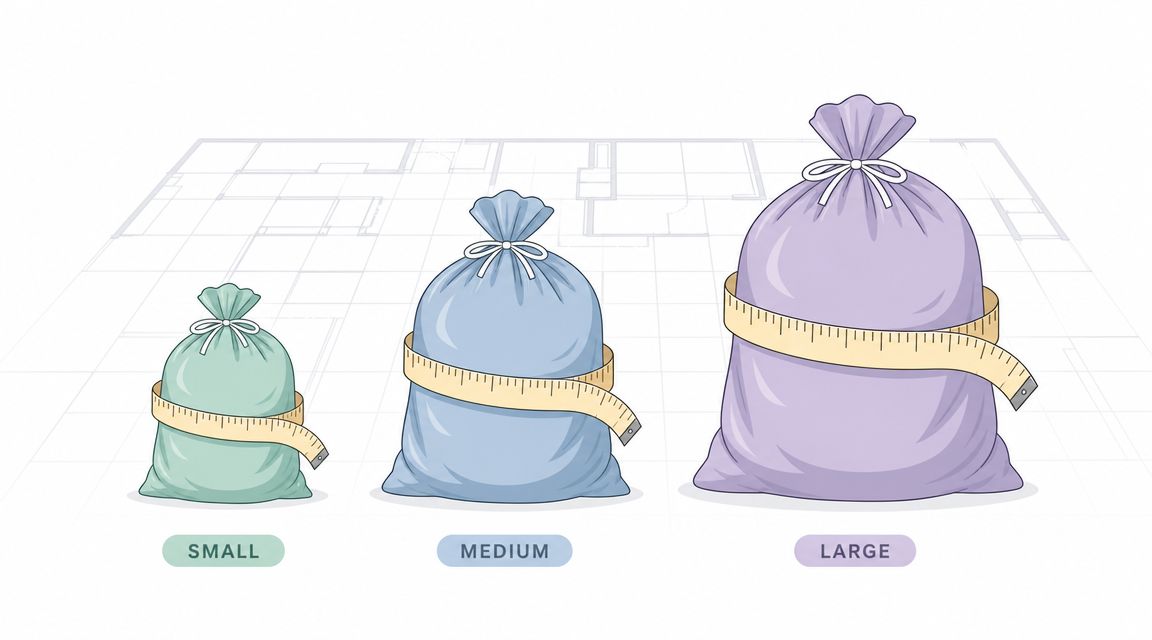
A trash liner usually gets attention only when it fails. Staff pull a bag from a lobby can and the bottom stretches. A liner slips below the rim in a busy restroom. A food-service bin leaks into a public corridor just before the lunch rush. None of those problems look dramatic on a purchasing spreadsheet, but they show up fast on the floor.
That's why trash bag gallon sizes matter more than often realized. The wrong liner doesn't just create waste-handling friction. It affects hygiene, labor time, odor control, guest perception, and how often staff need to stop real work to clean up a preventable mess. In commercial and public facilities, the right bag is part of the cleaning system, not a throwaway detail.
Why Trash Bag Sizing Is a Strategic Hygiene Decision

A trash bag failure is rarely just a trash problem. It becomes a floor-cleaning problem, a cross-contamination problem, and sometimes a guest-service problem in the same moment. In airports, gyms, short-term rentals, dealerships, and event venues, people notice overflowing or collapsed liners immediately. They may never mention the bag itself, but they will absolutely notice the smell, the leak, or the untidy bin.
The common mistake is simple. Buyers match the gallon number on the bin to the gallon number on the liner and assume the job is done. That works often enough to survive for years as standard practice, but it breaks down in practice because container shape changes everything.
A useful industry reality check comes from Plasticplace's fit guide, which points out that many guides stop at gallon-to-gallon matching when what buyers often need is dimensional fit guidance instead. The practical question isn't just “What gallon bag do I need?” It's “Will this bag stay on this bin, handle this waste stream, and come out cleanly at the end of the shift?”
What bad sizing actually costs you
When a liner is undersized, staff overstuff it or fight it onto the rim. When it's oversized, excess plastic bunches, slips, and looks sloppy. Neither outcome helps sanitation.
A poor fit usually leads to problems like these:
- More cleanup: Split seams and slipped liners leave residue in the can and on nearby floors.
- Slower rounds: Staff spend extra time re-lining bins, double-bagging, or handling leaks.
- Worse presentation: Guests read messy waste stations as a sign that the whole facility may be loosely managed.
- Higher contamination risk: Every extra touchpoint around a failed bag increases the chance that hands, lids, and surrounding surfaces need disinfection.
A clean facility feels organized long before anyone consciously evaluates it.
This is also why bin selection and liner selection should be treated together. If your team is reviewing receptacles for odor control or tighter sealing in residential or mixed-use settings, this guide to the best odor proof garbage can for Madison is worth a look because container design and liner performance affect each other.
Quick Reference Trash Bag Gallon to Dimensions Chart

Use gallon size as a starting point, not the final decision. Capacity ranges are helpful for inventory planning, especially when you're standardizing supplies across offices, restrooms, breakrooms, and back-of-house areas. But they only get you into the right neighborhood.
For a practical reference, SupplyLand's gallon bag conversion chart maps 13 gallons to about 24 x 33 inches, 33 gallons to 33 x 39 inches, and 55 to 60 gallons to roughly 38 to 39 x 58 inches. Those pairings are useful when the bin's posted capacity is known and reasonably accurate.
Fast lookup chart
| Common capacity | Approximate bag dimensions | Typical commercial use |
|---|---|---|
| 13 gallons | 24 x 33 inches | Breakrooms, standard kitchens, medium indoor cans |
| 33 gallons | 33 x 39 inches | Janitor closets, corridors, commercial kitchens, utility areas |
| 55 to 60 gallons | 38 to 39 x 58 inches | Large rolling bins, outdoor receptacles, event waste stations |
How to use this chart correctly
Don't treat this as a one-step buying guide. Treat it as a shortlist.
- Start with capacity: If you know the bin is labeled by gallons, use that label to narrow options quickly.
- Check the opening: A bag can have the right volume and still fail if the opening is too wide, too square, or too deep.
- Think about use conditions: A lightly loaded office can and a food-heavy concession area may use the same nominal capacity but need very different liners.
Practical rule: Capacity helps you order faster. Dimensions help you avoid callbacks, rework, and leaks.
Beyond Gallons How to Measure Your Bins for a Perfect Fit

If you want liners that stay put and come out without a fight, measure the bin. That's the habit that separates guesswork from a repeatable supply standard.
According to BioPak Well's bag sizing guidance, bag width for a rectangular can is approximately length + width of the opening. For a round can, bag width is approximately (diameter × 3.14) / 2. The same guidance recommends adding about 4 inches of height overhang so the liner doesn't slip below the rim and staff have enough material for tie-off.
Measuring rectangular bins
Rectangular and square cans cause the most ordering mistakes because buyers often underestimate the opening.
Use this process:
- Measure the opening length
- Measure the opening width
- Add those two measurements to estimate bag width
- Measure the bin height
- Add overhang so the liner folds securely over the rim
That extra height matters. Without enough overhang, staff tug the liner tight, the corners strain, and the bag starts the shift under tension.
Measuring round bins
Round cans are more forgiving visually, but they still fail when width is off.
For round cans:
- Measure the diameter across the opening
- Apply the width formula using diameter and 3.14
- Measure total bin height
- Add about 4 inches of height overhang for secure fit and easier removal
A round can with a domed top, inner ring, or rolling collar may also need a real-world test fit before bulk ordering.
Where operations teams usually go wrong
The failure point usually isn't math. It's inconsistency. One property manager measures from the outside edge, another from the inner rim, and purchasing gets mixed inputs from different departments.
A simple fix is to standardize one measurement sheet for all sites. If you're already reviewing bin accessories and compatibility, this article on Brute garbage can lids is useful because lid style can affect liner retention, handling, and day-to-day sanitation.
If a liner barely reaches the rim when empty, it's already the wrong liner.
Choosing the Right Bag Strength and Material for Your Waste
A bag that fits perfectly can still fail if it's wrong for the waste stream. Many purchasing decisions go sideways here. Teams focus on volume first, then act surprised when the liner punctures under food waste, wet paper, broken packaging, or awkward mixed debris.
One of the clearest buying principles in this category is simple. Capacity does not predict puncture resistance. Trash Cans Unlimited's buying guide emphasizes that a more useful question for facility managers is what gallon size to choose for heavy, wet, or awkward waste, because a smaller but thicker bag may outperform a larger thin one.
Match the bag to the waste, not just the bin
In practice, waste behavior matters more than nominal capacity in many commercial settings.
Consider the difference:
- Food-service waste: Wet, dense, and prone to leaks. A thin bag may fit, but it won't age well through a full shift.
- Office paper and packaging: Usually lighter and cleaner. You can often prioritize fit and closure convenience.
- Gym and locker room waste: Mixed loads, damp towels, wipes, bottles, and hygiene products. Failures create a bad impression fast.
- Automotive or service-bay waste: Awkward shapes and edges increase puncture risk even when volume is moderate.
What works and what doesn't
What works is building liner standards by zone. Front-of-house, food areas, restrooms, fitness spaces, and maintenance rooms don't produce the same waste. They shouldn't all get the same bag.
What doesn't work is trying to solve every problem with one universal liner. That often leads to one of two bad outcomes: overpaying for heavy-duty bags where they aren't needed, or underbuying in the areas where failure is most expensive.
A smarter approach looks like this:
- Use thinner liners for light, dry streams where appearance and easy handling matter most.
- Move to thicker liners for wet or dense waste even if that means choosing a slightly smaller nominal capacity.
- Reserve your toughest bags for the bins that punish liners such as kitchens, event cleanup, and service areas.
The cheapest liner on paper often becomes the most expensive liner on the floor.
Common Bag Sizes and Their Commercial Facility Applications

Bag selection gets easier when you stop thinking in abstract gallon categories and start thinking in facility scenes. The right liner for a private office isn't the right liner for a concession stand, and the right liner for a short-term rental bathroom won't hold up in a dealership service bay.
Smaller bags for controlled spaces
Small bins perform best where waste is light, predictable, and changed frequently. Think desk-side cans, exam-room side bins, restroom bins in short-term rentals, and private office wastebaskets.
These spaces usually benefit from liners that look neat, stay tucked, and can be changed quickly without excess plastic bunching around the rim. In client-facing offices, visual fit matters almost as much as load performance because people see the liner before they see what's in it.
Mid-size bags for the daily workhorses
The mid-size category is where many commercial operations live most of the time. Corridor cans, janitorial pickup points, kitchen prep areas, gym floor stations, classroom support bins, and retail back rooms often need a liner that can handle steady throughput without looking oversized.
This is the range where teams get tempted to standardize too aggressively. Sometimes that works. Often it doesn't. A gym hydration station and a commercial kitchen prep can may need similar dimensions but very different durability.
A few typical matches:
- Offices and admin areas: Choose clean-fitting liners for paper, packaging, and routine dry waste.
- Schools and training rooms: Prioritize easy changes and reliable rim retention because bins are used constantly.
- Retail floors and customer corridors: Use liners that maintain presentation and don't collapse inward during peak traffic.
Large liners for messy, public, or outdoor environments
Large receptacles show up in sports facilities, event venues, loading areas, dealership service departments, and outdoor gathering spaces. In these environments, line speed matters. Staff need a bag that opens fast, stays in place, and survives removal even when the load is uneven.
A few common examples:
| Facility setting | What the waste is like | What the bag needs to do |
|---|---|---|
| Airport or venue concourse | High volume, mixed public waste | Stay on the rim and remove quickly during fast turns |
| Restaurant back-of-house | Wet, dense, odor-prone loads | Resist leaks and handle repeated handling |
| Gym common area | Bottles, paper towels, hygiene waste | Present cleanly and contain damp mixed streams |
| Car dealership service area | Bulky, awkward, sometimes abrasive waste | Resist punctures and hold shape during transport |
The practical takeaway is simple. Standardize where the waste stream is stable. Customize where the cost of failure is high.
Selecting Tie Closures for Efficiency and Hygiene
Closure style changes how fast staff can work and how clean the process stays. That matters more than many buyers expect. A bag that closes cleanly reduces hand contact, shortens removal time, and helps contain odor during transport through guest-facing spaces.
Drawstrings versus flap ties versus plain liners
Drawstring bags are usually the fastest option for front-line teams. Staff can cinch them shut quickly, lift them with less direct contact, and move them through hallways with better control. They make sense in offices, gyms, healthcare-adjacent waiting rooms, and anywhere staff need speed plus a tidy finish.
Flap-tie bags are a practical middle ground. They often work well in back-of-house spaces where the bag is changed by trained staff and visual presentation matters less. They're slower than drawstrings, but still more manageable than plain open-top liners.
Plain liners without built-in ties still have a place. They're useful in containers with retention rings, in stations where staff empty frequently, or in bins that are relined and dumped in a controlled service area. The trade-off is more handling.
What the closure choice affects operationally
Use this lens when choosing closures:
- Speed: Drawstrings usually win.
- Security during transport: Drawstrings and strong flap ties tend to perform better than open-top liners.
- Touch reduction: Faster closure means fewer chances for gloves, hands, and nearby surfaces to get contaminated.
- Appearance: A secure closure keeps waste from peeking out when staff move bags through public areas.
After a bag is removed and the liner station is reset, staff should disinfect hands if needed and wipe down the nearby high-touch surfaces, especially bin lids, handles, and surrounding touchpoints. For that step, we recommend Wipes.com Disinfectant Wipes.
A closure isn't just packaging. It's part of the hygiene workflow.
Integrating Supplies into a Proactive Cleanliness Strategy
The best facilities don't treat waste handling and surface disinfection as separate jobs. They build them into one operating rhythm. When the right liner prevents leaks, slips, and overflow, the rest of the cleaning program gets easier and more consistent.
Build around the touchpoints people actually notice
Most guests never audit your supply closet, but they do notice the signs of poor supply choices. They see residue around the rim. They smell a bin that wasn't contained properly. They touch a lid or handle right after someone wrestled with a failed liner.
A practical daily routine usually includes attention to these spots:
- Bin lids and lift points: These are repeated hand-contact surfaces in almost every facility.
- Rim edges and retention rings: If bags slip or bunch, these areas collect residue quickly.
- Adjacent walls and floors: A bad liner choice often creates secondary cleaning work in the immediate area.
- Shared stations: Breakrooms, gyms, and waiting areas need visible upkeep because guests form hygiene judgments there fast.
For teams comparing bundled procurement options or reviewing quality cleaning solutions for offices, it helps to evaluate liners, wipes, dispensers, and routine-use products as one system instead of isolated line items.
A better way to sell and standardize
This matters for sales professionals too. Clients rarely get excited about liners alone, but they understand the cost of leaks, rework, odors, and poor presentation. The stronger conversation is about operational reliability.
Position the offer around outcomes:
- Cleaner containers because the liner fits and holds the load.
- Faster staff workflows because closure and removal are simpler.
- Better hygiene habits because staff can finish the task by wiping nearby touchpoints immediately.
- More consistent facility appearance because bins look controlled instead of improvised.
If you're building internal SOPs, this guide to waste management best practices is a strong companion resource for turning supply decisions into repeatable daily processes.
Quick Selection Guide and Final Recommendations
Choosing among trash bag gallon sizes gets simpler when you use a short decision path instead of shopping by label alone.
Start here:
- Measure the bin first: Don't assume the gallon label tells you enough.
- Identify the waste stream: Light office trash, wet food waste, awkward mixed debris, and guest-facing restroom waste all behave differently.
- Choose the closure for the workflow: Fast public-area rounds often justify drawstrings. Controlled back-of-house areas may not need them.
If you remember one thing, remember this: the right trash bag is a hygiene tool. It helps prevent spills, protects staff time, keeps bins looking orderly, and supports the visible cleanliness people judge your facility by.
Treat liners, disinfectant wipes, and related supplies as part of one cleanliness standard, not separate purchases. Audit your current bins, test fit by dimensions, standardize by waste type, and make wiping high-touch trash areas part of the routine. For more facility sanitation guidance, practical cleaning strategies, and supply-focused insights, visit WipesBlog.com.
Prioritize cleanliness this week by reviewing your liners, tightening your waste-handling routine, and adding disinfectant wipes to daily rounds or client supply recommendations. Small supply decisions shape the way your facility looks, smells, and performs.
Leave a Reply