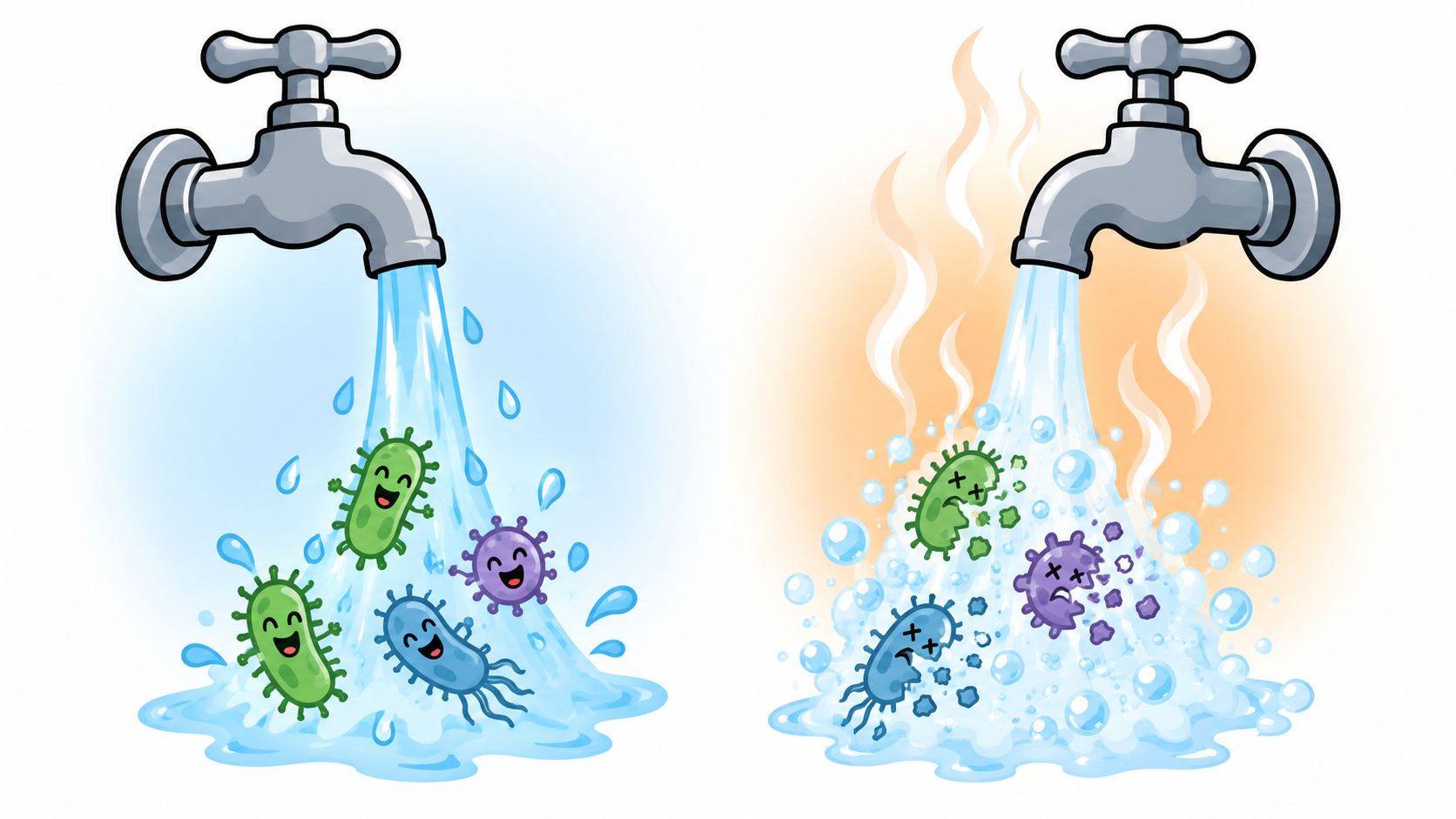
Warm tap water alone does not reliably kill bacteria. Meaningful thermal inactivation typically requires sustained heat above 60°C, while ordinary handwashing and shower water is usually much cooler.
That distinction matters in offices, gyms, schools, restaurants, retail stores, and other public facilities. A warm faucet can make soap more comfortable and help loosen oily soil, but it isn't a disinfectant. If a facility depends on warm water to sanitize a sink handle, workout bench, door pull, or shared terminal, it has a safeguard that was never reliable in the first place.
The practical answer to does warm water kill bacteria is therefore no, not at normal tap temperatures and not without sufficient contact time. A dependable sanitation program combines the right temperature where heat is appropriate, soap and friction for hands, chemical disinfection for surfaces, and clear procedures that staff and visitors can follow.
The Short Answer on Warm Water and Bacteria
Warm tap water by itself usually does not kill bacteria. Water in the approximate 35°C to 45°C range is comfortable for most restroom, kitchen, and fitness-facility users, but it falls well below the sustained temperatures used for validated thermal disinfection. One PubMed-indexed study found that water at 50°C had no effect on bacterial numbers, while 60°C for five minutes and 70°C or 100°C for any time period effectively killed E. coli (PubMed study on water temperature and bacterial survival).
That gap between comfort and disinfection creates a common operational mistake. A manager feels hot water at a sink and assumes the surface or hands are being sanitized. In reality, comfortable water may help dissolve grease, but it doesn't provide the heat, exposure time, or controlled process needed to make a dependable microbial-kill claim.
Three variables determine the outcome:
- Heat: Higher temperatures can inactivate bacteria, but only after reaching an appropriate threshold.
- Contact time: Water or a chemical product must remain in contact with the target for the required duration.
- Chemistry and friction: Soap, detergent, and disinfectant ingredients perform work that warm water alone cannot.
For handwashing, soap and rubbing do most of the practical work. For hard surfaces, cleaning removes soil, while an appropriate disinfectant provides the chemical inactivation step. Facility leaders should treat warm water as a comfort and cleaning aid, not as a substitute for disinfectant wipes, validated hot-water cycles, or proper hand hygiene.
What Temperature Actually Kills Bacteria
Bacterial inactivation is a temperature-and-time process. The same water temperature can produce different results depending on how long the target remains exposed, whether the water reaches every area, and whether organic soil shields the organisms.
The available evidence shows why ordinary “hot” tap water can mislead facility operators. The PubMed-indexed study cited above found no change in bacterial numbers at 50°C, but effective killing at 60°C for five minutes and at 70°C or 100°C for any time period (PubMed research on thermal bacterial inactivation). New York State public-health guidance reports that a 99.999% kill of waterborne microorganisms can be achieved at 65°C after five minutes, while boiling at 100°C for one minute is commonly used to inactivate most waterborne pathogens (New York State water-safety guidance).
| Temperature | Contact time | Approximate result | Common example |
|---|---|---|---|
| 50°C | Any ordinary exposure | May leave bacterial numbers unchanged | Warm tap or plumbing water |
| 60°C | Five minutes | Effective reduction reported for E. coli | Managed thermal process |
| 65°C | Five minutes | 99.999% kill of waterborne microorganisms reported | Public-health thermal treatment |
| 70°C | Any time period in the cited study | Effectively killed E. coli | High-temperature disinfection |
| 100°C | One minute | Common boiling treatment for most waterborne pathogens | Emergency water treatment |
These figures shouldn't be used to set a faucet temperature casually. Higher temperatures can create scalding hazards, damage materials, and require controlled storage, circulation, and flushing. CDC guidance for healthcare water systems recommends storing hot water above 60°C and circulating it above 49°C to suppress gram-negative waterborne bacteria such as Legionella (CDC healthcare water-system guidance). For facility operators researching environmental conditions alongside sanitation, a practical resource on indoor humidity below 50% tips can add useful context, although humidity control doesn't replace surface disinfection.
Water heaters set around comfortable or scald-limited temperatures aren't sterilizers. They may support a plumbing-control strategy when designed and managed correctly, but they shouldn't lead staff to skip detergent cleaning or chemical disinfection. For a separate explanation of the equipment and heat-transfer principles behind steam cleaning, see how steamers work.
Handwashing and the Real Role of Soap
Handwashing isn't designed to sterilize skin with heat. It reduces contamination by combining soap, friction, rinsing, and drying. Water temperature can be comfortable, but it isn't the main antibacterial mechanism at the sink.
Soap contains surfactants that interact with oils, soil, and microorganisms. During lathering, soap helps surround and lift oily material from the skin, while rubbing dislodges particles from palms, fingertips, thumbs, between the fingers, and beneath the nails. Running water then carries that loosened material down the drain.
The practical sequence is straightforward:
- Wet hands with clean running water at a comfortable temperature.
- Apply plain soap and cover all hand surfaces.
- Rub vigorously for 20 seconds, including the backs of the hands and between the fingers.
- Rinse thoroughly.
- Dry completely with a clean towel or an air dryer.
A study summary described by Medical News Today reports no significant difference in bacterial reduction between cold, lukewarm, and hot wash temperatures, and explains that water would need to be much hotter than skin can tolerate to kill microbes by heat alone (handwashing temperature and bacterial reduction). That makes comfort and skin protection operational concerns, not minor preferences. If water feels painfully hot, staff and visitors may shorten the wash or avoid washing properly.
Practical rule: Set handwashing water for comfort and compliance. Train people to spend their effort on soap coverage, friction, rinsing, and drying.
Plain soap is generally the sensible community choice. The important behavior is complete coverage and rubbing, not chasing hotter water or assuming an antibacterial label solves poor technique. Managers planning touchless upgrades can also review how sensor taps work, then pair the hardware with visible instructions rather than treating automation as a replacement for handwashing behavior.
Post the technique where people can see it. A concise sink poster should show the full hand surface, the 20-second scrub, and thorough drying. Staff who need a refresher can use this guide to proper hand hygiene techniques.
Laundry Dishwashing and Surface Cleaning
Hotter water doesn't automatically make every cleaning task safer or more effective. Each job has a different balance of detergent, mechanical action, dilution, temperature, and contact time.
Laundry illustrates the point. A cooler wash can remove soil when detergent, agitation, rinsing, and drying are properly controlled. A high-temperature cycle can reduce bacterial load, but the heat must be sustained and the textiles must tolerate it. Facilities handling linens or reusable cloths should follow the applicable laundry standard and manufacturer instructions rather than raising the thermostat on every load.
Dishwashing has a similar split. Manual washing uses detergent, rubbing, rinsing, and water that helps dissolve grease. A commercial dishwasher is a controlled process, and its final rinse can reach sanitizing temperatures specified by the equipment and applicable food-safety requirements. A sink filled with warm water isn't equivalent to that validated final rinse.
Surface cleaning is different again. Cross-contamination on a counter, handle, point-of-sale terminal, treadmill rail, or locker-room fixture occurs at ambient temperature. Increasing the room or tap temperature won't reliably solve it. Staff need to remove soil with the correct cleaner and use a disinfectant product for the required wet contact time.
| Cleaning task | Typical temperature | Contact time | Heat versus detergent |
|---|---|---|---|
| Handwashing | Comfortable running water | 20-second scrub | Soap and friction do most of the work |
| Routine laundry | Cool to warm cycle | Full wash cycle | Detergent, agitation, and rinsing remove soil |
| High-risk textile processing | Above 60°C where the process requires thermal reduction | Sustained exposure | Heat matters only when the cycle is controlled |
| Manual dishwashing | Warm water that supports grease removal | Washing and rinsing process | Detergent and mechanical action dominate |
| Commercial dishwashing | Controlled hot wash and final rinse | Equipment-defined cycle | Heat and chemistry work together |
| Hard-surface disinfection | Ambient or comfortable conditions | Product label contact time | Chemical action, coverage, and wetness matter |
Managers should avoid turning up thermostats without a defined purpose. Excess heat can waste energy, damage fabrics or finishes, and increase scald risk while leaving high-touch surfaces inadequately disinfected. The better question is not whether a task feels hot. It is whether the facility has a controlled process that matches the soil, material, organism risk, and required contact time.
Where Disinfecting Wipes Change the Outcome
Warm water fails as a surface disinfectant because it doesn't deliver enough heat for long enough. EPA-registered disinfecting wipes change the process by using a chemical active ingredient, combined with physical wiping, instead of relying on thermal killing.
The label controls the result. One EPA-registered wipe label requires users to keep a hard, non-porous surface visibly wet for a one-minute contact time and says to use enough wipes to maintain wetness throughout that period (EPA disinfectant wipe label). Don't wipe a treadmill handle until it looks damp and immediately dry it with a towel. Apply enough product to cover the surface, keep it visibly wet for the stated time, and follow any rinsing direction.

Match the wipe to the surface
High-touch targets deserve priority because people repeatedly handle them. CDC cleaning guidance identifies surfaces such as bedrails and sink handles in healthcare settings, while its facility guidance includes frequently touched electronics such as phones and computers (CDC environmental-cleaning procedures, CDC cleaning and disinfecting guidance for facilities).
In a gym, place gym equipment wipes beside treadmills, weight machines, bikes, benches, locker-room touchpoints, and shared mats. For an office, focus on door handles, shared keyboards, phones, breakroom appliances, and conference-room controls. Schools, restaurants, and retail stores should map their own high-touch points, including checkout terminals, carts, tables, faucet handles, and shared devices.
A product's instructions matter more than its marketing name. A baby wipe may remove visible residue but doesn't carry a disinfectant claim. An EPA-registered disinfecting wipe should be used according to its label, with attention to surface compatibility, ventilation, gloves, and food-contact instructions. Some EPA-labeled sanitizer wipes can sanitize hard, non-porous food-contact surfaces in 60 seconds with no rinse required, making them useful for fast-turnover commercial settings when the label applies (EPA food-contact sanitizer wipe label).
For facility-grade options, managers can review the wipes.com disinfecting wipe range, including formats suited to shared equipment and rapid turnover. Additional commercial disinfection insights from Arelli Cleaning can help teams think through broader surface programs.
Signage Training and Facility Protocols
A dispenser helps only when people notice it, understand its purpose, and use the product correctly. Facility leaders should make the desired behavior visible at the point of action, then give staff a written process they can perform consistently.
Place a handwashing poster at every sink. On a fitness floor, mount the gym wipe dispenser beside the equipment it serves, not across the room or inside a locked supply closet. In a restaurant, put the cleaning instruction near the prep station. In a retail store, keep the procedure close to the checkout area and shared handheld devices.
A practical signage set includes:
- Entrance reminders: Prompt respiratory etiquette and hand hygiene before visitors enter.
- Restroom posters: Show soap coverage, rubbing, rinsing, and drying beside the sink.
- Fitness-floor decals: Display the wipe, wait, and discard sequence beside equipment.
- Breakroom visuals: Remind staff to clean shared appliance handles and controls.
- Staff-area checklists: Keep daily duties where employees clock in or collect supplies.
The supplied visual asset should appear with the exact URL provided for facility-protocol planning.
Train the routine, not just the rule
Use regular training touchpoints to demonstrate contact time, glove use, surface compatibility, and the difference between cleaning and disinfecting. Show employees what “visibly wet” means, when one wipe isn't enough, and why they shouldn't mix chemicals or transfer a wipe between unrelated surfaces.
A useful audit checks behavior rather than only logged labor hours:
- Are signs present, readable, and positioned at the point of use?
- Are dispensers stocked and accessible?
- Do employees follow the stated contact time?
- Do supervisors observe correct hand hygiene and wipe technique?
- Are procedures updated and training current?
Clear signage costs less than repeatedly correcting an invisible process. It also gives customers a visible signal that the business manages cleanliness deliberately, whether the setting is an office, school, gym, restaurant, or retail store.
Building a Real Sanitation Program
A dependable program doesn't ask one method to do every job. It assigns each layer a specific purpose and gives a named person responsibility for carrying it out.
Layer one is controlled temperature. Use appropriately hot wash and dish cycles where the process requires thermal reduction, and verify that equipment settings and material instructions support the chosen cycle. Don't treat a warm faucet as a disinfection system.
Layer two is hand hygiene. Provide comfortable running water, plain soap, drying supplies, and clear instructions. Supervisors should reinforce complete coverage and the 20-second scrub rather than telling staff to turn the handle hotter.
Layer three is surface disinfection. Use approved wipes on high-touch, hard, non-porous surfaces. In a fitness center, that includes equipment handles, benches, adjustment levers, touchscreens, and shared accessories. A facility may use fitness wipes, gym equipment cleaning wipes, or another label-approved format, provided staff follow the product directions.
Layer four is visible compliance. Put dispensers, signs, schedules, and checklists where the work occurs. Assign opening, mid-shift, and closing responsibilities according to the facility's traffic and risk profile, then record completion in a way supervisors can verify.

Turn the layers into shift work
An office team might wipe shared meeting-room controls, door handles, phones, and kitchen touchpoints during scheduled resets. Gym staff can place wipes for gym equipment at each activity zone and check dispenser stock during every floor walk. A school can prioritize classroom touchpoints, shared technology, and restroom fixtures. Restaurants should separate food-contact procedures from general high-touch cleaning and follow the applicable label directions.
Use a weekly audit to review missed tasks, empty dispensers, damaged signage, unsuitable products, and observed contact-time errors. Sales professionals can explain this layered model when presenting commercial disinfecting wipes: the value isn't a vague promise of “more hygiene.” It's a practical way to close the gap between visible cleaning and validated disinfection, support staff consistency, and make sanitation easier for customers to see.
For facility managers: Warm water supports comfort. Soap supports hand hygiene. Controlled heat supports selected wash processes. Disinfectant wipes handle the high-touch surface step that warm water can't.
Prioritize cleanliness as a daily operating practice, not a temperature setting. Equip each work area with the right sanitizing wipes, clear instructions, and a replenishment plan, then review the routine with staff and customers at wipes.com to select suitable products for your facility or cleaning-supply offering.
Start today by mapping your highest-touch surfaces, placing the appropriate disinfectant wipes beside them, and training every shift to follow the full label contact time.
Leave a Reply