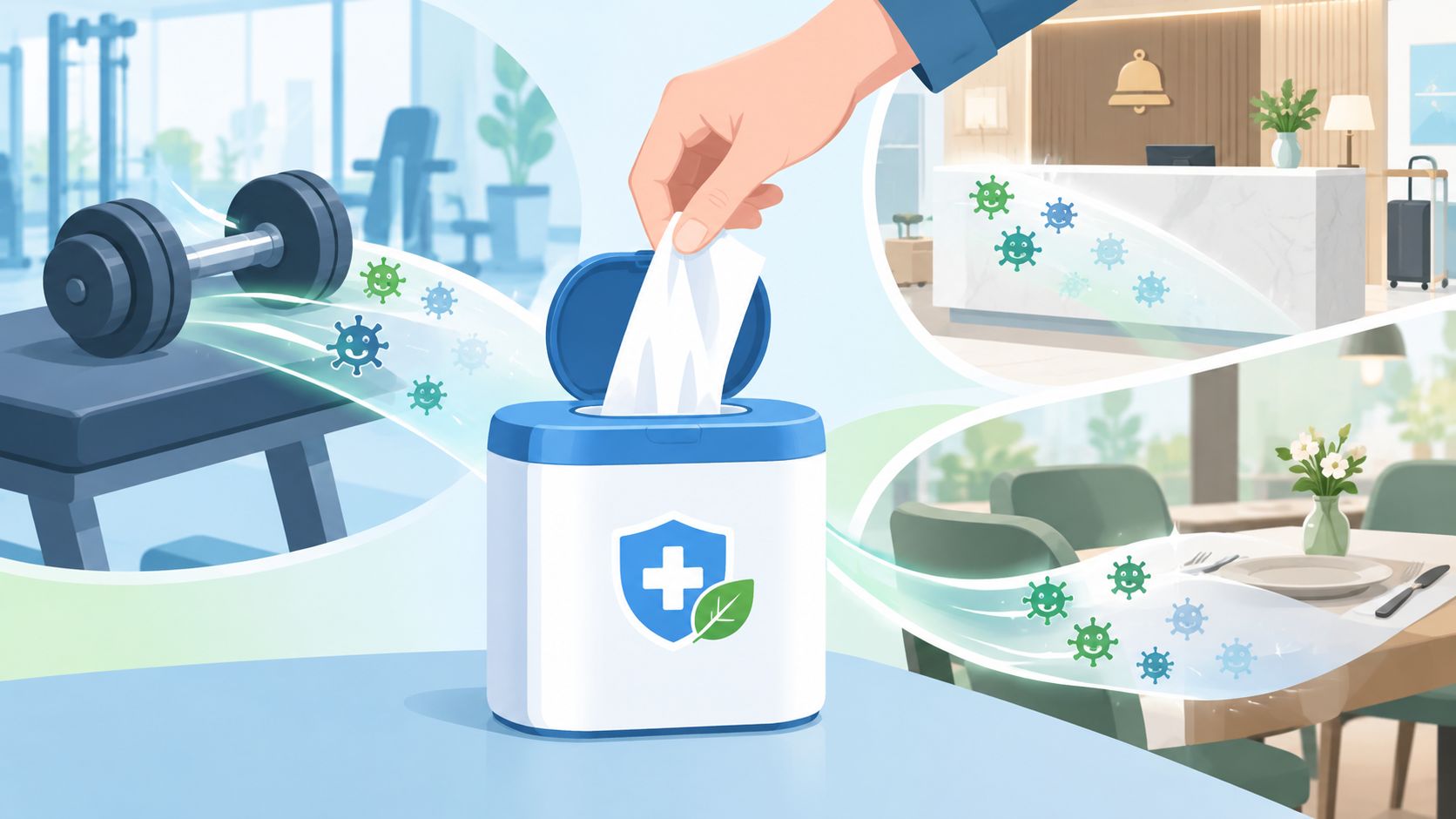
A staff member arrives before opening, pulls a tub of antibacterial disinfectant wipes from the supply closet, and makes a fast circuit of the front desk, payment terminal, door handle, and shared screen. At a gym, the same routine happens between classes, with someone wiping dumbbell handles and benches while members are already waiting for the next session. The surface looks clean. The operational question is whether it was disinfected.
That distinction matters in offices, schools, restaurants, retail stores, hotels, and fitness centers. Cleaning removes soil and many germs. Disinfecting wipes add a tested antimicrobial step, but only when the product is used according to its label. A rushed wipe that dries immediately may improve appearance without meeting the product's kill claim.
For facility operators, the purchase decision isn't about price per canister. It's about contact time, wetness retention, surface compatibility, staff behavior, and throughput. Choose the wrong formula or place it too far from the point of use, and even a compliant product can perform poorly in daily operations.
Why Cleanliness Is a Commercial Strategy
A front desk can look spotless while the disinfection step fails. An employee wipes the counter, keyboard, phone, badge reader, and pen cup before opening, then moves toward the entrance. In a gym, the same worker may cover check-in points, locker-room touchpoints, water stations, and equipment rows between rushes. The decision that matters is whether each surface stayed wet long enough for the product's claim to apply.
EPA-registered disinfectants are tested against listed microorganisms under specific label directions. For hard, non-porous surfaces, the treated area generally must remain visibly wet for the stated contact time. One EPA-registered wipe label specifies one minute and requires enough product to keep the surface visibly wet throughout that interval (EPA product label). If the surface dries in seconds, the operator has missed the label condition, even when the counter appears clean.

Visible hygiene influences trust
Customers notice cleaning signals. A wipe dispenser beside treadmills, an employee cleaning tables between parties, or an associate wiping a payment keypad shows that the facility is being managed during operating hours. Those cues support confidence, but they do not replace effective kill performance.
The purchase decision should connect contact time, wetness retention, surface compatibility, single-pass use, and cost per wipe. A wipe that keeps a surface wet longer may support the label claim but slow throughput. A thinner, cheaper wipe may dry quickly, require a second pass, or force staff to use more sheets. Select the product and dispenser placement together, then test the routine on real high-touch surfaces.
Market estimates show sustained demand for disinfectant wipes across institutional, commercial, and consumer settings. Data Bridge Market Research estimates the global market at about USD 4.33 billion in 2022, reaching USD 6.64 billion by 2030 at a 5.5% CAGR (Data Bridge Market Research). The figures support treating wipes as an operating supply, not an occasional specialty purchase.
Operational rule: Buy for the real workflow. Confirm the label contact time, verify that the wipe remains wet across the intended area, and budget for enough sheets to prevent rushed single-pass use.
Managers who need structured staff education can find infection control CE courses. Training should show employees why a dry, rapid pass may improve appearance without satisfying the product's stated claim.
What Antibacterial Disinfectant Wipes Actually Are
Treat a wipe as a three-part system, not as a wet paper towel. The substrate provides the material and friction. The active chemistry targets microorganisms. The contact-time claim defines how long the treated surface must remain wet for the tested performance to apply.
The substrate affects how the wipe behaves in a worker's hand. A thin sheet may tear around textured rubber grips or become overloaded quickly when it picks up sweat, oil, dust, and other soil. A stronger nonwoven substrate can support a single-pass method across a defined surface area, but it may cost more per wipe.
The liquid matters just as much. Active ingredients can include alcohol, benzalkonium chloride, bleach, or hydrogen peroxide. Each family brings different trade-offs involving evaporation, odor, material compatibility, residue, and the microorganisms named on the label.

Match the claim to the job
The word antibacterial generally centers on bacterial claims. Disinfectant wipes can carry broader claims against bacteria, viruses, and sometimes fungi, depending on the registered product and its label. Sanitizing wipes are intended for a different performance standard and may reduce microorganisms without carrying the same disinfection claim.
That difference isn't cosmetic. EPA labeling can distinguish sharply between sanitizing and disinfecting. One example label specifies five minutes for disinfection but 15 seconds for sanitizing and deodorizing on hard, non-porous surfaces (EPA label example).
Buyers should therefore ask three questions before ordering:
- What must the product kill? Check the microorganisms listed on the label.
- How long can staff keep the surface wet? A long dwell time may conflict with rapid equipment turnover.
- Where will the wipe be used? Electronics, painted metals, plastics, rubber, and food-contact surfaces need separate compatibility checks.
An EPA registration number supports the product's documented claims, but it doesn't make every wipe suitable for every surface or workflow. The label remains the operating instruction.
Active Ingredients and How They Perform
No single chemistry suits every facility. A gym needs low residue and material compatibility on rubber equipment. A restroom may require a broader registered claim. Food-service areas need a formula and process that follow food-contact directions, including any required rinse.
Real-world performance can fall short of the EPA label when staff use one quick pass and the wipe dries before the stated contact time. An EN 16615 study found major formulation differences. At 30 seconds, a benzalkonium chloride-based wipe was ineffective against E. coli and S. aureus in that test, while other products achieved more than a 5-log reduction within 60 seconds (PubMed). Wetness retention, single-pass coverage, and throughput therefore matter as much as the active ingredient.
| Active Ingredient | Kill Spectrum | Typical Contact Time | Surface Compatibility | Odor |
|---|---|---|---|---|
| Benzalkonium chloride and other quats | Depends on the registered label and target organism. Formulation affects performance. | Use the exact label time. A rapid staff pass may be inadequate. | Often practical for general hard surfaces, but check residue and material directions. | Usually less sharp than bleach, though formulation and fragrance vary. |
| Alcohol | Commonly chosen for fast evaporation and broad antimicrobial utility. | Often useful where rapid turnaround matters, but the label controls. | Can affect some plastics, acrylics, coatings, and finishes. Test sensitive materials. | Evaporates quickly, with a noticeable alcohol odor. |
| Sodium hypochlorite | Strong chemistry with broad disinfection potential under registered claims. | Follow the specific label. | Can be aggressive toward metals, fabrics, and colored materials. | Chlorine odor is pronounced. |
| Hydrogen peroxide | Useful when broad claims and lower persistent residue are priorities. | Follow the specific label and wetness requirement. | Check metals, coatings, and manufacturer compatibility guidance. | Often less persistent than chlorine, but formulation matters. |
Choose quats, alcohol, hypochlorite, or peroxide only after matching the label claim to the actual job. A quat may control residue and odor better, yet fail the workflow if staff cannot maintain wetness. Alcohol can support fast turnover, but may damage sensitive finishes. Hypochlorite offers strong disinfection potential, with greater material and odor trade-offs. Hydrogen peroxide may leave less persistent residue, but still requires label-compliant wetness.
For a clearer explanation of quaternary ammonium compounds, review how quat chemistry works before standardizing a product. Then test the wipe on representative surfaces, measure how long one pass keeps them visibly wet, and calculate cost per usable wipe rather than cost per container. A product that needs repeated passes or leaves equipment out of service can cost more than its purchase price suggests.
High-Touch Zones and Cleaning Frequency
A facility doesn't need a complicated chart to identify priority surfaces. Start with the places hands repeatedly touch, then adjust the schedule to traffic, visible soil, and the consequences of contamination.
CDC guidance identifies light switches, countertops, handwashing sinks, and cupboard doors as high-touch surfaces and recommends cleaning them at least once every 24 hours (CDC cleaning procedures). That is a baseline, not a ceiling for a busy commercial site.

Build the schedule around use
Use this practical allocation:
- Offices: Wipe check-in counters, shared keyboards, phones, badge readers, elevator buttons, and door push plates at every shift change, with more frequent attention during heavy visitor periods.
- Gyms: Provide gym equipment cleaning wipes at each equipment zone. Prioritize dumbbell handles, machine grips, benches, touchscreens, locker handles, water-bottle fillers, and shared mats. Wipe between users where feasible, and replenish stations before they run empty.
- Schools: Focus on door handles, desk surfaces, shared devices, restroom fixtures, cafeteria tables, and light switches. Staff should increase attention after visibly soiling or illness-related incidents.
- Restaurants: Clean tables and payment keypads between uses where practical. Follow the product label for food-contact surfaces, including any potable-water rinse requirement.
- Retail: Prioritize baskets, carts, fitting-room touchpoints, payment terminals, counters, and entrance hardware.
CDC home and early-care guidance supports cleaning high-touch surfaces regularly and cleaning more often or adding disinfection when an area is used frequently (CDC home cleaning guidance).
Separate soil removal from disinfection
A single wipe can work for a lightly soiled hard surface when the label permits that use. Visible grease, sweat, food residue, or dirt changes the process. Clean first, then disinfect, because soil can interfere with the active solution and a loaded wipe can transfer organisms.
Independent research found that wipes may cross-contaminate hard, non-porous surfaces and retain viable bacterial cells after use, particularly across larger areas (Purdue dissertation). Use a fresh wipe for each defined zone, don't stretch one sheet across multiple high-risk stations, and keep the treated surface visibly wet for the full label time.
Matching Wipes to the Right Facility
The right wipe depends on the facility's surfaces, pace, and contamination profile. Buying one formula for every room usually creates avoidable problems, such as alcohol evaporating too quickly on a large counter or bleach damaging a metal fixture.
| Facility Type | Recommended Active Family | Substrate / Format | Typical Contact Time |
|---|---|---|---|
| Office | Alcohol or quat, selected against the surface mix and label claims | Medium-strength wipe for counters, phones, keyboards, and shared devices | Use the registered label time and confirm wetness on electronics-safe surfaces |
| Gym or fitness center | Quat or hydrogen peroxide when compatible with equipment materials | Durable, low-lint fitness wipes for rubber grips, benches, and touchscreens | Choose a time staff can maintain between users |
| School | Formula matched to desks, devices, and restroom surfaces | Tear-resistant wipe with controlled dispensing | Follow the label, with added cleaning when soil is visible |
| Restaurant | A product specifically labeled for food-contact use | Low-lint format with a clear rinse workflow where required | Follow the food-contact instruction, not the general surface time |
| Retail store | Alcohol or quat based on plastics, payment devices, and counters | Compact canister or wall-mounted dispenser | Select a realistic time for opening and shift routines |
| Short-term rental | Quat or peroxide based on surface compatibility | Large-format wipe for rapid turnover, with separate cleaning supplies for heavy soil | Confirm the label time fits the turnover process |
| Automotive detailing | Formula tested on dashboards, controls, plastics, and coated surfaces | Low-lint, non-scratching substrate | Use the label time and test delicate finishes first |
Gyms need durability and access
Fitness facilities are the strongest use case for wipes for gym equipment because members move between shared surfaces quickly. A wipe that tears on a textured handle or dries before a full machine console is covered creates extra labor and weakens the routine.
Place a gym wipe dispenser within arm's reach of equipment clusters, not behind the reception desk. If the site needs a larger replenishment program, compare bulk gym wipes by usable wipe, wetness retention, dispenser waste, and labor, not by tub price alone. A lower-priced sheet isn't cheaper if staff need two or three to complete one station.
Food service requires a different decision. Never assume a general-purpose antibacterial product is suitable for a dining surface. Confirm the label, use a no-rinse formula only when the label explicitly permits it, and train staff to complete any required rinse step.
Safety, Storage, and Responsible Disposal
A wipe program can protect surfaces while creating damage if the chemistry doesn't match the material. Alcohol may cloud acrylic and some plastics. Bleach and hydrogen peroxide can affect metals, coatings, and fabrics. Quats are often gentler on common hard surfaces, but they can leave residue and odor, so the product label and a small compatibility test should guide the choice.
Don't approve a product based on the active ingredient alone. Ask the vendor for surface compatibility information, test it on a concealed area, and document approved uses for electronics, rubber, vinyl, painted metal, stainless steel, acrylic, and food-contact surfaces.
Store products as operational chemicals
Keep tubs and refill containers sealed when not in use. Store them in a moderate-temperature area away from direct sunlight, heat, and ignition sources, especially for alcohol-based products. Rotate inventory so older stock is used first, and inspect lids and dispensing openings for drying or contamination.
Staff should follow the product's safety data sheet and label directions. Gloves, ventilation, and hand hygiene may be appropriate depending on the chemistry, exposure, and task. For procedures involving blood or other potentially infectious materials, a dedicated ProMed Certifications safety guide can help supervisors reinforce precautions beyond routine surface wiping.
Never flush used wipes
Used antibacterial wipes belong in the appropriate waste stream unless the facility's waste contractor specifies another process. “Flushable” marketing doesn't guarantee sewer or septic safety. Independent research links improper wipe disposal with sewer blockages, landfill burdens, and microplastic pollution, and reports that 50% of wipes labeled flushable contain PET, a non-degradable plastic associated with microplastic fibers (Royal Society of Chemistry research).
High-volume facilities face a real sustainability trade-off. Single-use wipes simplify rapid turnover and reduce the risk of reusing a contaminated cloth, while reusable microfiber programs can reduce disposable waste when laundering, segregation, and quality control are reliable. Choose the system your team can execute consistently, then manage the resulting waste.
Procurement Checklist for Facility Buyers
A buyer should reject any wipe that looks inexpensive only because the calculation ignores waste, rework, or failed contact time. Put each candidate through the same scorecard before approving a contract.
Start with the label. Verify the EPA registration number, not merely an establishment number, and check the registered product's target microorganisms, surfaces, application directions, and contact time. The EPA registration identifies the product and its approved claims. The establishment number identifies where a product was produced, so it isn't a substitute for registration verification. This EPA registration number guide can help purchasing teams interpret the distinction.

Use a scorecard, not a sample tub
Give each candidate a simple rating from poor to strong, then require written evidence for every rating:
- Kill spectrum: Does the label cover the organisms relevant to the facility?
- Surface compatibility: Does the vendor identify safe use on the actual materials in your building?
- Contact time: Can employees keep surfaces visibly wet at the operating pace?
- Substrate quality: Does the wipe resist tearing, linting, and premature drying?
- Dispenser ergonomics: Can staff pull one wipe with one hand at the point of use?
- Total landed cost: Include freight, refills, discarded dry wipes, labor, and the number of wipes used per zone.
- Vendor reliability: Review lead times, documentation, refill availability, training support, and response quality.
Test the product through a full canister rather than approving it from one fresh sample. Check whether the first and last wipes deliver comparable wetness, whether the lid closes securely, and whether staff can use the dispenser without touching multiple sheets.
The winning product isn't necessarily the cheapest wipe. It's the one that delivers the required claim on the required surface under the actual workflow.
Turning Hygiene Into a Competitive Edge
Cleanliness becomes commercially valuable when customers can see the routine and staff can repeat it without disrupting service. A gym member notices a wipe station beside the cable machines. A parent notices a school employee cleaning shared tables. A restaurant customer notices the payment terminal and table being handled deliberately, not casually brushed aside.
Those signals support different business outcomes. Members are more likely to trust a facility that visibly maintains shared equipment. Parents want evidence that common touchpoints receive attention. Restaurant guests judge the overall operation through the condition of tables, menus, counters, and restrooms. Retail shoppers form similar impressions at carts, baskets, fitting rooms, and payment stations.
Sell hygiene as operating value
Sales professionals should stop presenting wipes as a commodity carton. Position the program around:
- Guest confidence: Dispensers and documented routines make cleaning visible.
- Labor control: A wipe at the point of use reduces trips to a janitorial closet.
- Workflow fit: A realistic contact time prevents staff from choosing between compliance and customer throughput.
- Supply integration: Pair wipes with dispensers, gloves, liners, surface cleaners, signage, and refill planning.
- Accountability: A supervisor can audit whether stations are stocked and whether staff follow the label.
The market's scale supports treating disinfectant wipes as a recurring facility supply rather than an emergency-only purchase. For teams comparing commercial disinfecting wipes, the key question is not whether the category is established. It's whether the selected product fits the facility's surfaces and service rhythm.
Run one practical audit this week. Choose the three highest-traffic stations, place dispensers within arm's reach, observe whether staff use a fresh wipe for each defined zone, and compare actual wetness retention with the product label. Record where the routine breaks, then adjust the product, dispenser location, training, or schedule.
Prioritize cleanliness as a daily operating standard. Add appropriate antibacterial disinfectant wipes to the places people touch most, train staff to clean and disinfect according to the label, and review your supply offering or facility routine after the first week of use.
Visit WipesBlog.com for practical sanitation guidance, then make your next purchasing decision around verified claims, realistic contact time, durable substrates, and responsible disposal.
Leave a Reply