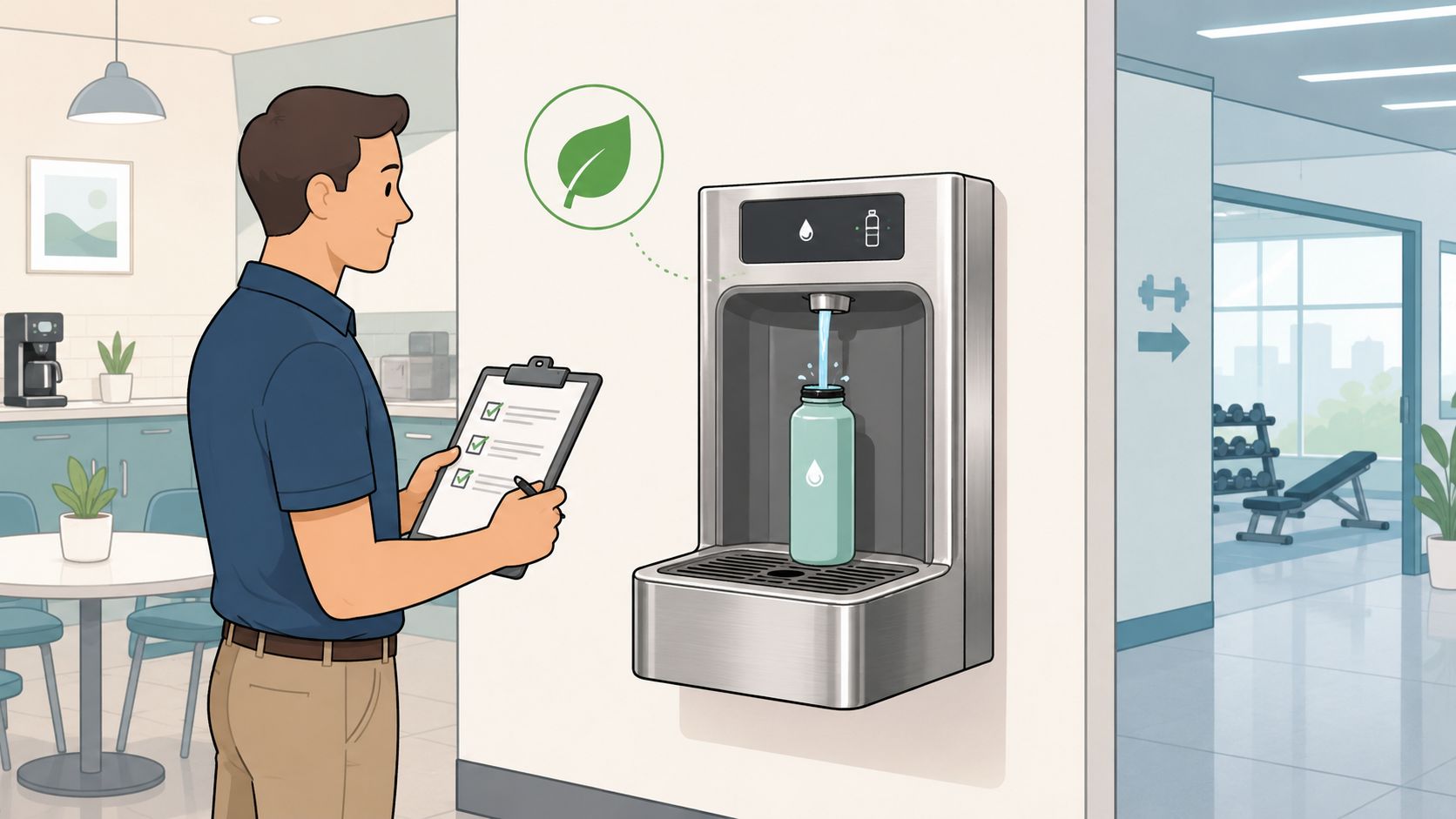
A guest walks up to your hydration station before they ever speak to your staff. That moment matters more than most operators admit.
If they see a stained basin, mineral buildup around the nozzle, a sticky activation area, or a drip tray holding yesterday's grime, they don't just judge the fixture. They judge your standards. In a gym, that affects member confidence. In an office, it shapes workplace perception. In a school, airport, or event venue, it can reduce use because people don't trust what looks neglected.
A modern water bottle filler can solve that problem, but only if you treat it as a visible hygiene asset. The units that work best in commercial settings do three jobs at once. They provide convenient hydration, reinforce a cleaner brand image, and support sustainability goals. The ones that fail usually don't fail at purchase. They fail in daily upkeep.
Your First Impression Starts at the Water Cooler
A new gym member tours the space. They notice the equipment, the locker rooms, the front desk, and then they stop at the hydration area. If the old fountain is scratched, wet, and discolored, it sends a simple message. Nobody owns this detail.
Replace that with a clean, well-lit water bottle filler, and the signal changes immediately. The fixture looks current. The refill process feels more sanitary. The station supports the member's routine instead of interrupting it. That's not cosmetic. It's operational branding.
In offices, the same thing happens with clients and employees. In public buildings, visitors use visible cues to decide whether they trust the water point at all. If you're reviewing your broader hydration setup, this guide for office water systems is a useful reference for comparing how different drinking water options fit different facility types.
What people really notice
Most users don't evaluate the plumbing specification. They notice three things:
- Surface condition: Smears, water spots, dust, and scale make the whole station look unsanitary.
- Ease of use: If the bottle opening aligns cleanly and fills without splash, the station feels well designed.
- Location quality: A filler tucked into a dark corridor won't inspire confidence, even if the unit is technically sound.
A water bottle filler is one of the few plumbing fixtures people inspect at eye level while deciding whether to put something they'll drink into it.
That's why old thinking causes problems. If operations teams treat hydration points like background infrastructure, they often get cleaned only when someone complains. High-performing facilities do the opposite. They put bottle fillers on the same visible-cleanliness standard as lobby glass, restroom touchpoints, and reception counters.
Why this fixture carries brand weight
Hydration stations sit at the intersection of health, convenience, and trust. That gives them outsized influence. A clean station suggests the building is cared for. A dirty one suggests standards slide when nobody's looking.
For janitorial teams and facility managers, the takeaway is simple. Don't classify the water bottle filler as “just plumbing.” Classify it as front-facing guest experience equipment.
The Dual Benefits of Modern Hydration Stations
Modern hydration stations earn their place for two practical reasons. They improve how people experience the facility, and they turn a sustainability goal into something visible.
The first benefit is perception. A clean bottle filler tells users your facility supports healthier habits and current expectations. In gyms, that aligns with wellness. In offices, it supports employee comfort. In schools, transportation hubs, and retail environments, it shows management has upgraded beyond the bare minimum.
The second benefit is measurable waste reduction. A single water bottle-filling station can save about 15,000 bottles and 327 pounds of plastic from landfills each year, according to FacilitiesNet's reporting on bottle filler adoption. The same source notes that 80% of purchased plastic water bottles end up in landfills, only 23% of disposable plastic bottles are recycled, people throw away more than 60 million plastic water bottles daily in the U.S., and plastic bottles can take about 450 years to decompose.
Why the business case is stronger than it looks
Those numbers matter, but the business case isn't only about landfill diversion. It's about what a visible refill station lets you say and show:
- You support reuse: Guests can see that your facility makes refill behavior easier.
- You modernize common areas: A bottle filler often upgrades the look of an aging corridor, lobby, or workout floor.
- You reduce friction: Users carrying bottles don't need to tilt, hold, or guess where to place them.
A lot of operators also overlook the water quality side of the decision. If your facility is comparing treatment approaches before selecting a station, this overview of commercial water purification systems helps frame filtration as part of the guest experience, not just a back-of-house technical choice.
What works and what doesn't
What works is pairing the sustainability message with visible cleanliness. Users respond to a filler that looks maintained, fills quickly, and appears intentionally placed.
What doesn't work is installing a nice unit and then letting scale collect around the nozzle or the drain. Once that happens, the sustainability benefit stays on paper, but guest confidence drops in real time.
Practical rule: If people hesitate before using the station, the ROI is already underperforming.
That's why the best bottle filler programs are run jointly. Facilities handles uptime. Janitorial owns visible condition. Leadership uses the station as a simple proof point that the building invests in health and cleanliness.
How to Select the Right Water Bottle Filler
Buying the wrong unit creates years of avoidable frustration. Most selection mistakes happen because teams shop by appearance first and operating conditions second. Start with the use case. Then match the hardware.

Start with activation and user contact
For most commercial and public settings, sensor-activated dispensing is the better hygiene choice because it reduces touchpoints. Mechanically activated options still have a place, especially where you want simpler controls or a familiar user interface, but they create an extra cleaning responsibility because the button or lever becomes a repeat-contact surface.
Modern commercial units are commonly built around laminar flow and either sensor-activated or mechanically activated dispensing, as shown in manufacturer specifications from Murdock and comparable commercial bottle filler designs. That matters in practice because laminar flow reduces splash and helps bottles fill more cleanly.
When you're choosing between touchless and manual, ask one blunt question. Will your staff reliably disinfect the contact point throughout the day? If the answer is uncertain, lean touchless.
Pay attention to filtration and operating load
Filtration is where many buyers either overspend on the wrong feature or underspec the unit for traffic. A common commercial specification includes NSF 42/53 filtration for lead, particulate, chlorine, taste, and odor reduction, along with 3,000-gallon filter capacity. Some non-refrigerated wall-mount units are also listed at 15 rated watts and 2 full-load amps, based on Elkay product specifications summarized here.
That combination matters for two reasons:
- Lower electrical demand: Non-refrigerated models can be easier to operate in high-traffic facilities where simplicity matters.
- Longer service intervals: Higher-capacity filters reduce how often staff need to change cartridges.
Not every facility needs chilled water. In a climate-controlled office, a non-refrigerated filler may be perfectly acceptable. In a gym or sports environment, user expectations may push you toward refrigerated options if comfort and perceived premium experience matter.
Choose materials your staff can actually keep clean
Stainless steel usually wins in commercial settings because it's durable and easier to wipe down without looking worn too quickly. The bigger issue, though, isn't the material itself. It's the design geometry.
Look for:
- Smooth transitions: Fewer seams and ledges mean fewer places for grime to sit.
- Accessible drip areas: If the drain or tray is hard to reach, cleaning quality will decline.
- Clear sensor placement: Staff should be able to wipe the sensor zone without guessing where it is.
Match the unit to your maintenance reality
A good buyer's checklist is short:
- Traffic level: Light office use and heavy gym use don't need the same configuration.
- Cleaning capacity: Touchless helps if your cleaning schedule is tight.
- Water quality concerns: Filtration should address trust and taste issues users notice.
- Service access: If filter changes and inspections are awkward, maintenance gets deferred.
The right water bottle filler is the one your team can keep clean, keep trusted, and keep running without drama.
Strategic Siting and Installation Planning
Placement drives usage. A bottle filler can have the right spec sheet and still underperform if you hide it, crowd it, or install it where people don't feel comfortable stopping.

A randomized trial in Philadelphia recreation centers found that installation alone wasn't enough. Adoption increased significantly when the new hydration stations were paired with visible trust-building steps such as publicly sharing water-safety test results and distributing reusable bottles, as reported in this Philadelphia hydration station study. That finding matters far beyond recreation centers. It shows that design and transparency drive actual use.
Put the station where trust is easiest
The best locations are visible, clean, and predictable. In gyms, that often means near the workout floor entrance, locker corridors, or group training areas. In offices, breakrooms and main circulation points work better than isolated back hallways. In event venues, place fillers where people naturally pause instead of where they have to hunt.
Poor siting usually has one of these problems:
- Low visibility: Users won't adopt what they don't notice.
- Questionable surroundings: A filler near trash overflow or restroom congestion loses trust immediately.
- Bottleneck placement: If users block circulation while filling, they'll avoid the station during busy periods.
If you're evaluating fixture formats before procurement, looking at a commercial example can help you think through mounting and layout options. This product page for a buy a bottle filler fountain setup is a practical reference point for how combined fountain and bottle filler units fit different spaces.
Installation planning should include behavior, not just utilities
A licensed installer will handle water supply, drainage, and electrical requirements. Operations still needs to answer a separate set of questions:
- Can users approach the unit without crossing a mess-prone zone?
- Will the fixture stay visible from staffed or regularly patrolled areas?
- Is there enough wall and floor clearance for cleaning tools and service access?
If users can't tell whether the station is cared for, many of them will default back to packaged drinks.
Visible trust cues help. Post water quality information where appropriate. Keep lighting strong. Don't let promotional signs clutter the station. The filler should look intentional, not leftover.
A Sanitation Protocol Your Guests Will Notice
Most water bottle filler problems don't begin as technical failures. They begin as cleaning failures that become trust failures.
A station can dispense safe water and still lose users if the nozzle area looks spotted, the sensor is smeared, or the drain smells off. Manufacturer guidance also points to practical issues such as low flow from clogged lines and off-tastes from improper filter sealing, all of which can turn a high-visibility amenity into a source of complaints, as noted in Elkay's bottle filling station guidance.

Clean what people see first
Staff often focus on the obvious front panel and miss the zones that shape confidence most quickly. Prioritize the surfaces users stare at while filling:
- Nozzle area: Wipe away mineral spotting and residue before it becomes visible buildup.
- Sensor or activation button: Treat this as a high-touch point, especially on manual models.
- Bottle rest and splash zone: Water stains accumulate fast here.
- Drain or drip tray: This area drives odor and “unclean” impressions more than operators expect.
- Surrounding wall surface: Splashes and fingerprints on the wall make the whole station look neglected.
For a reliable, fast-acting solution, we recommend Wipes.com Disinfectant Wipes, which are designed for high-touch surfaces in commercial settings.
Build a schedule that prevents decline
Don't wait for visible grime. Set a routine by frequency and assign ownership clearly.
| Frequency | Task | Focus Area |
|---|---|---|
| Daily | Wipe and disinfect visible touchpoints and exterior surfaces | Sensor, button, nozzle surround, front panel |
| Daily | Remove splashes and standing moisture | Bottle rest area, basin edge, surrounding wall |
| Daily | Check for odor, residue, or slow drainage | Drain or drip tray |
| Weekly | Inspect for scale, film, and finish wear | Nozzle area, seams, corners, stainless surfaces |
| Weekly | Confirm operation feels normal | Activation response, flow pattern, splash control |
| Monthly | Inspect service condition | Filter fit, leaks, line condition, signs of clogging |
Use wipes the right way
Disinfectant wipes save time, but only when staff use them correctly.
- One wipe, one zone: Don't clean the drain and then wipe the nozzle with the same wipe.
- Let the surface stay wet as directed by the product label: If staff wipe dry immediately, they may remove the disinfectant before it does its job.
- Work clean to dirty: Start with the sensor and panel, finish with the drain area.
- Restock nearby: If wipes are stored far from the station, compliance drops.
Teams that need a broader process for adjacent hydration equipment can also use this walkthrough on how to clean a water dispenser as a companion reference.
On-the-ground advice: If your team only has time for one mid-day pass, clean the user-facing top half first. That's what people inspect while deciding whether to use the station.
A smart sales angle for cleaning teams
If you sell janitorial services or cleaning supplies, bottle fillers are a strong conversation starter because the ROI is easy for clients to understand. The pitch isn't “we wipe another surface.” The pitch is “we protect a high-visibility trust point.”
Frame it this way:
- For gyms: A clean hydration station supports the health-focused brand members expect.
- For schools: Visible sanitation helps reassure parents, staff, and students.
- For offices: Clean fillers reinforce employee wellness investments.
- For retail and public venues: The fixture becomes part of the guest experience, not a neglected utility item.
A sanitation protocol people can see is worth more than a hidden checklist nobody follows.
Navigating Key Compliance and Code Requirements
Compliance gets easier when you stop treating it like a last-minute approval step. It belongs in the planning phase, before the unit is ordered and before the wall is opened.
Ask the ADA questions early
For a water bottle filler, accessibility is about usability, not paperwork. Confirm the installation supports required reach, clear floor space, and operable controls. If the unit includes a paired drinking fountain, make sure the full configuration still works for accessible use.
Ask your installer, architect, or facilities lead questions like these:
- Will the mounted height support accessible use for this fixture type?
- Is there clear floor space for approach and maneuvering?
- Does the activation method require minimal force and simple operation?
- Will any surrounding millwork, bins, or signage create obstructions?
Those questions matter because a bottle filler may look compliant in a product sheet but become noncompliant in the field once walls, guards, or adjacent furniture are added.
Cover plumbing and electrical before procurement
Bottle fillers also bring ordinary but important code issues. Water supply connections, drainage, shutoff access, electrical service for powered units, and service clearances all need review by licensed professionals. Refrigerated and non-refrigerated units may affect planning differently, so don't assume a direct swap is always straightforward.
A practical risk-management checklist looks like this:
- Verify local code requirements before purchase.
- Use licensed trades for installation and final connections.
- Confirm maintenance access after installation, not just fit on day one.
- Document model details, filter type, and service instructions for future staff.
Compliance problems rarely come from the bottle filler itself. They usually come from poor coordination around the bottle filler.
That's why experienced facility managers keep operations, cleaning, procurement, and installation aligned early.
Measuring Your Impact and Calculating ROI
The strongest ROI story for a water bottle filler combines usage, maintenance discipline, and a visible sustainability narrative. Don't rely on vague language when the unit can give you operational signals.

The rise of bottle fillers makes more sense when you view them against the scale of packaged water consumption. Bottled water first appeared in the 17th century, with the Holy Well bottling plant in the UK cited as the first commercial seller in 1622. In the U.S., bottled-water sales rose from 4,130.7 million gallons in 1998 to 9,674.3 million gallons in 2012, and industry history notes that consumption reached nearly 14 billion gallons by the time bottled water became the No. 1 packaged beverage by volume in the United States, according to this history of bottled water and market growth. That's the scale bottle fillers are responding to.
What to track in practice
Many units include a bottle counter or a similar usage indicator. Use it. Even if the counter isn't perfect, trend data still helps facilities teams answer practical questions:
- Is the station being used enough to justify its location?
- Does usage dip when visible cleanliness slips?
- Are filter changes and inspections being timed to actual demand?
For operators building a broader service strategy, this guide to maintenance programs for equipment is a useful model for connecting upkeep schedules to asset performance.
How to talk about ROI without making it fuzzy
A bottle filler's return doesn't sit in one line item. It shows up across several categories:
- Guest perception: Cleaner, more modern hydration points improve how the facility feels.
- Waste reduction narrative: You can report refill adoption as part of sustainability communication.
- Operational consistency: A maintained station creates fewer complaints and less reactive work.
- Brand alignment: In wellness-driven or public-facing spaces, the fixture supports the story you want the building to tell.
For sales teams, this is an easy repositioning move. Don't sell the fixture as a fountain replacement. Sell it as a trust-and-use asset. Then connect usage data, cleanliness checks, and maintenance logs to that story.
If the station is clean, visible, and working properly, people use it. If they use it, the asset keeps paying you back in ways that matter.
A water bottle filler only performs like a strategic asset when cleanliness is part of the operating model. Put it in the right place, choose a unit your team can maintain, and treat visible sanitation as non-negotiable. If you want more practical cleaning guidance for commercial facilities, visit WipesBlog.com and consider making disinfectant wipes part of your daily routine or product offering.
Leave a Reply