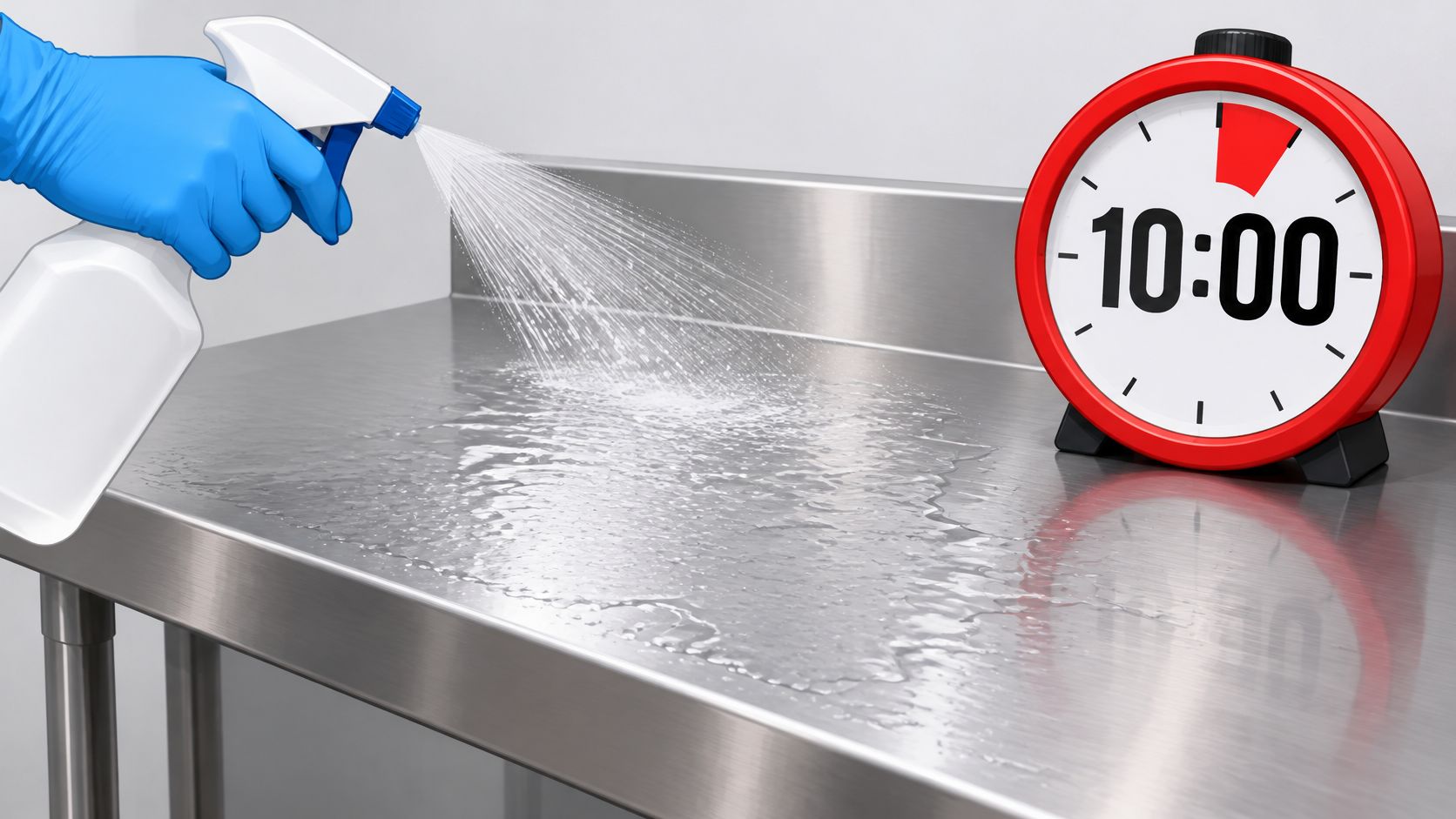
General disinfection with Virkon S on hard, non-porous surfaces needs a 1% solution kept visibly wet for 10 minutes. Shorter contact times apply only when the product label explicitly lists the matching organism, dilution, temperature, and use conditions.
That distinction changes how a cleaning crew should work. A surface can look spotless and still miss the disinfectant's required exposure because someone applied too little solution or wiped it dry too soon. Managing Virkon disinfectant contact time means managing the wet film, not just watching a timer.
For gyms, offices, schools, and other shared facilities, cleaning and disinfection serve different jobs. Cleaning removes visible dirt and residue. Correctly used disinfectants, including appropriately labeled wipes, add a targeted treatment step without turning every touchpoint into a complicated task.
Virkon Contact Time Values at a Glance
For general disinfection, the EPA's Virkon S label specifies a 1% solution at room temperature and 10 minutes of visible wetness on pre-cleaned, hard, non-porous surfaces.
The same document includes narrower claims of 30 seconds against swine influenza A virus and 15 seconds at 5°C for certain organisms, subject to its listed conditions. Historical and later labeling summarized alongside the EPA's earlier Virkon S label also includes a 3-minute claim at 1:75, selected claims of 1 minute or less, and the direction that 10 minutes is the maximum necessary contact time for metal objects.
Virkon S contact times by labeled situation
| Use case | Concentration | Contact time | Condition |
|---|---|---|---|
| General disinfection, hard non-porous surfaces | 1% solution | 10 minutes visibly wet | Full coverage, then air-dry |
| Reduced claim, 1:75 dilution | 1:75 | 3 minutes | Listed claim only, with its specified organism and temperature |
| Selected organisms and conditions | Label-specified | 1 minute or less | Listed claims only, at the specified dilution and temperature |
| Swine influenza A virus, hard non-porous surfaces | Label-specified | 30 seconds | Listed claim, not a general substitute |
| Reduced claim at 5°C, certain organisms | Label-specified | 15 seconds | Only where the label lists the organism and dilution |
| Metal objects | 1% solution | 10 minutes maximum | Avoid prolonged soaking |
Read the conditions as part of the time
A shorter claim isn't a faster version of the general procedure. It's a separate combination of organism, concentration, temperature, surface, and application directions.
Don't select the quickest row and apply it across a building. An equipment console, restaurant counter, and animal-care fixture may require different product choices or finishing steps even when staff use the same cleaning cart.
Check the current, jurisdiction-specific label before timing any job. This table summarizes labeled situations; it doesn't authorize every product or surface application.
What Contact Time Means and Why Wet Matters
Think of a sponge that must stay damp throughout a task, rather than drying after its first squeeze. The useful comparison is continued moisture, not absorbency: Virkon S's general surface directions concern hard, non-porous materials, not permission to disinfect porous items.
The CDC's facility cleaning guidance defines contact time, also called wet time, as the period a treated surface must remain visibly wet for the disinfectant to work. The clock and the surface condition must agree.

A clean appearance isn't proof of exposure
Say a worker wipes a gym bench and it dries almost immediately. The bench may look better because the wipe removed sweat and visible marks, but appearance doesn't establish that the disinfectant received its labeled wet period.
Now consider the same compatible bench with an even film maintained throughout the required interval. That's the exposure the crew needs to deliver. Spraying, soil removal, and completed disinfection aren't interchangeable milestones.
Three practical problems explain early drying: too little liquid, warm rooms or moving air, and uneven materials that distribute moisture poorly. Porous upholstery adds a different problem because a hard-surface claim doesn't automatically cover it.
Wetness check: Inspect the film during treatment, not just when applying the product. A completed timer can't confirm what happened while nobody was looking.
For a training exercise, look at a treated surface at the five-minute mark and ask whether a visible film remains across the whole section. Treat that as an observation checkpoint, not an alternative contact-time claim.
How to Keep Surfaces Wet for the Full Contact Time
Post a short procedure where staff mix solutions and collect supplies. Equip the cart with a measuring tool, labeled container, compatible applicator, timer, clean cloths, and a zone checklist so workers aren't improvising between jobs.
The EPA's Virkon S surface directions establish the routine 1% solution and 10-minute saturated, visibly wet treatment, along with precautions against extended soaking of metal objects. Build the work sequence around those requirements rather than around how quickly someone can finish spraying.
A cart-ready application procedure
Remove visible soil first. Use an appropriate cleaner and mechanical wiping or scrubbing, then remove cleaner residue as directed before disinfecting. Spraying over grime is the common slip because workers mistake a wet surface for a prepared surface.
Measure the solution accurately. Prepare the labeled concentration using the product's mixing directions, and record when it was mixed. Guessing from the color or adding extra powder creates an uncontrolled preparation, not a dependable improvement.
Wet a manageable section completely. Work on a single console, bench section, or counter area and apply enough solution for an even film without flooding seams. A light mist may look thorough from a distance while leaving edges and textured areas untreated.
Start timing after full coverage. Begin the timer when the entire section is wet, not when the worker first picks up the sprayer. Mark the section as temporarily unavailable so another employee or customer doesn't wipe it prematurely.
Watch the areas that dry first. Check edges, vent-facing surfaces, and warm spots, adding compatible use-solution before the film disappears. If a section becomes dry, don't count the dry interval as wet exposure; restore coverage and ensure a complete continuous labeled treatment.
Control liquid on metal. Avoid immersion and remove excess pooling without stripping the required wet film from the treated surface. Leaving a puddle in a joint or recess isn't a substitute for controlled coverage.
Finish only after the required exposure. Keep the section wet through the full labeled interval, then follow its air-drying, rinsing, or other finishing directions. The frequent mistake is a final polishing pass before treatment has finished.

Wipes follow their own product label
Pre-wetted disinfecting wipes aren't interchangeable with prepared Virkon S solution. The solution follows its own directions; a wipe follows the contact time printed on that wipe's label. Changing the applicator doesn't authorize a shorter Virkon claim.
An EPA disinfectant-wipe label directs users to wipe until visibly wet, use enough wipes to maintain wetness, and allow the labeled contact period before air-drying. A wipe that leaves a console dry halfway across has stopped delivering adequate coverage.
Replace soiled wipes, work section by section, and keep restroom tools away from clean equipment touchpoints. At completion, a correct job has an evenly maintained film, no known drying gaps, and a recorded finish time, not merely a checked box beside “sprayed.”
Where Contact Time Breaks Down on Real Surfaces
Suppose a crew member returns at the four-minute mark, sees a dry counter, and gives it a finishing wipe. The mistake isn't finishing early. It's assuming that a dry-looking surface has completed treatment.
Evaporation can remove the visible solution before staff return. The CDC's cleaning and disinfection guidance reinforces the need to clean first and keep disinfected surfaces wet for the product's stated contact time.
Contact time failures, causes and fixes
| Symptom | Likely cause | Fix |
|---|---|---|
| Surface dries within a minute | Too little solution | Apply enough to keep visible wetness for the full interval |
| Wipe removes soil but no wet film remains | Wiping before 10 minutes | Hold the timer and wait before wiping |
| Pooling or residue on metal | Prolonged immersion or excessive application | Apply in a controlled way and wipe off excess |
| Visible soil remains after treatment | Pre-cleaning skipped | Clean soil first, then disinfect |
| Fast drying in warm or sunlit rooms | High temperature or airflow | Reapply in smaller sections on a shorter cycle |
The times in this troubleshooting table describe failure scenarios, not alternative treatment directions.
More liquid isn't always better
Metal exposes the trade-off most clearly. Staff need sufficient liquid to maintain coverage, but soaking dealership fixtures, stainless equipment, or gym-machine hardware indefinitely isn't a sensible safety margin. Apply carefully, prevent liquid from collecting in joints, and follow both product and equipment instructions.
Test a compatible treatment on an inconspicuous area before introducing it across mixed finishes. Check for discoloration, finish changes, and residue after the complete application and finishing process, not just immediately after spraying.
Porous materials require a separate decision. A yoga mat, damaged bench covering, or unsealed surface may not qualify for the general hard-surface procedure, regardless of how wet staff make it.
More waiting won't repair a period when the surface was dry.
Warm kitchens and sunlit lobbies need tighter work zones and closer observation. Don't compensate by increasing concentration or leaving metal immersed. If a surface dries before the timer ends, the job isn't done: restore the labeled wet treatment across a smaller area rather than waiting longer beside a dry surface.
Applying Contact Time in Gyms, Schools and Offices
Machine grips, benches, touchscreens, and compatible mats should anchor a gym's touchpoint plan. Schedule staff rounds before opening, around the midday peak, and at close, then add attention between users where the facility's policy calls for it. Those rounds are operational starting points, not permission to ignore contamination between scheduled cleans.
Place gym wipes in a gym wipe dispenser beside the equipment, with a clear wet-time cue. Check the equipment manufacturer's instructions before treating screens, and verify both material compatibility and labeled use before choosing wipes for gym equipment or yoga mats.

Match the rhythm to shared use
Desks, door handles, shared devices, and restroom fixtures deserve explicit assignments in schools. Plan access between class changes and at close, but don't squeeze a product's required exposure into a break that's too short. Choose an authorized product and workflow that fit the available downtime.
Elevator buttons, shared printers, and desks need named owners in offices. A daily round plus checks after busy meetings is a practical starting schedule. In retail stores, add checkout counters, shared touchpads, basket handles, and entrance hardware after rush periods.
Tables, payment terminals, handles, and service counters need attention between customer groups in restaurants. Distinguish routine cleaning, food-contact sanitizing, and disinfection, and follow applicable rinsing directions. At airports, assign zone checks for security trays, restroom fixtures, and gate seats alongside a scheduled full pass.
The CDC's environmental-cleaning procedures demonstrate risk-based scheduling in healthcare. Commercial facilities shouldn't copy healthcare schedules as universal rules, but can apply the underlying approach: adjust frequency for shared use, visible soil, and higher-risk activities.
Sell a usable system rather than a refill
When discussing bulk gym wipes, show buyers how the dispenser, refill, waste bin, staff checklist, and posted contact-time cue work together. Our gym equipment disinfectant spray guide provides a useful companion topic when customers are deciding where sprays fit alongside wipes.
Purchasing advice: Demonstrate coverage on the customer's actual touchpoint before discussing cost per wipe.
Explain hygiene ROI through tasks the buyer can inspect: fewer missed stations, accessible supplies, predictable replenishment, and a process customers can understand. Don't promise an unsupported reduction in illness or a guaranteed financial return.
Keep floor-care spending separate from touchpoint supplies. For hardwood areas, J.R. Hardwood Floor Refinishing & Cleaning's resource can help managers compare commercial floor cleaning costs while planning the broader cleaning budget.
Check Your Label Before the Next Clean
Choose the schedule after identifying the exact product, not before. Similar branding doesn't establish identical instructions, and an EPA registration number isn't a substitute for reading the complete use directions. Our guide to understanding an EPA registration number can help staff identify what they're checking.
Keep specialist surfaces out of the general checklist until someone confirms the appropriate method. A property with an outdoor pet area, for example, needs a separate material and animal-access review; Modern Yard Landscapes' guide to safe cleaners for backyard dog runs offers context for that distinct task, not permission to transfer an indoor disinfection procedure outdoors.
Put ownership on the checklist
- Identify the product. Keep the current label accessible and copy the applicable dilution, surface restrictions, and wet-contact requirement onto the work card.
- Qualify every exception. Put any shorter claim beside its specified organism, dilution, and temperature, never beside a building-wide default.
- Assign the timer. Name the worker responsible for starting treatment and checking the film during and at the end of exposure.
- Mark the zones. Give gym, school, office, restaurant, and airport touchpoints clear ownership and access arrangements.
- Stage the supplies. Place appropriate wipes at small touchpoints and keep their own label directions visible.
For entrances, reception desks, and equipment stations, compare disinfectant wipe options at wipes.com, then verify each candidate's EPA registration, labeled uses, and required wet time. Compare the whole task, including coverage and disposal, rather than choosing by package price alone.
Prioritize cleanliness on the next shift: remove soil first, demonstrate a complete wet-contact treatment, and add suitable disinfectant wipes to daily routines or cleaning-supply offerings. Owners, janitorial teams, and cleaning sellers can start with a single busy station and a posted checklist. The full labeled wet time, not the speed of the wipe, is what makes the disinfection step count.
Leave a Reply