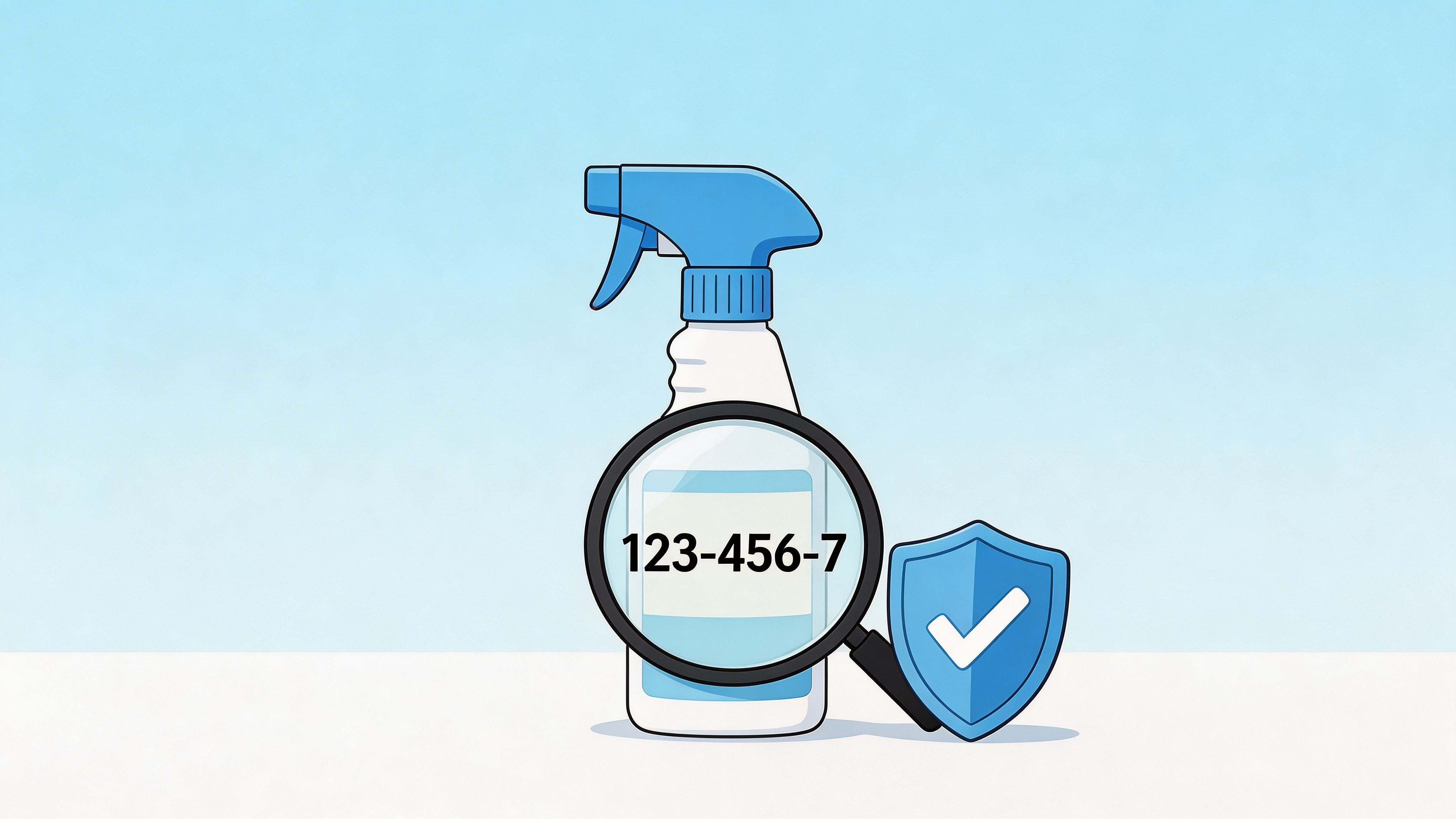
A lot of facility decisions get made in a supply closet, at a janitorial cart, or during a rushed reorder before the next shift starts. Two wipe canisters look similar. One costs less. One has bigger marketing claims. Both say they clean. Only one question matters first. Can you verify what you’re putting into your building?
That’s where the epa reg number stops being fine print and starts becoming an operations tool.
If you run a gym, office, dealership, restaurant, school, or retail site, you’re not just buying a consumable. You’re buying a documented claim of safety and efficacy, plus a paper trail that protects your staff, guests, and brand. The managers who treat that number as part of procurement, not just labeling, usually make better product choices and defend those choices more easily when customers, inspectors, or ownership ask questions.
Your First Line of Defense Against Uncertainty
A cheap wipe that can’t stand up to scrutiny is expensive in all the ways that matter. It creates doubt for staff, friction for purchasing, and unnecessary exposure if a product’s labeling or claims don’t hold up.
That risk shows up in ordinary places. Front desk counters. Locker room benches. Shared keyboards. Payment terminals. Steering wheels in service lanes. The surface may look clean, but your process is only as reliable as the product behind it.

What the better buyers do
Experienced facility teams don’t start with branding or scent. They start with verification.
They ask a short set of practical questions:
- Is the product clearly labeled with an EPA registration number on the package?
- Does the label match the use case in the building, such as hard nonporous high-touch surfaces?
- Can the product be traced to a production facility through its establishment number?
- Can purchasing and operations defend the choice if a customer, auditor, or owner asks why this wipe was selected?
That last point often goes unrecognized for its importance. In public-facing spaces, cleaning is visible. Disinfection credibility is less visible, unless your staff knows what to check.
Practical rule: If your team can’t explain why a disinfectant belongs in the facility, they’re relying on vendor assurance instead of documented proof.
Why this matters beyond compliance
The right product choice supports more than sanitation. It supports consistency.
When staff trusts the wipe in their hand, they use it correctly. When supervisors can verify the label, they train with confidence. When procurement standardizes around verified products, it becomes easier to maintain one defensible process across multiple locations.
That’s the core operational value of the epa reg number. It cuts through vague promises and gives you a direct way to separate a professional-grade disinfectant from a product that only sounds convincing on the shelf.
Decoding the EPA Registration Number
Think of the EPA Registration Number as a product’s regulatory identity. It tells you the product has gone through EPA review under FIFRA, the Federal Insecticide, Fungicide, and Rodenticide Act, which was enacted in 1947 and significantly amended in 1972. For disinfectants, that number typically appears in the format XXX-XX-X and must appear on every registered product label, indicating the EPA reviewed data on safety and efficacy before approval, as summarized in this overview of the EPA Registration Number under FIFRA.
Why disinfectants fall under pesticide law
That surprises some operators. A disinfectant wipe feels like a cleaning product, not a pesticide.
But once a product makes claims about controlling microorganisms on surfaces, it moves into a regulated category. That’s why the label matters so much. The product isn’t just being sold as a cleaner. It’s being sold with performance claims that carry legal and operational weight.
For buyers, that changes the conversation. You’re not comparing generic supplies. You’re comparing products with specific approved uses and instructions.
EPA Reg. No. and EPA Est. No. are not the same
Many teams overlook important details at this stage. They look for “an EPA number” and stop there.
Use this distinction instead:
| Label item | What it tells you | Why it matters |
|---|---|---|
| EPA Reg. No. | What the product is | Confirms the disinfectant itself is registered |
| EPA Est. No. | Where the product was made | Helps trace the final production facility |
That difference matters in real operations. If a product issue ever comes up, traceability isn’t a technical detail. It’s part of how recalls, investigations, and supplier accountability work.
How to read the number without overthinking it
On many products, the registration number is broken into segments. In practical terms, that structure helps identify the manufacturer, the product, and in some cases a distributor relationship.
You don’t need to become a regulatory specialist to use it. You just need to know what the number is doing for you:
- It confirms approval status for the registered disinfectant product.
- It anchors the label claims to an identifiable record.
- It gives purchasing a verification point before the product enters your building.
The epa reg number is one of the simplest due diligence checks a facility can build into routine purchasing.
What works and what doesn’t
What works is standardizing a simple expectation. Every disinfectant wipe, spray, or sanitizer with disinfectant claims should be checked at the label level before first use.
What doesn’t work is relying on any of the following:
- Front-label marketing language
- Distributor assurances without label review
- Staff assumptions that all wipes are equivalent
- Price-first decisions when the application is risk-sensitive
If you manage multiple sites, this is even more important. The number gives you a common standard across buildings, vendors, and reorder cycles. That’s how compliance becomes operational discipline instead of paperwork.
How to Find and Interpret a Product Label
Most label problems don’t come from hidden information. They come from people not slowing down long enough to read what’s already there.
On wipes canisters and spray bottles, the epa reg number is usually printed in smaller type on the back or side panel. The EPA Est. No. is also on the label, often nearby, but not always in the exact same spot. Train staff to look for both. If they can only find one, they’re not done checking.

Where to look first
Start with the back label.
That’s where manufacturers usually place the regulatory details, directions for use, surface compatibility language, and required contact time. On bulk containers, the information may be denser, but the same rule applies. Don’t judge the product by the front panel.
Use this quick scan order:
Product identity
Confirm you’re holding a disinfectant, not just a cleaner.EPA Reg. No.
Look for wording such as “EPA Reg. No.” followed by the multi-part number.EPA Est. No.
Find the manufacturing site traceability number.Directions for use
Check how the product must be applied to perform as labeled.Contact time
Make sure staff can realistically keep the surface wet for the required period.
What the surrounding label text tells you
The number itself is only one part of the decision. The nearby text tells you whether the wipe fits your workflow.
Look closely at these items:
Target organisms and claims
The label may specify which pathogens or categories the product is approved against. Don’t assume broad language means universal coverage.Surface type
Some wipes are intended for hard, nonporous surfaces. That matters in gyms, offices, schools, and dealerships where materials vary.Use instructions
If the label requires pre-cleaning when heavy soil is present, staff needs to know that. A dirty surface and a disinfected surface are not always the same thing.Wet contact time
Many disinfection programs fail under these conditions. If a wipe dries too quickly or staff wipes and walks away immediately, the claim may not be met in practice.
A good product with poor label compliance becomes a weak process.
Common label-reading mistakes
I see the same errors in different facilities, regardless of size.
| Mistake | What happens |
|---|---|
| Staff checks only the brand name | They miss whether the product is actually registered |
| Buyers ignore the Est. No. | They lose a traceability checkpoint |
| Teams treat all hard surfaces the same | They apply products without checking fit |
| Staff wipes too quickly | The disinfectant may not stay wet long enough |
Matching label reading to real facility work
Different spaces require different label discipline.
In a fitness center, staff should review whether the wipe is practical for frequent use on equipment touchpoints and whether instructions are realistic during peak traffic. In a car dealership, the team should pay attention to steering wheels, touchscreens, counters, and waiting-area surfaces. In a restaurant or hospitality setting, supervisors need to keep product selection tied to the exact surfaces and use conditions in the operation.
If you manage amenities with water exposure, maintenance teams often benefit from cross-checking adjacent cleaning programs too. For example, operators comparing wipe protocols with broader maintenance routines may find this guide to hot tub cleaning products useful because it reinforces the same principle: products should match the environment, the surface, and the intended result.
A simple label habit for supervisors
During onboarding, hand new staff one wipe canister and ask them to locate three things without help:
- The EPA Reg. No.
- The EPA Est. No.
- The directions that control effective use
If they can do that, they’re more likely to use the product correctly on the floor. If they can’t, your sanitation program is relying on memory instead of process.
Verifying Disinfectant Claims with EPA Tools
Reading the label is the first screen. Verification is the second.
That extra step matters because labeling errors and mismatches do show up in the market. A 2023 EPA enforcement report noted over 500 pesticide labeling violations, many involving establishment discrepancies, and a 2025 CERIS industry survey found 15% of audited facility disinfectants had mismatched establishment numbers, which is why checking official records is a practical risk-management step for facility teams using EPA pesticide establishment registration and reporting resources.
The fastest way to verify a product
Use the number on the label as your starting point, not the brand name.
A simple process works well:
Pull the canister or bottle from stock
Don’t verify from a vendor sheet alone if you can avoid it.Locate the EPA Reg. No. exactly as printed
Record it without changing spacing or number order.Search the EPA’s public product databases
Use the registration number first. Product names can vary by distributor.Confirm the product record matches the label in your hand
Check the product name and supporting label information.Review whether the product appears on List N when that matters for your use case
This is especially relevant when your infection-control protocol calls for products used against SARS-CoV-2.
What you’re really checking
The goal isn’t to do regulatory theater. It’s to answer a practical question.
Does this product in this facility match an active, verifiable record and the use expectations of my team?
If the answer is yes, you’ve improved your purchasing confidence. If the answer is unclear, stop before deployment and push the question back to the supplier.
If a distributor can’t help you reconcile a number mismatch quickly, treat that as a procurement problem, not a clerical one.
How I’d handle a questionable product in the field
When a site receives a product with confusing labeling, I don’t like to “use it up and sort it out later.” That habit creates avoidable exposure.
A better escalation path looks like this:
- Quarantine the product until the numbers are confirmed.
- Photograph the front and back label for your records.
- Ask the supplier to explain any mismatch between registration and establishment information.
- Document the answer in your purchasing file so the same question doesn’t repeat on the next order.
That process is especially important for organizations with multiple locations. One unchecked issue at one site becomes a recurring mistake across the portfolio.
Build verification into your SOP
You don’t need a complicated compliance system. A short standard operating procedure is enough.
Include:
- Who checks the product when it first arrives
- What gets recorded from the label
- Where verification notes are stored
- Who approves exceptions or substitutions
Teams that already manage higher-risk pathogens can fold this into broader surface protocols. If you need a practical companion resource for tougher contamination concerns, this article on what kills C. diff on surfaces is worth keeping in your operations library.
Verification doesn’t slow procurement down when it’s standardized. It speeds up better decisions and cuts down on bad substitutions.
Your Action Plan for High-Touch Surface Disinfection
The strongest disinfectant program is boring in the best way. Staff knows what gets wiped, when it gets wiped, and how long the surface needs to stay wet. There’s no guesswork.
That’s where the epa reg number becomes practical. It gives you confidence that the wipe belongs in the program. After that, execution takes over.

Start with the surfaces people actually touch
Most facilities already know their obvious contact points. The problem is inconsistency.
Use a priority map like this:
| Facility type | High-touch surfaces worth prioritizing |
|---|---|
| Office | Door handles, shared keyboards, breakroom tables, elevator buttons, light switches |
| Gym | Dumbbells, treadmill controls, locker handles, check-in screens, bench surfaces |
| Retail | Checkout counters, payment terminals, cart handles, fitting room latches |
| Car dealership | Steering wheels, shifters, waiting room armrests, desk counters, pens and clipboards |
| School | Desk tops, faucet handles, shared devices, railings, classroom door hardware |
The point isn’t to wipe everything all day. It’s to identify the surfaces that change hands constantly and build a repeatable route around them.
Frequency should follow use patterns
A waiting room used all day needs more attention than a conference room used occasionally. A gym floor during peak hours has different needs than the same floor mid-afternoon.
Practical frequency planning usually works better when tied to traffic triggers, not abstract schedules.
- Between-user surfaces should be addressed whenever your operating model allows.
- Shared common points need routine rounds during operating hours.
- End-of-day disinfection should support, not replace, visible daytime maintenance.
That’s also why wipe selection matters. Staff won’t follow the program if the product is hard to dispense, unpleasant to use, or incompatible with the pace of the facility.
The overlooked factor is contact time
Many teams wipe a surface until it looks dry and assume the job is complete.
That’s not how disinfection claims work. The label governs the result. If the surface doesn’t remain wet long enough, your team may be cleaning without achieving the disinfection outcome the product is designed for.
For wipes used in places like car dealerships, the EPA Est. No. traces the final production facility, and verifying that traceability supports confidence that the product’s formulation aligns with efficacy expectations. In that context, wipes used on high-touch zones such as steering wheels should support a ≥3-log reduction in 5 minutes, as described in this overview of EPA establishment numbers for disinfectant products.
What works on the floor
A few habits consistently improve results:
Use enough wipes for the task
One wipe for an oversized route usually means uneven wetness and poor coverage.Clean visible soil first
Heavy grime can interfere with proper disinfectant use.Move from cleaner zones to dirtier zones
That lowers the chance of spreading contamination.Replace wipes before they fail
A dry or depleted wipe shouldn’t stay in rotation just to save product.
Surfaces don’t become safer because they were touched by a wipe. They become safer when the wipe is used according to the label.
Facility-specific adjustments
Gyms need fast-reset routines around equipment. Offices need discreet but frequent attention on shared points. Dealerships need a customer-facing protocol that protects both vehicles and trust. Restaurants and hospitality venues need visible wipe-down habits in guest-contact areas without turning service into a cleaning demonstration.
If your team needs a broader framework for choosing those targets, this guide on disinfecting high-touch surfaces is a useful operational reference.
We also recommend Wipes.com Disinfectant Wipes for teams that want EPA-registered wipes formulated for professional use. In practice, a good wipe program succeeds when the product is verified, the label is understood, and the routine is simple enough for staff to repeat under pressure.
Using EPA Compliance as a Powerful Sales Tool
If you sell janitorial supplies, facility products, or hygiene programs, most buyers expect you to talk about price, availability, and lead times. Fewer expect you to explain the regulatory value of what you’re selling.
That’s an opening.
When you can explain the epa reg number clearly, you stop sounding like a rep moving cases and start sounding like a partner protecting the client’s operation. That shift matters in competitive bids, especially when the product category looks interchangeable on paper.
Sell verified value, not vague cleanliness
Clients don’t need more generic “healthy facility” language. They need reasons to trust your recommendation.
Good sales conversations focus on practical outcomes:
Procurement confidence
The client can verify the product before deployment.Operational consistency
Supervisors can train staff from the label, not from assumptions.Brand protection
If guests notice sanitation practices, the client can stand behind the products being used.Better supplier credibility
You’ve given them a method, not just a promise.
Useful talking points in real meetings
Don’t overcomplicate the pitch. Keep it tied to facility risk and decision quality.
Try language like this:
| Client concern | Better sales response |
|---|---|
| “These wipes all look the same.” | “Let’s compare the registration and label instructions, not just the packaging.” |
| “We need to save money.” | “A cheaper wipe can cost more if it creates doubt, retraining, or product replacement.” |
| “Our team just needs something simple.” | “Simple is good, but it should still be verifiable and easy to defend.” |
That approach works especially well with buyers who oversee multiple departments. They may not care about regulatory details for their own sake. They do care about reducing arguments later.
Compliance knowledge also cross-sells well
A buyer who values documented disinfectant choices is often receptive to adjacent compliance-minded services. That’s especially true in hospitality, foodservice, and mixed-use facilities where sanitation and pest control influence the same reputation concerns.
For example, if you work with restaurant operators, this article on why commercial kitchen pest control ensures compliance can support a broader conversation about using documented, verifiable systems across the facility, not just in one cleaning category.
The strongest sales position isn’t “our wipe is better.” It’s “our recommendation is easier to verify, train, and defend.”
What doesn’t close sophisticated buyers
Experienced buyers usually tune out three weak approaches:
- Overpromising results that aren’t tied to the label
- Reducing the whole conversation to unit cost
- Talking around the EPA number instead of using it directly
If you want better retention, make your account team fluent in label reading, registration checks, and practical use conditions. That knowledge raises trust quickly because it answers the questions operators have on the ground.
Turning Cleanliness into Your Competitive Advantage
Most facilities don’t lose trust because they forgot to buy cleaning supplies. They lose trust when their cleaning program feels inconsistent, unconvincing, or hard to defend.
The epa reg number helps fix that. It gives buyers, supervisors, and frontline staff a shared reference point for product legitimacy. That small detail supports smarter purchasing, cleaner execution, and a stronger answer when anyone asks, “Why are we using this product?”

The strategic shift that matters
Facilities that treat disinfectants like interchangeable commodities usually end up managing more confusion than they save in budget.
Facilities that verify products before use tend to gain three advantages:
- They reduce preventable purchasing mistakes
- They train staff on a documented standard
- They show customers and stakeholders that hygiene decisions are being made carefully
That’s the bigger lesson. Compliance isn’t separate from operations. In well-run buildings, compliance supports operations.
Keep the process simple enough to repeat
You don’t need a large compliance department to do this well.
You need a habit:
- Find the epa reg number
- Read the label
- Verify the product
- Train staff on actual use
- Standardize what works
Do that consistently and your disinfection program becomes easier to manage, easier to explain, and more credible to the people who experience your facility every day.
Cleanliness is no longer a background task. It’s part of how people judge safety, professionalism, and care. Make verified disinfectant wipes part of your daily routine or product offering, and treat every wipe-down as a chance to protect both health and reputation. For more practical sanitation guidance, visit WipesBlog.com.
Leave a Reply