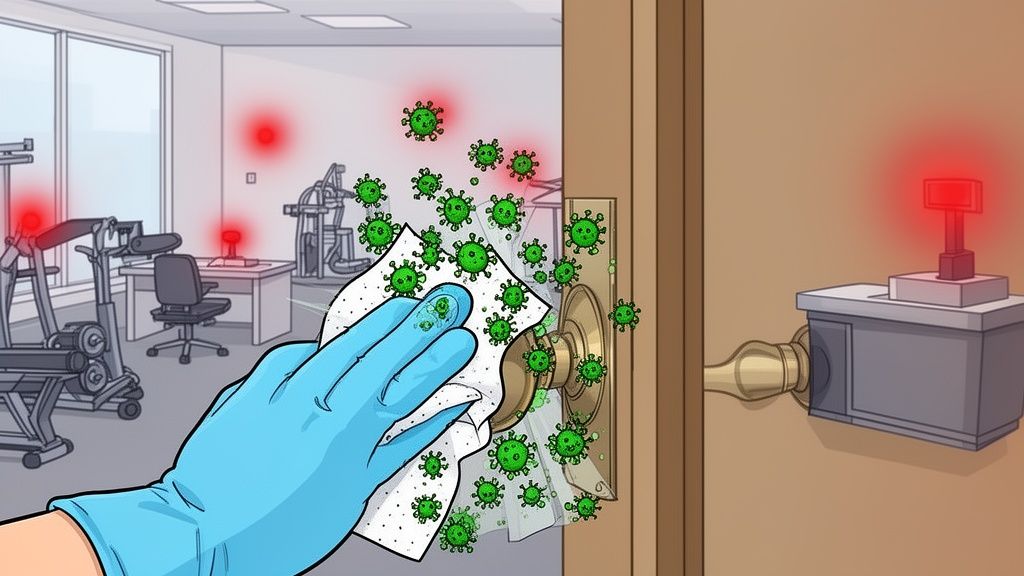
When facility managers hear "superbug," their minds often jump straight to hospitals. But Methicillin-resistant Staphylococcus aureus, or MRSA, is a serious threat that thrives far beyond healthcare settings. This isn't just another germ. It's a resilient bacterium that has outsmarted many common antibiotics, making infections difficult to treat.
For any public facility—from a busy office or school to a high-traffic gym—an outbreak isn't just a health risk; it's a direct threat to your business's reputation and bottom line. Simply cleaning isn’t enough; strategic disinfection is non-negotiable.
Why Proactive MRSA Disinfection is a Smart Business Move

What makes MRSA so dangerous in commercial and public facilities is its remarkable staying power. This hardy bacterium can survive on everyday surfaces for days, weeks, or even months, waiting for the next person to make contact. A generic spray-and-wipe simply won't cut it.
The Real-World Risks of Inadequate Hygiene
For business owners, facility managers, and sales professionals in the cleaning industry, understanding these risks is the first step toward building a bulletproof defense.
- Liability and Legal Headaches: An outbreak traced back to your building can trigger expensive lawsuits and regulatory scrutiny. A documented, robust disinfection protocol is your best line of defense.
- Reputation Damage: In the age of instant online reviews, news of a hygiene issue spreads like wildfire. The damage to your brand’s reputation can be deep and long-lasting, scaring away customers and top talent.
- Operational Shutdowns: A confirmed MRSA case can force a temporary closure for deep cleaning. That means lost revenue, lost productivity, and a cloud of uncertainty for both your staff and patrons.
It's time to shift your perspective. Enhanced hygiene isn't just a cost; it's a direct investment in customer trust, risk management, and business continuity. A visibly clean and properly disinfected facility is your single best marketing tool.
From Basic Cleaning to Strategic Disinfection
Moving from routine cleaning to strategic disinfection requires a new mindset and the right tools. Cleaning is about removing visible dirt and grime. Disinfection is what actually kills microscopic threats like MRSA. This is where choosing the right products, like EPA-registered disinfectants, becomes critical. They are proven to kill specific pathogens, but only if used correctly.
For targeting crucial high-touch surfaces, disinfectant wipes are a practical and highly effective tool. They deliver a controlled dose of disinfectant, ensuring the surface stays wet long enough to meet the required "contact time"—the window needed to kill the bacteria. This is especially vital in fast-paced places like fitness centers, where equipment must be treated quickly and effectively between users. We recommend using a high-quality product like Wipes.com Disinfectant Wipes for reliable results.
This guide will walk you through actionable cleaning tips, sales insights, and facility-specific advice to help you protect your patrons, your staff, and your business from the silent threat of MRSA.
Mapping Your Facility’s High-Risk MRSA Hotspots

Effective disinfecting for MRSA isn’t about randomly spraying every surface. That’s a great way to waste time, money, and product. Real control comes from surgical precision—thinking like the bacteria and knowing exactly where it’s most likely to be transmitted.
A strategic approach that targets these high-touch 'danger zones' is far more effective than broad, unfocused cleaning. This starts with creating a "hotspot map" for your facility, reflecting how real people move through and interact with your space to make every single wipe count.
Identifying Hotspots in Office Environments
The real threat in an office lives in the shared spaces that dozens of employees touch all day long. This is where your hotspot map needs to be laser-focused.
Your priority list should include:
- Elevator Buttons and Door Handles: Nearly everyone touches these. Pay extra attention to the main entrance, restroom doors, and conference room handles—they’re germ superhighways.
- Shared Kitchen Appliances: The handle on the community fridge, the buttons on the microwave, and the office coffee pot get touched countless times before noon.
- Conference Room Equipment: That shared keyboard, mouse, or remote control in the meeting room is a classic high-risk surface that’s often overlooked.
Sales Tip: When talking to a potential client, walking them through a custom hotspot map for their office shows you’ve done your homework. It proves you’re thinking beyond a simple surface clean and are ready to protect their team’s health—a huge selling point. For a more structured approach, you can learn how to conduct a complete infection control risk assessment in our detailed guide.
Targeting Danger Zones in Fitness Centers
Gyms are the perfect storm for MRSA: sweat, constant skin contact, and a high volume of shared equipment. A simple "wipe down after use" policy is a good start, but it hinges on member compliance, which can be inconsistent.
A study by the Mayo Clinic found that approximately 5% of hospitalized patients carry MRSA. While your gym isn't a hospital, this shows how easily carriers can unknowingly bring the bacterium into public spaces. Your team's regular, professional disinfection of hotspots is the primary line of defense.
Break down your gym's hotspot map into key zones:
Workout Floor:
- Handles and grips on dumbbells, barbells, and kettlebells.
- Touchscreens and heart rate monitors on treadmills, ellipticals, and bikes.
- Adjustment pins and seats on weight machines.
- Community yoga mats, foam rollers, and resistance bands.
Locker Rooms:
- Locker handles and the benches right in front of them.
- Shower knobs and floors.
- Restroom stall doors and faucet handles.
A visible and frequent cleaning routine in these areas—especially with easy-to-use disinfectant wipes placed strategically—doesn’t just cut down the risk. It’s a massive confidence booster for your members, showing them you’re serious about their well-being.
Retail and Public Venue Hotspot Strategy
For retail stores, restaurants, and event spaces, the risk is all about the customer journey. Your disinfection plan should follow the path a person takes from the moment they walk in to the moment they leave.
Zero in on checkout counters, credit card keypads, touch-screen ordering kiosks, and dining tables. In a car dealership, it’s the steering wheel, gear shift, and door handles of every demo vehicle. In a clothing store, it's the shopping cart handles, fitting room doors, and interactive product displays.
When you methodically map these hotspots, cleaning stops being a chore and starts being a targeted public health strategy.
Choosing the Right Disinfection Tools for the Job
Once you’ve mapped your facility’s high-risk hotspots, it's time to arm your team with the right tools. When you’re up against a superbug like MRSA, grabbing just any cleaner off the shelf is like bringing a water pistol to a firefight. It gives you a false sense of security.
Your first checkpoint, and it’s a non-negotiable one, is the EPA registration. A disinfectant must have an EPA registration number on its label and be specifically proven to kill Staphylococcus aureus. Even better, look for a specific claim against Methicillin-resistant Staphylococcus aureus (MRSA). This is the only way you can be sure the product can do the job you need it to do.
The Critical Role of Contact Time
Here’s where most disinfection efforts fall apart: contact time. Also called dwell time, this is the amount of time a surface must remain visibly wet with the disinfectant to actually kill the pathogens. A quick spray-and-wipe is a waste of time and product.
Disinfectants need anywhere from 2 to 10 minutes to penetrate and destroy tough bacterial cells.
Cleaning Tip: Failing to respect contact time is one of the most common—and dangerous—mistakes in facility hygiene. It leaves behind live pathogens while making everyone think the area is safe. Always read the product label and use a timer if you have to.
This is a huge educational point for any cleaning team or sales professional. It’s what separates a professional, effective protocol from just "wiping things down."
Comparing Disinfectant Formats
Disinfectants come in various formats, and the right one depends on the job at hand.
- Sprays and Solutions: Concentrates can seem cost-effective for large areas like floors, but they require precise dilution (a common point of failure) and can create aerosols that spread germs.
- Foggers: These are fantastic tools for terminal cleaning after an outbreak but aren’t practical for the daily, targeted disinfection your high-touch zones demand.
- Pre-Saturated Disinfectant Wipes: For high-touch surfaces, disinfectant wipes are the clear winner. They’re convenient, controlled, and take the guesswork out of dilution and application. You pull, you wipe, and you know the surface has the right amount of solution to meet contact time requirements.
This targeted approach is essential. A 2021 study showed that during routine outpatient appointments, MRSA from a carrier contaminated the surrounding environment 45% of the time. This is exactly why disinfectant wipes are perfect for wiping down gym equipment between users or sanitizing a restaurant table after a party leaves.
Facility-Specific Recommendations
The sheer convenience of disinfectant wipes makes them a go-to solution in almost any commercial environment. In an office, they’re ideal for staff to quickly hit shared keyboards or conference room remotes. In a gym, placing wipe dispensers near equipment empowers members to help keep the facility safe.
As you build out your cleaning protocols, a good air duct cleaning and sanitizing guide can also offer insights into overall environmental health. For a deeper dive into specific products, check out our guide on the best disinfectants for MRSA.
Ultimately, your disinfection strategy is only as strong as the tools you use. By choosing EPA-registered products, enforcing contact times, and using convenient formats like disinfectant wipes for high-touch zones, you can build a defense that works.
Putting Your MRSA Disinfection Protocol into Action
Turning a plan into a daily, muscle-memory routine for your team is where the real work of disinfecting for MRSA begins. It’s about building consistent habits that don't just look good on a checklist but actually protect people. The more a surface gets touched, the more it needs to be disinfected.
Setting a Practical Disinfection Frequency
Figuring out the right disinfection frequency is a balancing act. Match your cleaning schedule to the real-world use of your space.
- Hourly or After Every Use: This is non-negotiable in places like fitness centers (dumbbell handles, cardio touchscreens) and restaurants (tables, high chairs). The best approach is a two-part system: place disinfectant wipe dispensers for patrons to use, and have staff make disinfecting rounds every hour to catch anything missed.
- Several Times a Day: Focus on what everyone in your facility touches between 9 a.m. and 5 p.m. This includes coffee pot handles, microwave buttons, main door handles, and elevator buttons. These hotspots need attention at least three times a day—mid-morning, after the lunch rush, and before closing.
- Daily: For surfaces with moderate traffic, a thorough disinfection once a day is sufficient. This includes conference room tables, individual desk phones in a shared office, or retail checkout counters as part of the end-of-day cleaning routine.
To make this happen, a detailed office deep cleaning checklist turns your strategy into concrete, verifiable tasks.
High-Touch Hotspot Disinfection Frequency Guide
Use this table as a starting point and adjust based on your facility's unique traffic patterns. Consistency is key.
| Facility Type | High-Touch Hotspot | Recommended Frequency |
|---|---|---|
| Office | Entry Door Handles, Elevator Buttons, Kitchenette Appliances | 3-4 Times Daily |
| Fitness Center | Dumbbells, Cardio Machine Controls, Locker Handles | Hourly / After Each Use |
| Retail Store | Checkout Counters, POS Terminals, Shopping Cart Handles | Every 1-2 Hours |
| School/Daycare | Desks, Doorknobs, Shared Toys, Water Fountains | Daily & After Use |
| Restaurant | Tables, Menus, POS Screens, High Chairs | After Each Use |
Mastering Disinfection Techniques for Maximum Impact
How your team disinfects is as critical as how often. The right technique ensures the disinfectant actually has time to kill pathogens instead of just smearing them around.
Efficiency Hack: Pre-saturated disinfectant wipes are a game-changer. They eliminate guesswork from improper dilution ratios or inconsistent application.
Cleaning Tip: Train your staff on the ‘S-pattern’ wipe. Start in one corner and move the wipe in an S-shaped motion across the area without lifting it. This method traps contaminants instead of spreading them. For larger areas or heavily soiled surfaces, grab a fresh wipe. Never reuse a soiled wipe on a new surface.
Pro Tip: Never use the same wipe for the toilet handle and then the sink faucet. It seems obvious, but people in a hurry make mistakes. Train staff to grab a new wipe for each distinct "zone" to avoid cross-contamination.
Selling Clean: How to Frame Hygiene as a Business Asset
Most business owners see disinfecting for MRSA as just another cost. But that’s a mistake. Shifting from an expense mindset to an investment mindset is key to gaining a competitive advantage. It's not about the price of disinfectant wipes; it's about what they represent: trust, safety, and a brand that cares.
Sales Tip: When a customer walks into a gym and sees staff actively wiping down equipment, or a diner sees their table being thoroughly disinfected, they don’t just see cleaning. They see that you’re looking out for them. That feeling is priceless and translates directly into repeat business and glowing online reviews.
Shifting the Conversation From Cost to Hygiene ROI
For anyone selling cleaning services or products, the job isn't to push a product; it's to sell an outcome. You’re selling confidence and peace of mind. Connect the dots for clients, showing them how a proactive disinfection strategy protects their brand, customers, and employees.
Use talking points they can’t ignore:
- Building Customer Trust: "When your patrons see you cleaning, they feel safe. That trust is what makes them choose you over the competition."
- Avoiding a PR Nightmare: "A few dollars a day for a solid MRSA disinfection program is nothing compared to the cost of a liability claim or the reputation damage from a single outbreak."
- Protecting Your Team: "A healthy staff means fewer sick days and better morale. When your employees feel safe at work, it shows."
The proof is in the data. When U.S. hospitals got serious about disinfection, they saw a 17.1% annual drop in hospital-onset MRSA bloodstream infections. That’s a direct result of a committed strategy. For more on the link between infection control and health outcomes, the CDC offers some powerful insights.
A Smarter Way to Sell: From Product to Solution
Stop pitching products and start selling solutions. No one is excited to buy disinfectant, but they are excited to buy a worry-free environment.
Sales Tip: A business owner isn’t just buying disinfectant wipes; they're buying peace of mind. Your job is to connect the product to that feeling of security. This transforms a commodity into a crucial business strategy.
Bundle your services. Don't just offer wipes as an add-on; build them into tiered service packages that showcase a comprehensive approach.
Example for a gym cleaning service:
- Standard Package: General cleaning, trash removal, and basic surface wipe-down.
- Premium Package: Everything in Standard, plus documented daily disinfection of all high-touch hotspots like free weights and cardio screens using EPA-registered wipes.
- Elite Package: Everything in Premium, plus hourly disinfecting rounds during peak times and member-facing wipe dispensers placed throughout the facility.
This tiered approach educates your client on what disinfecting for MRSA truly requires and provides a natural upsell path, making the higher investment feel like a smart, necessary upgrade.
Your Top MRSA Disinfection Questions, Answered
When you're staring down a threat like MRSA, it's natural to have questions. Here are straight answers to the most common queries we hear from teams on the front lines of facility hygiene.
How Long Can MRSA Survive on Surfaces?
MRSA is stubbornly resilient. It can cling to common surfaces like plastic, stainless steel, and fabric for days, weeks, or even months under the right conditions. This incredible survival window is why daily, targeted disinfection of high-touch hotspots is the only strategy that works.
Are Disinfectant Wipes Really as Effective as Sprays?
Yes, and in many real-world settings, they're actually better. When used correctly, EPA-registered disinfectant wipes are incredibly effective against MRSA. Their main advantage comes down to two things: control and convenience, which translates to better compliance and more reliable results.
Wipes come pre-saturated, eliminating the risk of incorrect dilution—a common and dangerous mistake with concentrated sprays. They also prevent pathogens from becoming airborne. Most importantly, they ensure the right amount of disinfectant gets where it needs to go to meet the required contact time.
What Is the Difference Between Cleaning, Sanitizing, and Disinfecting?
These terms are not interchangeable. Getting them right is fundamental to an effective hygiene program.
- Cleaning: Removes visible dirt, grime, and some germs. It's a crucial first step but doesn't kill tough pathogens.
- Sanitizing: Reduces the number of bacteria on a surface to a safe level, usually killing up to 99.9% of specific bacteria. It's a step up, but not enough for MRSA.
- Disinfecting: Kills virtually all microorganisms on a surface, including hardy bacteria like MRSA.
For a high-consequence pathogen like MRSA, the process is non-negotiable: always clean first to remove physical soil, then follow up with an EPA-registered disinfectant. This ensures you’re killing the bacteria, not just smearing it around.
How Do I Train My Staff to Properly Disinfect?
Your team is your most valuable asset in preventing an outbreak. Training needs to be hands-on, ongoing, and focused on the "why" behind the protocol.
Start with simple, visual checklists. Show them the right way to use a disinfectant wipe, like the ‘S-pattern’ technique. But the most critical concept to hammer home is contact time. Have them practice wiping a surface and timing how long it stays wet. Explain that this is the active window where the disinfectant is working. If it dries too soon, the job isn't done.
The need for this vigilance is stark. MRSA was a leading cause of death from antimicrobial resistance in 2019, contributing to 121,000 fatalities worldwide. Outbreaks can also follow seasonal patterns, often peaking in the summer—a critical fact for gyms and other public facilities. You can explore more of these global health trends through the WHO's insightful data.
By building a robust disinfection strategy, you aren't just cleaning. You're actively protecting your people, your customers, and your brand. Prioritize cleanliness and consider integrating high-quality disinfectant wipes into your daily routine or product offerings to prove that their well-being is your top priority.
Leave a Reply