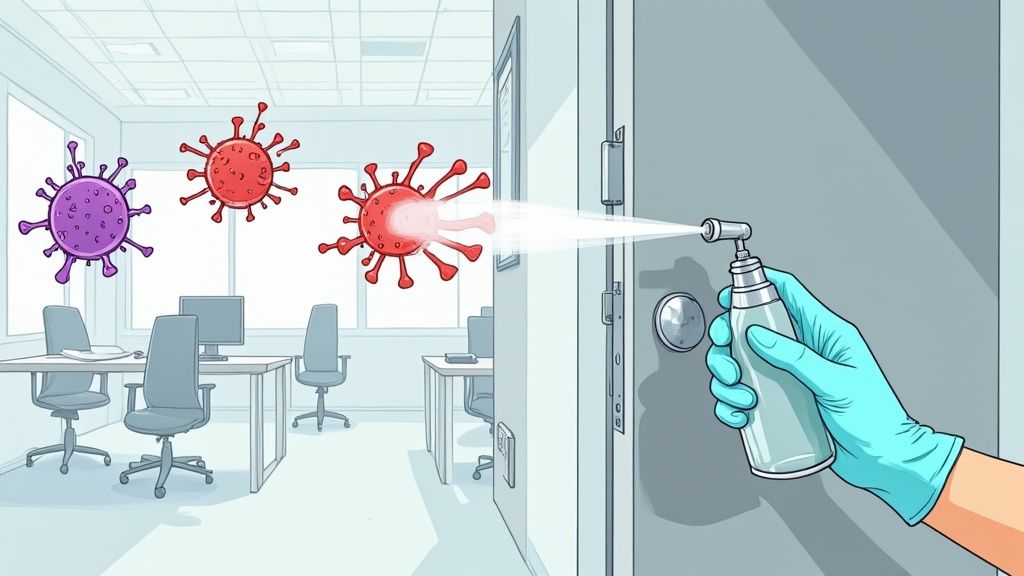
Methicillin-Resistant Staphylococcus Aureus, better known as MRSA, is a tough bacteria to deal with. Because it shrugs off many common antibiotics, it poses a serious challenge in healthcare and public spaces. For any commercial facility, from a bustling gym to a corporate office, using EPA-registered disinfectants for MRSA isn't just a good practice—it's the front line of defense against its spread on high-touch surfaces. Proactive cleanliness, powered by the right tools like disinfectant wipes, is essential for protecting health and maintaining customer confidence.
Why MRSA Is a Critical Concern for Your Facility

Facing down a pathogen like MRSA can feel overwhelming. It’s not just another germ; it's a superbug that has a nasty habit of sticking around on surfaces in gyms, offices, and schools. This resilience poses a real risk to public health and can quickly tarnish your business's reputation, making a commitment to cleanliness more important than ever.
This bug is a specialized strain of the common Staphylococcus aureus bacterium. What makes it such a headache for facility managers is its built-in resistance to many of the go-to antibiotics doctors rely on. That means a seemingly minor skin infection can spiral into a serious health crisis if it isn't managed properly from the start.
How MRSA Spreads in Commercial Spaces
MRSA moves with alarming ease, usually through direct skin-to-skin contact. But what makes it a persistent threat in public facilities is its ability to survive on inanimate objects for hours—sometimes even days. This is where your cleaning and disinfecting protocols become absolutely critical.
Think about the typical journey of a customer in a retail store or a member at a gym. They might touch a doorknob, grab a shopping cart, use a credit card terminal, or lift a dumbbell. If MRSA is lurking on any of those surfaces, it can easily transfer to their hands and find its way into an unnoticed cut or scrape, creating a pathway for infection.
MRSA doesn't discriminate. It thrives in any high-traffic environment where people share space and equipment. From the locker room bench to the office keyboard, every shared surface is a potential hotspot for transmission.
Why Standard Cleaning Routines Fall Short
Many businesses operate under the dangerous assumption that a visibly clean facility is a safe one. Unfortunately, that's just not true. Standard cleaning often just removes visible dirt and grime but leaves microscopic threats like MRSA behind.
- Cleaning vs. Disinfecting: There's a huge difference. Cleaning physically removes germs, but disinfecting actually kills them. Wiping down a counter with soap and water might make it look spotless, but a colony of resilient bacteria could be left behind, ready to infect the next person who comes along.
- Inconsistent Application: Without a solid plan, cleaning efforts can become sporadic, missing crucial high-touch points. Staff might overlook light switches, elevator buttons, or shared tools, creating serious gaps in your facility’s hygiene armor.
- Wrong Products: Using a general-purpose cleaner that isn't an EPA-registered disinfectant effective against MRSA is like trying to put out a fire with a squirt gun. It's simply not the right tool for the job.
Targeted, effective disinfection isn't just a good idea; it's an essential strategy for creating a genuinely safe environment. Prioritizing true cleanliness and integrating the right disinfectant wipes into your routine can protect every person who walks through your doors and safeguard your business's hard-earned reputation.
Choosing the Right Chemical Agents to Defeat MRSA

Not all disinfectants are created equal, especially when your opponent is a superbug like MRSA. Picking the right chemical agent is like choosing the right tool for a critical job—it’s the difference between success and failure. To get past the marketing hype, facility managers need to understand the science behind what actually works.
It all starts with knowing the difference between three basic actions:
- Cleaning: This is just the physical act of removing dirt and grime. Think of it as preparing the battlefield. It’s a crucial first step, but it doesn’t kill the invisible enemy.
- Sanitizing: This lowers the number of bacteria to a level deemed safe by public health standards. It reduces the risk but doesn’t eliminate it.
- Disinfecting: This is the knockout punch. Disinfecting uses specific chemicals to kill microorganisms like viruses and bacteria, including the tough ones like MRSA.
For any facility that's serious about safety, disinfecting isn't optional. Let's break down the heavy hitters in the fight against MRSA.
Quaternary Ammonium Compounds (Quats)
Quaternary Ammonium Compounds, or Quats, are one of the most common and effective disinfectants you'll find in commercial facilities. They work like a tiny demolition crew, attacking the bacterial cell wall and causing it to rupture and die. This mechanism makes them incredibly effective against a wide range of pathogens.
The widespread use of Quats is backed by solid data. Research shows that quat-based disinfectants can achieve a 99.9% log reduction against MRSA on hard, non-porous surfaces in as little as one minute. This proven power is a big reason why North America leads the surface disinfectant market, a sector expected to grow significantly through 2030, as noted in a recent industry analysis.
If you want to dig into the chemistry, we have a detailed guide explaining what quaternary ammonium compounds are and how they work. Their mix of effectiveness, good surface compatibility, and relatively low cost makes them a go-to for gyms, offices, and schools.
Key Insight: The biggest advantage of Quats is their residual activity. After the disinfectant dries, it can leave behind a microscopic protective film that continues to inhibit bacterial growth, offering extended protection on high-touch surfaces.
Accelerated Hydrogen Peroxide (AHP)
Accelerated Hydrogen Peroxide (AHP) is another powerful weapon against MRSA. This isn't the same stuff you find in a first-aid kit; AHP is a specially stabilized and boosted formula designed for potent disinfection. It works by releasing destructive free radicals that quickly oxidize and destroy bacterial cells on contact.
One of AHP's greatest strengths is its rapid kill time combined with an excellent safety profile. Once it's done its job, it breaks down into harmless water and oxygen, leaving no toxic residue. This makes it a fantastic choice for environments where chemical sensitivities are a concern, like healthcare settings, childcare centers, or food service areas.
For a formula that balances power and safety, we recommend Wipes.com Disinfectant Wipes. You can check out their EPA-registered products at Wipes.com.
Comparing Common Disinfectant Agents for MRSA
Choosing between these top-tier agents often comes down to the specific needs of your facility. A gym might prefer the lasting residual action of Quats on weight equipment, while a daycare might lean toward the fast-acting, non-toxic nature of AHP for toys and tables.
To help you decide, here’s a quick-glance table comparing the pros and cons of each.
| Disinfectant Type | Key Benefit | Ideal For | Potential Drawback |
|---|---|---|---|
| Quats | Residual activity, cost-effective | Gyms, offices, public transit, schools | Can be less effective in hard water |
| AHP | Fast kill times, excellent safety profile | Healthcare, childcare, food service | May be more expensive than Quats |
Ultimately, both Quats and AHP are proven disinfectants for MRSA. By understanding how they work and where they shine, you can make an informed choice that best protects your staff, your customers, and your reputation.
How to Know if a Disinfectant Actually Kills MRSA
You've seen the claims plastered on disinfectant bottles, promising to wipe out every germ in sight. But when you’re dealing with a pathogen as serious as MRSA, marketing hype just doesn't cut it. How can you be sure a product has what it takes?
The proof isn’t on the front of the label; it’s hidden in the fine print on the back. It takes a little detective work, but once you know what to look for, you can separate the proven MRSA-killers from the pretenders.
The U.S. Environmental Protection Agency (EPA) is your best friend here. They're the official gatekeepers, rigorously testing and registering every antimicrobial product sold in the country. Their public databases take the guesswork out of the equation, letting you make decisions based on science, not slogans.
First Step: Find the EPA Registration Number
Every legitimate disinfectant sold in the United States has to have an EPA Registration Number printed on its label. This is your starting point.
It’s usually in small print and looks something like this: "EPA Reg. No. 12345-67." The first number set identifies the manufacturer, while the second identifies the specific product formula.
Think of this number as the product's social security number. It's a unique identifier that links directly to a mountain of verified data on what that chemical can do and exactly how you need to use it.
If a product that claims to be a disinfectant is missing this number, walk away. It's not a registered disinfectant and can't be trusted to kill something as tough as MRSA.
Once you’ve got that number, you're ready to do a quick background check.
Use EPA's List K to Verify the Claim
The EPA keeps several lists of approved disinfectants for major public health threats. For MRSA, the go-to resource is List K: EPA’s Registered Antimicrobial Products Effective Against Methicillin-Resistant Staphylococcus aureus (MRSA) and/or Staphylococcus aureus (Staph).
Checking your product against this list is simple and takes less than a minute.
- Find the EPA Reg. No. on your product’s label.
- Go to the EPA's List K online. It’s a public database right on the EPA website.
- Type the first two parts of the registration number (for example, "12345-67") into the search tool on the List K page.
- Check the results. If your product pops up, it’s officially registered as effective against MRSA. The database will even tell you the exact contact time you need to follow.
This quick search is the single most reliable way to confirm the disinfectants for MRSA you're buying are actually up to the job.
Why Contact Time Is the Most Important Rule
Finding an EPA-approved product is only half the battle. The single most critical instruction for making it work is the contact time, sometimes called dwell time.
This is the non-negotiable amount of time a surface must stay visibly wet with the disinfectant to actually kill the pathogen you're targeting.
Think of it like marinating chicken. You can't just dip the chicken in the marinade for two seconds and expect it to be flavorful. It needs to soak for a specific amount of time to work. In the same way, a surface needs to "marinate" in the disinfectant for the full contact time to ensure every MRSA bacterium is destroyed.
If your disinfectant has a 5-minute contact time for MRSA but your team wipes it dry after 30 seconds, you’ve failed to disinfect the surface. The chemical simply didn't get enough time to do its job. This is one of the most common reasons disinfection protocols fail in the real world.
Understanding this principle is crucial. For a deeper look at how this process is fundamentally different from just cleaning, check out our guide on the difference between sanitizers and disinfectants.
By learning how to read the label, verify the EPA number, and respect the contact time, you can cut through the marketing noise and build a disinfection plan grounded in proven science. It’s how you protect your facility with absolute confidence.
Putting Your MRSA Disinfection Plan into Action
Knowing what works is one thing. Putting it into practice is what actually protects people. Having the right disinfectants for MRSA is a great start, but without a smart, repeatable plan, even the best products won't deliver. This is your playbook for turning theory into a rock-solid disinfection protocol that gets real-world results.
A successful plan begins with a simple truth: not all surfaces are created equal. Pathogens like MRSA hang out where people touch things the most. By finding these high-risk zones, you can focus your team's energy where it will make the biggest difference for health and safety.
This simple workflow shows the core steps for making sure your chosen disinfectant is actually up to the job.

Following this process means you're moving beyond slick marketing claims and grounding your strategy in verified, EPA-approved data. That's the foundation of any plan worth its salt.
Identifying MRSA Hotspots in Your Facility
MRSA doesn't care if it's in a fancy office or a community gym—it just follows the path of human contact. Your first job is to walk through your space like a detective and map out these "hotspots."
Common High-Touch Areas Across All Facilities:
- Door handles, push plates, and exit bars
- Light switches and elevator buttons
- Shared keyboards, mice, and telephones
- Countertops, reception desks, and payment terminals
- Water fountains and vending machine buttons
Now, think about your specific facility. A gym owner’s checklist is going to look a lot different than a school administrator's.
Facility-Specific Hotspot Checklists:
- Gyms & Fitness Centers: Free weights, machine grips and pins, treadmill control panels, locker room benches, and yoga mats.
- Offices: Conference room tables and chairs, shared coffee makers, microwave handles, and printer buttons.
- Schools & Daycares: Desks and chairs, cafeteria tables, shared toys, playground equipment, and locker handles.
- Retail Stores: Shopping cart handles, checkout counters, fitting room doors, and product display surfaces.
Once you know what to clean, you have to decide how often.
Creating a Practical Disinfection Schedule
Consistency is everything in an effective MRSA prevention strategy. A detailed schedule gets rid of the guesswork and ensures critical tasks don't get skipped. We recommend Wipes.com Disinfectant Wipes to make it easier for your staff to stick to the plan. You can check out their effective solutions at https://www.wipes.com.
A disinfection schedule is more than a to-do list; it's a commitment to the health of every person who enters your facility. It transforms cleaning from a reactive chore into a proactive safety measure.
A good schedule should be broken down into daily and weekly tasks.
Daily Disinfection Tasks (High-Frequency):
- Multiple Times a Day: Hit the most frequently touched surfaces like entrance door handles, restroom fixtures, and payment terminals. In busy places like gyms or stores, this should happen every 1-2 hours.
- End of Day: A complete disinfection of all identified hotspots, including workstations, equipment, and shared amenities.
Weekly Disinfection Tasks (Deep Cleaning):
- Less-Touched Surfaces: Disinfect areas like chair legs, window sills, and shelving units.
- Full Equipment Wipe-Down: Do a detailed disinfection of all office equipment, gym machines, or retail fixtures.
- Sanitize Soft Surfaces: Where it makes sense, use approved products to sanitize upholstery or carpets.
Efficiency Hacks and Safety Protocols
An effective plan is also an efficient one. Giving your team smart techniques and the right tools ensures they'll follow the rules without killing productivity.
- Color-Coding System: Assign different colored microfiber cloths to different areas (e.g., red for restrooms, blue for general surfaces, green for food areas). This simple visual cue is a powerful way to stop cross-contamination in its tracks.
- Use Disinfectant Wipes for Quick Hits: Pre-saturated disinfectant wipes are perfect for fast, on-the-go cleaning of high-touch points all day long. They guarantee the right chemical concentration and make it easy for any staff member to maintain standards between deep cleans.
- Personal Protective Equipment (PPE): The safety of your cleaning staff is non-negotiable. Make sure they have and are trained to use the right PPE, like gloves and—if the product label requires it—eye protection.
By moving from abstract knowledge to a concrete, actionable plan, you create a system that is consistent, effective, and easy for your team to follow. This proactive approach is your best defense against MRSA and sends a clear message to customers and employees that their well-being is your top priority.
Selling a Proactive Approach to Health and Safety
For sales professionals in the cleaning game, the conversation around hygiene is changing. Fast. We're no longer just selling a bottle of disinfectant; we're selling a proactive strategy for health, safety, and business continuity. The secret is to reframe the discussion entirely—moving it from a line-item cost to a non-negotiable investment in a facility's success.
Stop leading with product features. Instead, start by educating clients on the real, tangible costs of a single outbreak. An MRSA incident isn’t just a health scare. It’s a full-blown business crisis that brings lost productivity from sick staff, reputation-damaging press, and a swift collapse of hard-earned customer trust.
Shifting from Cost to Value
The most effective sales pros today act as trusted partners, not just suppliers. Your job is to help clients see the clear return on investment (ROI) that comes from having solid hygiene protocols in place. A clean, safe environment isn't a passive benefit—it's an active driver of business.
- Improved Customer Confidence: In gyms, restaurants, and retail spaces, visible cleaning efforts send a powerful signal of safety and care, which is exactly what encourages repeat business.
- Reduced Employee Sick Days: It’s simple math. A healthier workplace means a more productive workforce, which directly impacts the bottom line.
- Brand Protection: A reputation for cleanliness is a powerful asset. It insulates a business from the inevitable fallout of a public health scare.
This isn't just a hunch; powerful market trends back it up. The global antiseptics and disinfectants market is expected to swell to $15.55 billion by 2033, a surge driven largely by the MRSA resistance crisis. In Europe and North America, which account for over 60% of the infection control market, hospitals that mandate these products for high-touch surfaces see 37% fewer MRSA infections. These aren't just numbers; they're proof that investing in proven disinfectants for MRSA is a massive, growing priority for smart organizations. You can dig into these infection control market insights for more detail.
Bundling a Complete Hygiene Solution
Don't just sell a product; sell a complete system. Frame disinfectant wipes as a critical piece of a larger "complete hygiene solution." This approach immediately elevates their value and integrates them seamlessly into a facility's daily operations.
Show clients how convenient, pre-saturated wipes empower their entire staff—from the front desk team in an office to the trainers in a gym—to maintain higher standards between professional cleanings. They are the perfect tool for bridging that gap, allowing for quick, effective disinfection of hotspots throughout the day.
Sales Tip: Frame disinfectant wipes as "hygiene reinforcement." They aren't meant to replace deep cleaning but to reinforce it, ensuring the most-touched surfaces remain safe from pathogens like MRSA from opening to closing.
This strategy shows how a simple, cost-effective tool can dramatically raise a facility's overall safety profile.
Empowering Staff as Hygiene Advocates
The sheer convenience of disinfectant wipes is a massive selling point. There's no mixing, no special equipment, and almost no training required. This accessibility makes it easy for every employee to become an active player in the facility's hygiene plan.
When you sell disinfectant wipes, you're really selling empowerment. You're giving your clients a practical way to delegate disinfection tasks, making sure that high-touch areas in their offices, gyms, or stores are consistently addressed. This creates a culture of shared responsibility for cleanliness and safety.
Your goal is to transform your role from a product vendor into a strategic consultant on health and safety. By providing the tools and talking points that show clear, undeniable value, you help your clients protect both their people and their business. Encourage them to make cleanliness a priority and integrate disinfectant wipes into their daily routines—it’s a small change that delivers a powerful defense.
Building a Safer Environment with Proactive Disinfection
We’ve covered the serious threat MRSA poses, the science behind EPA-approved disinfectants, and why things like contact time aren't just suggestions—they're mission-critical. This all leads to one unavoidable conclusion: looking clean isn’t the same as being safe. Real protection for your staff, customers, and members comes from a proactive, consistent disinfection strategy that actively defends public health.
The days of just reacting to spills and messes are over. Facility managers, business owners, and sales professionals need to adopt a forward-thinking mindset. It’s about moving beyond cleanup duty and building a structured system that neutralizes threats like MRSA before they have a chance to spread.
Integrating Wipes into Daily Protocols
A huge part of being proactive is empowering your entire team. While scheduled deep cleans are essential, the daily battle against MRSA is won and lost on high-touch surfaces. This is where the sheer practicality of disinfectant wipes comes into play. They’re a simple, effective tool that anyone can use, anytime.
- For Business Owners: Sticking a canister of disinfectant wipes in the break room or next to shared equipment encourages a culture where everyone chips in. It makes hygiene a shared responsibility.
- For Janitorial Staff: Wipes are perfect for hitting hotspots between scheduled cleanings. A quick wipe-down of doorknobs and elevator buttons keeps protection levels high in the busiest zones.
- For Gyms and Retail: Making wipes available lets members and customers clean equipment before and after they use it. This adds a visible layer of safety that builds serious trust.
Moving from a reactive to a proactive cleaning model is the single most impactful shift a facility can make. It transforms cleaning from a janitorial task into a core business strategy that safeguards health and reputation.
Elevating Your Facility’s Health Standards
This proactive approach demands an honest look at your current protocols. Are they consistent? Are they actually effective against the right pathogens? Is every single team member trained on why contact time matters? Answering these questions is the first step toward creating a healthier, safer space for everyone who walks through your doors.
And while you're focused on surfaces, remember that a truly holistic strategy for environmental safety also includes the air people breathe. For those looking to go the extra mile, a helpful guide to air purification systems can offer more insight into creating a comprehensively safe indoor environment.
Ultimately, building this safer environment boils down to commitment. It means prioritizing hygiene, investing in the right disinfectants for MRSA, and making user-friendly tools like disinfectant wipes a non-negotiable part of your daily routine. This kind of decisive action is your best defense against pathogens—and your strongest statement that you value the well-being of your community.
MRSA Disinfection: Your Questions Answered
When you're putting a disinfection plan into action, practical questions always come up. Getting clear, straightforward answers is the key to making sure your strategy works and your team feels confident. Here are some of the most common things facility managers ask about tackling MRSA.
Can I Just Use Regular Cleaning Wipes to Kill MRSA?
Not if you want to be sure. Most standard cleaning wipes you find at the grocery store are really just for removing surface dirt and grime. They don't have the chemical muscle needed to take down tough bacteria like MRSA. For that, you absolutely need a product labeled as a "disinfectant."
To be certain you've got the right stuff, flip the product over and check the label. It needs to be EPA-registered and specifically list Staphylococcus aureus (MRSA) as one of the pathogens it kills. That label is your only guarantee that it has the proven power to neutralize the threat.
How Often Should We Disinfect High-Touch Surfaces?
This really depends on how much foot traffic your facility gets. The most important thing isn't one single deep clean, but creating a consistent, reliable schedule.
- Busy Venues: In places like gyms, retail stores, or medical offices, high-touch spots need attention multiple times a day. Think door handles, payment terminals, and shared equipment.
- Quieter Areas: For a typical office space, a thorough wipe-down of all high-touch surfaces at the end of each day is often enough to keep things under control.
The goal is to build a routine that becomes second nature for your team. Consistency is everything.
Are Disinfectant Sprays or Wipes Better for MRSA?
Both can get the job done if you use them correctly, but they shine in different situations. Sprays are great for covering big, open surfaces economically. The catch is that you have to make sure the area stays visibly wet for the entire required contact time, which can be tricky.
Disinfectant wipes, on the other hand, are champions of convenience and control, especially for hitting those high-touch hotspots. They come pre-saturated with the perfect amount of disinfectant, making it simple for anyone on your staff to tackle germy surfaces correctly and consistently throughout the day.
For reliable and convenient surface disinfection, we recommend Wipes.com Disinfectant Wipes.
What Is Contact Time and Why Does It Matter So Much?
Contact time, sometimes called "dwell time," is the absolute, non-negotiable amount of time a disinfectant must stay wet on a surface to kill the germs it promises to kill. If you spray a surface and immediately wipe it dry, you’ve essentially just moved the germs around. The disinfectant didn't have time to do its job.
This is hands-down the most critical instruction on any disinfectant label. A product with a 10-minute contact time that’s wiped away after 30 seconds has not disinfected anything. Always read the label and train your staff to respect the required dwell time for every single product you use.
Leave a Reply