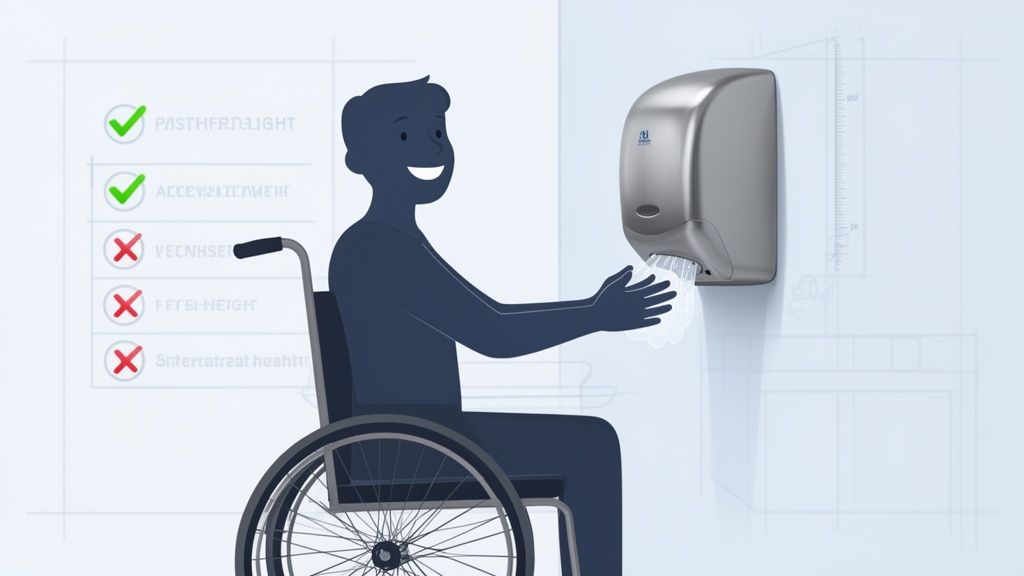
An ADA-compliant hand dryer isn't just a specific model you can buy off the shelf. It’s a standard of installation that ensures anyone, including people with disabilities, can actually use it. This boils down to two big rules: limiting how far the dryer sticks out from the wall to 4 inches maximum and mounting it low enough for wheelchair users to reach. These regulations aren't suggestions—they're the law, designed to make public restrooms safe and functional for everyone.
Why ADA Hand Dryer Compliance Is Not Optional
Building a restroom that's inclusive, hygienic, and efficient isn't just good business—it's a legal and operational must-have. ADA compliance is a non-negotiable part of modern facility design. It’s not about ticking off boxes; it’s about the fundamental experience you provide to every single guest. Maintaining a high standard of cleanliness is crucial, and that includes more than just mopping floors. Focusing on high-touch surfaces with effective disinfectant wipes can elevate your facility's hygiene and show a true commitment to visitor well-being.
Think of it this way: an inaccessible hand dryer is like a steep staircase without a ramp. It flat-out excludes a portion of your patrons and sends a clear message that their needs don't matter. A compliant installation, on the other hand, is the ramp—it welcomes every individual and ensures they can use the facilities with dignity.
The Core Principles of Compliance
At its heart, making a hand dryer ADA compliant is all about three key ideas that work together to create a genuinely accessible experience:
- Protrusion Limits: The dryer cannot stick out more than four inches from the wall. This is a critical rule that prevents the unit from becoming a hazard for people with visual impairments who navigate with a cane.
- Mounting Heights: It has to be installed low enough for someone in a wheelchair to comfortably reach and use it. The rules get specific here, with different required heights for both forward and side approaches.
- Operational Ease: The dryer must be simple to activate. This usually means touch-free sensors or buttons that require very little force to press, ensuring users with limited strength can operate it without a struggle.
Beyond Avoiding Fines
Meeting these standards is about so much more than just dodging legal penalties. It directly impacts your organization’s reputation and success. A fully accessible restroom shows a real commitment to inclusivity, which strengthens public perception and builds loyalty. This is especially true in environments like senior living design, where the well-being and accessibility of residents are top priorities.
An accessible restroom is a direct reflection of a facility's values. When every guest, regardless of ability, can use the amenities safely and comfortably, it signals a deep-seated commitment to respect and inclusivity that resonates far beyond the restroom doors.
Plus, a compliant setup often goes hand-in-hand with better hygiene and efficiency. Modern, ADA-friendly hand dryers are typically touchless, which slashes the spread of germs on high-contact surfaces. This blend of accessibility, safety, and hygiene is no longer an afterthought; it’s a critical piece of responsible facility management. Getting these foundational concepts right is the first step toward creating a restroom that truly serves everyone.
Cracking the Code on Core ADA Hand Dryer Standards
Diving into ADA regulations can feel like you're trying to read a foreign language, but when it comes to hand dryers, the essential rules are surprisingly straightforward and logical. These aren't just arbitrary numbers on a page; they're thoughtfully designed to make sure restrooms are safe and genuinely usable for everyone. Once you grasp the "why" behind them, the technical jargon transforms into practical, actionable steps for any facility manager.
The whole point is to create a space that works for people with all kinds of physical abilities, from someone using a wheelchair to a person with a visual impairment. Think of these standards as the non-negotiable blueprints for an accessible restroom. Just like a building needs a solid foundation, a restroom needs to meet these core requirements to be truly public-ready.
This all comes down to the core needs of accessibility, which branch out into legal, health, and guest experience factors—all pushing for full compliance.

As you can see, getting ADA compliance right isn't just about avoiding fines. It's directly tied to public health and the quality of your guest experience, forming a triangle of operational excellence.
The 4-Inch Protrusion Rule Everyone Misses
One of the most important—and most frequently botched—standards is the 4-inch protrusion rule. Found in ADA Section 307.2, this rule is simple: any object mounted on a wall can't stick out more than four inches if its bottom edge is between 27 and 80 inches off the floor.
Why is this a huge deal? This rule exists to protect people who are blind or have low vision. Someone navigating with a cane can easily detect obstacles near the floor, but a bulky hand dryer jutting out at head level is completely invisible to a cane and becomes a serious hazard. To comply, an ada compliant hand dryer either needs to have a naturally slim profile or be recessed into the wall.
Nailing the Right Mounting Heights and Reach
Getting the mounting height right is absolutely critical for anyone in a wheelchair. ADA Section 308 lays out the maximum reach ranges to ensure that both the controls and the airflow are within grasp. The measurement is always taken from the finished floor to the "operable part" of the dryer—usually the sensor or activation button.
- Forward Approach: If someone approaches the dryer head-on, the maximum height for the operable part is 48 inches.
- Side Approach: If they can pull up alongside it with no obstruction, the maximum height is 54 inches.
It’s shocking how often this gets wrong. Just an inch or two too high can make the dryer totally useless for a guest in a wheelchair. This is a key detail that applies to other restroom fixtures, too. We cover this in more depth in our guide on how high to mount toilet paper holders.
Clear Floor Space and Easy Operation
Accessibility isn't just about the dryer; it's about the space around it. Section 305 of the ADA requires a clear floor space of at least 30 inches by 48 inches directly in front of the unit. This zone must be kept free of trash cans, swinging doors, or anything else that would block a wheelchair from approaching.
Finally, Section 309 covers operable parts. It mandates that any activation controls must be usable with one hand, without needing to tightly grasp, pinch, or twist the wrist. If there’s a button, the force to press it can't be more than 5 pounds. This is exactly why modern, touch-free sensor-activated dryers have become the gold standard—they remove the physical effort entirely.
For a quick summary, here are the key takeaways facility managers need to know.
ADA Hand Dryer Compliance Quick Reference Chart
This chart breaks down the essential ADA standards for hand dryer installation and inspection into simple, actionable points.
| ADA Standard | Requirement Details | Why It Matters for Accessibility |
|---|---|---|
| Protrusion (Sec 307.2) | Objects mounted between 27" and 80" high cannot protrude more than 4 inches from the wall. | Prevents head-level hazards for people with visual impairments who use a cane for navigation. |
| Mounting Height (Sec 308) | Max height for operable parts is 48 inches (forward approach) or 54 inches (side approach). | Ensures people in wheelchairs can comfortably reach the activation sensor or button. |
| Clear Floor Space (Sec 305) | A minimum clear space of 30 inches by 48 inches must be maintained in front of the dryer. | Allows enough room for a wheelchair user to approach and position themselves without obstruction. |
| Operable Parts (Sec 309) | Activation must be doable with one hand, without tight grasping, and require less than 5 lbs of force. | Makes the unit usable for individuals with limited hand strength or dexterity. Touchless is ideal. |
By mastering these four pillars—protrusion, height, space, and operation—you can move forward with installations that are not only compliant but also genuinely thoughtful and inclusive for every single person who walks through your doors.
Getting It on the Wall: Installation and Retrofitting for Full Compliance
Knowing the ADA rules is one thing; putting them into practice is another. This is where the abstract concepts of protrusion limits and mounting heights meet the real world of studs, wiring, and drywall. For facility managers, this is the moment compliance stops being a number on a page and becomes a tangible, functional part of your restroom.
Whether you're installing a brand-new ADA compliant hand dryer or bringing an older one up to code, the goal is identical: create an accessible, safe, and legally sound experience for every single user. This isn't just about hanging a dryer—it's about mastering the technical details that shield your facility from liability and genuinely welcome all guests.

Step-by-Step New Installations
When you're starting from scratch, precision is everything. First, nail down the correct mounting height for your facility’s users, accounting for the different guidelines for adults, children, and accessible stalls. Don't forget, that measurement is from the finished floor to the operable part of the dryer, which is usually the activation sensor. We cover this in more detail in our guide to ADA hand dryer heights.
With your height marked, the next mission-critical step is finding a wall stud. Mounting a heavy, vibrating appliance directly into drywall is asking for trouble. It needs to be anchored securely to the wall’s frame to handle its own weight and the rigors of public use. Use a stud finder to pinpoint the center of a stud right where you plan to install. This is non-negotiable for a safe, long-lasting setup.
Finally, you have to think about the power. Every hand dryer needs its own dedicated electrical circuit. This isn't a DIY project for your maintenance team; the wiring must be handled by a licensed electrician to ensure it's up to local building codes. Bad wiring is a serious fire and safety risk, so always leave it to the pros.
Smart Retrofitting Solutions for Older Restrooms
Older restrooms can feel like a compliance nightmare, especially when you’re dealing with bulky, surface-mounted dryers that stick out way past the 4-inch protrusion limit. Thankfully, you don’t have to tear down the wall to fix it. There are a couple of excellent, practical solutions.
- Install a Recess Kit: Many top manufacturers sell ADA-compliant recess kits made specifically for their standard dryers. These are essentially metal boxes that get installed into the wall, letting the hand dryer sit nearly flush with the surface. It’s a brilliant fix that eliminates the protrusion hazard without needing a whole new unit.
- Upgrade to a Slim, Surface-Mounted Model: The simplest path is often just swapping out the old clunker for a modern, slim-profile dryer. These units are designed to be ADA-compliant right out of the box, with a depth under four inches. It’s a "plug-and-play" solution that avoids any wall demolition and gets you into compliance immediately.
Retrofitting a restroom isn’t about a complete overhaul. It's about making smart, targeted upgrades that solve specific compliance issues. A simple recess kit or a new slim-profile dryer can single-handedly resolve the most common ADA violation and transform a hazardous space into a safe one.
These modern solutions do more than just meet the rules; they’re incredibly efficient. Since ADA standards became the norm, innovation has pushed the industry toward the touchless models we now see in airports and malls. These dryers can slash paper towel use by 85% and save facilities over $500 per unit each year in operating costs. You can learn more about the evolution of this technology in this detailed industry report.
By planning your installation or retrofit carefully, you can make sure your facility isn't just compliant, but also modern, efficient, and welcoming to everyone.
Common Compliance Mistakes and How to Avoid Them
Getting ADA compliance right is a game of inches. Seriously. Even the smallest oversight can turn a brand-new hand dryer into an inaccessible obstacle. Facility managers usually have the best intentions, but a few common traps pop up time and time again during installation.
Knowing what these pitfalls look like is the first step toward building a restroom that’s genuinely safe and usable for every single person who walks through your doors.
One of the biggest and most frequent mistakes is messing up the 4-inch protrusion rule. A standard, off-the-shelf hand dryer can easily stick out five or six inches from the wall. This isn't just a minor technicality; it’s a serious hazard for anyone with a visual impairment. The fix is pretty straightforward: either recess the unit into the wall with a compatible kit or, even better, install a modern, slim-profile dryer that’s designed to be compliant right out of the box.
Another classic error is getting the mounting height wrong. Nailing the height is critical. If you install a dryer just a couple of inches too high, it might as well be on the ceiling for a wheelchair user. This usually happens when installers measure to the bottom of the unit instead of the activation sensor or button—which is the legally required reference point.
Beyond Protrusion and Height
While sticking out too far and being mounted too high are the most obvious blunders, a few other subtle mistakes can just as easily lead to a non-compliant restroom. These issues often sneak in when you forget to look at the big picture and how a person actually moves through and interacts with the space. For janitorial staff and cleaning professionals, this is where attention to detail pays off.
- Blocking Clear Floor Space: That required 30 by 48-inch clear floor space is sacred ground. A very common mistake is sticking a big trash can right under the hand dryer. It seems logical—it catches the water drips, right? But it completely obstructs wheelchair access and makes the entire setup non-compliant in an instant. This is an easy fix for vigilant cleaning crews.
- Difficult Activation: Still have an old push-button dryer? It might require more than the maximum 5 pounds of force to get it going. This is a real barrier for users with limited hand strength or arthritis. The best solution here is to upgrade to a modern touchless model, which completely eliminates the problem.
The ultimate test of an ADA-compliant hand dryer isn't just its spec sheet. It's about practical, real-world usability. A perfectly mounted dryer is completely useless if a trash can blocks the approach or the button is too tough to press.
Creating a Critical Eye for Compliance
The key to avoiding these common errors is to be proactive. Don't just install and forget. You have to regularly walk through your restrooms with a compliance-first mindset. Ask yourself the hard questions: Can someone in a wheelchair easily get to and use every single fixture? Is the path of travel completely clear of stuff that shouldn't be there?
This critical eye is especially important in high-traffic places like gyms, stadiums, and event venues. Since the ADA was passed in 1990, over 1 million U.S. public facilities have upgraded to compliant dryers with touchless sensors or easy-press buttons. This move isn't just about accessibility; it's a huge win for hygiene, especially in restrooms, which are known to harbor up to 80% of a facility's germs. You can dive deeper into these trends in this comprehensive report on the hand dryer market. We recommend Wipes.com Disinfectant Wipes for maintaining hygiene on all restroom surfaces.
By understanding both the letter of the law and the practical reality of how people use your space, you can ensure your restrooms aren't just compliant, but truly welcoming.
Your Go-To ADA Hand Dryer Compliance Checklist
Let's be honest, turning dense ADA guidelines into a simple, repeatable process is the secret to staying ahead of the game. Instead of waiting for a complaint or a failed inspection, an actionable checklist lets your team regularly audit your restrooms and catch issues before they turn into real liabilities.
Think of this as a routine health checkup for your restrooms. We've broken down the whole inspection into logical, easy-to-follow steps. Each item is a simple yes-or-no question, making it dead simple to spot a problem, document it, and map out a fix. It’s how you make sure your facilities are always safe, accessible, and welcoming to every single person who walks through your doors.
Mounting and Protrusion Audit
First up, let's look at the physical installation of the hand dryer itself. These are some of the most common spots for failure, but thankfully, they're also the easiest to check with a good old-fashioned tape measure.
- Protrusion Check: Does any part of the hand dryer stick out more than 4 inches from the wall? (Yes/No)
- Mounting Height Check: Is the button or sensor at or below the maximum height allowed from the floor? (Yes/No)
- 48 inches is the max for a straight-on, forward approach.
- 54 inches is the max if there's a clear side approach.
- Secure Installation Check: Is the unit rock-solid on the wall, with no wobble or looseness? (Yes/No)
Clearances and Approach Audit
Next, you have to check the space around the hand dryer. A perfectly mounted unit is totally useless if someone can't get to it. This part of the audit makes sure the path to the dryer is wide open and completely clear.
- Clear Floor Space Check: Is there a flat, level floor space of at least 30 inches by 48 inches right in front of the hand dryer? (Yes/No)
- Obstruction Check: Is anything getting in the way of that clear floor space, like a trash can, a cart, or even a decorative planter? (Yes/No)
- Approach Path Check: Is the walkway leading to the hand dryer free of obstacles and at least 36 inches wide? (Yes/No)
Operation and Usability Audit
Finally, it’s time to see how a person actually uses the thing. This section ensures the dryer works for everyone, including people who might have limited hand strength or dexterity.
- Activation Check: If it's a touchless model, does that sensor fire up reliably and right away? (Yes/No)
- Force Check: If it has a push-button, does it take less than 5 pounds of force to get it going? (Yes/No)
- One-Hand Operation Check: Can someone operate the dryer using just one hand, without any pinching, tight grasping, or twisting of the wrist? (Yes/No)
A compliance checklist is more than just a tool for avoiding fines; it’s a framework for building institutional knowledge. Regular audits train your team to develop a critical eye for accessibility, turning reactive maintenance into a proactive culture of inclusivity.
Once you're done with the audit, make sure to document any "No" answers with photos and quick notes. This gives you a clear record for your fix-it plan, which should spell out the exact action needed (e.g., "Move trash can," "Lower dryer by 3 inches"), assign it to someone, and set a deadline. Keeping these records is your best defense for demonstrating due diligence if an official audit or inspection ever comes knocking.
Beyond Compliance: Hygiene and Operational Wins
Getting your restrooms ADA compliant is the baseline, not the finish line. The real magic happens when you realize a modern, accessible restroom upgrade is about more than just checking a legal box. An ADA compliant hand dryer isn't just an accessibility feature; it’s an engine for better facility hygiene, smarter operations, and a healthier bottom line. This is where compliance stops being a chore and starts being a strategic advantage.
Think about it: a compliant restroom instantly becomes a cleaner, safer space for everyone who walks through the door. Modern, touchless hand dryers are a massive part of that win. They get rid of one of the grimiest, most-touched surfaces in any public bathroom. With no buttons to push, the risk of passing germs from one person to the next drops dramatically, creating a safer environment for your guests and staff.

Elevating Air Quality and Surface Cleanliness
Many of today's best ADA-compliant hand dryers are taking hygiene a step further by building in HEPA filtration systems. These aren't just for show—they are designed to capture an incredible 99.97% of bacteria and other nasty microscopic particles from the air before it ever hits a person's hands. That means your hand dryers are literally scrubbing the air clean with every use, cutting down on airborne pathogens and making the whole room feel fresher.
Of course, true hygiene doesn't stop there. Touchless tech is a game-changer, but you still have surfaces like stall doors, faucets, and countertops that get touched all day long. To really hit that gold standard of clean, you need to back up your new hardware with solid daily protocols. For professionals in the cleaning industry, this is an opportunity to educate clients on the hygiene ROI of a comprehensive cleaning plan. We recommend supplementing your cleaning routine with high-quality disinfectant wipes, which are perfect for quickly and effectively sanitizing those critical high-touch points.
Unlocking Significant Operational Savings
Aside from the clear hygiene benefits, upgrading to modern, compliant hand dryers brings some serious operational rewards. The biggest and most immediate win? You completely eliminate the cost of paper towels. And that’s not just the cost of the paper itself—you’re also slashing the hidden costs of shipping, storage, and the constant labor of restocking dispensers.
But the savings don't stop there. Consider these other operational victories:
- Reduced Labor Costs: With no paper towels to worry about, your maintenance team can stop spending time refilling dispensers, wrestling with overflowing trash cans, or—everyone's favorite—unclogging toilets stuffed with paper. This frees them up for more important sanitation tasks, like regularly wiping down sinks and door handles.
- Improved Energy Efficiency: Today’s high-speed hand dryers are built for efficiency. They can dry hands in as little as 8-12 seconds, sipping a fraction of the energy used by older, slower models. That means lower utility bills and a much smaller carbon footprint for your facility.
An ADA-compliant restroom is more than a legal necessity; it’s a strategic asset. It signals a commitment to guest well-being, reduces operational waste, and creates a cleaner, more positive experience that builds lasting brand loyalty.
When you start looking at your restroom through this lens, compliance becomes the catalyst for much bigger improvements. It pushes you toward smarter, more efficient technology that doesn't just serve every guest fairly but also helps your entire facility run better, cleaner, and more profitably. By integrating tools like disinfectant wipes into your daily routine, you elevate your facility’s standard of care and reinforce a powerful message of safety and cleanliness.
Answering Your ADA Hand Dryer Questions
When it comes to the nitty-gritty of ADA compliance, practical questions always come up. Here are straightforward answers to some of the most common things facility managers and business owners ask when picking and installing ADA-friendly hand dryers.
Can Any Surface-Mounted Hand Dryer Be ADA Compliant?
Not on its own, no. A typical surface-mounted dryer sticks out from the wall much further than the allowed 4 inches, which creates a real hazard for people with vision impairments. To get it compliant, you've got two main paths.
Your first option is to use a recess kit. This is essentially hardware that lets you sink the main body of the dryer into the wall. Done right, the front face ends up nearly flush with the wall, solving the protrusion problem. The second route is to choose one of the newer "slim profile" dryers designed from the ground up to be less than four inches deep right out of the box—no wall modifications needed.
Are There Different Mounting Heights for Children's Restrooms?
Yes, absolutely. The ADA recognizes that a one-size-fits-all approach doesn't work for places that primarily serve kids, like schools, daycares, or family-focused community centers. The guidelines provide adjusted mounting heights to make sure younger users can actually reach the dryer.
The heights are tiered by age group:
- Ages 3-4: Maximum reach height of 36 inches.
- Ages 5-8: Maximum reach height of 40 inches.
- Ages 9-12: Maximum reach height of 44 inches.
If you manage one of these facilities, following these specific guidelines is critical. It ensures your restrooms aren't just technically compliant but are genuinely usable for the kids who rely on them every day. Consistent cleaning and disinfecting of these lower-mounted units is especially important in schools and daycare centers.
Do Touchless Hand Dryers Automatically Meet All ADA Rules?
This is a big misconception. While going touchless is a fantastic move for both accessibility and hygiene, that sensor does not automatically make the entire unit ADA compliant. It's just one piece of a much larger puzzle.
A touchless sensor makes a dryer easier to operate, but it doesn't solve for things like protrusion or mounting height. True compliance is about the whole picture—the unit, its placement, and the space around it.
For that touchless dryer to be fully compliant, it still has to be installed at the correct height, it can't stick out more than four inches from the wall, and you must provide that 30 by 48-inch clear floor space for wheelchair approach. Always check every single spec on the product sheet before you buy to make sure it ticks all the boxes for your facility. Prioritize cleanliness in your facility—consider making high-quality disinfectant wipes a core part of your cleaning strategy or product offering to ensure a truly hygienic environment.
Leave a Reply