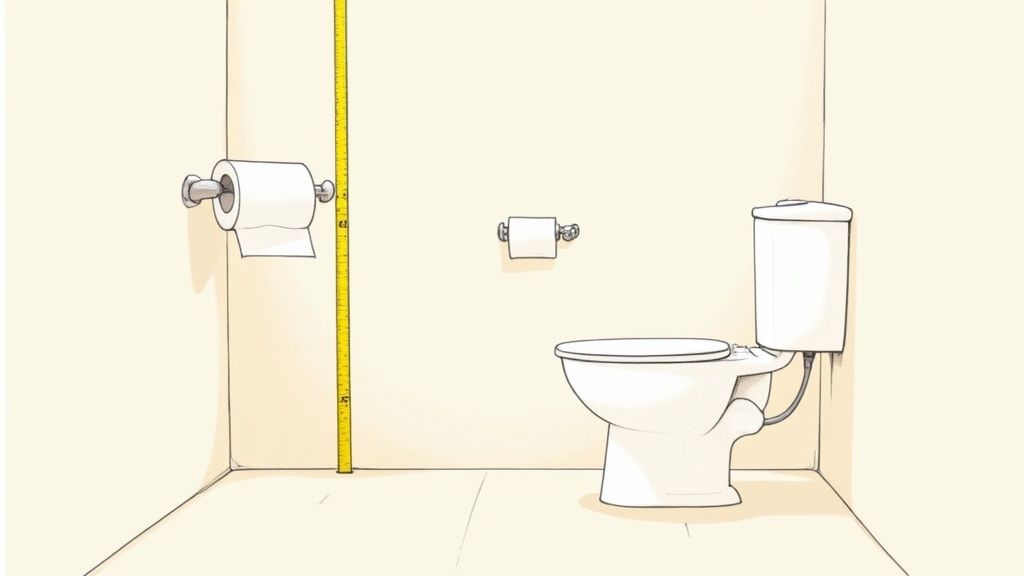
Let’s get right to it. The magic number for toilet paper holder height is 26 inches from the finished floor to the center of the holder. For the distance, you’ll want to aim for somewhere between 8 to 12 inches in front of the toilet bowl's edge. This is the sweet spot that provides a comfortable, natural reach for most adults without any awkward twisting or leaning.
Understanding the Standard Toilet Paper Holder Height
Getting the placement of a toilet paper holder right is one of those small details that makes a huge difference in how comfortable and functional a bathroom feels. It might seem like a minor decision, but these measurements are actually rooted in solid ergonomic principles designed to prevent unnecessary stretching or straining.
The standard 26-inch height works so well because most toilet seats are about 15 to 17 inches off the floor. This placement allows an average-sized adult to grab the paper comfortably while seated. Just as important is the front-to-back positioning; installing it 8 to 12 inches forward from the toilet bowl’s rim is what makes the reach feel completely natural.
This illustration gives you a clear visual of the standard 26-inch mounting height in a typical bathroom.

As you can see, this placement keeps the roll within an easy, relaxed arm's reach, which is exactly why this measurement has become the go-to standard for builders and designers. To really see how this fits into the bigger picture of a well-designed space, it’s helpful to understand the standard bathroom rough-in dimensions for all fixtures. This ensures every element in your bathroom works together seamlessly.
For a quick summary, here’s a table outlining the most common recommendations.
Toilet Paper Holder Height Recommendations at a Glance
| Bathroom Type | Recommended Height (from floor) | Recommended Distance (from toilet bowl) |
|---|---|---|
| Standard Residential | 26 inches | 8 to 12 inches |
| ADA Compliant | 15 to 48 inches (usable range) | 7 to 9 inches (centerline) |
| Children's Bathroom | 18 to 20 inches | 8 to 12 inches |
These are the core numbers you'll need for most projects, ensuring comfort, compliance, and functionality every time.
Why Perfect Placement Matters More Than You Think
It’s one of those details you only notice when it’s wrong. The placement of a toilet paper holder might seem minor in the grand scheme of a bathroom renovation, but get it wrong, and you create a source of daily, low-grade annoyance for everyone who uses the space.
An improperly placed holder forces an awkward twist, a strained reach, or leaves the paper dragging on the floor. Get it right, however, and the experience is seamless. The goal is simple ergonomics: minimize strain. When a holder is too far back, users have to twist their spine. Too far forward, and they have to lean uncomfortably. This tiny detail, repeated day after day, genuinely impacts comfort and accessibility.

Beyond Just Comfort
The real-world impact of correct placement extends far beyond simple convenience. It's a matter of safety and inclusivity, especially for certain users.
- Children: A holder mounted at standard adult height is out of reach for little kids, which kills their independence and usually ends with a pile of wasted paper on the floor.
- Elderly Users: For someone with arthritis or limited mobility, twisting and reaching for a poorly positioned holder can be painful or downright impossible.
- Individuals with Disabilities: For a person using a wheelchair or other mobility aid, a holder outside the accessible reach zone can make an otherwise compliant restroom unusable.
Getting the height and distance right isn't just about following a code; it's about showing consideration for every single person who will use the bathroom. A well-placed holder is a subtle sign that user comfort was a top priority in the design.
This attention to detail also has a direct effect on the bathroom's overall hygiene and cleanliness. When the paper is easy to reach, it's far less likely to end up on the floor, which can harbor bacteria and just looks messy. For more tips on keeping your restrooms fresh, check out our guide on how to eliminate toilet odor.
Ultimately, figuring out how high to mount a toilet paper holder is a small investment of time that pays huge dividends in functionality, accessibility, and user satisfaction. It’s a detail that, when done right, goes completely unnoticed—and that's exactly the point.
Navigating ADA Guidelines for Accessible Bathrooms
When it comes to public or commercial restrooms, the Americans with Disabilities Act (ADA) guidelines are not just suggestions. They’re the law, designed to ensure everyone can use the facilities safely and with dignity. These standards transform a restroom from just functional to truly accessible, and believe it or not, the placement of the toilet paper holder is a huge part of getting it right.

These rules aren’t random; they’re carefully thought out to support people in wheelchairs or those with limited mobility. Put a holder in the wrong spot, and you could make the stall unusable for someone who can't easily twist, bend, or stretch. Getting it right is just fundamental to inclusive design.
Key ADA Height and Distance Rules
The ADA gives a specific range for mounting height to make sure the dispenser is within reach without being an obstacle. Here’s the breakdown: the dispenser's outlet (where the paper comes out) must be between 15 inches and 48 inches above the finished floor.
However, the sweet spot for the centerline of the holder is between 19 inches and 36 inches from the floor. This narrower range is ideal for accommodating a wide variety of users, especially those in wheelchairs. Sticking to a maximum height of 36 inches is critical—it ensures the roll is reachable without forcing someone to stretch awkwardly.
The core principle behind ADA dispenser placement is all about "unobstructed forward reach." The dispenser must be on the side wall closest to the toilet, with its centerline positioned 7 to 9 inches in front of the front edge of the toilet bowl.
This horizontal measurement is the detail that trips people up the most. It’s what prevents users from having to twist backward, a motion that can be painful or impossible for many. This tiny detail is what makes a public restroom stall truly functional and compliant.
Practical Application for Facility Managers
For any business owner or facility manager, compliance is completely non-negotiable. When you’re doing a renovation or a new build, always remember to measure from the finished floor—not the subfloor—to get it right.
Here are a couple of pro tips I always recommend:
- Do a Real-World Test: Before you drill those final holes, grab a tape measure and an office chair. Better yet, if you have access to a wheelchair, use it. Have someone test the reach from a seated position to confirm the placement feels natural and is genuinely easy to access.
- Pick the Right Dispenser: Not all dispensers are created equal. Make sure the model you choose is ADA-compliant itself. It shouldn't require tight grasping, pinching, or twisting of the wrist to operate and should dispense paper smoothly.
By following these guidelines, you’re doing more than just checking a legal box. You’re creating a space that’s safe, respectful, and welcoming for every single person who walks through your doors.
Customizing Placement for Your Home and Family
The “standard” height is a great starting point, but it's not always the perfect height, especially when you’re designing a bathroom for your family’s real-world needs. Residential spaces give you the freedom to move beyond one-size-fits-all rules and truly customize your setup. This is about making the bathroom work for everyone, from the youngest to the oldest.
A perfect example is designing a bathroom for children. Placing a toilet paper holder at the standard 26-inch adult height can be really frustrating for a small child who’s just trying to be independent. Lowering it makes all the difference, promoting better hygiene habits from a young age.
Finding the Right Height for Kids
For a child's bathroom, the whole point is to foster self-sufficiency. That means mounting the holder significantly lower than the adult standard.
Advisory specs for children aged 3 to 12 suggest a much lower placement is essential. For instance, kids aged 3 and 4 benefit most from a dispenser height of about 14 inches. Older children, from ages 9 to 12, are more comfortable with a height between 17 and 19 inches. Following these child-specific recommendations ensures the toilet paper is always within easy reach, not a frustrating stretch.
Adjusting for Modern Comfort Height Toilets
On the other end of the spectrum are comfort height toilets, which are popping up in more and more modern homes. These models sit a few inches taller than standard toilets, typically measuring 17 to 19 inches from the floor to the seat.
The rule of thumb here is simple: as the toilet seat goes up, so should the toilet paper holder. For a comfort height toilet, raising the holder to around 28 inches from the floor often restores the ergonomic balance and prevents an awkward downward reach.
This slight adjustment maintains that comfortable, natural arm angle that makes the standard height so effective in the first place. Beyond just the holder, understanding the full range of top bathroom fittings available can really open up your options for placement and overall design, ensuring every element works together perfectly.
Ultimately, the best way to figure out how high to mount a toilet paper holder in your own home is to test it yourself. Before you drill any holes, just sit on the toilet and have someone hold the dispenser in the proposed spot. Close your eyes and reach for it. This simple, real-world test is the single best way to guarantee your final placement is perfect for the people who will actually use it every day.
Common Installation Mistakes to Avoid
Knowing the right measurements is only half the battle. A perfect installation also means sidestepping the common mistakes that turn a simple project into a frustrating fix-it job. Getting these details right from the start is what separates a professional result from an amateur one.
One of the most frequent mishaps is mounting the holder too far back. This creates the dreaded “twist and reach,” forcing users to contort themselves just to grab a piece of paper. It’s an ergonomic nightmare that’s incredibly easy to prevent with a little forethought.
Similarly, placing the holder too low is a major hygiene red flag. If the toilet paper roll can touch the floor, it’s going to pick up moisture and bacteria. That’s the last thing you want in any restroom, public or private.
Securing Your Installation Properly
Another classic blunder is failing to use the right hardware for your wall type. Just driving screws into bare drywall is a recipe for disaster. A few firm tugs are all it takes to rip the holder right out, leaving you with an ugly hole and a bigger problem to solve.
For a rock-solid installation that will last for years, you have to anchor it correctly. If you can’t screw directly into a wall stud, always use wall anchors rated for the weight. For trickier surfaces like tile or plaster, you’ll need specialized anchors and the right drill bit to avoid cracking the surface. Don’t skip this step.
A wobbly toilet paper holder isn't just an annoyance—it signals a poor installation. A secure mount is non-negotiable for both durability and user safety, especially in high-traffic commercial settings.
Avoiding Environmental Obstacles
Finally, always be mindful of what’s around—and inside—the wall. Installing a holder directly above a heat vent, for example, can make the paper dry and brittle. Over time, the buildup of dust and lint can even become a potential fire hazard.
Before you drill a single hole, do a quick visual check for:
- Heat Vents: Keep a safe distance to avoid drying out the paper or creating a fire risk.
- Electrical Outlets: Make sure you aren’t about to drill into hidden wiring.
- Cabinet Doors: Check that the holder won't block a nearby vanity or cabinet from opening all the way.
By steering clear of these common mistakes when deciding how high to mount a toilet paper holder, you’ll guarantee a result that’s secure, functional, and perfectly placed.
Common Questions We Hear on the Job
Even with the best plans and measurements, every bathroom has its quirks. Here are some quick answers to the questions that come up most often when you’re trying to find that perfect spot for a toilet paper holder.
What Do I Do with an Awkward Bathroom Layout?
If your bathroom layout makes it physically impossible to mount a holder in that ideal 8-12 inch forward range, don't try to force a bad fit. Bad placement is worse than no placement.
A freestanding toilet paper holder is a fantastic, drill-free solution. It gives you total flexibility to place it wherever feels most natural. Another great option is mounting the holder on the side of a nearby vanity. Just double-check that it’s still easy to reach and won’t block any drawers or cabinet doors from opening.
Does the Holder Go on the Left or Right Side?
Honestly, there’s no hard-and-fast rule here. The best side is the one with the most open, comfortable space. It’s less about being left-handed or right-handed and more about which side doesn’t feel cramped.
Take a look at your setup. Which side gives you a clear, unobstructed reach from the toilet? That’s your answer. Practicality and available space should always win out over trying to guess someone’s dominant hand.
How Do I Find a Wall Stud for a Secure Mount?
The easiest and most reliable way is with a stud finder. Just slide it across the wall, and it’ll beep or light up when it finds a stud. This is the gold standard for getting a rock-solid installation that won’t ever wiggle loose.
Pro Tip: No stud finder? No problem. Try the old-school 'knock test.' Tap your knuckle along the wall. A hollow, deep sound means you're between studs. When the sound changes to a solid, dull thud, you've found one. Mounting directly into a stud is always the best way to go—it gives you the strongest possible hold.
Leave a Reply