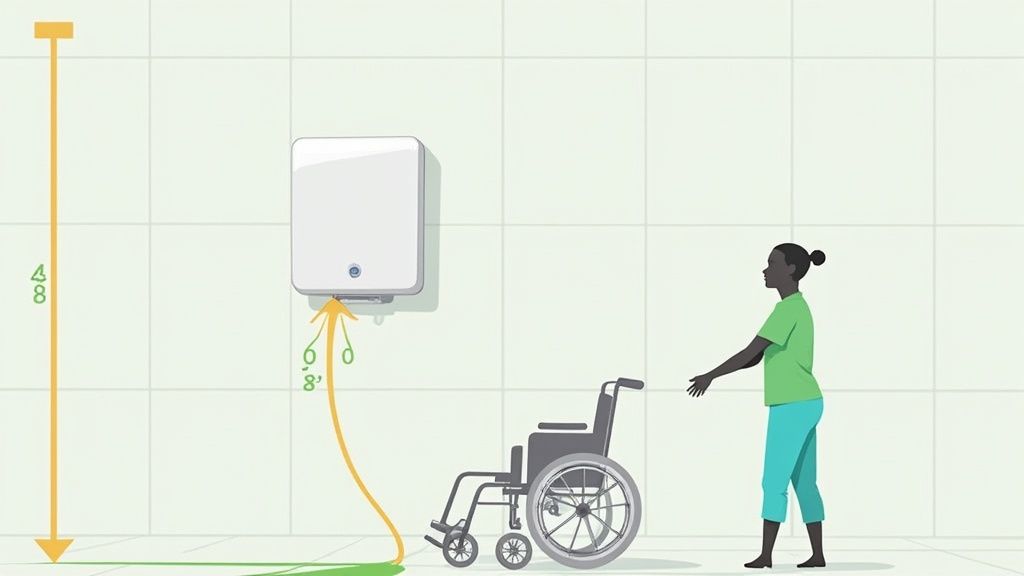
When it comes to ADA hand dryer height, there's one number that rules them all: 48 inches. That’s the absolute maximum height the operable part of the dryer—whether it’s the activation sensor or a button—can be from the finished floor. Getting this right is the key to ensuring someone in a wheelchair can comfortably reach and use the unit.
Getting Your Hand Dryer ADA Height Right

During installation, precision is everything. A single inch can be the difference between a compliant, accessible restroom and one that puts up a barrier for your visitors. Nail the hand dryer height from the get-go, and you’ll avoid costly rework while making sure your facility truly welcomes everyone.
The Americans with Disabilities Act (ADA) set the standard back in 1990, and its guidelines are crystal clear. For adults, the hand dryer's controls or air outlet can’t be higher than 48 inches (1220 mm). If you're installing dryers in a facility for children or shorter individuals, that number drops to a maximum of 44 inches (1120 mm).
These aren't just suggestions; they are crucial measurements that make sure people using wheelchairs or facing other mobility challenges can access the same amenities as everyone else. To dig deeper into the code, you can find a great breakdown of compliant hand dryer installation on berls.com.
Key Installation Numbers to Know
Think of these measurements as the non-negotiable foundation for your project. They’re what make a restroom design not just functional, but also inclusive and legally sound.
- Maximum Reach Height: 48 inches (for adults)
- Maximum Protrusion from Wall: 4 inches (this is a big one for preventing hazards for people with visual impairments)
- Clear Floor Space: 30 inches by 48 inches (to ensure enough room for a wheelchair to approach and turn)
A compliant restroom is more than just a legal box to check. It’s a powerful signal to your customers that you value their business and respect their needs. The right hand dryer height is a small detail that makes a massive difference in a user's experience and dignity.
Here’s a quick-reference table that breaks down the essentials for a standard installation.
ADA Hand Dryer Installation At a Glance
This table summarizes the core requirements you'll need to follow for most hand dryer installations to ensure they are fully ADA-compliant.
| Requirement | ADA Standard (Maximum) | Purpose |
|---|---|---|
| Operable Part Height | 48 inches | Ensures a person in a wheelchair can reach the button or sensor. |
| Forward Reach | 48 inches | Defines the highest reachable point for someone approaching head-on. |
| Protrusion into Path | 4 inches | Prevents the unit from being a hazard for visually impaired individuals. |
| Clear Floor Space | 30" x 48" | Guarantees enough maneuvering space for a wheelchair in front of the dryer. |
Keeping these simple numbers in mind from the start will save you from headaches and ensure your facility is built for everyone.
Why ADA Compliance Is Smart Business

Getting ADA hand dryer heights right isn’t just about following rules—it’s just plain good business. When your facilities are genuinely accessible, you’re sending a clear signal that everyone is welcome, building a reputation for inclusivity and respect. A simple restroom fixture becomes a powerful statement about your company’s values.
Prioritizing accessibility literally opens your doors to more people. In the U.S. alone, over 61 million adults live with some form of disability. By designing a restroom that meets their needs, you're not just checking a legal box; you're inviting a huge and loyal customer base into your establishment.
The Financial Case for Compliance
Beyond your brand’s image, there are some pretty compelling financial reasons to get your hand dryer ADA height correct. Non-compliance isn't just an inconvenience for customers; it's a major financial risk for your business.
Businesses that fail to comply can face civil lawsuits and steep penalties, sometimes costing tens of thousands of dollars for a single violation. On the flip side, an accessible restroom improves the customer experience, which can boost your reputation and expand your market reach. You can learn more about how ADA guidelines protect businesses on exceldryer.com.
Investing in an accessible restroom is an investment in your brand’s integrity. It shows you’re committed to social responsibility and acknowledges the millions of patrons who depend on thoughtful, compliant design for basic dignity and access.
Ultimately, designing for everyone isn't a burden—it’s an opportunity. It shields you from legal headaches while simultaneously making your public image stronger and growing your potential customer pool. This approach turns a compliance chore into a cornerstone of smart, sustainable business.
How to Measure and Install for Flawless Compliance
Getting the theory right is one thing, but proper installation is where the rubber meets the road. Nailing the ADA hand dryer height on the first try saves you from costly redos, ensures your restroom is safe from day one, and keeps everyone happy. It all boils down to two key ideas: reach height and protrusion depth.
First things first: always measure from the finished floor. That’s the surface people will actually be walking or rolling on—not the subfloor underneath. Grab a tape measure and a level to mark the wall. Your target is to make sure the highest usable part of the dryer, whether it’s a button, sensor, or the air nozzle itself, is no higher than 48 inches.
Mastering the Protrusion Rule
Just as important is the 4-inch protrusion rule. If the bottom of your hand dryer is anywhere between 27 and 80 inches from the floor, it cannot stick out from the wall more than four inches. This isn't just a random number; it's a critical safety measure for people with visual impairments who use a cane to detect obstacles. Anything jutting out above cane height is a serious hazard.
A perfect installation is more than just hitting the right numbers. It's about creating a predictable and safe environment where every visitor can navigate with confidence and dignity, knowing the space was designed with their needs in mind.
This infographic breaks down the three core steps for a compliant installation.

As you can see, the mounting height, clear floor space, and reach limits are all interconnected pieces of one accessible design puzzle.
A Step-by-Step Installation Checklist
To make sure your installation is flawless, just follow this simple checklist. Taking a methodical approach helps you avoid missing any small but crucial details.
- Confirm Measurements: Before you drill a single hole, double-check your marks. Is the highest operable part at or below the 48-inch maximum height?
- Use a Level: This might seem obvious, but make sure the unit is perfectly horizontal. A crooked dryer looks unprofessional and can even mess with the sensor's performance.
- Check Protrusion: Once it's on the wall, measure from the wall to the dryer's furthest point. You have to be within that 4-inch limit.
- Verify Clear Space: Finally, confirm there’s a 30" x 48" clear patch of floor right in front of the unit, leaving plenty of room for wheelchair access.
These installation rules aren't unique to hand dryers; they apply to many restroom fixtures. For more tips on getting placements just right, check out our guide on how high to mount a toilet paper holder. A careful, deliberate approach is all it takes to ensure your hand dryer is compliant, safe, and ready for use.
Designing for Universal Access, Not Just Minimums

Meeting the 48-inch maximum hand dryer ADA height is the legal starting point, not the finish line. True accessibility, what we call universal design, aims much higher. It’s about creating a restroom that feels intuitive and comfortable for every single visitor, regardless of their age, size, or ability.
This is where we move from merely compliant to genuinely thoughtful. The goal is to use anthropometric data—the science of human body measurements—to find the sweet spot for placement. Instead of a one-size-fits-all height, you can tailor installations to better serve your specific audience, creating an environment that feels welcoming and just plain works.
Optimizing Heights for Different Users
A few inches can make a world of difference. Research shows that small adjustments based on the primary users of a restroom can significantly improve their experience. For example, in women's restrooms, dropping the dryer to around 44 inches is often a better fit for the average female stature. It's a small change that removes a minor but real inconvenience.
Consider these user-centric adjustments for a more inclusive space:
- Men’s Restrooms: The ideal height is around 46 inches (1170 mm).
- Women’s Restrooms: A slightly lower height of 44 inches (1120 mm) is often more comfortable.
- Children’s Restrooms: You'll see a range from 32 to 44 inches, depending on the age group.
- Accessible Stalls: A mounting height of 37 inches (940 mm) is much more practical for most wheelchair users.
Universal design isn’t about making special accommodations; it's about smart design that works better for everyone. By considering average user heights and reach, you remove small but meaningful barriers that make your facility more functional.
Of course, a truly accessible space is more than just the dryer on the wall. It requires thinking about the entire area. This means ensuring there’s enough clear floor space for a wheelchair to maneuver easily between sinks, stalls, and dryers. A well-designed layout inside a public restroom stall is just as critical.
To create a bathroom where everything works in harmony, it's also important to understand specific ADA faucet requirements. When all the elements are considered together, you create a space that is not just compliant, but genuinely welcoming to all.
Choosing the Right ADA-Compliant Hand Dryer
Not all hand dryers are built the same, and the hardware you pick has a huge say in both user experience and whether you meet those strict hand dryer ADA height and protrusion rules. If you start by selecting a model designed with accessibility in mind, the whole installation process becomes simpler, and you end up with a restroom that’s both compliant and genuinely user-friendly.
Your first big decision comes down to two main styles: surface-mounted and recessed.
A surface-mounted dryer bolts directly onto the wall. It’s the straightforward, more budget-friendly route. But there’s a catch—you have to choose a “slim profile” model that sticks out no more than 4 inches from the wall. Anything more creates a serious hazard for people with visual impairments.
Recessed hand dryers, on the other hand, are built right into the wall. This is definitely a more involved installation, but it completely solves the protrusion problem. The result is a sleek, integrated look that’s inherently compliant from day one. This is easily the best choice for new builds or major renovations where you’re already opening up the walls.
Key Features for Compliance
Beyond how it’s mounted, think about how it turns on. For ADA compliance, touch-free, sensor-activated models are the gold standard. They don’t require any physical force to operate, which makes them accessible for everyone, including users with limited strength or dexterity.
A well-chosen hand dryer does more than just tick a legal box; it helps create a restroom that feels safe, modern, and thoughtfully designed for every single visitor.
To help you sort through the options, let’s compare the two main types of ADA-compliant hand dryers.
Comparison of ADA-Compliant Hand Dryer Types
This table breaks down the main differences between recessed and slim surface-mounted models, helping you pick the best fit for your building’s needs and budget.
| Dryer Type | Protrusion Depth | Installation Complexity | Best For |
|---|---|---|---|
| Recessed (In-Wall) | Zero | High (requires cutting into wall) | New construction, high-traffic areas, and premium aesthetics. |
| Slim Surface-Mounted | Under 4 inches | Low (mounts directly to wall surface) | Retrofitting existing restrooms and budget-conscious projects. |
Ultimately, whether you choose a recessed unit for a seamless finish or a slim surface-mounted model for a quick upgrade, the goal is the same: to create a space that works for everyone.
Got Questions About ADA Hand Dryer Height? We've Got Answers.
When it comes to ADA compliance, the devil is in the details. Getting the mounting height for a hand dryer just right can feel tricky, but it's one of those things you absolutely have to nail. A few inches off, and you could be looking at a costly fix and a facility that isn't truly accessible.
Let's clear up some of the most common questions that pop up during installation.
Does the 48-Inch Rule Apply to the Top of the Dryer or the Button?
This is a fantastic question, and the answer is critical. The 48-inch maximum height rule applies to any "operable part" of the hand dryer.
Think of it this way: what part does someone actually have to touch or interact with to make it work? That's the part that matters. Whether it's a classic push-button or the motion sensor, that specific component cannot be mounted higher than 48 inches from the floor. Always double-check the manufacturer's installation guide—it will tell you the exact mounting height needed to keep those all-important parts in the compliant zone.
Are There Different Height Rules for Childrens Restrooms?
Yes, and this is where thoughtful design comes in. While the ADA sets the maximum height for adults, it's just plain smart to install dryers lower in places built for kids, like schools, daycares, or family restrooms.
- A good range for children is typically between 32 and 44 inches.
- If your restroom serves everyone, the best solution is to install two dryers at different heights. One for adults, one for kids.
True accessibility isn’t just about meeting the bare minimum legal standard. It’s about creating a space where everyone, including your smallest visitors, can have a comfortable and dignified experience.
What if a Dryer Sticks Out More Than 4 Inches From the Wall?
If a hand dryer protrudes more than 4 inches from the wall and its bottom edge is anywhere between 27 and 80 inches high, you've got a serious ADA violation. This creates a major hazard for people with visual impairments who use a cane to detect obstacles.
The fix is straightforward: either replace it with a certified slim-profile model designed to be compliant or recess the unit directly into the wall. Recessing it is the gold standard because it eliminates the protrusion entirely.
Do ADA Height Rules Apply to My Private Business?
Yep, they sure do. The Americans with Disabilities Act covers all "public accommodations," which is a broad category that includes nearly every privately-owned business that serves the public. We're talking retail stores, restaurants, gyms, and private offices.
Any new construction or alteration project must follow the current ADA Standards for Accessible Design, and that absolutely includes the proper installation of hand dryers.
Leave a Reply