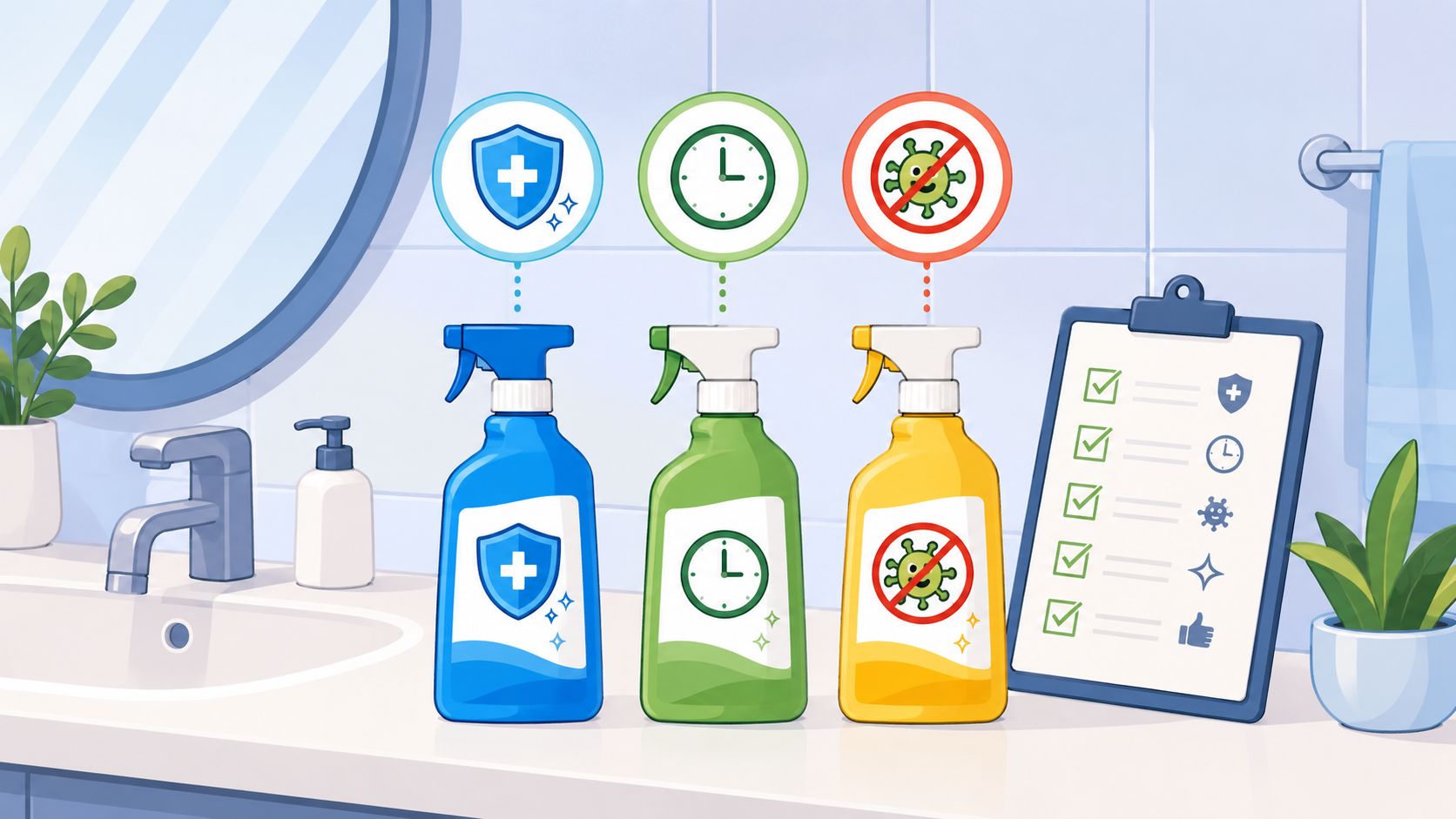
The restroom tells the truth about a facility fast. A guest grabs the handle, touches the stall latch, uses the faucet, and judges the place long before they read a sign or look at a menu. In a gym, office, school, restaurant, or retail space, that first impression comes down to one thing, whether the surface was properly disinfected, not just wiped dry.
Most operators still shop for the best disinfectant for bathrooms as if every bottle does the same job. It doesn't. The product that wins on a busy countertop can fail on a vertical tile wall, and a cleaner that smells pleasant can be the wrong choice for toilets, grout, or post-illness cleanup. The decision is not brand recognition, it's whether the chemistry matches the surface, the pathogen risk, and the time staff can leave it wet.
A good facility manager reads restroom chemistry the way a mechanic reads a dashboard. The label tells the story, the contact time tells the truth, and the material compatibility tells you whether the finish survives the month. If you want a broader operations lens, the guide for commercial facility management is useful context, but the restroom call still comes down to protocol, not polish.
The smartest way to think about bathroom disinfection is in three jobs, daily touchpoints, post-illness deep cleans, and mold-prone wet zones. Different jobs deserve different chemistry, different dwell times, and different staff habits. That's the standard I'd use on any property I was responsible for.
Why the Disinfectant You Pick Drives Your Facility
A manager walks a guest into a restroom, and the room either feels controlled or neglected. The door handle, the stall latch, the faucet, and the air each expose a different weak point, and the disinfectant choice decides whether those points get handled or just cosmetically touched. On paper, a wipe is a wipe. In practice, the active chemistry and the dwell time decide whether you're reducing risk or moving soil around.
The bottle on the shelf is not the real decision
Public-health guidance is blunt about this. Disinfectants must stay visibly wet long enough to kill microorganisms, and many products are formulated to reach full disinfection in about 10 minutes on hard, nonporous surfaces like tile, porcelain, and fixtures, while sanitizing can mean 99.9% reduction in 30 seconds and food-contact sanitizers must achieve a 5-log (99.999%) reduction Fight BAC. That is why a restroom product that looks strong but flashes off in a minute is usually the wrong answer.
CDC guidance also makes the material point clear. A disinfectant should be broad-spectrum, fast-acting, active in the presence of organic matter, and compatible with common bathroom materials such as metal, plastic, and rubber CDC. In plain language, the best disinfectant for bathrooms is usually the one that can stay wet long enough on the exact surface you're cleaning.
Practical rule: if the label doesn't tell staff how long the surface must stay wet, it's not a serious bathroom disinfectant.
Why this matters in real facilities
Shared restrooms punish vague cleaning programs. A janitor can make a sink look clean in seconds, but a guest still reads the faucet, handle, and counter as a verdict on the whole building. That is why a real restroom program separates daily touchpoints from deeper corrective work, instead of pretending one chemistry solves everything.
There is also a reason facilities that standardize process tend to look calmer to visitors. They are not improvising in the stall with whatever is left in the cart. They are using products with known claims, known wet times, and known use cases, which is exactly how operations stays predictable under pressure.
A practical operator also matches the product to the job. Daily touchpoints call for fast, repeatable disinfection on handles, flush hardware, and sink areas. Post-illness cleanup needs a stronger protocol with a verified label claim and enough dwell time to matter. Wet zones, especially grout lines, shower edges, and anywhere mold keeps coming back, need a chemistry and cadence built for moisture, not a generic wipe-down.
That is the distinction worth making before anyone starts shopping for a bottle. The right disinfectant does not just clean a restroom, it supports the whole routine, from routine contact-point work to heavier corrective cleaning. A solid guide for commercial facility management helps with the bigger operating picture, but restroom results still come down to matching the product class to the task.
The Six Criteria That Decide a Bathroom Winner
Start with the label, not the scent
The first filter is EPA registration. If a product is not a real disinfectant, it is a cleaner with marketing. Ask the supplier whether it is EPA-registered for the exact surface and organism risk you are trying to control. If they cannot answer cleanly, move on.
The next question is the pathogen claim. Some products target bacteria only, others cover a wider range of viruses and fungi. That difference matters in restrooms because toilets, flush handles, rails, sinks, and high-touch fixtures do not carry the same risk profile. A buyer should ask what the product kills, and what it does not kill.
Contact time beats hype every time
The third check is contact time. If a label calls for a long wet dwell, that may work on a horizontal counter and fail on a stall latch or vertical tile wall. The question is simple. Can your team keep the surface wet for the full labeled period without constant re-spraying?
Then look at material compatibility. Bathroom finishes vary a lot, and a product that works on porcelain can haze glass, dull metal, or punish grout. CDC guidance says the ideal disinfectant should stay compatible with common bathroom materials such as metal, plastic, and rubber CDC.
Odor comes next. Guests notice a strong scent fast, but staff are the ones breathing it all shift. A low-odor peroxide or quat product often fits daily work better than a heavy chlorine smell, especially in occupied buildings.
If the room still smells harsh after the task is done, the protocol is probably too aggressive for daily use.
Finish with residue. Film attracts the next round of soil, which means a glossy counter can become a sticky one if the product leaves too much behind. That is the buyer-facing question I would use every time. Will this leave the surface ready for the next guest, or just visibly wet and tacky?
Match the chemistry to the job
A restroom does not need one all-purpose answer. Daily touchpoints, post-illness deep cleans, and mold-prone wet zones each call for a different level of chemistry and a different protocol. Quats usually make sense for routine handles and flush hardware, peroxide fits crews that want a cleaner daily finish, and bleach still has a place on tougher soils and corrective work where the surface can handle it. For teams that want a closer look at hydrogen peroxide disinfectants, this guide breaks down where peroxide earns its keep and where it does not.
The wrong product in the right room still creates bad results. A strong label with poor dwell time, the wrong finish compatibility, or residue that keeps collecting soil is still a bad operational choice. Choose the chemistry that fits the surface, the traffic, and the cleaning cadence, then train staff to use it the same way every time.
Comparing the Five Main Disinfectant Classes
The chemistry that actually shows up on restroom carts
Chlorine bleach is the blunt instrument. It's cheap, broad, and unforgiving, which is why it stays in the conversation for toilets, grout, and post-illness cleanup. Public-health-aligned guidance also keeps bleach in the bathroom toolkit, with the CDC mix reported by Family Handyman as 5 tablespoons, or 1/3 cup, per gallon of water or 4 teaspoons per quart, with a 10-minute dwell time, while alcohol-based disinfectants should contain at least 70% alcohol NBC News. I'd use bleach where the room can be ventilated and where the surface can handle it.
Quaternary ammonium compounds, or quats, are the daily-driver option. They're common on touchpoints, they're easier on staff than bleach, and they fit routines where the room has to stay open. Their weakness is spectrum, so they're not my first pick for every high-risk outbreak scenario.
Hydrogen peroxide sits in the middle. It's a good balance of efficacy and day-to-day usability, and I'd rather see peroxide in a busy restroom than a harsh product that staff avoid. Alcohol is the spot-treatment specialist. It belongs on hardware and fast jobs, not as the only bathroom strategy. Peracetic acid is the deep-clean and post-illness tool for trained crews who can manage fumes and stronger handling requirements.
Disinfectant Classes at a Glance
| Class | Typical Contact Time | Best Use Zone | Key Trade-Off |
|---|---|---|---|
| Bleach | 10 minutes | Toilets, grout, post-illness deep cleans | Strong odor, ventilation burden |
| Quats | Fast, label-specific | Daily touchpoints, desks, handles, stalls | May not cover every pathogen type |
| Hydrogen Peroxide | Label-specific, often moderate | Countertops, sinks, wet zones | Must still stay visibly wet |
| Alcohol | Fast for spot work | Hardware, small fixtures, electronics-adjacent areas | Not a full-room solution |
| Peracetic Acid | Label-specific, usually for pros | Deep cleans, high-risk resets | Fumes and handling demands |
For readers comparing peroxide options in more detail, the internal breakdown at hydrogen peroxide disinfectants helps frame why this class keeps winning in occupied spaces.
The Two-Step Protocol That Makes Any Product Work
Clean first, then let the disinfectant do its job
Every strong restroom program starts the same way. Remove visible soil first, then apply the disinfectant, then leave it visibly wet for the full labeled contact time before wiping or rinsing. That sequence matters because disinfectants work best on surfaces that aren't buried under debris, soap film, or mineral buildup.
The most common mistake I see is speed wiping. Staff spray, swipe, and move on before the chemistry has time to work. That looks productive and accomplishes very little. The second mistake is spraying too far away, which wastes product and leaves uneven coverage.
Use the spray correctly, not just generously
A bathroom spray should hit the surface from about 20 cm, or roughly 8 inches, away so the coating is even without fogging the room Sanytol. For wipe formats, the rule is even simpler, keep the surface wet long enough and use a fresh side of the wipe when the first side is loaded.
For floors, walls, and toilet exteriors, a sanitizer can be enough in many programs, while high-touch touchpoints like faucets, latches, flush handles, and rails deserve a true disinfectant SF Environment. Spain's authorized virucide guidance also accepts disinfection by rubbing with impregnated wipes on contact surfaces and stresses respecting contact time with mops, cloths, sponges, or diluted solutions Spain Ministry of Health.
A wipe is the fastest tool when staff need portability, control, and less over-application. A spray wins when the area is bigger, the surface is irregular, or you need better coverage around fixtures. Either way, the product only works if the crew leaves it wet long enough.
Daily Touchpoints Versus Deep Cleans Versus Wet Zones
One restroom, three jobs
A lot of operators treat the bathroom like one cleanup problem. That's lazy, and it creates bad purchasing decisions. Daily touchpoints, post-illness deep cleans, and mold-prone wet zones deserve different chemistry, different cadence, and different tolerance for scent and dwell.
For daily touchpoints such as faucets, latches, dispensers, flush handles, and rails, I'd use a fast-dwell quat or peroxide product that fits repeated use during the day. The point is to keep the room safe without making it unusable for guests. In occupied buildings, that usually means cleaning the visible soil, then hitting the high-touch points with disinfectant wipes, sanitizing wipes, or a low-odor spray that the crew can apply quickly and consistently.
For post-illness deep cleans, go harder. That's where bleach or peracetic acid earns its keep, especially on toilets, floors, and grout where contamination risk is higher and a stronger reset makes sense. A facility should also keep an eye on ventilation and staff protection when using those products, because a room can't be “clean” if the crew can't work safely in it.
Wet zones need a different chemistry
Mold-prone areas are a separate problem. Grout lines, shower walls, under-sink cabinets, and other persistently damp spots benefit from hydrogen peroxide-based formulas that break down residue without the same staining risk you'd accept from a chlorine-heavy routine. That's where gym equipment cleaning wipes, yoga mat wipes, or wipes to disinfect gym equipment become useful in adjacent spaces too, because fitness facilities often run the same moisture and odor problems across locker rooms and restrooms.
Operational truth: daily touchpoints need speed, deep cleans need force, and wet zones need chemistry that won't wreck finishes.
If you're comparing daily-use options for a broader sanitation shelf, wipes.com is one place operators look for wipe formats alongside sprays and dispensers. The product line matters less than the match between chemistry and the job.
PPE, Ventilation, and the Mixing Mistakes That Send Staff to the ER
Safety is part of the product
A disinfectant isn't “best” if it can't be used safely by a rotating crew. Gloves are the baseline, eye protection belongs in the cart, and ventilation matters whenever you're using bleach or peracetic acid. Staff should also know when a room needs to be cleared briefly instead of being worked through.
The worst mistake is mixing chemicals. Never combine bleach with ammonia, acids, or any quat product that warns against it. That isn't a minor training miss, it's a facility incident waiting to happen. One bad pour can shut down a restroom and turn a routine shift into a reportable problem.
Give new hires a script, not just a bottle
Every new employee should be able to answer five questions before touching the product:
- What product am I using? Know the exact name and class.
- What surface am I treating? Tile, porcelain, metal, plastic, or rubber.
- What dwell time applies? Follow the label, not habit.
- What PPE do I need? Gloves at minimum, plus eye protection when warranted.
- What do I do if I'm splashed? Stop, rinse, report, and replace the product if it's contaminated.
For biohazard situations, the guide for proper biohazard remediation is a useful reference point because restroom incidents aren't always routine cleaning events.
If you need help thinking through dilution and product strength, the internal note at dilution of chemicals fits into staff training well. In day-to-day operations, pre-measured EPA registered disinfecting wipes are often the safer choice for routine touchpoints because they remove guesswork and reduce overuse.
Facility-Specific Picks and Cadence
Match the product to the building type

Airports and event venues need turnover speed first. A peroxide-based spray plus pre-wetted wipes at gates, concourses, and restrooms keeps staff moving while still giving guests a visible standard of care. In these settings, commercial disinfecting wipes are worth the shelf space because people will use them correctly when they're obvious and close at hand.
Gyms and fitness centers are a different animal. Sweat, moisture, and hand contact make gym wipes, fitness wipes, and bulk gym wipes a practical core item, especially near cardio equipment, benches, lockers, and showers. A gym wipe dispenser at the point of use helps staff and members clean the machine they just touched instead of waiting for a roaming cleaner.
Schools and offices lean toward low-odor, fast-use products for desks, rails, and doors. The room has to stay usable, which is why a quat or peroxide rotation usually makes more sense than a strong-smelling heavy hitter in occupied areas.
Restaurants need a split program. Guest restrooms can run on disinfectant wipes and a low-odor daily spray, while food-contact areas must stay in the sanitizer lane and use a food-safe product matched to that surface.
In shared facilities, the best bathroom program is the one people can see, use, and repeat without calling the supervisor.
The visual reference above works because it maps product class to real use cases. That kind of clarity also helps sales teams explain why a restaurant, gym, or office needs different inventory than a warehouse or back-of-house closet.
Your Visible Sanitation Program Checklist
Make the program visible, not invisible
A restroom strategy should read like a checklist, not a mystery. Pre-clean, select the right product, apply it correctly, and hold the wet contact time. Then document what was cleaned, train the people doing it, and keep the stock where the work happens.

The best operators make cleanliness visible to guests and simple for staff. That means wipes at the point of use, dispensers where hands naturally land, and a log that shows the room isn't being guessed at. It also means telling buyers, especially in gyms, schools, offices, restaurants, and retail stores, that the restroom standard is part of the brand, not an afterthought.
For sales teams, that's the core hygiene ROI conversation. Disinfectant wipes, sanitizer refills, and bathroom-specific sprays don't just sell cleanliness, they sell confidence and consistency. For operations teams, they keep the daily routine tight and the deep-clean response ready.
Start with the visible zones, stock the right disinfecting wipes where guests and staff stand, and assign the heavier chemistry to the rooms and moments that justify it. If you manage a facility, audit the restroom cart this week, replace the wrong products, and build a routine your team can repeat every day.
Leave a Reply