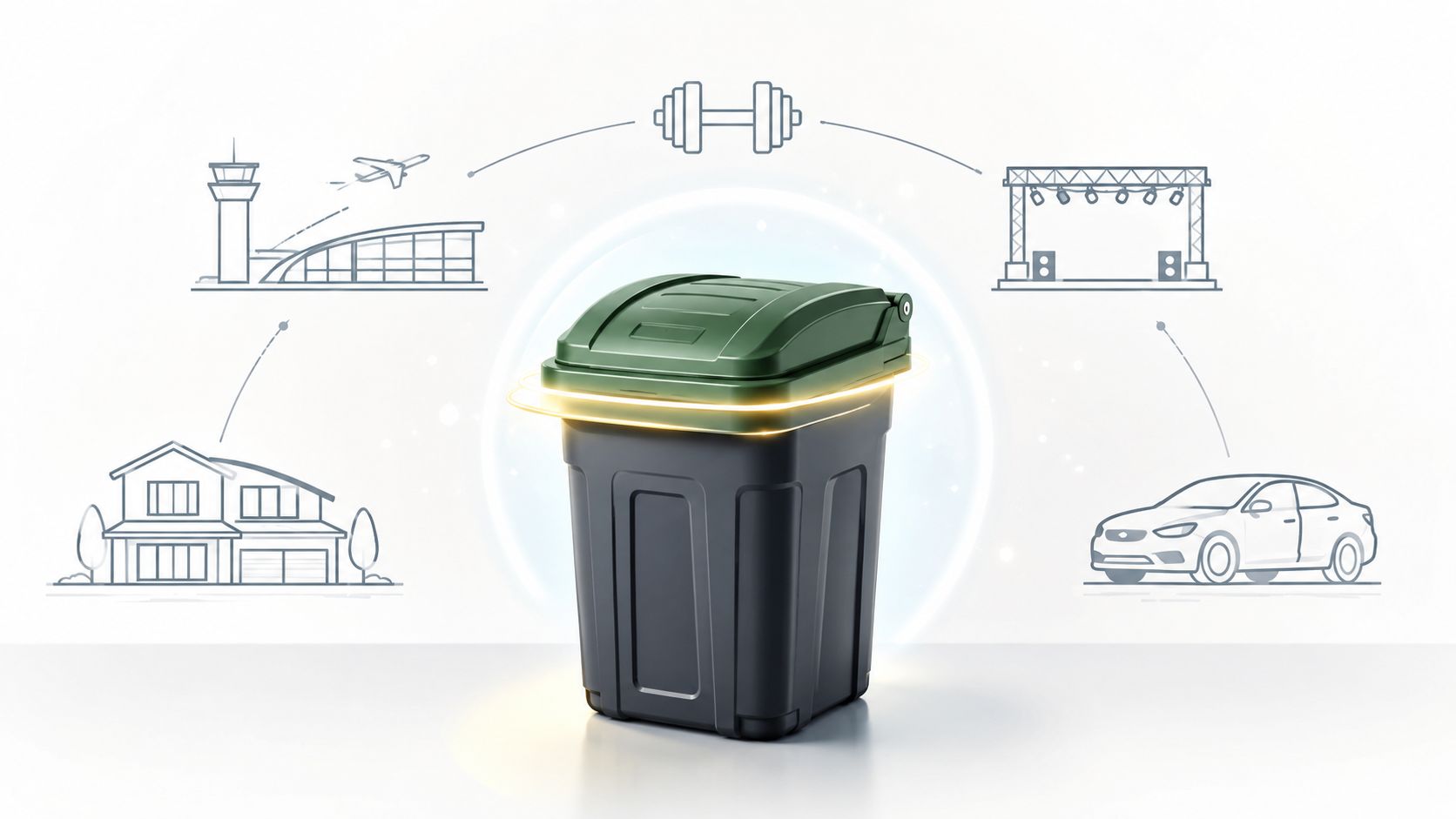
You're standing near a back door or service corridor, and the bin area is the first thing guests notice before they ever see the lobby, court floor, or showroom. If the lid is warped, missing, or too flimsy to stay shut, the message is instant, this place cuts corners on cleanliness. A garbage can cover does more than hide waste, it helps control odor, limit pest access, and keep the whole operation looking managed instead of neglected.
That matters even more in places where people linger, sweat, eat, or judge you quickly. In gyms, airports, event spaces, and retail sites, the waste station isn't background equipment, it's part of the guest experience. Pairing covered containment with a consistent wipe routine on nearby surfaces is one of the simplest ways to make a facility read as clean, not just cleaned.
Why a Garbage Can Cover Is a Frontline Hygiene Asset
A broken enclosure at a gym loading area can undo a lot of good work. Staff may have just wiped down treadmills, the locker room may smell fresh, and the front desk may be spotless, but one open waste cart near the service path changes the whole impression. That's the practical reason I treat a garbage can cover as frontline equipment, not an accessory.
The bin area shapes the first clean impression
Covered containment affects three things guests notice fast. It reduces visible waste, it helps keep odors from drifting, and it discourages pest activity around high-traffic doors and pads. That lines up with why regulated waste containment developed in the first place, from the Paris Poubelle Law of 1883 to England's official garbage collection system in 1875 and the move toward motorized waste service in the U.S. around 1914 (history of the garbage can).
The historical point matters because it shows the cover was never just decorative. It grew out of sanitation rules, odor control, and street cleanliness, which is exactly how facilities should think about it today.
Practical rule: if guests can see the waste and smell it before they reach the service desk, the cover is failing its job.
I've seen this play out in airports and gyms, where people judge the entire operation by one bad corner. The bin area doesn't need to be glamorous, but it does need to look deliberate.
Cleanliness, not concealment, is the standard
The right approach is to treat the cover as part of the hygiene stack, alongside disinfectant wipes, staff training, and daily surface checks. That's especially true in public-facing facilities where every touchpoint matters. The cover should support a clean workflow, not create a hiding place for mess.
A smart program also helps with compliance and guest trust. New York City now requires covered bins for certain properties, and that's a useful signal for anyone managing dense, public-facing sites (NYC bin FAQ). A visible, well-fitted cover tells people the space is managed with intent.
What a Garbage Can Cover Is
A garbage can cover can mean two different things in practice. It may be a simple lid that closes a single bin, or it may be a full enclosure that surrounds a cart or dumpster in a built structure. Both sit in the same sanitation workflow, but they solve different operational problems.
Start with the container, then choose the cover
If the waste stream stays indoors and staff handle the bin inside the facility, a lid may be enough. If the container sits outside, near a curb, or in a guest-visible service lane, a full enclosure starts to make more sense. The right choice depends on whether the main issue is odor, access, visibility, pests, weather, or all five at once.
That distinction is older than most facility specs. Closed storage became standard because cities needed tighter containment as waste collection became formalized. Early garbage receptacles were designed to store ash from burned waste, which shows how sanitation systems moved toward enclosed storage instead of exposed piles.
Why closed containment became the norm
By the early 20th century, U.S. trash handling had become more industrial, with horse-drawn carts giving way to motor carts around 1914. That shift matters because once collection became scheduled and mechanical, waste had to be stored in a way that was predictable for crews and less disruptive for the public.
A cover is not a style choice first. It is a containment decision that affects sanitation, access, and service consistency.
In a facility setting, that means the first question is not what looks nice. It is what will contain the waste stream without slowing pickup. On dense properties, that can mean compliance pressure too, since New York City container rules push certain sites toward covered storage and San Francisco enclosure permitting affects how outdoor waste areas are built and serviced. For some sites, that is a heavy lid. For others, it is a ventilated enclosure with a straight cart path. If you are buying for a high-use site, use the container type, service route, guest visibility, and permit constraints to define the cover, not the other way around.
For spec sheets and hardware comparisons, start with the container and lid together, then check how the whole setup will be handled in the field. A practical reference point is shop waste receptacles, and for lid styles that hold up under repeated use, this guide to BRUTE garbage can lids is a useful companion.
Cover Types and Materials Compared
The market is full of covers that look tidy in photos and fail once staff start using them every day. The main divide is simple, attached lids for individual cans, or enclosures for carts and larger containers. After that, material choice determines whether the unit survives weather, cleaning, and repeated handling.
What usually works in the field
Attached lids are the easiest to live with indoors. Flip tops and dome lids help in busy corridors because people can open and close them quickly, which reduces the chance they stay propped open. Sliding hoods and full enclosures make more sense outside, especially when you need to limit visibility or manage service access.
Material choice matters just as much as format. Plastic is light and easy to move, but it can blow around or degrade if it's constantly abused. Galvanized steel and stainless steel hold up better in harsh environments, while powder-coated steel gives you a workable middle ground when appearance and durability both matter. Treated wood slats and composite panels can look better near guest areas, but they need ventilation and maintenance discipline.
If you're sourcing a broader sanitation package, it's worth comparing the waste receptacle with the cover together, not separately. A useful starting point is shop waste receptacles from Material Handling USA, because the container and cover should be selected as one working system.
A quick comparison for selection
| Cover Format | Common Materials | Best Fit For | Watch Out For |
|---|---|---|---|
| Attached lid | Plastic, powder-coated metal | Indoor bins, break rooms, lower-traffic restrooms | Light lids can shift or warp |
| Flip top | Plastic, metal | Quick access in gyms, cafeterias, common areas | Moving parts need cleaning |
| Sliding hood | Metal, composite | Tight service zones, shared back-of-house areas | Can bind if alignment is poor |
| Dome lid | Plastic, metal | Visible public areas where waste should stay concealed | Often less weather-resistant than pitched tops |
| Full enclosure | Wood slats, composite, metal | Outdoor carts, guest-facing service yards, retail lots | Poor ventilation traps moisture |
A lot of buyers overfocus on finish and ignore service life. I'd rather see a plain cover that stays functional than a decorative enclosure that starts swelling, sticking, or rusting after a season. If you're weighing standard commercial sizes, the internal fit matters too, and the Brute garbage can lids guidance at this reference is a useful reminder that lid compatibility should come before style.
Geometry, Ventilation, and Weather Performance
A cover can look solid on paper and still fail in wind, rain, or heat. In the field, geometry beats aesthetics almost every time. A sloped top, a workable overhang, and ventilation keep the cover usable instead of turning it into a moisture trap.

Build for drainage, not airtight sealing
Outdoor cover guidance commonly favors sloped tops and roof overhangs so rain sheds away from the opening. The same build approach uses small deliberate gaps instead of fully sealed panels, with roof slats spaced about 3/16 to 1/4 inch apart and side slats cut progressively longer on sloped faces to keep the alignment clean (DIY slatted enclosure example). That tiny amount of airflow is useful because it helps limit trapped moisture, mildew, and odor buildup.
The big mistake is trying to seal everything shut. A tight box can trap heat and smell, especially when the bin is used all day. A cover should block weather and sightlines, but it still needs to breathe.
Practical rule: weather-shedding beats airtight every time for outdoor waste containment.
Read the spec sheet for function, not just finish
Check four things before you approve a cover. First, look at the roof pitch. Second, look at overhang depth. Third, look at fastener type, because corrosion-resistant hardware matters in wet or salty environments. Fourth, look for airflow around the panels, especially where the enclosure sits in sun or near food service.
Liner fit matters too. If the liner balloons open or rides too high, the lid won't close cleanly, and the whole enclosure becomes harder to manage. That's why a ventilated cover only works when the liner under it is right-sized and changed on a schedule staff can keep.
Choosing the Right Cover by Facility Type
The right cover depends on who sees it, who services it, and how often the waste stream changes. A cover that works in a low-traffic office can be a headache in an airport concourse or a late-night event venue. I've learned to choose by operating rhythm first, then by appearance.

Airports and travel spaces
Airports need covers that can survive constant turnover and still look clean at a glance. A full enclosure usually makes sense near exterior service routes, while lidded indoor bins work better inside passenger zones. The key is service access, because crews can't afford a cover that slows pickup at a busy gate or restroom bank.
Gyms and fitness centers
Gyms benefit from covered bins near locker rooms, supplement bars, and equipment rooms, where towels, wipes, and packaging build up quickly. That's where gym wipes, fitness wipes, and workout wipes programs tie into waste control, because the bin area needs to support the wipe station instead of competing with it. If you already use gym equipment wipes or fitness center wipes in bulk, it makes sense to keep the waste station just as disciplined.
Events, rentals, and dealerships
Event venues and outdoor festivals need covers that can handle overnight staging and weather. Short-term rentals need bins that don't broadcast mess to guests at the curb. Car dealerships need a cover that won't undermine the showroom experience when a service drive or back lot is visible from customer traffic.
For size reference, a 96-gallon trash can is commonly described as a large Brute-style container that can hold up to about 8 kitchen bags of trash (Waste Connections). That's a useful benchmark for high-traffic sites because it gives you a real sense of how quickly a covered container can fill before service.
If you're expanding a facility cleaning program, commercial disinfecting wipes and EPA registered disinfecting wipes often belong in the same buying conversation as the cover itself. A garbage can cover only works as part of a broader containment strategy.
Compliance, Permits, and Service Access
A good-looking garbage can cover can still fail the job if it blocks hauling, sits where it should not, or misses local rules. At that point, the cover stops being a hygiene control and starts creating an access problem for staff and collection crews.

What local rules are really telling you
New York City treats covered containment as an enforcement issue, not just a visual preference. As of November 12, 2024, properties with 1 to 9 residential units must set out trash in bins of 55 gallons or less with secure lids, and fines can rise from $50 for a first offense to $100 for a second and $200 for a third or subsequent offense (NYC bin FAQ). The message is straightforward, the cover has to keep waste contained in a way that code enforcement can recognize and collection crews can service.
San Francisco handles the same issue through placement and permitting. Garbage-can enclosures on private property do not need a Public Works permit, but an enclosure in the public right of way requires a Minor Encroachment Permit before work begins, and the ordinance includes fines of up to $300 per violation for noncompliance (San Francisco Public Works). The location of the enclosure changes the approval path, so the first question is not how the cover looks, it is where it sits.
Service access is part of compliance
Access clearances matter as much as the lid itself. Recology's enclosure guidance requires 24 inches of lateral clearance on each side of wheeled carts and 6 feet of vertical clearance above cart lids for truck loading access (Recology bin and enclosure specifications). If a cover looks clean but pinches those clearances, collection becomes awkward fast, and crews usually stop treating the setup kindly.
A practical review should cover lid security, cart clearance, gate swing, and whether the enclosure is on private property or in public right of way. That same review also needs to account for liner fit, because bin capacity and liner size need to match the container the site uses. The guide on trash bag gallon sizes is useful for that check, especially when large carts or outdoor enclosures are involved and a poor fit turns into daily friction.
The field lesson is simple. A compliant garbage can cover should make service easier, not force staff to drag carts by hand or work around a lid that cannot close properly. In schools, restaurants, retail, and similar facilities, the right spec protects hygiene, avoids permit trouble, and keeps the service route moving.
A covered bin also needs to fit the broader sanitation routine. In places where waste attracts pests or sits near guest-facing areas, a cover works better when paired with frequent cleaning and a layout that does not invite overflow. That is why a reference like MODERN LYFE's restaurant fly guide still belongs in the planning conversation, because lid design alone will not solve a bad waste workflow.
Maintenance, Liners, and Staff Training
A covered bin only stays useful when the routine around it is disciplined. If staff don't know who closes it, who wipes it, and who reports damage, the enclosure turns into a neglected box with a lid on top.

Get the liner fit right
Liner compatibility affects whether the cover closes properly. If the liner is too large for the container, it can bunch up and keep the lid from sealing. If it's too small, staff will fight it during removal, and that usually leads to spills or rushed handling.
For size planning, the internal guide on trash bag gallon sizes is useful because bin capacity and liner size need to match the actual worksite, not just the label on the receptacle. That's especially true for large carts and outdoor enclosures where a sloppy fit can cause daily frustration.
Keep the lid, hinge, and pad clean
The cover itself is a touchpoint, so it needs wipe-downs just like railings and handles. I'd clean the lid, hinge, and the surrounding floor or pad on a routine basis using disinfectant wipes or another approved surface cleaner that fits the material. In restaurants, a resource like MODERN LYFE's restaurant fly guide is a helpful reminder that waste area control and pest prevention are linked, not separate tasks.
For buying and stocking, WipesBlog.com is one place that publishes sanitation and disinfection guidance for hard surfaces, including how facility teams choose wipes for specific surface types. That kind of buying support matters when you need bulk gym wipes, gym wipe dispenser setups, or wipes to disinfect gym equipment that fit a broader hygiene program.
Keep the waste station on the same checklist as the cardio deck, locker bench, and restroom touchpoints.
Train the shift, not just the manager
A simple handoff sheet should note who closed and locked the lid, whether the liner was changed, and whether the cover is damaged. If a pest issue shows up, staff should log it the same day and escalate it before the waste station becomes a recurring complaint. The cover works best when staff treat it as a daily asset, not as a fixed object that never needs attention.
Turning Covered Bins Into a Visible Cleanliness Signal
A clean waste station says a lot without saying anything. Guests may not know the model of the bin or the material of the enclosure, but they notice whether the area feels controlled, sanitized, and easy to trust.
That's why I'd treat covered containment as part of the visible cleanliness program, right alongside restroom care, lobby wipes, and front-of-house presentation. Audit every public-facing bin this week, confirm the garbage can cover fits the space, clears service access, and closes cleanly, then pair it with a wipe-down routine for the lid and nearby surfaces. If you do that consistently, the bin area stops being a weak spot and starts supporting the kind of operational discipline guests remember.
Prioritize the bins your guests can see, then back them up with a simple cleaning routine that staff can actually keep. If you're refreshing your sanitation program, add disinfectant wipes to the daily checklist, match the cover to the container, and make that setup part of your regular facility standards.
Leave a Reply