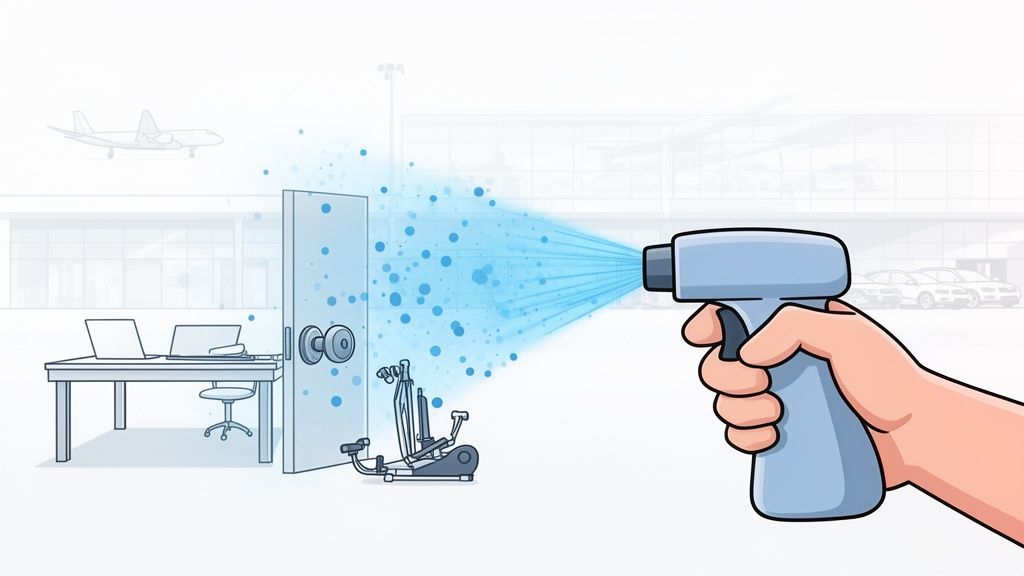
When you're managing a commercial or public facility, achieving a deep, lasting clean is a constant battle. The old-school approach of just wiping down surfaces is crucial for removing visible dirt, but it often falls short of comprehensive disinfection. It’s slow, labor-intensive, and prone to human error, leaving behind missed spots—especially around complex equipment or in high-traffic areas.
This is where a modern, multi-faceted approach to hygiene, incorporating tools like disinfectant wipes and electric disinfectant sprayers, marks a huge leap forward in how we think about facility health and safety.
So, what’s the optimal strategy? It’s a combination of targeted daily cleaning and broad, periodic disinfection. Disinfectant wipes are perfect for the daily grime and high-touch points, while an electric disinfectant sprayer is a tool that turns liquid disinfectant into a fine mist, allowing you to cover huge areas quickly and evenly. For large-scale operations, pairing these methods is a total game-changer.
The Modern Approach to Facility Disinfection
Think about maintaining a pristine office lobby. You could have staff constantly wiping down every single surface, but they’d struggle to keep up. A smarter approach is to use disinfectant wipes for immediate, targeted cleaning on high-touch zones like door handles and reception desks, while using a sprayer for weekly deep disinfection of the entire space. That’s the kind of efficiency and total coverage a modern cleaning protocol brings to the table. For daily, targeted cleaning, we recommend Wipes.com Disinfectant Wipes for their proven effectiveness and convenience.

From Manual Labor to Efficient Coverage
Instead of just splashing liquid on top of a surface, modern technology atomizes disinfectant. An electric sprayer creates a fine mist that settles on, under, and around objects, providing wall-to-wall sanitation that you simply can't achieve by hand.
This isn't just about looking clean; it's a powerful risk management strategy. By ensuring every surface gets treated, facilities can dramatically cut down on the harmful pathogens that cause illness, disruptions, and costly downtime.
A Strategic Investment in Health and Reputation
For places like offices, gyms, schools, or retail stores, a robust cleaning protocol is far more than a chore—it’s a strategic investment. It protects the health of everyone who walks through the door while sending a clear, visible message that you take safety seriously.
This approach aligns perfectly with today’s heightened expectations for cleanliness, like the stringent Modern Food Service Hygiene Standards that demand a truly safe environment.
Ultimately, this commitment builds trust and strengthens your reputation. In a world where cleanliness is front and center, proving your facility is sanitized to the highest possible standard is a powerful statement that resonates with every single person on your property.
How to Elevate Your Cleaning Strategy
At the end of the day, your cleaning program has one job: to create a safe and healthy environment. This requires the right tools and the right techniques. For daily maintenance, disinfectant wipes are invaluable. For broad-area disinfection, an electric disinfectant sprayer turns liquid into a fine, powerful mist. This process, called atomization, gives them speed and uniform coverage.
But not all tools are used the same way. Understanding the best application for each is what separates a smart, efficient program from one that wastes time and resources.

Cleaning Tips: Wipes for High-Touch Zones
Disinfectant wipes are your first line of defense. They are perfect for tackling the most frequently touched surfaces throughout the day.
- Where to Focus: Prioritize door handles, light switches, elevator buttons, countertops, shared keyboards, phones, and credit card terminals. In a gym, this includes treadmill screens, dumbbells, and machine grips.
- Frequency: High-touch surfaces in busy commercial spaces should be wiped down multiple times a day. For offices, 2-3 times is a good starting point. For high-traffic retail or gyms, it should be even more frequent.
- Efficiency Hack: Equip staff with portable wipe canisters or place dispensing stations in key areas. This encourages "clean-as-you-go" behavior from both employees and customers.
Sales Tips: Promoting a Culture of Clean
For sales professionals in the cleaning industry, the conversation is no longer just about price. It's about the Return on Investment (ROI) of hygiene.
- Educate on Hygiene ROI: Explain to clients how visible cleanliness and the availability of disinfectant wipes can boost customer confidence and employee morale. A healthier workforce means fewer sick days and higher productivity.
- Bundle Solutions: Don't just sell a case of wipes. Offer a comprehensive hygiene package that includes wipes for daily use, bulk disinfectant for sprayers, and hand sanitizer. Frame it as a complete "health and safety" solution.
- Promote Proactive Cleaning: Position disinfectant wipes as a tool for proactive, visible cleaning that customers and employees will notice and appreciate. It’s a powerful marketing tool for any business.
Electrostatic Sprayers: The Science of Attraction
For less frequent, deep disinfection, the electrostatic sprayer is a more advanced option. This technology adds a positive electrical charge to the disinfectant droplets as they leave the nozzle.
The physics here is simple but incredibly effective. Most surfaces in a room carry a neutral or negative charge.
When those positively charged disinfectant droplets fly out of the sprayer, they are actively pulled toward those surfaces. This magnetic-like pull is so strong that the droplets don't just land on top; they literally wrap around objects, coating the sides, the back, and even the underside.
This "wraparound" phenomenon delivers true 360-degree coverage, making sure that complex objects like office chairs, gym machines, or restaurant tables get completely coated.
Facility-Specific Suggestions
| Facility Type | High-Touch Wipe Targets | Deep Disinfection Focus (Sprayer) |
|---|---|---|
| Offices | Desks, keyboards, mice, phones, conference tables, drawer handles. | Full coverage of cubicles, conference rooms, and common areas. |
| Gyms | Cardio machine consoles, weights, benches, locker room handles. | Entire workout floor, locker rooms, and front desk area. |
| Restaurants | Tables, chairs, menus, POS systems, door handles, condiment dispensers. | Dining room (after hours), kitchen surfaces, and waiting areas. |
| Retail Stores | Shopping cart handles, checkout counters, PIN pads, door handles. | Sales floor, fitting rooms, and stockrooms. |
Ultimately, a combination of tools is a massive leap forward. The global market for electrostatic disinfectant sprayers alone is projected to more than double, hitting $791.0 million by 2031, because this smarter approach ensures total surface contact.
Choosing the right tools comes down to your environment. For a deeper dive into sprayer technology, check out our complete guide on electrostatic disinfectant sprayers. By understanding how wipes and sprayers complement each other, you can build a truly effective cleaning protocol.
Alright, once you've wrapped your head around a combined strategy, it’s time to get into the nuts and bolts of the equipment and supplies. We’re moving from the “how” to the “what,” and that means diving into the details. But don't let the options intimidate you—these details are what separate a game-changing program from a glorified cleaning checklist.
Think of it like building a toolkit. A master carpenter would never use just a sledgehammer. In the same way, you shouldn't rely on a single solution for every unique environment in your facility. The whole game is about matching the right product and technique to your specific operational needs.
Droplet Size: The Micron Measurement
When using a sprayer, the most critical spec is droplet size, measured in microns (μm). For perspective, a single human hair is about 70 microns thick. Most professional sprayers produce droplets in the 20 to 120 micron range. This isn't just a technical detail; it controls coverage and evaporation time.
- Smaller Droplets (20-50 microns): These create a fine, fog-like mist, perfect for 360-degree coverage on complex objects like office chairs or gym equipment. The advantage is minimal wetness, but they can evaporate too quickly to meet a disinfectant's required contact time.
- Larger Droplets (50+ microns): A coarser spray produces heavier droplets ideal for dousing hard, non-porous surfaces like locker room floors or bathroom stalls, where you need to guarantee the surface stays wet long enough.
The best sprayers come with an adjustable nozzle, letting you toggle between a fine mist for sensitive areas and a heavier spray for resilient surfaces.
Dwell Time: The Key to True Disinfection
Whether using a wipe or a spray, the most critical factor is contact time (or dwell time). This is the minimum amount of time a surface must remain visibly wet with the disinfectant to kill the germs listed on the label.
For facility managers, understanding and enforcing dwell time is non-negotiable. If staff wipes a surface dry immediately after applying a disinfectant, they are likely not achieving disinfection. The chemical needs time to work.
Battery Life and Portability
For any cordless sprayer, battery life is a make-or-break feature. For large venues, a short battery life is a non-starter. Look for models with several hours of runtime or swappable battery packs to keep your team moving without interruption.
Don't forget the human element. For daily tasks, the portability of disinfectant wipes is unmatched. For larger jobs, a lightweight handheld sprayer is great for targeted areas, while a comfortable backpack unit is essential for disinfecting large spaces. By carefully selecting your tools, you can create a program that’s perfectly dialed in for your operation.
Choosing the Right Disinfectant for Your Program
An electric disinfectant sprayer is a fantastic tool, but it's only as good as the chemical you put inside it. The same principle applies to wipes—the formula is what actually neutralizes pathogens. Grabbing any product off the shelf is one of the most common—and costly—mistakes we see.
Getting this wrong can lead to damaged equipment, ineffective results, and a whole lot of wasted money.
True disinfection boils down to two things: chemical compatibility and contact time. Nail these two, and you’ll have a sanitation program that actually works.
The Myth of Instant Sanitization
One of the biggest misconceptions is that wiping or spraying a surface makes it instantly safe. The reality is that every disinfectant needs a specific amount of time to do its job. This crucial window is called contact time or dwell time.
It’s the minimum amount of time a surface has to stay visibly wet with the disinfectant to kill the germs listed on the label.
If your team sprays a counter and immediately wipes it dry, they’ve accomplished almost nothing. Training your staff on this is essential, especially in high-stakes environments like schools, gyms, or healthcare settings.
Think of it like this: contact time is to a disinfectant what baking time is to a cake. If you pull the cake out of the oven too early, you don't get the desired result. The same is true for disinfection—cutting the time short undermines the entire process.
Verifying Chemical Compatibility
Not all disinfectants are built the same, and not all liquids are safe to run through an electric sprayer. Using an incompatible chemical—like bleach or certain high-concentration alcohols—can corrode the sprayer's internal parts, clog the nozzle, and void your warranty.
Before you buy any liquid disinfectant for a sprayer, you absolutely must check that it's approved for your model. Approved chemicals often include:
- Quaternary Ammonium Compounds (Quats): A go-to choice for their broad-spectrum power.
- Hydrogen Peroxide: An eco-friendly option that breaks down into water and oxygen.
- Hypochlorous Acid: A powerful but gentle disinfectant safe for many surfaces.
For a deeper dive into what makes these chemicals different, our guide on professional cleaning chemicals is a great resource.
How to Find and Follow Contact Time
Finding the contact time couldn't be easier: it's printed right on the disinfectant's label, for both wipes and liquids. Dwell times can be anywhere from 30 seconds to 10 minutes or more.
This is a big deal. The global electrostatic disinfectant sprayer market shot up to USD 1.9 billion after the COVID-19 outbreak, largely because these devices could efficiently apply chemicals that kill 99.99% of pathogens with just 1-5 minutes of contact time. You can read the full analysis of the electrostatic sprayer market trends.
Your standard operating procedure (SOP) has to include this. Train your team to apply enough product so surfaces stay wet for the full duration. This one step is the difference between performing "disinfection theater" and actually protecting public health.
How to Implement a Safe and Effective Cleaning Program
Rolling out a comprehensive cleaning program isn’t just about buying supplies. To get it right, you need a structured approach that ensures safety, efficiency, and consistent results. A smart plan protects your staff, maintains your equipment, and turns your cleaning routine into a reliable part of your facility's daily health protocol.
The bedrock of any safe program is a deep respect for the chemicals you’re using. Your first stop, always, is the Safety Data Sheet (SDS) that comes with your disinfectant. It details every potential hazard, handling instruction, and, most importantly, the Personal Protective Equipment (PPE) required.
Prioritizing Personal Protective Equipment
When using sprayers, your team needs to be geared up. The SDS dictates the exact PPE, but a standard kit is straightforward.
- Eye Protection: Safety glasses or goggles are a must.
- Gloves: Chemical-resistant gloves, like nitrile, are essential.
- Respiratory Protection: Depending on the chemical, a mask or respirator might be necessary.
This isn't just about checking a compliance box; it's about building a culture where safety is job number one.

This simple visual breaks down the three critical checkpoints: confirm the disinfectant is approved for your equipment, verify it’s the right product, and follow the required contact time to the letter.
Developing a Standard Operating Procedure
A clear Standard Operating Procedure (SOP) is your playbook. It eliminates guesswork and ensures every cleaning task follows the same safe, effective steps.
1. Surface Preparation
Before disinfecting, surfaces must be cleaned of visible dirt and grime. This is where disinfectant wipes can pull double duty, both cleaning and disinfecting in one step on lightly soiled surfaces. For sprayer applications, a pre-cleaning step is essential.
2. Application Technique
Train your team to be methodical. For wipes, use enough to ensure the surface stays wet for the full dwell time. For sprayers, maintain the recommended distance (2-4 feet) and use a consistent, overlapping "S" motion for uniform coverage.
3. Post-Application Protocol
The job isn’t finished once the product is applied. The area needs to be left undisturbed for the full required dwell time. Afterward, if required by the product label, ventilate the space to help clear the air and dry the surfaces.
An electric sprayer gives you fantastic broad coverage, but you can't forget about targeted cleaning on high-traffic spots. For daily touch-ups on things like door handles, light switches, and elevator buttons, we always keep Wipes.com Disinfectant Wipes on hand for their quick and proven effectiveness.
Finally, daily maintenance will make your equipment last. After every use, have your team rinse the sprayer tank and spray clean water through the nozzle. This quick habit prevents clogs and ensures your sprayer is ready to go every day.
Calculating the ROI for Your Business
Investing in a modern cleaning program isn’t just an operational expense. It’s a strategic move that pays for itself. The long-term gains in efficiency, safety, and brand perception quickly turn the purchase of quality supplies and equipment into a powerful business asset.
This is exactly why the market is heating up. Projections show the electrostatic disinfectant sprayers market is set to explode from USD 0.14 billion to USD 0.37 billion by 2033, all thanks to a growing demand for effective cleaning methods. You can get a deeper look at these trends in the full business research report.
Where the Real Returns Show Up
The true value of a robust cleaning protocol clicks when you see it in action. Different industries unlock unique benefits that hit the bottom line.
-
Gyms and Fitness Centers: Treadmills, weights, and dumbbell racks are a nightmare to sanitize by hand. Disinfectant wipes at each station empower members to clean equipment before and after use, while a weekly electrostatic spray provides deep 360-degree coverage. The ROI here is measured in stronger member confidence and a lower risk of outbreaks.
-
Offices and Corporate Buildings: Providing disinfectant wipes for employees to use on their own desks, phones, and keyboards fosters a culture of shared responsibility for cleanliness. This leads to fewer sick days, higher morale, and improved productivity.
-
Short-Term Rentals and Hospitality: For Airbnb hosts and hotel managers, turnover time is money. Using wipes for quick, targeted cleaning of high-touch surfaces and a sprayer for deep sanitization of the entire room means slashed labor costs and rooms ready for booking sooner. This earns glowing reviews that specifically call out cleanliness—a huge draw for travelers.
Measuring the Impact on Your Brand and Budget
Beyond these specific gains, the ROI is easy to track through a few key metrics.
A modern cleaning program doesn't just clean; it optimizes your entire operation. You reduce illness-related downtime, free up staff for other important tasks, and reduce chemical waste with more efficient application. Most importantly, you build a reputation for safety that attracts and keeps customers.
The biggest return often comes from improved perception and confidence. In today’s market, people actively choose businesses that make them feel safe. That visible commitment to hygiene—seeing staff wipe down surfaces, having wipes available for use—builds customer trust, leading to better online ratings, repeat business, and a clear advantage over competitors.
Prioritize cleanliness by integrating proven tools like disinfectant wipes and modern sprayers into your routine. This investment in hygiene is an investment in the health of your business, your staff, and your customers.
Common Questions About Cleaning & Disinfection
Even after you commit to a better cleaning program, some practical questions always pop up. Getting straight answers is the key to making a smart investment and hitting the ground running. Here are some of the most common things we hear from facility managers just like you.
Are Electric Disinfectant Sprayers Safe Around Electronics?
Yes, but they have to be used correctly. The trick is using a sprayer with an adjustable nozzle set to a fine mist—under 50 microns. This creates tiny droplets that coat surfaces without soaking them.
Electrostatic sprayers shine here because their charged particles are pulled toward surfaces, meaning less mist drifts into sensitive equipment. As a rule of thumb, always keep the recommended distance and consider powering down or covering anything super sensitive.
How Do I Calculate How Much Disinfectant I Need?
Figuring out your chemical needs is simpler than it looks. For sprayer liquids, you need:
- The total square footage you need to cover.
- Your sprayer’s flow rate (ounces per minute).
- The disinfectant's recommended coverage rate from the label.
Many manufacturers have online calculators to help. Remember that an electrostatic sprayer can slash your chemical use by 30-65% compared to old-school methods. For wipes, usage depends on traffic, so start with an estimate and adjust based on how quickly you go through your initial supply.
Can I Use Any Disinfectant in My Sprayer?
This is a hard no. You can only use disinfectants explicitly approved for sprayer application by both the sprayer and chemical manufacturers.
Pouring unapproved chemicals—like bleach or high-proof alcohol—into your machine can destroy internal parts, void your warranty, and create serious safety risks. Always check for compatibility.
What Is the Difference Between Cleaning, Sanitizing, and Disinfecting?
People use these terms interchangeably, but they mean very different things. Nailing this distinction is everything.
- Cleaning: This is physically removing dirt and grime. You always start here.
- Sanitizing: This reduces the number of bacteria to a safe level.
- Disinfecting: This is the kill step. It uses chemicals to eliminate viruses and bacteria on a pre-cleaned surface.
An electric sprayer is your tool for disinfection, performed after cleaning. Disinfectant wipes can often clean and disinfect in one step on lightly soiled surfaces, making them incredibly efficient for daily use. For that day-to-day cleaning and disinfecting of high-touch spots, we recommend Wipes.com Disinfectant Wipes to make sure surfaces are consistently maintained before a deep disinfection.
Leave a Reply